
Growth has a gravity problem in B2B. When revenue targets go up, the instinct is to go wider: new verticals, new regions, new segments. The logic feels sound. More market coverage should mean more pipeline, which should mean more revenue.
Except it often doesn’t work that way. Expanding into unfamiliar markets stretches your team thin, dilutes your messaging, and introduces longer sales cycles with lower win rates. Meanwhile, the segments where you already have strong fit, proven demand, and real momentum get less attention than they deserve because resources have been redirected toward unproven territory.
The most efficient growth in B2B rarely comes from chasing every available market. It comes from doubling down on the segments where your product, your positioning, and your buyer’s readiness are already aligned. The companies that outperform consistently concentrate their effort where the data tells them the return will be highest.
Broad expansion is the default strategy, but it’s rarely gives the highest-yield
The pressure to expand is real and it comes from everywhere. Boards want to see new logos in new markets. Sales leadership wants more territory to cover. Marketing wants to test new verticals. And in growth-stage organizations especially, the fear of leaving opportunity on the table can push teams toward breadth before they’ve fully captured the depth available in their existing segments.
The cost of that instinct is harder to see than the cost of missing a quarter, but it compounds over time. When your GTM teams are spread across too many segments, several things happen simultaneously:
- Messaging loses precision. The value proposition that resonates in your strongest vertical gets diluted when it’s stretched to fit five new industries, where each has different buying triggers and pain points.
- Sales cycles lengthen. Reps entering unfamiliar markets spend more time on discovery and education, which slows pipeline velocity and increases cost per opportunity.
- Win rates drop. Accounts in segments where you have limited reference customers, fewer case studies, and less market credibility are inherently harder to close.
- Resource allocation becomes reactive. When every segment is a priority, none of them get the sustained investment needed to build real momentum.
None of this means expansion is always wrong. There are moments when entering a new market is the right strategic move. But those moments should be driven by evidence, not instinct. And more often than not, the evidence points toward deepening focus before broadening reach.
Focused growth means concentrating effort where fit and demand already exist
When we talk about market focus as a strategy, it’s worth being precise about what that means. It doesn’t mean shrinking your ambition or settling for a smaller addressable market. It means aligning your GTM effort within well-defined, opportunity-rich segments where the conditions for conversion are strongest.
Focused growth produces measurable advantages that broad expansion struggles to match:
- Faster pipeline velocity because your team is engaging accounts that already understand the problem your product solves.
- Higher win rates because your positioning, proof points, and competitive differentiation are strongest in segments where you have depth.
- Better resource efficiency because your reps, your campaigns, and your content are all aimed at a defined audience rather than spread across a dozen loosely related markets.
- More predictable revenue because concentrated effort in proven segments produces more consistent outcomes than scattered effort across unproven ones.
The strategic question isn’t whether to grow. It’s where to concentrate your growth effort for the highest return. And answering that question well requires data that goes beyond firmographic segmentation.
The right data turns market focus from a philosophy into an operating strategy
Choosing where to focus is only as good as the intelligence behind the decision. If your segment selection is based on historical revenue or anecdotal feedback from the sales team, you’re making a high-stakes choice on incomplete information. The data that supports focused growth needs to go deeper.
Install base and technographic data reveal where your product fits best
Firmographic criteria can tell you which companies fall within your general target range. Install base and technographic data tell you which of those companies are operating in a technology environment where your product adds the most value.
HG Insights database includes over 25 million companies, with more than 150 million installations verified in the last two years alone. This surfaces what technologies are deployed, at what intensity, and where stacks are maturing or shifting. That granularity is what separates a list of companies that have a tool from a list of accounts that are approaching a transition point, actively expanding a deployment, or running a technology your solution was built to complement.
With that level of detail, you can target high-fit, in-market accounts with far more precision than industry and revenue filters alone would allow. This is especially valuable for focused growth strategies because it helps you identify which accounts within your chosen segments have the strongest technical alignment, not just the right firmographic profile.
Spend and intent signals confirm that readiness exists right now
Knowing that an account fits your product is one dimension. Knowing that the account is actively investing in your category and researching solutions adds the timing dimension that separates a good target from a great one.
Spend signals show you where budgets are flowing at the category level, which confirms financial readiness. Intent signals show you which accounts are actively consuming content and evaluating solutions in your space, which confirms behavioral readiness. When both signals are present in a segment you’ve already identified as high-fit, you have strong validation that focusing your resources there will produce returns.
Using HG Insights’ RGI Platform, you can combine spend signals with buyer intent enriched through TrustRadius, layering verified peer review activity on top of spend and technographic fit to confirm both financial and behavioral readiness in the same dataset.
This combination of fit, financial readiness, and behavioral readiness is what makes focused growth strategies work.
Market sizing and whitespace analysis validate whether your focus is well-placed
Once you’ve identified high-fit segments, the next step is confirming there’s enough addressable opportunity within them to justify concentrated investment.
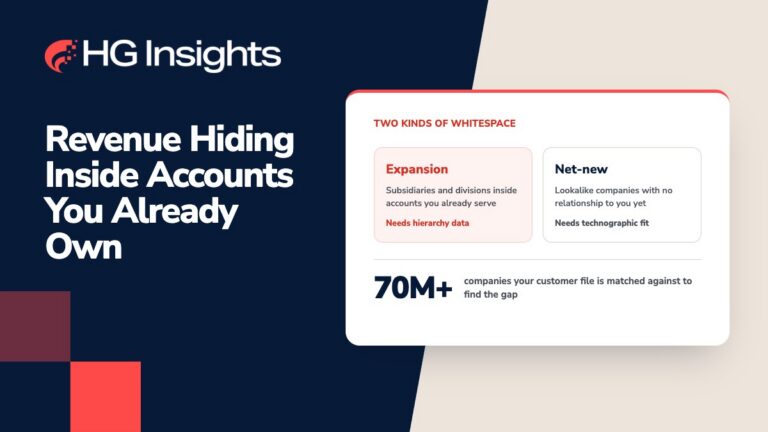
Market sizing tells you where your TAM is still under-penetrated. Whitespace analysis goes further — revealing hidden subsegments and untapped accounts that teams miss when they measure coverage by account count alone. In many cases, the whitespace inside a focused market is larger than expected, which reinforces the case for deepening investment rather than broadening it.
HG Insights’ Market Analyzer Copilot brings both into a single AI-powered workspace, letting your team size TAM, map ICP against HG’s database, and surface whitespace without routing a request through a data analyst. When your market sizing and whitespace analysis agree, you have the evidence to commit resources with confidence rather than spreading them thin across speculative new markets.
Account scoring and signal-based prioritization keep your team focused on the right opportunities
A focused market strategy only produces results if your reps are spending their time on the accounts most likely to convert within that segment. This is where account scoring becomes a force multiplier.
Scoring models that incorporate firmographic fit, install-base data, spend indicators, and intent signals produce account rankings that reflect actual conversion likelihood rather than surface-level attributes. When you align scoring models with actual conversion signals, your team gains a prioritization framework that directs effort toward accounts where the conditions for a deal are strongest.
Dynamic prioritization is particularly valuable in a focused strategy because the account universe is more concentrated. When your team is working a defined segment rather than a broad market, the difference between a well-prioritized account list and a poorly prioritized one has an outsized impact on pipeline performance. Every hour spent on the wrong account within a focused market is an hour not spent on one that’s showing active buying signals.
Signal-based prioritization also helps your team adapt as conditions within the segment shift. Accounts that weren’t ready last quarter may be showing new intent or spend activity this quarter. A scoring model that updates dynamically keeps your team’s focus aligned with current market reality rather than a static snapshot.
Territory design should reflect where the focused opportunity actually sits
When your GTM strategy is built around market focus rather than market expansion, your territory model needs to reflect that concentration. Traditional territory designs that distribute accounts evenly by geography or headcount can undermine a focused strategy by spreading rep attention across a mix of high-fit and low-fit accounts within the same territory.
Designing territories around growth-ready accounts within your proven segments ensures that every rep has a book of business that aligns with the focused strategy. This means building territory assignments based on real opportunity data: account density within your chosen segments, technographic fit, spend concentration, and intent activity.
The result is a territory model where reps aren’t splitting their time between accounts that match your focused strategy and accounts that don’t. Coverage is aligned with conviction, and every territory has a credible path to quota because the accounts inside it were selected based on verified opportunity.
ABM campaigns perform best when the target is narrow, well-defined, and data-validated
Account-based marketing is one of the GTM motions that benefits most from a focused strategy. ABM programs are resource-intensive by design. They require personalized messaging, coordinated outreach, and sustained engagement across multiple touchpoints. When those resources are spread across loosely defined account lists, the return diminishes quickly.
When your ABM campaigns are concentrated on high-value accounts within well-defined segments, three things improve simultaneously:
- Targeting precision increases because the accounts in your campaigns are selected using consistent, signal-rich criteria that reflect both fit and readiness.
- Messaging relevance improves because your content and outreach can speak directly to the challenges, technology environments, and priorities specific to that segment.
- Sales and marketing alignment strengthens because both teams are working from the same narrow, well-defined target list with shared definitions of what makes an account a priority.
Shared intelligence between sales and marketing is easier to maintain when the target is focused. The smaller and more defined the audience, the more naturally the two functions coordinate around it.
Focus drives the metrics that matter most
The aggregate effect of a focused market strategy shows up in the metrics that revenue leaders care about most:
- Customer acquisition cost decreases because your team is spending less time and budget on segments with lower conversion rates.
- Conversion rates improve because your pipeline is built from accounts that were selected based on multiple layers of fit and readiness validation.
- Revenue becomes more predictable because concentrated effort in proven segments produces more consistent outcomes than distributed effort across untested ones.
- Sales and marketing alignment is stronger because a narrow, clearly defined target market leaves less room for interpretation and fewer opportunities for the two functions to drift apart.
Repeatability is the underappreciated benefit of focus. When your team develops deep expertise in a concentrated set of segments, the playbooks, messaging, competitive positioning, and deal strategies they build become reusable assets. That institutional knowledge compounds over time and creates a durable advantage that broad expansion strategies rarely produce.
HG Insights gives your team the intelligence to focus with confidence
HG Insights provides granular market-level data enriched with install-base intelligence, technology spend signals, and buyer intent indicators, giving your revenue organization the inputs it needs to identify and commit to the segments where focused growth will produce the highest return.
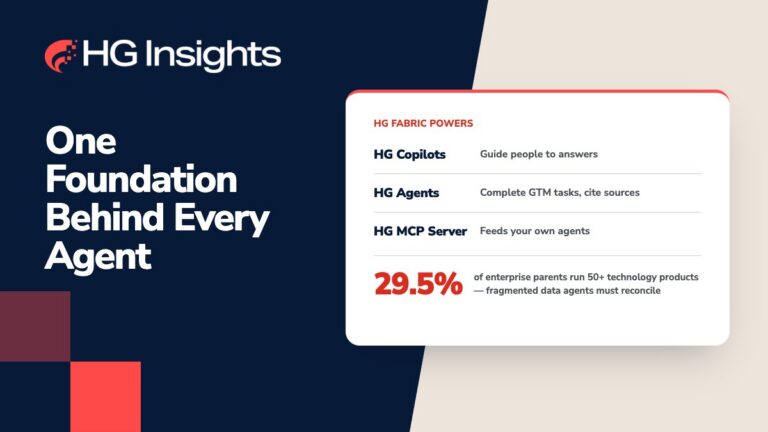
HG Insights surfaces all of this through our RGI Fabric (built from billions of data signals and intent records, and 240M+ all-time technology install detections) and RGI Platform so your revenue, marketing, and RevOps teams are working from the same picture of the market, built on the same underlying intelligence. There’s no reconciling signals from multiple vendors or explaining why your intent provider and your spend data disagree about an account’s readiness.
Build your growth strategy around the segments that will actually deliver. Connect with HG Insights to see how focused, data-driven market intelligence accelerates revenue where it matters most.
Frequently Asked Questions
When does market focus outperform market expansion as a growth strategy?
Market focus tends to outperform expansion when your organization has strong product fit, proven demand, and existing momentum within defined segments that still contain significant untapped opportunity. When the data shows that your highest-converting accounts are concentrated in specific verticals, technology environments, or spend profiles, deepening your investment in those segments typically produces faster pipeline velocity, higher win rates, and lower acquisition costs than entering new, unproven markets.
How do you identify the right segments to focus on?
The strongest approach combines multiple intelligence layers. Install-base and technographic data reveal where your product fits best within a company’s technology environment. Spend signals confirm that accounts in the segment are actively investing in your category. Intent signals show whether those accounts are currently researching solutions. And market sizing and whitespace analysis validate that enough addressable opportunity remains within the segment to justify concentrated investment.
How does a focused strategy affect territory design and account scoring?
Territory models should reflect the focused strategy by concentrating rep coverage on growth-ready accounts within your chosen segments rather than distributing accounts evenly by geography. Account scoring models should incorporate fit, spend, and intent signals so that prioritization within the focused market reflects actual conversion likelihood. Together, these adjustments ensure that every rep’s time is directed toward the accounts most likely to produce revenue.
How does HG Insights support a focused growth strategy?
HG Insights combines firmographic, technographic, spend, and intent intelligence in a single platform, giving GTM teams the ability to identify high-fit segments, validate remaining opportunity through TAM and whitespace analysis, score and prioritize accounts based on real buying signals, and optimize territory design around concentrated opportunity. This intelligence supports focused execution across sales, marketing, and RevOps without requiring teams to switch between multiple tools or reconcile conflicting data sources.