

AI sales tools are software platforms that use machine learning, natural language processing, and predictive analytics to automate prospecting, surface buyer intent signals, coach representatives, and forecast pipeline. They connect to CRM systems to turn behavioral and technographic data into prioritized, actionable recommendations for revenue teams.
Why B2B revenue teams are turning to AI sales tools
Across the 44.5 million companies tracked by HG Insights, the vast majority of businesses running enterprise CRM software have not yet paired it with a dedicated intelligence layer. HG Insights data shows that 92% of companies globally running Salesforce CRM have no dedicated sales intelligence or buyer intent platform connected alongside it. That gap matters: when reps lack signal about which accounts are in-market, ready to buy, or running competitive technologies, they default to volume-based outreach that burns time and budget on the wrong accounts.
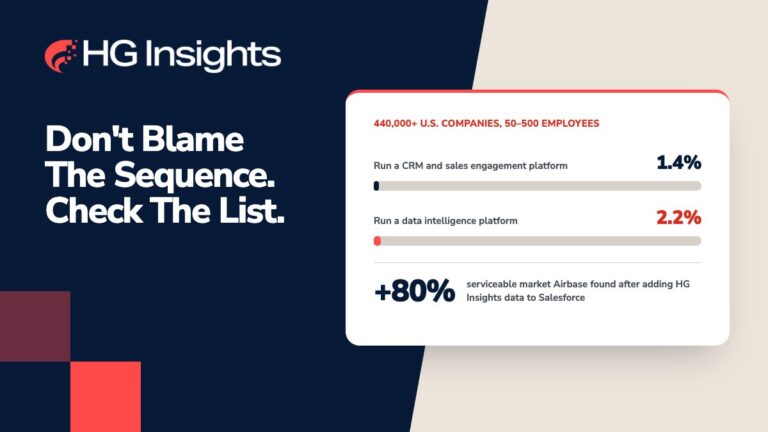
Modern revenue teams face a compounding challenge. Of the 441,480 companies globally running Salesforce CRM, fewer than 35,344 have added a dedicated intelligence or intent product alongside it, according to HG Insights install data. As enterprise software environments grow more complex and the number of stakeholders involved in a B2B purchase rises, the gap between teams that use AI sales tools and those that do not becomes a measurable revenue disadvantage.
AI sales tools close that gap by translating signals from technology install data, behavioral patterns, and conversation history into concrete recommendations: who to prioritize, what to say, and when to reach out.
What are AI sales tools?
AI sales tools are B2B software applications that apply machine learning and data science to the sales process. They span use cases from contact enrichment and predictive lead scoring to conversation intelligence and revenue forecasting. What unifies them is the ability to surface signal from large data sets that would be invisible or overwhelming for human reps to process manually.
The defining characteristic is automation tied to prediction. Rather than simply storing data (what a CRM does), AI sales tools actively surface insights: which accounts show buying intent, which reps close at the highest rate in a given vertical, which deals are at risk. This shifts rep behavior from reactive to proactive.
Key categories of AI sales tools
B2B revenue teams typically deploy a combination of these categories rather than relying on any single platform. Understanding what each category does, and what data it depends on, makes it easier to build a stack that compounds rather than duplicates.
AI-powered CRM and pipeline management
CRM platforms with embedded AI capabilities help revenue operations teams prioritize pipeline based on predicted close likelihood, flag stalled deals, and surface next-best-action recommendations. HG Insights tracks Salesforce CRM at 441,480 companies globally and HubSpot across 425,853 sites, making these the two dominant CRM platforms in the market. Both have added AI features in recent years, but the quality of AI recommendations depends heavily on how much clean historical data the platform has to train on.
The value for sales managers comes from aggregate signal: instead of reviewing every deal in a pipeline review, AI surfaces the three deals most at risk and the two opportunities where rep engagement has dropped. That shift in workflow compounds over time as the model learns from your specific win and loss patterns.
Conversation intelligence and coaching
Conversation intelligence tools record, transcribe, and analyze sales calls and meetings. They identify which talk tracks correlate with won deals, flag competitor mentions, and surface coaching opportunities at the individual rep and team level.
Platforms in this category include Gong, Chorus (acquired by ZoomInfo), and Salesloft. The AI layer learns over time which questions, objections, and responses predict closed-won versus churned outcomes, making coaching scalable across large teams without requiring managers to sit on every call.
AI-driven prospecting and outreach
Prospecting tools automate the identification and prioritization of outbound targets based on firmographic, technographic, and behavioral signals. Platforms such as ZoomInfo, Apollo, and 6sense use install data and buying intent signals to surface accounts that match an ideal customer profile before a rep makes first contact.
HG Insights data shows ZoomInfo is the most widely deployed dedicated sales intelligence vendor among the companies HG tracks, installed at 38,694 sites globally. Apollo, Demandbase, and 6sense add more than 22,000 combined installations, reflecting the competitive and fragmented nature of the prospecting tool market. The differentiation between providers largely comes down to data quality: coverage, freshness, and accuracy in your specific target market.
Predictive analytics and sales forecasting
Forecasting tools apply statistical models and historical deal data to predict which opportunities will close, at what value, and within what timeframe. They reduce the reliance on rep-reported commit calls, which tend to run optimistic, by anchoring forecasts in activity data.
At enterprise scale, where HG Insights tracks companies managing an average of 200+ technology products, the forecasting layer becomes a critical coordination point. Revenue operations teams use forecast accuracy as a leading indicator of process health, not just a lagging measure of results.
Revenue intelligence platforms
Revenue intelligence platforms aggregate signals across CRM data, conversation data, intent signals, and technographic data to give revenue teams a unified view of account health. Platforms in this category include Clari, Boostup, and Gong’s revenue intelligence features.
The differentiation point for best-in-class platforms is the quality of their underlying data. Teams using technographic data can see which technologies a prospect currently runs, estimate their technology spend, and identify displacement opportunities before a competitor reaches out. That specificity is what separates a generic AI recommendation from one a rep can act on immediately.
How to evaluate AI sales tools
Evaluating AI sales tools requires a different lens than evaluating traditional SaaS tools. The key criteria fall into four areas.
Data quality. The value of any AI sales tool is only as good as the underlying data it trains on and the signal sources it draws from. For prospecting and intent tools, this means asking vendors what percentage of their install records are verified, how frequently they refresh data, and whether they can demonstrate accuracy in your specific market segment. Technographic data quality varies significantly across providers.
Integration depth. AI tools that operate in isolation from your CRM and marketing automation platform create data silos and reduce rep adoption. Prioritize vendors that offer native integrations with your existing tech stack and that write data back to the record of truth, rather than requiring reps to switch between systems for each task.
Outcome measurement. Define success metrics before signing a contract. Pipeline influenced, outbound response rate, rep ramp time, and forecast accuracy are all reasonable measures depending on the category you are evaluating. Ask vendors for outcome data from customers in your segment, not aggregate case study data drawn from different market contexts.
Total cost of ownership. Include implementation time, data enrichment costs, and the internal resources required to manage the platform. AI tools that require significant data cleaning before they surface reliable signal will take longer to deliver ROI than vendors with strong data foundations out of the box.
Real-world applications in B2B revenue teams
Revenue operations teams using technographic intelligence have found that knowing what technology a prospect already runs fundamentally changes the quality of the outreach. A rep targeting a company actively running a legacy CRM can lead with a displacement message. A rep reaching a company that recently installed a complementary technology can position for expansion rather than net-new acquisition.
When applied at scale, this approach transforms sales from a volume game into a relevance game. Teams that prioritize accounts based on intent and install data consistently improve meeting acceptance rates and pipeline conversion because they reach buyers at the moment of highest receptivity, rather than running indiscriminate outreach against broad lists.
The same signal that helps individual reps prioritize also helps revenue operations build more accurate territory models. When the majority of in-market accounts for a given product are clustered around a specific technology stack, territory boundaries can be drawn around signal rather than geography.
“We created a dashboard for prospecting with HG’s data. At any given point in time, when the reps or BDRs take a look they know who to target, why they’re targeting them, and have the background information at their fingertips to know what kind of conversation they need to have.”
— Gigi Gazelle Urquico, Senior Director, Revenue Enablement, Informatica
The future of AI in B2B sales
The trajectory of AI in sales points toward tighter integration of signals that currently live in separate systems. Most revenue teams today access technographic data, intent data, CRM data, and conversation intelligence through separate platforms. The next evolution is unified account views where a rep can see what technology the prospect runs, what their recent buying behavior looks like, how previous conversations have gone, and what the AI predicts about their readiness to buy.
Teams that will have a competitive advantage in this environment are those building a foundation of high-quality data now. That means investing in data hygiene, technographic enrichment, and intent signal tracking before the most sophisticated AI tools arrive, so that the training data is already in place when they do.
HG Insights has tracked technology installations across millions of companies globally for more than a decade. That longitudinal data set allows AI models to surface meaningful signal about what technology companies buy, how much they spend, and when they are actively evaluating new purchases. For revenue teams deciding where to start with AI, technographic data is consistently the highest-signal input: it reveals what prospects already buy, what they are evaluating, and where the best displacement and expansion opportunities are hiding.
Ready to see how technographic data can sharpen your AI-powered sales strategy? Explore HG Insights’ technographic intelligence.
Frequently asked questions
What makes a sales tool an "AI sales tool"?
A sales tool earns the “AI” label when it uses machine learning or statistical models to generate predictions or recommendations, rather than simply storing or displaying data. True AI sales tools learn from historical outcomes, surface patterns that humans would miss in large data sets, and improve their predictions over time. Tools that use rules-based automation without a learning component are workflow tools, not AI tools.
Are AI sales tools a replacement for sales representatives?
No. AI sales tools are decision-support systems that help reps prioritize their time, personalize their outreach, and forecast more accurately. They eliminate low-value administrative work, which gives reps more time for the high-value activities that require human judgment: building relationships, navigating complex buying committees, and tailoring solutions to specific customer needs.
How long does it take to see ROI from AI sales tools?
ROI timelines vary by tool category and implementation quality. Conversation intelligence tools often show coaching impact within one to two quarters. Prospecting and intent tools typically require at least one full sales cycle to demonstrate pipeline influence. Forecasting tools take longer because they require historical data before their models become reliable. Organizations that implement with strong change management and clear success metrics consistently see faster time-to-value than those that deploy without an adoption plan.
What data does HG Insights provide for AI sales tool strategies?
HG Insights provides technographic data, technology spend data, and buyer intent signals across tens of millions of companies globally. For revenue teams using AI sales tools, HG Insights data serves as a foundational signal layer: it reveals which technology products a prospect runs, how much they spend on technology by category, and whether they are showing active buying behavior. That signal feeds directly into AI models for lead scoring, territory planning, and personalized outreach at scale.