
The discovery game has changed in B2B
You spent months building out your content strategy. Blog posts, case studies, comparison pages, SEO-optimized everything. And for a while, it worked. Your pages ranked. Buyers found you. The funnel moved.
Now something has shifted and the signals are hard to ignore. Traffic patterns are changing. Buyers seem to arrive more informed, or more decided, than they used to. Sometimes they skip the discovery phase entirely. And when you ask how they found you, or what shaped their thinking, the answer is increasingly some variation of: “I just asked AI.”
That is not a small thing. That is the whole game changing underneath your feet.
Traditional digital discovery is dead for B2B vendors
There was a time when finding something meant going somewhere. A buyer had a question, they opened Google, skimmed a page of links, and made a choice. Rank well and you earned attention. Write well and you could shape perception. The whole system was legible. You could trace it, map it, and improve it.
That legibility is gone.
Buyers are no longer navigating the internet the way they used to. They are handing their questions to AI and expecting answers back, not directions. Answers. The goal of these systems is not to send anyone anywhere. It is to resolve the question on the spot. The journey collapses. What used to be exploration becomes interpretation. And somewhere in that collapse, the window of influence moves. Earlier, quieter, often before your website loads or your team picks up the phone.
Here is where it gets uncomfortable for most marketing teams: you are probably not in that answer. Or if you are, you have no idea what is being said.
Reviews are now the source LLMs pull from
In the old model, reviews helped buyers find you. In the new one, they help AI describe you. That distinction sounds minor, but it’s not. It is a full reclassification of what reviews actually do.
AI systems don’t retrieve information. They synthesize it. They absorb what they trust, connect it, and hand back something that reads like a settled point of view. When a buyer asks which tools are worth considering, or what real users think of a given product, the answer gets assembled from signals scattered across the market. And the signal these systems trust most is not what companies say about themselves. It is what customers say.
Reviews are no longer supporting material. They shape your narrative.
This is the part most marketing organizations have not fully absorbed. Customer voice has moved from the back end of the funnel to the front. It no longer confirms decisions that are nearly made. It informs decisions before the search has really started. The model forms a perspective. The buyer receives that perspective. And by the time your sales team enters the picture, a version of the story is already in place, one your team had no hand in shaping.
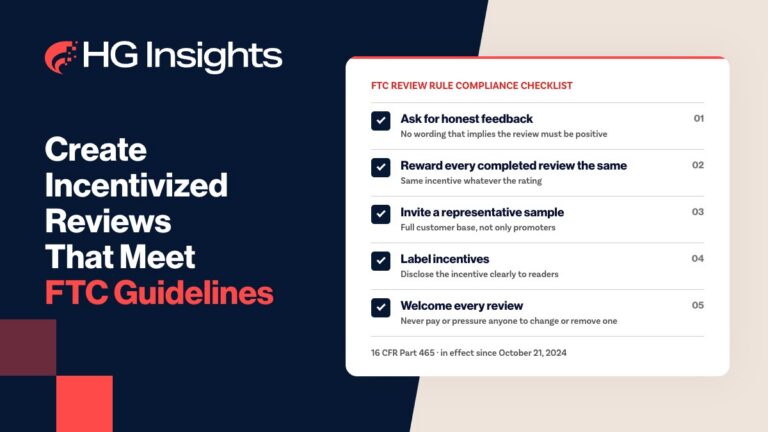
The evidence is not abstract. AI systems lean toward user-generated content because it carries something your marketing rarely does: specificity. Reviews name actual tradeoffs. They answer uncomfortable questions. They describe what breaks and what holds. Platforms like TrustRadius, an HG Insights Company, are being crawled continuously, and that content is being absorbed and redistributed across an expanding layer of AI-driven touchpoints in real time.
Reviews are live inputs into how your product gets characterized.
Attribution is often invisible. Your content can be shaping the answer without your brand name appearing in it. The narrative moves whether you are steering it or not. For marketing teams already stretched thin on bandwidth and budget justification, that is a deeply frustrating reality: influence without visibility, and risk without a clear owner.
Rather than piecing together a picture from a dozen different sources, buyers increasingly start with a synthesized take. That take becomes the anchor. It sets the frame for which options are on the table, which tradeoffs matter, which questions come next. The field narrows before you even know you were being evaluated.
What used to unfold as a journey of discovery now collapses into a moment of interpretation.
Here is the structural gap most companies have for discoverability
Inside most organizations, customer voice is still treated like a bonus feature. Useful, not essential. Something that adds credibility at the margins but does not drive outcomes at the core. When budgets tighten, it is one of the first places scrutinized, because the return does not show up in a clean line on a dashboard.
You see this in how programs actually run. Reviews get collected without being shaped. Campaigns are sporadic or nonexistent. Nobody truly owns the function. There is no system, no throughline, no visible connection between what customers say and how demand actually gets created. The product is not the problem. The structure around it is.
That is the gap. The market is treating customer voice as infrastructure. Most companies are treating it like a nice-to-have. And in that distance, the narrative writes itself, just not the one you would write.
Reviews have moved from validation to representation
Customer reviews used to help buyers confirm what they had already more or less decided, a last check before moving forward. Now they help form what buyers think before they have decided anything. They shape how categories get framed, how competitors land, how strengths and weaknesses get characterized. That work happens earlier, faster, and largely out of view. Customer voice is no longer downstream of the decision. It is upstream of it.
A program built for this environment
This is why we offer the Customer Voice Package, a program designed specifically for this environment. It is not about collecting more reviews or chasing badge placements. It is about shaping the narrative that AI surfaces when a buyer asks a question your team will never see.
The Customer Voice Package combines a fully managed review sourcing engine, custom go-to-market questions that extract the proof points and competitive messaging you actually need from TrustRadius, and global review content licensing so verified reviews work across your site. It also delivers the LLM and SEO visibility that puts your product in the frame when AI assembles its answer. On top of all of that, it includes reference candidate tracking, so you can connect the dots between what customers say and how it moves your active pipeline.
Every review becomes an input into how your product is represented in rooms you are not in. The Customer Voice Package gives you a way to shape that input intentionally, at scale, with structure behind it.
What happens when customer voice meets intent data?
This is where the connection to intent-driven leads becomes concrete.
The customer’s voice shapes the story. Intent data catches the moment that story starts producing movement. Reviews influence how buyers think. Intent signals reveal when that thinking is turning into action. When these systems run separately, value leaks out on both sides. When they run together, they form a loop: customer voice informs the narrative, AI carries that narrative outward, buyers absorb it and begin to move, intent signals surface that movement, and your team engages at the exact moment the buyer is already arriving with a picture that matches yours.
That is not just a tighter funnel. It is a more coherent one. The companies operating this way are not reacting to demand. They are building the conditions for it and meeting buyers in the middle.
Here’s how you decide what gets said about your brand
Once you see it that way, the frame shifts for good.
You are not investing in reviews as a marketing asset. You are investing in how your product is understood in the places where understanding is formed, in the AI responses, the synthesized comparisons, the quietly assembled answers that buyers treat as ground truth. You are deciding what gets said when the question is asked and you are not in the room.
That answer is being constructed right now. Across thousands of daily prompts, your category is being defined. Your competitors are being characterized. Your product is being described.
The only real question is whether that description is being shaped deliberately or left to form on its own.
The shift from reviews to representation is not coming. It is already here. The marketing teams that see it clearly will not just adapt to it. They will use it to define how they are known.
See clearly. Express clearly.
Learn how to turn customer-validated reviews into trust with HG Customer Voice.
Author
-

Anderson Duncan is an Enterprise Account Manager at HG Insights, where he works with enterprise GTM leaders to turn complex market signals into clear, actionable account strategies. His work sits at the intersection of data, storytelling, and revenue execution, helping organizations align buying groups and move with precision. Beyond his role, Anderson explores clarity as both a business discipline and a personal practice. Influenced by Zen Buddhism and modern leadership thinking, his writing focuses on how better seeing leads to better decisioning.