
Precise segmentation is no longer a nice-to-have capability for revenue teams. As buying journeys become more intricate and GTM motions span multiple channels, RevOps leaders are under pressure to deliver segmentation that is accurate, scalable, and actionable across the entire organization. Achieving this level of precision requires more than disconnected data tools. It requires a purpose-built RevOps data stack that unifies market, account, buyer, and internal signals into a single intelligence layer that powers GTM execution.
Why RevOps Needs a Purpose-Built Data Stack For Segmentation
Segmentation consistently fails when GTM teams rely on siloed, outdated, or incomplete data sources. Lists built from static firmographics quickly lose relevance, while disconnected intent tools and CRM data create conflicting views of the same accounts. The result is inconsistent targeting, misaligned campaigns, and wasted GTM effort.
RevOps owns the infrastructure that aligns marketing, sales, and GTM strategy teams around shared ICPs and target segments. Without a unified data foundation, RevOps cannot enforce consistency or scalability across systems and workflows.
Unified intelligence that combines market, account, and buyer data provides the foundation for accurate segmentation. By enabling data-driven ICP design, RevOps teams can move beyond assumptions and define segments rooted in real-world market opportunity and buying behavior.
Core Components Of The Ideal RevOps Data Stack
A high-performing RevOps function depends on more than disconnected tools or static reports. It requires a unified data stack that brings together market, account, buyer, and internal signals to support accurate segmentation, prioritization, and execution across the GTM lifecycle.
Market Intelligence For TAM/SAM/SOM & High-Level Segmentation
Market intelligence anchors segmentation in strategic reality. By sizing total addressable market, serviceable available market, and serviceable obtainable market, RevOps teams help GTM leaders focus on high-potential opportunities rather than broad, unfocused targeting.
Market intelligence enables segmentation at the macro level by defining industries, regions, company sizes, and growth segments that align with GTM strategy. This approach supports use cases such as Market Sizing, ICP Design & Segmentation Insights while ensuring alignment between long-term planning and day-to-day execution.
Integrating market intelligence into the RevOps data stack ensures segmentation targets the markets and opportunities that truly matter, rather than simply relying on the data that is readily available.
Account Intelligence For Fit, Spend, & Technographic Segmentation
Account intelligence brings segmentation to life at the execution level. By combining firmographic, technographic, and spend data, RevOps teams can create deeper, more actionable segments based on real account signals.
This intelligence supports ICP tiering, cluster analysis, and prioritization models that distinguish high-fit, high-value accounts from low-propensity targets. Technographic data reveals technology environments and gaps, while spend insights signal budget readiness and expansion potential.
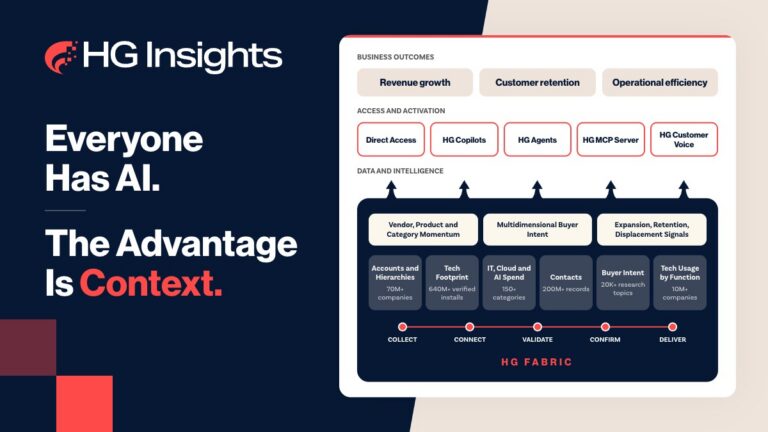
HG’s Data Fabric serves as the underlying account intelligence layer, enabling scalable segmentation for use cases such as B2B Data Enrichment for GTM Precision and Predictive Account Targeting, Prioritization & Scoring.
Buyer Intent For Timing & Behavioral Segmentation
Buyer intent data adds the critical dimension of timing to segmentation. Rather than treating all accounts within a segment equally, RevOps teams can identify which accounts are actively researching relevant solutions.
Behavioral segments such as “in-market now,” “competitor comparison,” and “expansion-ready” help GTM teams prioritize outreach and personalize engagement. TrustRadius intent data strengthens this capability by capturing real buyer research behavior, elevating segmentation accuracy and relevance.
When buyer intent is unified with market and account intelligence, segmentation reflects both fit and readiness.
Internal CRM + Product Signals For Lifecycle Segmentation
Internal signals refine segmentation further by incorporating customer activity, product usage, and lifecycle stage data. CRM interactions, pipeline movement, and product telemetry provide insight into where accounts sit within the customer journey.
This data enables lifecycle-based segments focused on cross-sell, upsell, churn-risk, and whitespace opportunities. When combined with external intelligence through a Unified data foundation, RevOps teams gain a holistic view of account potential across acquisition and expansion motions.
When these intelligence layers work together, RevOps teams can move from reactive reporting to proactive strategy, ensuring that planning, targeting, and measurement stay aligned as markets and buyer behavior evolve.
How AI Enhances Segmentation Precision
AI transforms segmentation from static lists into dynamic, actionable intelligence. By analyzing market, account, and buyer data, predictive models uncover high-value clusters and reveal emerging opportunities. This enables RevOps and GTM teams to target accounts with precision, adapt segmentation in real time, and maintain alignment across marketing, sales, and operations for measurable impact.
Predictive Segmentation Models
AI-driven segmentation models uncover patterns that manual approaches cannot detect. By analyzing relationships across market, account, and buyer data, AI identifies predictive clusters based on shared behavior, technology adoption, and spend trends.
These models enable RevOps teams to move beyond static rules and build segmentation that adapts to changing market conditions and buyer behavior. Predictive segmentation models support more accurate targeting and prioritization across GTM workflows.
Dynamic Segmentation That Adapts In Real Time
Static lists age quickly and undermine GTM performance. AI-powered segmentation updates automatically when intent surges occur, technographic profiles change, or lifecycle signals shift.
Dynamic segmentation ensures GTM teams always operate on current intelligence, reducing wasted outreach and improving engagement quality. This adaptability is essential for maintaining segmentation precision at scale.
Cross-Functional Alignment With AI-Based Clustering
AI-based clustering ensures marketing, sales, RevOps, and GTM strategy teams align on the same segmentation logic. When all teams operate from a shared intelligence layer, targeting inconsistencies are eliminated.
This alignment improves collaboration, reporting accuracy, and execution efficiency while reinforcing RevOps as the owner of GTM data governance.
Designing GTM Workflows Powered By The RevOps Data Stack
As GTM strategies scale, traditional segmentation methods struggle to keep pace with shifting markets, ever-morphing technology adoption, and changing buyer behavior. AI introduces a more precise, adaptive approach by analyzing complex data relationships and continuously refining how accounts are grouped and prioritized.
Unified Lead & Account Scoring
Unified lead and account scoring blends fit, intent, and engagement signals into a single prioritization framework. AI-driven models ensure scoring logic remains consistent across marketing and sales systems.
This approach improves pipeline quality and ensures GTM teams focus on the highest-probability opportunities first.
Segmentation-Driven ABM, Ads, & Nurture Programs
Segmentation-driven workflows enable personalized ABM, advertising, and nurture programs at scale. Strategically built plays trigger automatically based on segmentation criteria, activating the right message across channels at the right time.
This capability supports use cases such as maximized ABM performance and signal-based account prioritization, while improving efficiency across paid and owned channels.
Sales Activation With Segment-Specific Messaging
Sales teams benefit from segment-specific talk tracks, content, and insights delivered directly within their workflows. By aligning messaging with segmentation logic, sales conversations become more relevant and impactful.
This personalization boosts deal velocity and improve win rates by aligning outreach with real buyer context and needs. These workflows are further optimized through ABM optimization powered by unified intelligence.
Overall intelligence-driven segmentation allows RevOps teams to improve targeting accuracy, maintain relevance over time, and ensure GTM execution remains aligned across functions.
Measuring The Performance Of Segmentation-Driven GTM Execution
Effective segmentation requires ongoing measurement. RevOps teams should monitor key KPIs, including segment-level conversion rates, average contract value growth, pipeline velocity, and win rates, to ensure targeting remains precise and impactful.
These metrics provide feedback loops that refine ICP tiers and predictive clusters over time. AI-driven learning continuously improves segmentation accuracy, ensuring GTM execution evolves alongside buyer behavior.
Upgrade Your Segmentation With a Unified RevOps Data Foundation
Segmentation precision requires more than good data. It requires a unified, AI-driven data stack that connects market opportunity, account reality, and buyer behavior.
HG Insights provides the intelligence layer that empowers RevOps teams to deliver scalable segmentation, consistent targeting, and aligned GTM execution across the organization. By unifying data and activating it through AI, organizations can transform segmentation into a competitive advantage.
Frequently Asked Questions
Why is a dedicated RevOps data stack necessary for precise segmentation?
A dedicated RevOps data stack ensures segmentation is built on unified, current intelligence rather than disconnected tools and static lists, improving accuracy and scalability.
What types of data should be included in a RevOps segmentation framework?
Effective frameworks include market intelligence, account intelligence, buyer intent data, and internal CRM and product signals.
How do RevOps teams maintain consistent segmentation across systems?
Consistency is maintained through a centralized intelligence layer that feeds segmentation logic into CRM, marketing automation, and analytics tools.
How does unified intelligence improve cross-functional GTM alignment?
Unified intelligence ensures all GTM teams operate from the same data foundation, eliminating targeting conflicts and improving collaboration, execution, and revenue outcomes.