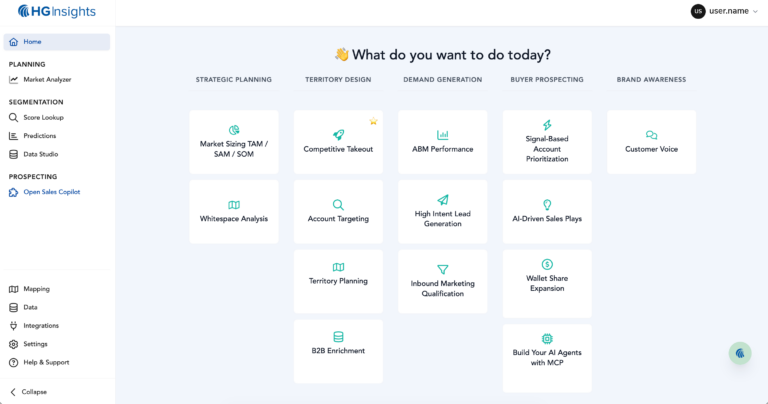


Because traditional competitive targeting methods rely on manual research and limited visibility, GTM teams risk missed revenue, slower growth, and inefficient allocation of resources. AI-driven competitive intelligence, powered by unified market and account data, enables GTM teams to pinpoint high-propensity competitor accounts, tailor messaging to competitive gaps, and activate campaigns at the optimal moment.
By leveraging these capabilities, organizations can execute precise, scalable competitive takeout campaigns that drive measurable revenue results.
Why competitive takeout campaigns matter more than ever

Rising acquisition costs, increased competition, and expanding solution options make competitive intelligence a core GTM growth driver. A competitive takeout campaign can be used as a structured strategy to target, acquire, and convert your competitors’ customers.
As a GTM leader, you want deeper visibility into buyer behavior and competitive movement, making B2B buyer intelligence essential. These insights reveal how prospects research vendors, compare solutions, and evaluate alternatives — enabling you to design competitive takeout campaigns that align with real purchase intent and evolving market demand.
Having AI-driven competitive intelligence, supported by unified market and account data, empowers your team to focus on high-propensity opportunities, tailor messaging around competitor gaps, and activate campaigns at precisely the right time. This data-driven approach ensures resources are deployed efficiently while maximizing displacement opportunities.
The foundation of a successful competitive takeout campaign
Analyze market share and identify competitor weak points
A robust competitive takeout strategy begins with market-level intelligence. By leveraging market analysis and spend data, your team can identify where competitors are vulnerable and disruption opportunities exist. Evaluating factors such as market share patterns, TAM, SAM, SOM distribution, contract cycles, and technology spending trends uncovers exposure points that signal accounts are primed for displacement. This includes expiring contracts, declining investments, or low customer engagement.
HG’s Market Analysis solution provides accurate market size insights so your team can prioritize segments where a competitive takeout is most achievable.
Use account intelligence to find high-propensity targets
Once market opportunities are identified, your team should pinpoint which competitor customers are most likely to evaluate alternatives. Account-level firmographics, technographics, and technology spend data reveal investment patterns in competitive solutions. Using AI-powered predictive models, your team can identify accounts showing signals of churn, like declining spend, mismatched technology needs, or organizational transformation.

Your team can use HG’s Data Fabric to consolidate technographic, firmographic, buying center, and spend intelligence into a single, unified dataset. this allows them to prioritize high-value competitor accounts efficiently while reducing wasted effort. A win-win for your company, your team, and your career.
Layer buyer intent signals for precision timing
Timing plays a critical role in competitive takeout success. Buyer Intent data, sourced from buyer intelligence platforms like TrustRadius, reveals when your competitors’ users are actively researching alternative solutions.
By integrating buyer intent signals with account intelligence, your team gains the ability to engage prospects at the exact moment they’re evaluating new vendors. This combination enables more precise outreach, higher engagement rates, and significantly improved conversion performance.
Turning intelligence into action: Executing the campaign
Build tailored messaging around competitor pain points
When outreach messaging addresses specific weaknesses in competitor offerings, they hit close to home with your prospects. HG’s data-driven insights reveal issues such as high total cost of ownership, limited product innovation, poor scalability, or customer support frustrations. Using AI-powered campaign optimization, your team can test variations, refine value propositions, and ensure that communications resonate with target segments by product line, region, and industry.
The differentiator in unified competitive intelligence
It’s no secret that high-value account displacement requires alignment between marketing, sales, and RevOps. When you have unified AI-driven competitive intelligence, RevOps can ensure all teams operate from the same data foundation, and guides sales on accounts with the highest probability of switching. Getting this to happen improves pipeline accuracy, reduces friction, and accelerates competitive takeout execution.
Measuring the impact of competitive takeout campaigns
Key metrics for assessing campaign effectiveness include:
- Conversion rate of competitor accounts
- Time-to-close
- Cost-per-opportunity
- Overall pipeline contribution

Continuous AI learning models refine targeting and messaging based on performance outcomes, while HG’s Revenue Growth Intelligence platform centralizes market, account, and intent insights, enabling you to optimize your takeout campaigns as soon as markets shift.
Win smarter with AI-driven competitive takeouts
You’ll be more successful with a competitive takeout campaign when intelligence, timing, and execution align. Unified market, account, and buyer data will allow you to uncover competitor weaknesses, prioritize high-propensity accounts, and activate highly targeted campaigns that convert faster and scale more efficiently.
Ready to transform competitive intelligence into revenue growth? HG Insights enables GTM teams to identify displacement opportunities faster, engage the right buyers at the right time, and execute data-driven takeout campaigns with confidence. Learn how HG’s platform can power your next competitive growth strategy.