
Most B2B teams already invest in data-driven marketing solutions, but pipeline growth often stalls because enriched data remains trapped inside CRMs and data warehouses instead of being put to work. Having access to intelligence is only the starting point. The real breakdown happens when enriched signals never reach the segmentation, targeting, scoring, and execution systems where marketing decisions are actually made.
This is the gap that separates teams with good data from teams with good results. And closing it requires more than better tools. It requires an activation strategy that connects enriched account intelligence directly to the campaigns, workflows, and prioritization models that produce pipeline.
In This Guide:
- Why enriched data without activation produces no results
- What data-driven marketing activation looks like in practice
- How enriched signals power specific marketing motions: segmentation, ABM, high-intent targeting, inbound qualification, competitive displacement, AI sales plays, and account scoring
- How to build infrastructure that makes activation repeatable and scalable
Enriched data that stays in storage doesn’t contribute to pipeline
Storing enriched account data in a CRM doesn’t produce pipeline any more than storing ingredients in a pantry produces a meal. The impact comes from how that data is used across decisions and execution. Technographic installs, spend tiers, and intent signals create value only when they flow directly into campaigns, workflows, and prioritization models. HG Insights, for example, tracks verified technology installs across 120+ million organizations, sourced from 20+ billion external data points. However, that intelligence only moves pipeline when it reaches the systems where decisions are made.
| What you are comparing | Enriched data left in storage | Enriched data activated into systems |
|---|---|---|
| How data moves | Manual exports, spreadsheet workflows, ops tickets | Automatic sync through APIs and native connectors |
| Speed from signal to action | Days or weeks | Minutes |
| Segmentation quality | Static profile lookalikes | Predictive segments built on fit, spend, and intent |
| Contribution to pipeline | None until someone acts on it | Continuous and measurable |
| Effect of one new signal | Updates a single CRM field | Updates scoring, ABM targeting, content, and the next AI play at once |
Marketing leaders focused on pipeline marketing with enriched data recognize that enrichment is one input into a much larger execution system. Activation is what translates those inputs into segmentation logic, targeting criteria, and routing rules inside live systems.
When that translation depends on manual exports, spreadsheet workflows, or ops team intervention, the speed and precision that enrichment is supposed to deliver get lost before they reach a campaign.
Activation turns intelligence into execution without unnecessary delay
A well-built data-driven B2B marketing strategy treats activation as an automated function that connects intelligence to action continuously. Enriched signals update audience segments, paid campaigns, ABM platforms, and scoring models without repeated manual intervention.
Effective GTM data activation for B2B follows a consistent pattern:
- Data refreshes continuously from enrichment sources
- Signals map to accounts and contacts with current attributes
- Fields sync into CRM, marketing automation, ABM, and media platforms automatically
- Campaign logic references enriched attributes in real time
- Performance ties back to pipeline contribution for measurable accountability
| Stage | What happens | Why it matters |
|---|---|---|
| Continuous refresh | Data refreshes from enrichment sources on an ongoing basis | Records reflect current reality instead of a stale snapshot |
| Signal mapping | Signals map to accounts and contacts with current attributes | Intelligence is tied to the right records |
| Automatic sync | Fields flow into CRM, marketing automation, ABM, and media platforms | Every system works from the same enriched data |
| Real-time campaign logic | Campaign logic references enriched attributes as they change | Targeting and personalization stay accurate without manual edits |
| Pipeline attribution | Performance ties back to pipeline contribution | Activation becomes measurable and accountable |
When enrichment feeds execution systems directly, marketing becomes faster, more precise, and significantly easier to measure. The gap between having intelligence and acting on it shrinks from days or weeks to minutes.
Audience segments built on enriched data reflect real buying potential, not just profile similarity
Firmographic filters alone often produce audiences that look like a strong fit on paper but include accounts with no active buying signals, no budget momentum, and no technology alignment with your product. High-performing teams go further by layering technographic data, spend capacity indicators, and behavioral intent into their segmentation.
B2B teams that build precise audience segments with enriched account intelligence organize their targeting around three questions simultaneously:
- Is the account structurally aligned with the solution? Technographic and firmographic data answer this.
- Can it realistically buy? Spend capacity and budget allocation signals answer this.
- Is there active research behavior suggesting near-term opportunity? Intent data answers this.
When all three layers inform segmentation, the process shifts from a static descriptive exercise into a predictive model that directs marketing investment toward accounts with genuine conversion potential.
ABM programs perform best when enriched data drives both account selection and personalization
An enriched data ABM strategy replaces rigid target lists with a dynamic reprioritization model that responds to new signals, account movement, and shifting opportunity. Technographic changes, competitive installs, and intent spikes automatically shift which accounts receive budget and attention rather than waiting for a quarterly list refresh.
The activation advantage deepens when the same intelligence that selects accounts also personalizes the campaigns they receive. When teams use HG Insights to activate enriched data across their ABM programs, messaging reflects each account’s current technology environment, competitive context, and buying readiness rather than a broad value proposition aimed at an entire segment.
That level of specificity improves engagement quality and accelerates account progression because the buyer sees evidence that your team understands their situation, not just your own product.
Intent signals combined with enriched profiles create the highest-performing targeting layer
Intent data marketing activation becomes significantly stronger when layered onto enriched account profiles. Intent alone can be noisy because it captures research behavior without confirming fit. ICP filters alone can be too broad because they identify who could buy without confirming who’s actively looking.
Combining both isolates accounts where fit and readiness intersect. Organizations that activate high-intent targeting with enriched account signals consistently outperform broad category campaigns because budget is directed toward accounts that are both structurally aligned and actively researching solutions in the category. Conversion rates improve and pipeline velocity increases because the targeting reflects two dimensions of qualification rather than one. For a deeper look at how this combination compresses deal timelines, see how to use AI-driven account intelligence and buyer intent to shorten your sales cycle.
Inbound programs accelerate when enrichment happens at the moment of conversion
Inbound programs move significantly faster when enrichment happens the moment a form is submitted rather than after a manual research cycle. Automatically appending firmographic, technographic, and intent data at the point of conversion gives marketing and sales teams account context before any routing decisions are made.
Teams that activate inbound enrichment for faster lead qualification see cleaner handoffs, shorter qualification cycles, and improved early-stage conversion because outreach reflects account fit and urgency from the first touchpoint. Reps don’t start with a bare-minimum record and spend their first interaction gathering information the system should have already provided.
The speed advantage matters because inbound interest decays quickly. Every hour between conversion and informed follow-up reduces the likelihood of engagement. Enrichment at the point of entry compresses that window to minutes.
Competitive displacement campaigns gain precision when powered by install intelligence
Technographic intelligence makes targeted competitive displacement campaigns possible by revealing where existing vendor relationships create openings. When an account runs a specific alternative solution, messaging can address migration risks, integration compatibility, and renewal timing with a level of specificity that generic competitive positioning can’t match.
Marketing teams that activate competitive displacement campaigns with install intelligence move beyond comparison messaging and engage accounts with context-aware outreach grounded in verified technology environments. The value compounds when install data is paired with contract timing signals, because those accounts aren’t just running a competitor’s product. They’re approaching a window where changing vendors becomes a realistic conversation.
AI sales plays produce better results when marketing feeds them enriched context
AI-powered outreach performs far better when informed by rich account context rather than operating from a thin layer of surface-level data. When AI systems work from generic firmographic inputs alone, the output typically looks templated rather than genuinely relevant to the account’s situation.
Enriched signals including technology stack, spend indicators, and intent behavior allow AI systems to recommend next actions that reflect actual account conditions. Organizations that power AI sales plays with enriched marketing intelligence see higher engagement because the recommendations align with what’s happening at the account rather than what a template assumes is happening.
Marketing’s role here is making sure the enriched data that powers these plays is current, complete, and flowing into execution systems automatically. When that pipeline is in place, AI plays become an extension of the marketing intelligence strategy rather than a separate initiative.
Account scoring becomes a shared activation layer when built on enriched signals
Shared scoring models turn enriched signals into a common framework that marketing and sales can both use to prioritize opportunities with consistency. When scoring brings together technographic fit, spending potential, and intent activity, both teams operate from one unified view of account readiness.
Teams that activate enriched scoring to align marketing and sales reduce handoff friction and improve pipeline quality because the criteria for what makes an account worth pursuing are standardized across functions. Marketing targets accounts that sales will actually want to work. Sales trusts the accounts marketing sends them because the scoring reflects signals they recognize from their own deal experience.
Scoring shifts from passive reporting to active decision support, and the alignment it creates between marketing and sales becomes structural rather than dependent on meetings and manual coordination.
Repeatable activation requires infrastructure, not one-off data projects
The teams that sustain activation performance over time are the ones that invest in infrastructure rather than individual campaigns. Repeatable B2B marketing data solutions depend on continuous integration through APIs and native connectors rather than scheduled exports or manual uploads.
When enriched data flows directly into marketing automation, CRM, ABM, and media systems, every new signal improves targeting, scoring, personalization, and AI-guided plays simultaneously. A technographic change at an account doesn’t just update a CRM field. It adjusts the account’s score, shifts its position in ABM campaign targeting, updates the content it receives, and informs the next AI-generated play, all without manual intervention.
Over time, this infrastructure compounds performance gains across all active programs. Each new enrichment signal makes every campaign slightly more precise, which means the return on activation investment grows as the data layer matures.
HG Insights powers data-driven marketing activation at scale
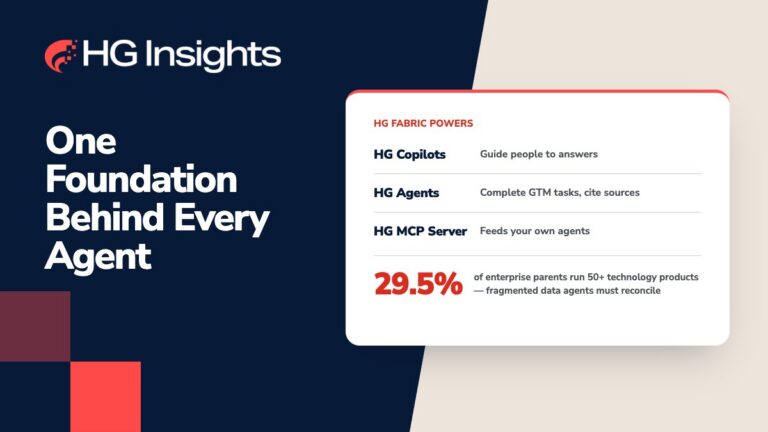
HG Insights delivers continuously refreshed technographic installs, IT spend intelligence, buyer intent signals, and firmographic data through a unified Revenue Growth Intelligence fabric that connects directly to the marketing tools where activation happens.
From ABM and inbound qualification to competitive displacement, AI play execution, and account scoring, HG Insights gives B2B marketing leaders the enriched data infrastructure needed to close the gap between intelligence and pipeline impact.
Turn enriched data into activated marketing performance. See how B2B leaders are putting it into practice.
Frequently Asked Questions
What does data activation mean in a B2B marketing context?
Data activation means connecting enriched account and contact intelligence directly to the campaigns, workflows, and prioritization models where marketing decisions are made. Rather than storing enriched data in a CRM or warehouse and pulling it manually when needed, activation ensures that signals like technographic fit, spend capacity, and buyer intent automatically inform segmentation, targeting, scoring, and personalization across live marketing programs.
Why does enriched data alone not improve marketing performance?
Enrichment adds depth and accuracy to account records, but that improvement only translates into pipeline when the enriched signals reach execution systems. If technographic, spend, and intent data sit in a database without flowing into campaign targeting, ABM account selection, or scoring models, marketing teams continue making decisions on incomplete information. Activation is the step that connects enrichment to outcomes.
How does data activation improve ABM program performance?
Activation improves ABM by replacing static target account lists with dynamic reprioritization based on current signals. When enriched data feeds both account selection and campaign personalization continuously, ABM programs reach accounts that are genuinely in-market with messaging tailored to their specific technology environment and buying context. This produces higher engagement rates and faster account progression than programs built on fixed quarterly lists.
How does HG Insights support data-driven marketing activation?
HG Insights provides continuously refreshed technographic, spend, intent, and firmographic data through a unified GTM intelligence fabric that integrates directly with CRM, marketing automation, ABM, and media platforms. This architecture ensures enriched signals flow into execution systems automatically, powering activation across segmentation, ABM targeting, inbound enrichment, competitive displacement, AI sales plays, and account scoring without manual data handling.