The number one question our sales team gets from someone interested in our products is, “How are customers getting the most out of HG Insights data?”
They’re often already using a combination of internal and external data points to validate market opportunities and customer readiness. They want to make sure that if they choose to go with HG Insights, they’re not just piling the same data they already have onto their tech stack. And they want to know if adopting HG Insights will allow them to reduce their current tech stack.
A fast-coming next question is what sets HG Insights apart from competitors.
Choosing the right technology for your needs is not always an easy decision. So, we’ve written out the answer to our number one question. That way, you can quickly see how HG Insights helps companies meet revenue goals.
How are customers getting the most out of HG Insights data?
In a conference room at a global technology company, a revenue operations leader pulls up a list of 14,000 accounts. Her team has HG Insights. They have technographic data, intent signals, and spend intelligence stacked three layers deep. What they don’t have in place yet, is a framework for deciding which accounts to call first.
That gap (not the data, but the activation of it) is the most common challenge enterprise GTM teams face today. Analysis of thousands of customer conversations with HG Insights, conducted through the FourFour intelligence platform, pointed to a single top question across major global organizations: how are other companies actually doing this?
What follows is the answer.
Quick answer Top enterprise teams extract value from HG Insights by applying technographic data across five distinct GTM motions: account prioritization by use case, market sizing for strategic planning, competitive displacement targeting, cross-team enablement, and CRM workflow integration. Teams that layer these practices convert raw intelligence into consistent, measurable pipeline. |
Step 1: Prioritize accounts using technographic data
The most useful first move is using technographic data and spend intelligence to shrink a sprawling account list into a ranked, scored priority queue, organized not just by firmographic fit, but by use-case-specific signals.
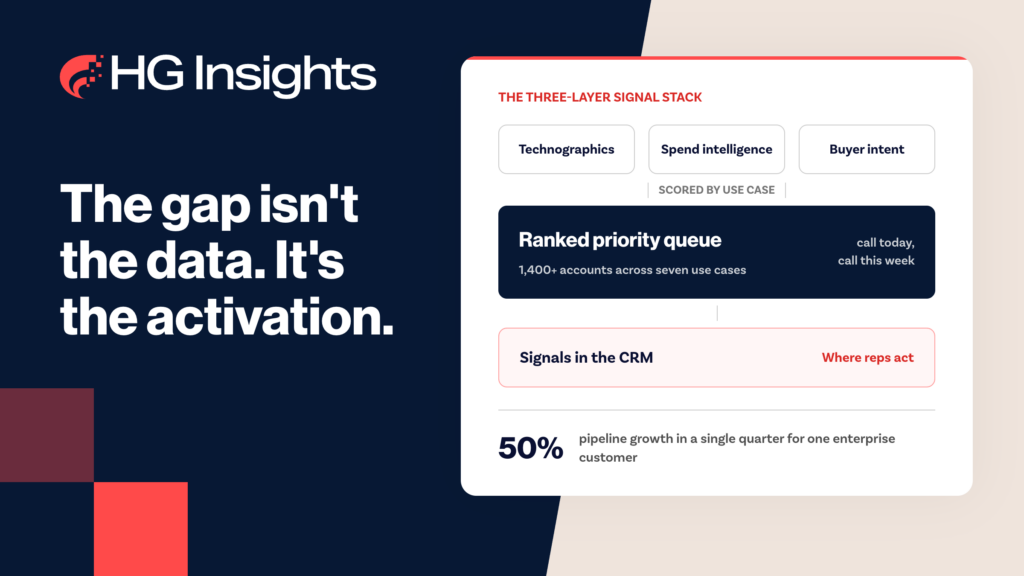
An enterprise cloud networking platform rebuilt its entire GTM motion around this principle. They applied a three-layer signal stack:
- Technographic fit across 50 to 70 products per use case
- 12-month rolling spend intelligence
- And more than 15,000 intent signal categories
This allowed the team to reduce over 1,400 accounts into a scored queue, organized by each of its seven use cases. A Senior Director of Platform at that firm described what changed: “I have never seen this level of technographic granularity before. Now every rep knows exactly where to start, where to go next, and honestly where not to go.”
High fit plus high intent means call today. High fit with emergent intent means call this week. Most enterprise teams aren’t short on accounts. They’re short on confidence about which accounts deserve attention right now.
Step 2: Build market cases before pitching
Strategic planning is the use case that moves HG Insights from a prospecting tool to a business intelligence platform.
An enterprise content management platform operating across 40-plus countries faced a challenge familiar to fast-growing SaaS companies: sales and marketing were targeting accounts without a shared, data-backed ICP. After layering HG Insights technographic and firmographic data into a propensity model scoring more than four million global accounts, the outcome was measurable. Pipeline grew 50 percent in a single quarter. A GTM lead put it directly: “We now operate with precision, clarity, and confidence. HG has been a game changer.”
The pattern holds across enterprise planning teams. Organizations use HG Insights data to size markets, answer account-level questions for internal stakeholders, and identify where budget is already allocated before a rep engages. The data becomes the basis of the market case, not just the outreach list.
Step 3: Execute competitive displacement plays
For companies selling into established markets, competitive displacement is where technographic data earns its highest return on investment.
Enterprise teams have used HG Insights to run industry-level technology analysis: identifying which sectors still run legacy tools, which competitors have installed bases showing adoption fatigue, and which accounts are entering an evaluation window based on contract timing and intent signals. The goal isn’t simply identifying who uses a competitor’s product. It’s understanding the depth of that installation, the spend committed, and whether research signals suggest a replacement conversation is already underway.
Over 60 percent of enterprise software purchases are replacements, not net-new deployments. Technographic data turns that statistic into a targeting system.
Step 4: Drive internal adoption with enablement
Here is what the data shows that rarely surfaces in a published success story: most enterprise teams are using a fraction of what HG Insights offers.
Customer conversations at several large enterprise technology firms point to the same underlying challenge. The platform’s surface area is genuinely broad (technographics, spend intelligence, buyer intent, account hierarchy tools, integrations) and without guidance on where to focus, teams default to whatever use cases they discovered during onboarding. A senior enterprise customer identified the core need: knowing which dashboards and data stories have delivered the most value for other enterprise clients, not to avoid doing the work, but to avoid reinventing what peers have already built.
The organizations getting the most from HG Insights treat enablement as a continuous discipline. A portfolio team lead at a global industrial technology company runs biweekly reviews of HG Insights data with portfolio teams. They’re structured sessions for ongoing education and message refinement, not just status reporting. That cadence is what converts platform access into platform adoption.
And for the ones who really want to get the most out of HG Insights, we host a monthly customer education series, HG Insider, where we showcase a new and/or different feature that we think users will benefit the most from.
Here’s a clip from our May 2026 session, showing the Fabric Feed and Sales Copilot Walkthrough.
Step 5: Close the signal loop within your CRM
The final step, and the one that separates teams who use HG Insights from teams that operationalize it, is surfacing signals directly in the workflows reps already live in.
Enterprise customers have consistently pushed toward one outcome: HG Insights data visible in Salesforce, refreshed automatically, with no manual export required. When intent signals and technographic fit scores appear in the same view as a rep’s active opportunities, the signal loop closes. Data stops being something analysts pull on request and becomes something sellers act on in real time.
The HG Insights platform connects natively with Salesforce, HubSpot, and other CRM and marketing automation tools, enabling automated enrichment, intent-triggered alerts, and account scoring that updates without human intervention.
This is how you go from signal to revenue with HG Insights
The five practices above aren’t sequential steps, they’re compounding layers. Teams that build a scored account universe also tend to use it for market sizing. Teams running displacement plays integrate the resulting lists into CRM workflows. Each layer makes the next one more effective, and the organizations moving fastest treat all five as parts of a single connected system.
The question “how are other companies doing this?” has a consistent answer. Start with prioritization, build toward strategy, and invest in the human infrastructure (enablement, cadence, regular review). Doing so keeps the data alive between planning cycles.
HG Insights supports the full arc of that motion, from initial account scoring through pipeline attribution. Explore how sales, marketing, and RevOps teams activate technographic intelligence across the HG Insights.
Author
-

Grace Wells is a seasoned marketing strategist with over a decade of experience leading marketing efforts for diverse brands. She is passionate about helping clients achieve their marketing, branding, and ROI goals through thoughtful 360 degree approach to campaign execution. Grace is a tech nerd and loves nothing more than reading up on the latest marketing technology trends. She enjoys advising her clients and customers on which tools will help move the needle for their business.