

Your GTM plan for 2026 can look polished and still be built on weak assumptions. Budgets are under pressure, AI is reshaping how buyers research vendors, and last year’s account list probably doesn’t reflect where real demand is forming now.
The difference between a GTM framework that performs and one that looks good in a deck comes down to whether the data behind each component is strong enough to support the decisions your team will make against it. Strong go-to-market strategy components give your team a clearer way to decide where to play, which accounts deserve attention, which motions fit each segment, and how the plan should adjust as the market moves.
This guide breaks down the components that belong in a data-driven go-to-market strategy for 2026 and shows how the data inputs behind each one determine whether the plan actually works.
In This Guide:
- Why GTM strategy frameworks need a refresh for 2026
- Market sizing and segmentation as the foundation
- ICP design and account prioritization
- Positioning, messaging, and offer design
- Channel and motion strategy
- Sales coverage and territory design
- Measurement and the GTM operating model
- How HG Insights supports a data-driven 2026 GTM framework
GTM strategy frameworks need a refresh because buyer behavior has outpaced most planning models
Buyer behavior has moved past what most planning models were designed to handle. According to Gartner, 67% of B2B buyers now prefer rep-free experiences, and 45% used AI during a recent purchase process. Buyers are comparing vendors through AI-assisted research, peer input, review platforms, and self-directed evaluation before your reps ever get a meeting.
A GTM strategy framework built around static segments and broad campaign assumptions won’t keep pace with that behavior. Your framework needs account-level intelligence at the center because every decision downstream depends on it. Market signals, technology footprints, spending patterns, intent, and buying context now shape which opportunities deserve investment and which ones will consume resources without producing pipeline.
For a foundational perspective on how these components connect, the four pillars of a go-to-market plan provides a framework with examples that ground the 2026 refresh in proven planning structure.
Market sizing and segmentation form the foundation every other component builds on
Market sizing shouldn’t end with a large TAM number that looks good in a board deck. Your team needs to know where fit, budget, and demand actually overlap.
A stronger data-driven go-to-market strategy starts with a defensible view of the market, then breaks it into segments by industry, geography, company size, technology environment, and spend profile. Industry alone rarely tells you enough. Two companies in the same sector can have completely different buying potential if one already runs adjacent technology, shows active demand, and has budget capacity while the other has no meaningful signal.
The useful layer is the overlap between fit and demand. A segment with high spend but weak product alignment drains resources. A segment with strong fit but little buying urgency slows pipeline. The strongest opportunities sit where account need, budget, timing, and your right to win intersect. HG Insights data puts global IT spending at $4.96 trillion in 2026, context that makes segment-level targeting decisions defensible rather than directional.
Grounding GTM strategy components in data-driven market sizing helps your team separate real opportunity from inflated TAM assumptions before committing budget, coverage, and headcount.
Your ICP should behave like a targeting model, not a whiteboard artifact
Your ICP shouldn’t be a document that gets reviewed once a year. It should reflect the patterns found in your best customers, including their tech stacks, spend levels, buying behavior, contract timing, and growth signals.
Fit still matters, but fit alone doesn’t tell your reps where to spend the next hour. A well-built scoring model combines fit signals with active demand, enabling sales and marketing to focus on accounts with higher conversion potential. Good-fit accounts belong in your universe. Good-fit accounts showing timely signals belong in your near-term motion.
Rep trust matters here. When sales can see why an account is prioritized, whether that’s an intent spike, a technology change, or a competitive displacement opportunity, the score becomes useful rather than decorative. Scoring that reps don’t trust is scoring that doesn’t get used, regardless of how sophisticated the model is.
Positioning and messaging should connect to the segments your data supports, not a universal value proposition
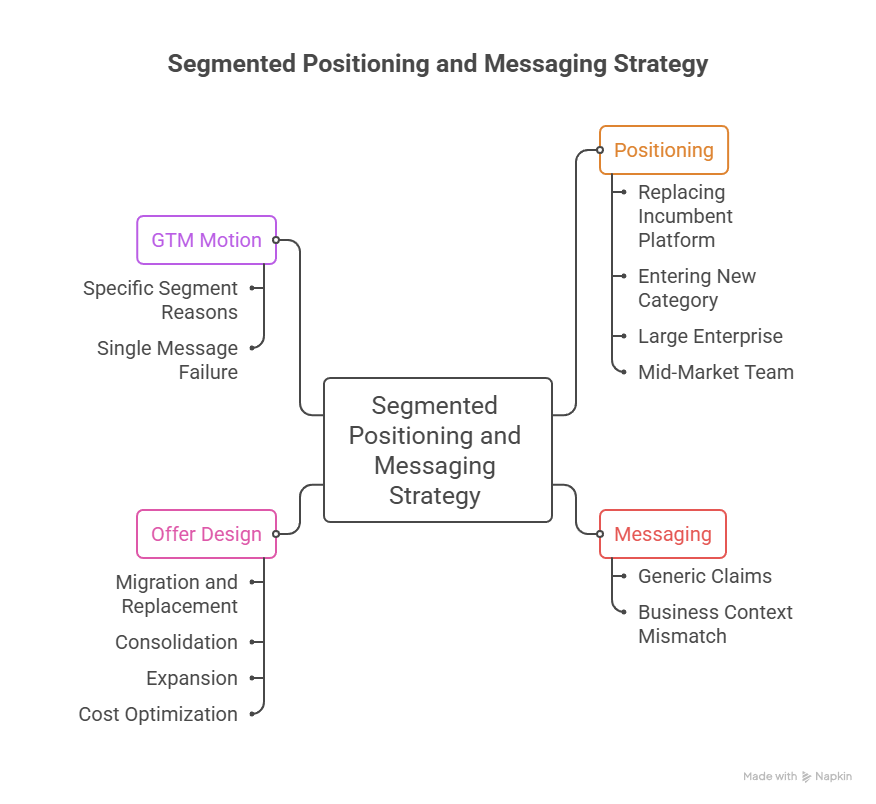
Strong targeting breaks down when the message sounds generic. Buyers doing their own research will quickly filter out claims that don’t match their business context.
Positioning should connect directly to the segments your data identifies. A company replacing an incumbent platform needs a different message than a company entering the category for the first time. A large enterprise with a complex stack needs different proof points than a leaner mid-market team trying to move quickly.
Offer design should follow the same logic:
- Migration and replacement appeals to accounts running competitors approaching contract renewal
- Consolidation resonates with accounts managing too many tools in a category
- Expansion speaks to accounts with a compatible foundation looking to extend capability
- Cost optimization connects with accounts where budget pressure is visible in spend data
Your GTM motion gets sharper when the offer reflects the specific reason each segment is likely to care right now rather than a single message aimed at everyone.
Channel strategy should follow how each segment buys, not how your team prefers to sell
Channel strategy should follow how each segment actually buys. Internal preferences matter far less than the evidence inside the account and market data.
McKinsey research found that B2B buyers now regularly use at least 10 channels during the purchase process. Sales-led, marketing-led, partner-led, and product-led motions often overlap, especially when buying groups gather information across several sources before engaging directly.
The mistake is treating channels like separate workstreams. With enterprise IT software spend projected at $1.39 trillion in 2026 per HG Insights data, the accounts your team reaches depend on having a shared signal layer, not parallel channel plans. Paid campaigns, outbound sequences, field programs, and sales plays should all respond to the same account triggers. When your team can align GTM framework execution with signal-based prioritization, each channel reinforces the same opportunity rather than creating noise.
Buyers notice when your teams operate from different assumptions. Coordinated outreach builds credibility. Disconnected outreach erodes it, and in a market where buyers are forming opinions before your reps get involved, that credibility gap is difficult to recover from.
Territory design should reflect where pipeline is likely to form, not where spreadsheets look balanced
Territory planning often looks fair on paper while hiding significant differences in opportunity quality. Equal account volume doesn’t mean equal revenue potential.
Coverage should be built around opportunity density. Technology installs, spend patterns, whitespace, competitive presence, and active demand reveal where pipeline is likely to form. A smaller territory with concentrated opportunity can outperform a larger book filled with low-propensity accounts.
Refresh cycles matter too. Markets shift, vendors get displaced, budgets move, and new buying signals appear. Stale territories quietly limit rep productivity long before the dashboard makes the problem obvious. Teams may keep operating inside outdated territory lines simply because no one has challenged the logic behind them. Regular territory reviews informed by current signal data prevent that drift.
Measurement should operate as a feedback loop, not a quarterly report
Aggregate pipeline reporting can make a weak plan look healthy. Segment-level measurement shows what’s actually working.
Your team should track pipeline, win rate, conversion, sales cycle, CAC, and channel performance by segment and motion. Those cuts reveal which parts of the GTM framework deserve additional investment and which need adjustment:
- High engagement with low pipeline often points to segments where targeting looks right but account fit is weak
- Strong fit with slow conversion may indicate messaging, timing, or competitive issues within a segment
- Uneven rep productivity across similar-looking territories often reveals coverage imbalances rather than performance differences
- Rising CAC in a previously efficient segment can signal competitive saturation or audience fatigue
Your GTM framework for 2026 should operate as a living system that adjusts as data, market signals, and buyer behavior change. Each measurement cycle should sharpen the next round of segmentation, prioritization, and execution rather than simply confirming what the team already assumed.
HG Insights supports a data-driven 2026 GTM framework at every stage
When the data foundation is strong, building GTM alignment across sales, marketing, and RevOps becomes structural rather than aspirational. For a closer look at how smarter GTM alignment starts with unified market and buyer insight, the connection between shared intelligence and coordinated execution becomes concrete.
Build your 2026 GTM framework on data your team can defend. Start with data-driven market analysis.