
The way B2B sales teams use technographic data has shifted hard. What used to be a side-of-desk enrichment field is now a baseline requirement for prospecting, account scoring, and AI-driven workflows. Sales reps in 2026 expect their data tools to surface not just what technologies a company runs, but how deeply, what they spend, when contracts expire, and which buying signals are firing right now.
That shift has crowded the market. Dozens of vendors claim technographic coverage, but the depth, freshness, and AI readiness vary widely. Picking the wrong platform stalls pipeline. Picking the right one compounds revenue.
This guide compares the platforms that actually move pipeline for B2B sales teams in 2026. We cover how to evaluate them, where each one fits, and which sales motions they suit best. By the end, you’ll know which platform deserves a closer look for your team.
Why technographic data matters more in 2026
Technographic data captures the technologies a company uses, how deeply they’ve adopted them, what their contracts look like, and how much they spend. The category started as a simple list of installed software per account. It has since evolved into a layered intelligence asset that sales teams treat as foundational.
Three things changed the game in 2026.
- First, AI agents now consume technographic data directly. When a seller’s AI assistant pulls account context for a meeting, technographic depth determines whether the briefing is useful or generic. A list of “uses Salesforce” is not enough. Sellers need contract end dates, integration footprints, and signs of stack consolidation.
- Second, intent and technographic signals have converged. Sales teams no longer treat them as separate datasets. The most actionable plays combine both, for example targeting accounts running a competitor’s product who are also showing in-market intent for a category replacement.
- Third, IT spend modeling has matured. Sales teams use it to size deals, prioritize accounts, and frame ROI conversations. Without spend context, technographic data tells you who uses what but not who can afford what.
How B2B sales teams use technographic data in 2026
| Use case | Signal type | Outcome |
| Competitive displacement | Competitor installs plus contract end dates | Higher win rates against incumbents |
| Whitespace analysis | Install gaps within customer base | Faster expansion revenue |
| Account scoring | Installs, spend, and intent combined | Sharper account prioritization |
| AI sales briefings | Full stack context | Faster, more relevant seller prep |
| Territory planning | Stack overlap with ICP | Better territory balance |
How to evaluate a technographic data platform
Buyers often pick a technographic data platform on coverage claims alone. That’s a mistake. Coverage is one input among many, and the gap between “we track 30,000 products” and “we deliver actionable signal per account” is wide.
Six criteria separate the leaders from the rest.
Coverage breadth. How many products and vendors does the platform track? What is the size of the account universe? Does it cover global markets or skew toward North America?
Data freshness. How often is the underlying data refreshed? What sources feed it? Is the refresh cadence transparent, or buried in vague language?
Signal depth. Does the platform deliver installs alone, or does it pair them with intent, IT spend, contracts, and consumption signals? The deeper the signal mix, the more actionable each account record becomes.
AI readiness. Does the platform expose data through an MCP server? Does it integrate with AI agent frameworks? How clean and well-documented is the API?
Native integrations. Salesforce, HubSpot, outreach tools, data warehouses, and ABM platforms. Strong native integrations cut implementation time and improve adoption.
Pricing transparency. Is pricing tiered and documented? Are there volume thresholds? Hidden fees and unclear contracts often signal a vendor that struggles in renewals.
Evaluation criteria checklist
| Criterion | What to ask | Why it matters |
| Coverage breadth | Products tracked, account universe size | Determines whether your ICP is covered |
| Data freshness | Refresh cadence and source diversity | Stale data kills sales productivity |
| Signal depth | Installs, intent, spend, and contracts | Drives prioritization quality |
| AI readiness | MCP server, agent integrations, API | Future-proofs your stack |
| Integrations | Native CRM, outreach, warehouse | Affects time to value |
| Pricing | Transparency and tier structure | Predicts renewal experience |
Account quality compounds when teams build their workflows on technographic enrichment platforms like HG Insights that score well across all six criteria, not just one or two.
The best technographic data platforms for B2B sales teams in 2026
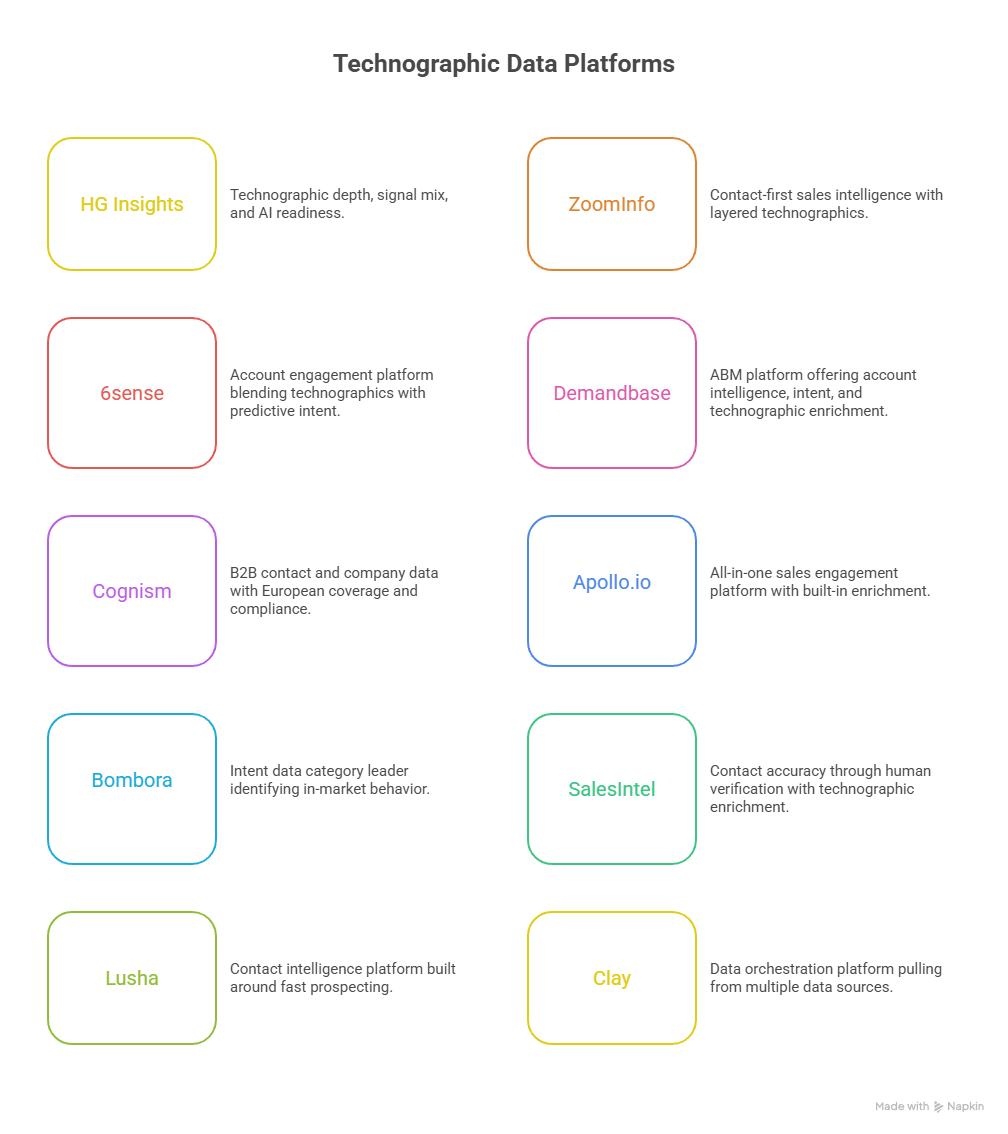
Here are the platforms B2B sales teams should know in 2026, ranked by overall fit for sales-led GTM motions. Each platform has its own ideal customer profile, and the right pick depends on your sales motion, not just feature checklists.
1. HG Insights
HG Insights leads the category for technographic depth, signal mix, and AI readiness. Its dataset combines technology installs, IT spend modeling, contract intelligence, intent signals, and customer voice in a single platform. That combination is rare. Most competitors focus on one or two of those layers and partner for the rest.
The platform powers some of the largest B2B sales teams in the world, including enterprise organizations running global displacement, whitespace, and account scoring programs. RGI Platform sits at the center, with Sales Copilot, Data Studio, Market Analyzer, and Customer Voice as workflow surfaces.
Where HG pulls ahead in 2026 is AI infrastructure. RGI Agent Builder and a native MCP server let sales teams expose technographic context to AI agents in real time. That matters because the agents your reps use are only as good as the data they can pull.
Best for: enterprise sales teams that need accurate, deep, AI-ready data across the full GTM motion. If your sales org runs displacement plays, whitespace expansion, or account scoring at scale, this is the platform that holds up under pressure.
2. ZoomInfo
ZoomInfo built its reputation on contact-first sales intelligence. Technographic data is layered on, but it’s not the platform’s center of gravity. Reps use ZoomInfo primarily to find decision-makers fast and feed outbound machines.
Its technographic depth is serviceable for pipeline generation. It will tell you what major systems a company runs. It is less reliable for niche stacks, contract intelligence, or IT spend context.
Implementation is fast for teams already running outbound at high velocity. Pricing skews enterprise, and customers report mixed feelings about renewal experiences.
Best for: high-velocity sales teams that lead with contact data and treat technographics as a supporting layer.
3. 6sense
6sense is an account engagement platform that blends technographic data with predictive intent. The platform shines for marketing-led ABM motions where sales teams pick up handoffs from in-market account identification.
Its predictive scoring is mature. Its technographic layer is competitive but not class-leading. Customers often pair 6sense with a deeper technographic provider for displacement-grade signal.
Implementation is heavy. Pricing aims at enterprise budgets. The payoff is highest when marketing and sales co-invest in the platform and align around shared account lists.
Best for: ABM-driven organizations with strong marketing and sales co-investment.
4. Demandbase
Demandbase competes directly with 6sense on ABM territory. It offers account intelligence, intent, and technographic enrichment in one stack. Sales teams use Demandbase mainly through the lens of account engagement workflows.
Its technographic data is solid for prioritization but rarely the reason teams buy. Buyers choose Demandbase for the broader ABM platform.
The vendor has invested in AI-driven workflows over the past year. Integrations with major CRMs are strong. Implementation requires marketing and sales alignment to extract full value.
Best for: marketing-led teams that want technographics inside an ABM workflow.
5. Cognism
Cognism is a B2B contact and company data platform with strong European coverage. It pairs contact data with technographic enrichment and a focus on EU compliance.
Its technographic depth is growing but lighter than dedicated install-data providers. Cognism’s strength is in EMEA prospecting, where its compliance-first approach reduces legal risk for outbound teams.
Pricing is more accessible than enterprise platforms. Onboarding is faster. Coverage outside Europe has improved but still trails the global leaders.
Best for: B2B sales teams prioritizing European market coverage and GDPR-aligned outbound.
6. Apollo.io
Apollo.io is an all-in-one sales engagement platform with built-in contact and technographic enrichment. Reps prospect, sequence, and engage from a single tool.
Its technographic data is functional. Apollo will tell you what major technologies a company uses. It will not tell you contract details, IT spend ranges, or stack depth.
Pricing is one of Apollo’s strongest selling points. Self-serve tiers make it accessible for SMB and mid-market teams. Larger sales orgs often outgrow the data depth and migrate to specialized platforms.
Best for: SMB and mid-market sales teams that want one tool for prospecting, sequencing, and basic enrichment.
7. Bombora
Bombora is the intent data category leader, not a pure technographic provider. Its strength is identifying which accounts are showing in-market behavior across thousands of B2B topics.
Sales teams typically pair Bombora with a technographic specialist rather than buy it as a standalone solution. The combination of Bombora intent and HG Insights technographic data is one of the most common pairings in enterprise GTM stacks.
Bombora’s data is licensed across the industry, including by other vendors on this list.
Best for: marketing and sales teams building intent-led account programs alongside a technographic platform.
8. SalesIntel
SalesIntel positions itself on contact accuracy through human verification. Its technographic enrichment is layered on top of that contact-first dataset.
The platform appeals to sales teams that have struggled with bad contact data and want a vendor focused on verification quality. Its technographic footprint is smaller than dedicated providers, but the contact data quality often justifies the trade-off.
Pricing is mid-market friendly. Coverage skews North America.
Best for: sales teams that prioritize contact accuracy over data breadth.
9. Lusha
Lusha is a contact intelligence platform built around fast prospecting. Reps use it for fast contact discovery, often inside Chrome via the browser extension.
The platform has expanded in recent years to include email sequencing, intent signals powered by Bombora, and conversation intelligence. That said, its technographic depth remains thinner than dedicated providers, and it doesn’t deliver the stack-level detail or spend context enterprise sales motions require. Coverage and signal depth fall short for enterprise sales motions.
Pricing is among the most accessible in the category. Self-serve adoption is the norm.
Best for: small sales teams and individual reps doing targeted outreach with light data needs.
10. Clay
Clay is a data orchestration platform, not a data provider. Sales and RevOps teams use it to pull from multiple data sources, run waterfall enrichment, and build custom prospecting workflows.
Its technographic data comes from third-party providers, including some on this list. The platform’s value is in the orchestration layer, not the underlying data.
Clay has become popular with RevOps teams that want flexibility and control over their enrichment stack. It pairs well with HG Insights and other specialized providers as upstream data sources.
Best for: RevOps teams building bespoke prospecting workflows that combine multiple data sources.
Sales leaders who want to surface technographic context inside reps’ daily workflows often start their evaluation with AI sales intelligence platforms before layering in orchestration tools.
Side-by-side platform comparison
The following comparison summarizes how the ten platforms stack up across the criteria that matter most. Use it as a starting point, not a final verdict. Every sales team has its own weighting, and the right platform depends on which trade-offs you can live with.
Feature matrix across 10 platforms
| Platform | Install data | IT spend | Intent | Contracts | AI/MCP |
| HG Insights | Class-leading | Yes | Yes | Yes | Native |
| ZoomInfo | Moderate | Limited | Yes | Limited | Partial |
| 6sense | Moderate | No | Class-leading | No | Partial |
| Demandbase | Moderate | No | Strong | No | Partial |
| Cognism | Moderate | No | Limited | No | Partial |
| Apollo.io | Light | No | Limited | No | Partial |
| Bombora | No | No | Class-leading | No | Partial |
| SalesIntel | Light | No | Limited | No | None |
| Lusha | Basic | No | Limited | No | Partial |
| Clay | Aggregated | Aggregated | Aggregated | Aggregated | Strong workflow |
Integration ecosystem and pricing tier overview
| Platform | CRM integrations | Warehouse support | Pricing tier |
| HG Insights | Salesforce, HubSpot, others | Yes | Enterprise |
| ZoomInfo | Strong native | Yes | Enterprise |
| 6sense | Strong native | Yes | Enterprise |
| Demandbase | Strong native | Yes | Enterprise |
| Cognism | Native | Limited | Mid-market to enterprise |
| Apollo.io | Native | Limited | SMB to mid-market |
| Bombora | Through partners | Yes | Enterprise |
| SalesIntel | Native | Limited | Mid-market |
| Lusha | Native | Limited | SMB |
| Clay | Wide | Yes | Mid-market to enterprise |
A few patterns stand out from the comparison. Only HG Insights pairs class-leading installs with IT spend, intent, and contract intelligence in one platform. Bombora dominates intent but is rarely a standalone purchase. Clay is the orchestration layer most teams now run on top of their data providers. ABM platforms offer broad capability but lighter technographic depth.
How to match a platform to your sales motion
The right platform depends on your sales motion. The same data that wins for an enterprise displacement team can be overkill for a high-velocity SMB outbound team.
Enterprise sales teams running complex deals. Displacement plays, multi-year contracts, and large deal sizes demand the deepest technographic signal available. Contract end dates, IT spend, and stack depth all matter. HG Insights is the strongest fit, often paired with Bombora for additional intent.
Mid-market and inside sales teams. Velocity matters more than depth. Contact data quality and outbound speed drive results. ZoomInfo, Apollo.io, and SalesIntel are common choices. A lighter technographic layer is fine if the sales motion is built around volume.
ABM-led organizations. Marketing and sales alignment is the bottleneck. The platform needs to serve both teams and integrate with marketing automation. 6sense and Demandbase lead this category. Pair with a technographic specialist if displacement is part of the motion.
Hybrid product-led and sales-led motions. Self-serve signups feed the pipeline, and sales steps in for expansion or enterprise tiers. Clay orchestration on top of a deep technographic source like HG Insights works well here. The flexibility matters because data needs shift fast as the motion evolves.
EMEA-focused teams. Compliance is the deciding factor. Cognism leads on EU coverage and GDPR alignment. Pair with a global technographic provider if you also sell into other regions.
Most enterprise teams pair their technographic provider with account intelligence software to run scoring models that pull from installs, spend, and intent in one place.
Common pitfalls when buying a technographic data platform
Smart buyers make the same mistakes when picking a technographic platform. Avoiding these traps saves both money and pipeline.
Mistaking stale data for fresh data. Many vendors list “weekly” or “monthly” refreshes without explaining what gets refreshed. Ask for source-level refresh details and verify with a sample audit before signing.
Confusing breadth with depth. A platform that tracks 50,000 products sounds impressive. The number that matters is depth per account: how many real, current installs are confirmed for the accounts in your ICP?
Treating intent and technographics as separate purchases. The strongest signal stack combines both. Buying them in isolation creates integration debt and weaker prioritization. Look for platforms that deliver them together or stitch them through a single provider.
Underestimating AI readiness. MCP server access, agent integrations, and API quality will matter more in 2026 than in any previous year. A platform that lags here will hold back your AI roadmap.
Skipping the renewal conversation. Ask current customers about renewal experiences. Vendors with poor renewal practices often surface that pattern in customer conversations long before it shows up in published reviews.
Why HG Insights leads for AI-era B2B sales teams
HG Insights leads the technographic data category in 2026 for three reasons.
Signal depth no other platform matches. HG combines installs, IT spend, contract intelligence, intent, and customer voice in one dataset. That mix is the foundation for displacement plays, account scoring, and territory optimization at scale. Competitors can match one or two layers. None match all of them in a single, integrated platform.
A full GTM platform, not a point tool. RGI Platform supports sales, marketing, RevOps, and strategy teams from one data backbone. Sales Copilot puts technographic context in front of reps inside their workflows. Data Studio runs predictive scoring and segmentation. Market Analyzer supports market sizing and whitespace analysis. The result is a single source of truth for GTM data, not a stack of disconnected tools.
AI-native infrastructure. RGI Agent Builder and a native MCP server expose technographic context to AI agents in real time. As sales teams build out their AI workflows, the platforms that ship strong agent infrastructure will pull ahead. HG Insights is one of the few providers shipping this today rather than promising it for next year.
Enterprise sales teams running global GTM programs already trust HG Insights as their core data layer. The platform is purpose-built for the scale, depth, and AI readiness that 2026 buyers demand.
For sales orgs evaluating GTM data platforms 2026 against the criteria in this guide, HG Insights is the benchmark to measure others against.
Final takeaways for B2B sales teams choosing a technographic platform
The technographic data category has matured fast. The leaders separate themselves on signal depth, AI readiness, and the ability to support a full GTM motion rather than a single use case.
A few principles guide the right pick:
- Pick the platform that matches your sales motion, not the one with the loudest marketing
- Prioritize signal depth over coverage claims
- Treat AI readiness as a near-term requirement, not a future feature
- Ask hard questions about data freshness, contract terms, and renewal experience
For enterprise sales teams running displacement, whitespace, and account scoring at scale, HG Insights delivers the deepest signal stack and the strongest AI infrastructure on the market. For other sales motions, the right pick depends on your priorities and trade-offs.
Ready to see how HG Insights stacks up for your sales team? Request a demo, or explore the RGI Platform to see the full signal stack in action.