

Whitespace analysis gives your GTM team a smarter way to uncover hidden revenue opportunities inside your existing markets, segments, and accounts. Instead of relying on surface-level metrics or pipeline assumptions, you can leverage unified market and account intelligence to expose where expansion potential, competitive displacement opportunities, and underpenetrated segments truly exist.
You may struggle to identify these opportunities because traditional reporting often focuses on closed deals and active pipelines rather than untapped growth areas. This creates blind spots for you around account expansion, competitive vulnerability, and emerging demand pockets.
Whitespace analysis addresses this gap by providing deeper visibility into market coverage and account-level opportunity signals. With a clearer view of where revenue potential exists, you can prioritize growth with precision, improve GTM alignment, and build a scalable account expansion strategy powered by data-driven market analysis.
Understanding whitespace and why it matters for revenue growth

Whitespace refers to revenue opportunities that remain unexplored or lightly penetrated within existing markets, customer segments, and target accounts. However, you may struggle to accurately pinpoint these opportunities due to fragmented data and limited visibility across market and account signals. As a result, your growth initiatives often rely on assumptions instead of actionable insights.
By applying whitespace analysis, you can systematically uncover high-potential areas and focus your go-to-market efforts on opportunities that deliver measurable revenue impact.
The data signals that reveal hidden whitespace
Identifying whitespace opportunities requires more than intuition or historical performance data. Your GTM team needs access to reliable market and account signals that surface where real demand, spend, and expansion potential exist across industries and segments.
Market intelligence to identify high-potential segments
Market and account intelligence gives you the visibility needed to uncover underserved verticals and emerging opportunity spaces. Using TAM, SAM, SOM, and category-level spend helps reveal high-potential segments that traditional targeting may miss. Market signals allow you to identify growth pockets beyond legacy segments, align market sizing and ICP design more accurately, and support predictive account insights for future expansion targeting.
Account intelligence to show penetration and expansion potential
You need account-level visibility to uncover unmet needs and whitespace inside existing customers and prospect accounts. Integrated firmographic, technographic, and spend intelligence helps you see where expansion opportunities exist, which segments offer the greatest upside, and where product gaps or competitive installs create cross-sell, upsell, or displacement potential.
This approach supports GTM opportunity mapping and improves your revenue growth intelligence through structured opportunity identification.
Buyer intent signals to identify active opportunities

Buyer intent insights reveal where real-time interest and research behavior align with whitespace segments. Buyer intent insights from TrustRadius help your GTM team identify accounts beginning to research relevant categories and reveal when genuine buying momentum is occurring.
Intent signals help prioritize whitespace opportunities based on active demand, not just theoretical fit, which improves your GTM prioritization and expansion targeting accuracy.
Turning whitespace insights into actionable revenue plays
Whitespace intelligence only creates value when it is translated into clear GTM actions. By operationalizing whitespace signals across scoring models, targeting frameworks, and sales plays, you can convert hidden opportunity into measurable pipeline and revenue growth.
Prioritize accounts with data-driven scoring
A unified scoring framework powered by fit, spend, technographic, and intent signals enables your GTM team to surface the most commercially viable whitespace opportunities. Data-driven prioritization ensures you focus effort on segments with the highest revenue potential rather than spreading resources across low-value markets. This supports predictive account targeting, prioritization and scoring while strengthening alignment across sales, marketing, and RevOps.
Develop expansion plays based on specific opportunity patterns
Whitespace analysis helps your GTM team design targeted expansion plays by identifying technology gaps, category growth potential, integration needs, and competitive displacement signals. Your messaging and content can then be tailored to whitespace-specific pain points, increasing engagement and driving more effective account expansion strategies.
Equip sales with insights for better conversations
When whitespace intelligence is operationalized across sales workflows, your teams gain access to richer opportunity context that improves deal execution. Sales representatives can identify segment-level opportunity patterns, interpret tech stack signals, analyze spend behavior, and act on real-time intent insights. This enables more relevant conversations, stronger value positioning, and faster deal progression across both expansion and competitive displacement motions.
Operationalizing whitespace analysis across GTM teams
Turning whitespace insights into consistent revenue impact requires more than data access, it demands cross-functional alignment and workflow integration. When you operationalize whitespace intelligence across your GTM team, you create a shared foundation for coordinated execution and scalable growth.
Align sales, marketing and RevOps on shared opportunity data
When your Sales, Marketing, RevOps, and GTM Strategy teams work from a unified opportunity view, collaboration improves and execution becomes more consistent. Shared whitespace intelligence enables aligned segmentation, coordinated messaging, and synchronized campaign and pipeline planning, reducing friction and improving expansion performance.
Integrate whitespace signals into GTM workflows
Embedding whitespace signals directly into CRM, MAP, and ABM systems allows your team to activate insights in real time. Your GTM team can launch campaigns when opportunity thresholds are met, trigger alerts based on intent spikes, and respond proactively to technographic or competitive shifts. This integration transforms whitespace analysis into a repeatable, scalable GTM capability that continuously improves revenue execution.
Measuring growth from whitespace activation

To maximize long-term impact, you must continuously measure and refine whitespace performance. Tracking KPIs such as segment penetration rate, account expansion revenue, competitive win rates, pipeline creation, and renewal uplift provides visibility into what is working. AI-driven feedback loops further strengthen whitespace models by incorporating performance data to improve conversion accuracy across segments, product fit, and intent activity.
Turn hidden opportunity into pipeline with unified intelligence
Whitespace analysis converts hidden market signals into measurable revenue impact and strengthens GTM opportunity mapping across accounts and segments. Unified intelligence helps you identify, prioritize, and act on high-value opportunity pockets that competitors often miss. By combining market and account intelligence with spend and technographic data, HG Insights delivers the intelligence foundation you need to uncover whitespace, accelerate expansion targeting, and drive scalable pipeline growth.
To learn how HG Insights can help operationalize whitespace discovery across your GTM strategy, connect with the HG Insights team.
Frequently Asked Questions
How do spend and technographic insights support whitespace identification?
Spend and technographic data reveal whether accounts have unmet needs, competitive tools in place, or gaps in product coverage. These signals help identify underpenetrated segments, cross-sell potential, and displacement opportunities that define whitespace.
What GTM workflows should incorporate whitespace insights?
Whitespace insights should be integrated into CRM routing, ABM targeting, territory planning, expansion playbooks, and intent-based activation workflows to support coordinated revenue growth motions.
How can marketing activate whitespace segments in ABM campaigns?
Marketing can use whitespace-driven segments to tailor messaging, prioritize account clusters, personalize engagement around tech gaps or category needs, and support predictive TAM modeling for future campaign investment.
How does HG Insights support whitespace analysis across GTM?
Spend and technographic data reveal whether accounts have unmet needs, competitive tools in place, or gaps in product coverage. These signals help identify underpenetrated segments, cross-sell potential, and displacement opportunities that define whitespace.
Whitespace insights should be integrated into CRM routing, ABM targeting, territory planning, expansion playbooks, and intent-based activation workflows to support coordinated revenue growth motions.
Marketing can use whitespace-driven segments to tailor messaging, prioritize account clusters, personalize engagement around tech gaps or category needs, and support predictive TAM modeling for future campaign investment.
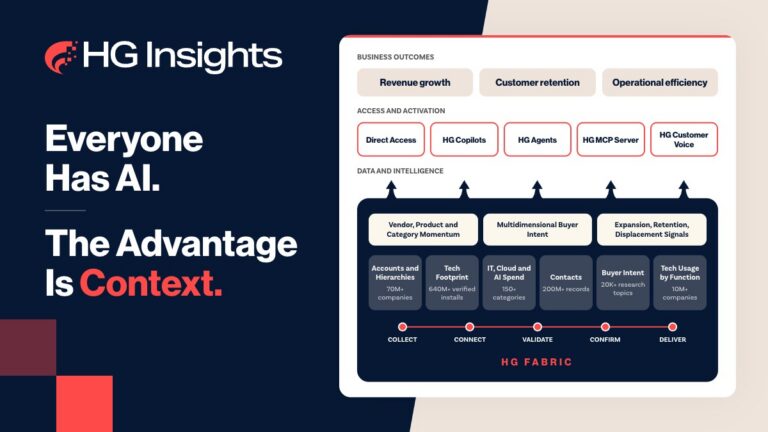
HG Insights unifies market and account intelligence, spend and technographic data, and buyer intent insights into a single platform that operationalizes whitespace analysis and enables data-driven GTM prioritization across Sales, Marketing, RevOps, and GTM Strategy teams.