
A modern sales business intelligence platform should help reps win deals, not just explain last quarter’s numbers.
Sales leaders, RevOps teams, and GTM strategists are under pressure to improve pipeline quality, even as reps still spend only about 40% of their time actively selling. Business intelligence for sales teams has to do something different today; it has to guide execution in real time.
Part of the problem is speed. Buying signals have a shelf life of 7 to 14 days. By the time a rep surfaces an insight from a retrospective dashboard and decides to act, the window has often already closed.
Why traditional BI tools fall short for sales teams
Most sales BI tools were built for retrospective reporting to summarize pipeline by region, segment, or time period to help leadership review performance and track quotas. That’s useful at the executive level, yet it rarely answers the frontline question, “Who should I call first today?”
Dashboards typically stop at visibility. They show trends and stage progression, yet they don’t translate those insights into clear next steps for reps.
The gap is especially costly when you consider that technology stack changes, IT spend shifts, and competitive installs are often more predictive of near-term buying intent than behavioral signals alone; yet most BI tools aren’t built to surface them at the account level, let alone in real time.
That gap is where many sales execution challenges begin, because sellers toggle between systems, interpret charts, and manually research accounts before deciding what to do.
Generic business intelligence explains what happened, but solid sales execution requires direction on what to do next.
| Dimension | Traditional Sales BI | Execution-Focused Revenue Intelligence |
|---|---|---|
| Primary purpose | Summarize past performance for leadership review | Guide rep execution in real time |
| Question it answers | What happened last quarter | Who should I call first today, and why now |
| Data freshness | Quarterly or static snapshots | Live signals, built around the 7 to 14 day buying window |
| Level of detail | Aggregated rollups by region, segment, or period | Account and buying-group level |
| Signals surfaced | Behavioral and pipeline data | Technographics, IT spend shifts, competitive installs, buyer intent |
| Output | Charts and trends for reps to interpret | Prioritized lists with recommended next actions |
| Workflow fit | A separate research project, reps toggle between systems | Embedded inside the CRM reps already use |
| Test of value | Looks polished in a review | Changes rep behavior and win rates |
What sales teams actually expect from BI platforms
Sales teams want clear guidance, fast access to insight, and useful context, all available directly within the platforms they already rely on every day.
Insights that support daily sales decisions
Reps don’t need another high-level performance view. They need answers to “which accounts are most likely to convert?” and “why now?”
A strong revenue intelligence platform should surface account fit, competitive presence, timing signals, and estimated spend potential in one place. Predictive sales insights consolidate CRM history, engagement data, and external signals into prioritized lists with recommended actions, which reduces the need for manual research and frees time for outreach and discovery.
When intelligence is embedded in sales analytics software, it becomes part of daily workflow instead of being a separate research project.
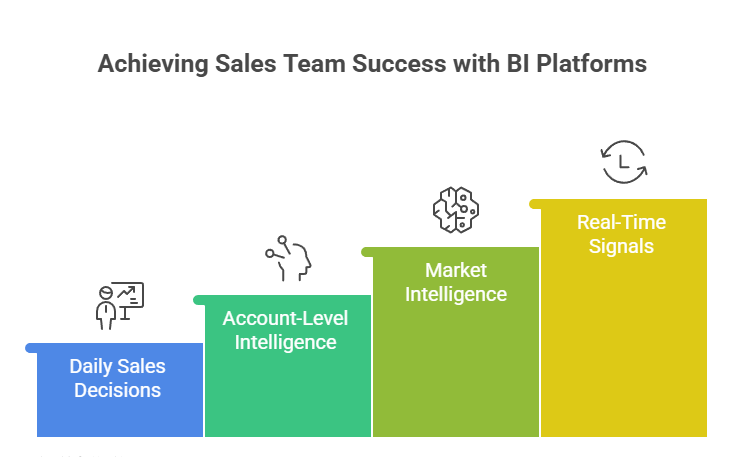
Account-level intelligence, not just aggregated reports
Market rollups are helpful for strategy, but they don’t close deals. Reps work account by account, buying group by buying group.
They need visibility into areas such as:
- Installed technologies and tech stack gaps
- Estimated IT spend and wallet potential
- Competitive footprint
- In-market activity and engagement signals
There’s a layer above account intelligence that most platforms skip entirely: market intelligence. Before you can prioritize the right accounts, you need to understand which markets are worth building around in the first place: which technology segments are growing, where competitive installs are concentrated, and where wallet potential exists at scale. HG Insights’ Market Analyzer is the only product in the category that lets GTM teams run open-ended market analysis, model TAM and SAM, and track technology adoption trends as a standalone capability. Every major competitor operates exclusively at the account level. Market Analyzer operates one layer up, giving you the strategic foundation before you ever build a target list.
That’s where a purpose-built Revenue Growth Intelligence platform stands apart from the competition. The HG Insights Revenue Growth Intelligence platform connects account intelligence to GTM execution, so sellers don’t have to assemble insights across disconnected tools.
Real-time signals that influence deal timing
Timing shapes pipeline quality. Static data snapshots miss buying momentum.
Buyer intent data, funding events, hiring surges, and technographic changes often indicate readiness. Modern business intelligence for sales teams must reflect live signals rather than quarterly updates. Integrated buyer intent signals help teams engage when interest is active, which improves meeting rates and opportunity progression.
Core capabilities sales teams need in a BI platform
Sales-focused BI should simplify prioritization and increase confidence in decision-making.
Predictive prioritization and scoring
Manual list building doesn’t scale across large territories and complex TAMs.
HG Insights research confirms the gap between scored and unscored approaches is not marginal: organizations using AI lead scoring generate 138% ROI on lead generation versus 78% for teams without it: a 60-point advantage driven directly by dynamic, real-time prioritization. HG Insights’ Data Studio takes this further by letting your team build and own custom predictive models without code or a data science team. Unlike other tools, which require professional services engagements to customize scoring logic, Data Studio lets you train models directly on your own win/loss history, product usage data, and ICP criteria, so the prioritization reflects how your best customers actually buy.
Solutions designed around predictive account targeting and scoring replace guesswork with data-backed prioritization. RevOps gains consistency; managers gain better coverage planning; reps gain trust in the list they’re working with.
Contextual insights for better sales conversations
Relevance is often what turns interest into action and makes conversion more likely. In fact, research indicates that 86% of buyers are more likely to make a purchase when they feel understood.
The downstream impact is measurable. Multi-signal personalized campaigns achieve reply rates of 25-40%, compared to 3-5% for generic cold outreach. The difference isn’t the volume of messages sent; it’s the quality of context behind each one.
Technographics, spend intelligence, and buyer intent data give reps meaningful context before the first touch. An integrated account intelligence data fabric consolidates those signals so sellers enter conversations prepared and aligned with the buyer’s environment.
Simple, action-oriented views for reps and leaders
Sales BI tools must reduce complexity rather than add it. Your reps need clear next accounts and outreach cues; managers need pipeline risk visibility; leadership needs coverage and revenue forecasting insights.
Role-based views increase adoption because they match how each persona works. Embedded analytics inside CRM and related tools reduce context switching and increase usage across teams.
How sales-focused BI supports GTM alignment
Intelligence has the greatest impact when it aligns sales, marketing, and RevOps on a shared data foundation. Conflicting scoring models and inconsistent account definitions create friction. A unified GTM intelligence layer aligns ICP criteria, prioritization logic, and signal thresholds.
Having shared visibility into account intelligence and buyer intent data improves collaboration and accountability. RevOps can measure impact consistently; sales can trust the targeting logic; marketing can activate campaigns against the same prioritized accounts.
BI that integrates into sales workflows
Insight loses value if reps have to hunt for it. Embedded analytics inside CRM and connected systems increase adoption and reduce friction.
Platforms built directly for GTM system integration workflows deliver predictive sales insights and recommended actions directly into sellers’ workflows, increasing usability and accelerating overall engagement.
Measuring the impact of BI on sales performance
Sales performance analytics should connect directly to revenue outcomes, as usage metrics alone don’t prove impact.
With intelligence-driven insights, sales teams aren’t just working harder, they’re working smarter. The clearest signal of real impact is a change in rep behavior. When scoring and intelligence are working, reps stop debating which accounts to work and start spending that time in conversations. You can measure this directly: compare pipeline conversion rates by scoring tier, analyze win rates against prioritized versus non-prioritized accounts, and track how much of closed revenue traces back to accounts that matched your scoring model’s top tiers. A platform that doesn’t change those numbers isn’t a BI tool; it’s a reporting layer.
In contrast, traditional targeting often feels like guesswork, leaving opportunities on the table and cycles unnecessarily long.
Compare prioritized accounts to non-prioritized ones; analyze conversion by scoring tier and revenue contribution. A revenue intelligence platform proves value when it changes rep behavior in ways that improve pipeline quality and win rates.
Common mistakes teams make when choosing BI platforms
Many teams prioritize visualization over frontline usability. A polished dashboard doesn’t automatically drive selling behavior.
Another mistake is overlooking data freshness and account-level depth. Without timely signals and reliable technographic context, sales decision intelligence loses credibility.
Treating BI as reporting rather than guidance limits its potential revenue impact. Sales analytics software should be able to take direct action, not simply summarize history.
Give sales teams BI that drives real revenue decisions
Sales teams need a business intelligence platform for sales that’s built for execution. Account intelligence, predictive sales insights, and buyer intent data turn analytics into prioritized actions that improve pipeline and deal timing.
We built HG Insights as a Revenue Growth Intelligence provider for enterprise GTM teams. The RGI Platform starts with your data: CRM history, product engagement, win/loss outcomes. HG’s Fabric adds the market layer: technographics, IT spend, buyer intent. That’s the context your internal data doesn’t have. It’s the only platform in the category that combines market-level analysis, no-code predictive modeling, and rep-ready account intelligence in a single data architecture, so your team isn’t stitching together three vendors to do what one platform should handle.
Set up a demo to see how HG Insights transforms business intelligence for sales teams into a decision engine your reps rely on daily.