

As a GTM leader, you’re moving away from broad, assumption-driven market sizing and toward TAM strategy approaches grounded in real account-level intelligence. Traditional TAM estimation methods often create inflated projections that do not reflect true purchasing capacity or switching readiness. For example, companies in financial services invest an average of $140,000 per employee on IT annually: 35x more than retail companies at $4,000 per employee, based on HG Insights analysis of Fortune 500 firms across both sectors. Yet most TAM models treat these segments equivalently based on headcount alone.
This disconnect makes it difficult for you to accurately assess opportunity size, prioritize high-value segments, and align revenue planning with real market behavior. As a result, your resources are often misallocated toward low-conversion opportunities while high-intent segments remain under-targeted.
By integrating account-level spend intelligence, contract visibility, technographics, and intent signals, you can build a smarter TAM strategy that aligns market opportunity with revenue-ready segments. This approach enables more accurate market sizing, supports data-driven market analysis, and helps you focus resources where growth potential is real.
Why traditional TAM models leave GTM teams guessing
Many traditional TAM frameworks depend on surface-level firmographic data and generalized industry benchmarks rather than real purchase behavior. Because these models lack visibility into active spending, competitive entrenchment, and saturation dynamics, they often present an incomplete picture of true market opportunity.
This can lead you to inflate opportunity estimates in mature segments while overlooking emerging, high-value demand pockets that show stronger revenue potential. It also creates blind spots around timing, addressable account coverage, and realistic expansion pathways.
A more effective TAM strategy introduces account-level spend and contract intelligence as the foundation for more accurate market sizing and revenue planning. When rooted in real purchase behavior and contract timing, TAM models become actionable resources for account prioritization, expansion targeting, and long-term GTM strategy execution.
This shift enables you to move beyond theoretical projections and operate with opportunity models that reflect real buying readiness. When supported by unified market and account intelligence, you gain stronger alignment between strategic planning and measurable business outcomes. You can operationalize this approach using intelligence-driven TAM frameworks that connect account visibility with opportunity mapping and market sizing accuracy.
The role of spend and contract intelligence in modern TAM strategy
Modern TAM strategies require more than surface-level market sizing. To accurately define opportunity and prioritize revenue-ready segments, you need visibility into how accounts actually allocate budgets and commit to vendors. This is where spend and contract intelligence become foundational inputs for building realistic, execution-ready TAM models.
Spend intelligence reveals real market potential
Actual budget allocation patterns make spend data a powerful indicator of which accounts are prepared to engage and able to invest. Rather than assuming demand based on company size or industry classification, spend intelligence highlights where money is already flowing across relevant technology and service categories. For example, based on HG Insights spend intelligence across 10,000+ companies: technology and financial services companies represent just 15% of the U.S. workforce but account for 62% of total enterprise IT spending. This allows you to move beyond theoretical market estimates and focus on accounts that demonstrate real buying capacity.
By analyzing account-level spend behavior, you can more accurately size opportunity, surface revenue-dense segments, and uncover high-value market clusters where purchasing intent is already established. This creates a clearer picture of where growth potential truly exists, beyond where it appears to exist on paper.
This intelligence is the foundation of HG Insights’ Revenue Growth Intelligence (RGI) Platform, which is built specifically to align TAM definitions with segments that reflect active investment behavior and realistic opportunity coverage — not assumed demand based on company size or industry code.
As a result, you gain a more actionable foundation for prioritization, targeting, and pipeline planning, ensuring TAM strategy translates directly into revenue execution.
By grounding market sizing in proven spend behavior, you shift from abstract modeling to practical, data-backed TAM strategy execution.
Contract intelligence shows timing and switching opportunity
Contract intelligence has a critical role in identifying when competitive opportunities are most likely to emerge. By tracking contract timelines and renewal windows, you can pinpoint accounts with a higher likelihood to evaluate alternatives and initiate vendor changes. This enables you to engage prospects at the right moment, rather than relying on broad outreach cycles.
Beyond short-term targeting, contract data also improves long-range TAM forecasting. Visibility into churn patterns, contract durations, and renewal cycles allows you to model future-year opportunity more accurately and anticipate revenue shifts tied to contract expirations.
This approach helps eliminate what HG Insights calls “phantom TAM” — inflated market potential driven by accounts that appear addressable on paper but are locked into long-term agreements with no near-term switching likelihood. Removing phantom TAM from your models produces a more honest view of the opportunity and keeps your team focused on accounts that can actually convert. As a result, TAM models become more realistic, actionable, and aligned with true buying windows.
When combined with predictive TAM modeling powered by unified data sources, contract intelligence further strengthens your scenario planning, pipeline visibility, and revenue forecasting accuracy.
Technographics connect spend to product fit
Spending alone does not tell the full story of whether an opportunity is truly viable. Technology context adds the missing layer needed to determine practical product alignment.
Technographic intelligence connects spend behavior to an account’s existing technology environment, helping you understand platform compatibility, integration readiness, and competitive reliance. HG Insights tracks more than 30,000 technology products across millions of companies globally, with data refreshed continuously — giving you a current, account-level view of the competitive landscape rather than a static snapshot. That breadth means you can identify not just whether an account uses a competing product, but how deeply it is embedded in that vendor’s ecosystem and how that changes over time. This allows you to move beyond surface-level targeting and focus on opportunities where technical fit supports faster adoption and lower implementation friction.
By enabling segmentation based on ecosystem alignment and solution compatibility, HG Insights’ technographic data strengthens GTM execution across signal-based account prioritization, competitive displacement targeting, and B2B data enrichment initiatives.
When layered alongside spend intelligence inside the RGI Platform, technographics provide deeper visibility into where products can realistically land, expand, and scale. Combined with predictive TAM modeling, this unified approach connects technology context, investment behavior, and future adoption likelihood into a single actionable view.
Before you can operationalize TAM, you must first build a unified intelligence foundation that replaces static assumptions with real account-level signals.
Building a smarter TAM strategy with unified account intelligence
Moving beyond single-source analysis and adopting a multi-signal approach that reflects true market dynamics is what builds a smarter TAM strategy.
Refine TAM with account-level insights
By combining spend, contract intelligence, technographics, and intent data inside the HG Insights RGI Platform, you can create high-resolution TAM models that reflect both current buying capacity and future revenue potential. This unified view enables you to prioritize segments where customers demonstrate strong investment patterns and higher switching likelihood — surfaced by real account-level signals, not modeled assumptions.
As a result, your market sizing becomes more precise, ICP definitions improve, and segmentation strategies align more closely with revenue-ready opportunity pools. This also reduces uncertainty around geographic focus, vertical prioritization, and target market coverage.
Build SAM and SOM models that match real buying behavior
Once TAM is grounded in account-level intelligence, downstream market models become more operationally relevant. HG Insights’ AI-powered analytics identify lookalike patterns and opportunity clusters by evaluating shared attributes such as contract cycles, technology environments, and investment maturity — drawing on one of the broadest account-level datasets available to B2B GTM teams.
This enables you to define serviceable and obtainable markets based on actual adoption behavior and competitive footprint rather than theoretical projections. The result is forecasting accuracy and predictive account targeting that reflect where the market actually is, not where a spreadsheet assumes it should be.
Identify expansion and competitive whitespace
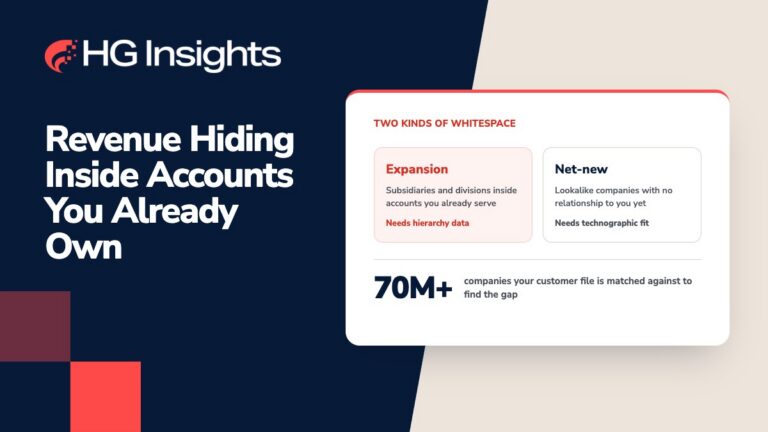
Unified TAM models also uncover growth opportunities that traditional approaches often overlook. By mapping underpenetrated accounts and segments using HG Insights’ combined spend and intent signals, you can surface cross-sell, upsell, and competitive displacement opportunities where buyer interest is emerging or vendor loyalty is weakening — including accounts your team may never have prioritized based on firmographics alone.
This visibility supports targeted expansion strategies while helping you balance net-new acquisition with revenue growth inside existing customer footprints.
Once TAM intelligence is built, the next step is turning strategy into execution across every GTM function.
Operationalizing TAM strategy across GTM teams
Beyond an effective TAM model, your insights should translate into day-to-day GTM decisions.
Equip sales with opportunity-based target lists
Sales performance improves when TAM insights are transformed into actionable target lists driven by spend signals, contract timing, and competitive indicators. The RGI Platform surfaces contract renewal windows and competitive install data at the account level, so your reps aren’t working from generic prospect lists — they’re engaging accounts with a demonstrated reason to evaluate and a window to act. These opportunity-based target lists improve territory coverage accuracy and support signal-based prioritization aligned to revenue goals.
When TAM outputs connect directly to field execution, strategy shifts from analysis to measurable performance impact.
Align marketing and demand gen to high-value segments
Marketing and demand gen programs become more efficient when aligned to TAM-driven segments that reflect real market opportunity. HG Insights’ account-level spend intelligence lets you build campaign audiences around accounts that are actively investing in your category — not just accounts that match a firmographic profile. You can use those TAM-aligned segments to tailor ABM, messaging, and campaign investment toward high-value clusters, minimizing wasted spend and improving program conversion efficiency across the funnel.
Give RevOps a data-first foundation for planning
Your RevOps teams rely on TAM intelligence to support routing logic, scoring models, territory design, and capacity planning. HG Insights provides the account-level spend, contract, and technographic data that makes those models accurate — so quota allocation, territory carving, and coverage decisions are anchored to real market opportunity rather than headcount ratios or last year’s performance data.
This alignment improves cross-functional collaboration and creates consistent planning models shared across sales, marketing, GTM strategy, and Revenue Ops — all working from the same account-level signal set.
With execution in motion, continuous measurement ensures TAM strategy stays aligned with changing market conditions.
Measuring the impact of a smarter TAM strategy
Key performance indicators for TAM-driven GTM execution include segment-level revenue capture, pipeline growth, territory coverage, competitive displacement, and new market penetration. AI-powered analytics help correlate execution outcomes with spend and contract signals, providing visibility into how TAM-aligned strategies improve your productivity and efficiency.
Ongoing optimization strengthens forecasting accuracy, supports long-term GTM planning, and ensures TAM models evolve alongside buyer behavior and technology adoption trends.
Ultimately, TAM strategy must move beyond theory and become a foundation for revenue execution.
Build TAM strategy that reflects true market opportunity
Account-level intelligence transforms TAM from a static, assumption-driven model into a revenue-aligned growth engine. By combining spend, contract, technographic, and intent insights, you gain a unified view of where opportunities exist, which accounts are ready to engage, and where expansion potential lies.
This intelligence-driven approach reduces risk, improves market coverage, and ensures your resources are focused on accounts with the highest likelihood to convert. By implementing predictive TAM modeling, you can make data-backed decisions for targeting, territory planning, and expansion programs — moving TAM from theory to measurable business impact.
HG Insights unifies spend, contract, technographic, and intent signals into a single platform that empowers you to:
- Accurately size and prioritize addressable markets.
- Identify expansion and competitive whitespace.
- Align sales, marketing, and RevOps execution to real market opportunity.
- Predictively model adoption, churn, and renewal-driven growth.
Turn your TAM strategy into a revenue engine that drives measurable growth. Contact HG Insights today to see how unified account intelligence can accelerate your GTM outcomes.
Frequently Asked Questions
Why is account-level spend essential for accurate TAM strategy?
Account-level spend intelligence reflects real purchasing behavior, helping teams understand where budget is already allocated and where active investment signals exist. This supports more accurate market sizing and improves prioritization across high-value segments.
How does contract intelligence improve market sizing accuracy?
Contract intelligence reveals renewal cycles, expiration windows, and switching likelihood, which helps teams model future-year TAM more realistically and avoid assumptions inflated by long-term locked-in customers.
How do spend and contract insights support competitive displacement?
Spend and contract signals identify accounts where competitors are entrenched, nearing renewal, or showing signs of churn readiness. These insights help GTM teams time outreach, design competitive plays, and prioritize expansion and displacement opportunities.
How does HG Insights unify spend, technographic, and intent data into TAM workflows?
HG Insights brings together intelligence, technographics, contract visibility, and intent signals into unified TAM workflows that support market sizing, predictive account targeting, and data-driven segmentation for more accurate and scalable GTM strategy execution.