

Most ABM programs don’t fail on strategy. They fail on the shelf life of the data underneath the strategy. A target list built in January looks compelling in March and is actively misleading by June, because installs change, contracts renew, and in-market windows open and close while the list sits static.
Data intelligence, layered across firmographic, install, spend, and intent signals, is what keeps account lists honest. Everything downstream, from segmentation to scoring to campaign activation, works better when the source data doesn’t quietly go stale. This post reframes ABM performance around that problem and shows how the teams producing real pipeline impact are solving it.
ABM has become a default GTM motion, but the performance gap between programs is widening

ABM has moved from a pilot motion into the default for most enterprise GTM teams. But becoming standard hasn’t made it uniformly effective. The performance gap between programs has widened, and the outliers on pipeline impact rarely have the best creative or the most channels. They have the freshest data.
The teams that consistently generate pipeline from ABM aren’t doing anything radically different in terms of strategy design. They’re operating from account intelligence that reflects what’s actually happening in the market right now rather than what was true when the list was built.
Traditional ABM approaches break down because they rely on data that was accurate once
Lists built from gut instinct and static CRM fields capture what accounts looked like at onboarding, not what they look like today. Programs launched without real-time signals spend the same effort on accounts that just closed a competing deal as on ones actively in-market, which is a significant reason why average conversion rates across ABM look worse than the case studies suggest.
The core problem is temporal. Traditional ABM treats account selection as a point-in-time decision and then runs campaigns against that frozen snapshot for months. In a market where buying signals shift weekly, that approach guarantees your team is working a list that has already drifted from reality by the time most campaigns launch.
Data intelligence gives your ABM program a live view of each account
Data intelligence for ABM is the combination of firmographic, technographic, IT spend, and intent signals inside a single view of each account, refreshed on a cadence that matches how fast each signal actually changes.
The operational shift is significant. The question moves from “Who should we market to?” to “Which accounts are showing buying behavior right now, and does the context support acting on it?”
That second question can only be answered when your account intelligence combines what an account looks like (firmographics), what it runs (technographics), what it’s spending (IT spend), and what it’s researching (intent) into one current picture.
| Signal type | What it tells you about an account | Coverage cited in this content | Why refresh cadence matters |
|---|---|---|---|
| Firmographic | What the account looks like (size, industry, structure) | Used as the baseline fit layer | Drifts slowly, but anchors everything scored on top of it |
| Technographic | What the account runs | Tracks technology installations across more than 20,000 products | Installs change as contracts renew, shifting compatibility and timing |
| IT spend | What the account is spending | Projects 12-month rolling IT spend across 140 spend categories, updated monthly | Spend acceleration can move an account from a 1:many to a 1:few tier |
| Intent | What the account is researching | Buyer Intent data combining second-party signals from TrustRadius with spend and technographic context | Buying signals shift weekly, so static lists go stale fastest here |
HG Insights tracks technology installations across more than 20,000 products and projects 12-month rolling IT spend at the individual account level across 140 spend categories, updated monthly. According to HG’s own 2026 Global IT Spend Forecast, 16.3 million businesses worldwide are projected to spend a combined $4.96 trillion on IT software, services, hardware, and communications in the next 12 months. That’s the underlying market your ABM list is fishing in, and the difference between a static account list. One informed by that data is not marginal.
When those signals are unified and refreshed continuously, every ABM decision downstream becomes more precise because it’s grounded in what’s actually true about the account today.
A smarter account selection model starts with evidence, not assumptions
Evidence-based ICPs outperform revenue-tier ICPs because they use install patterns, spend signals, and product-fit data that correlate with actual won deals rather than demographic attributes that merely correlate with your existing customer base.
Validating the model against real win rates and deal velocity exposes which attributes genuinely predict conversion and which ones are noise. Teams that build a data-driven ICP for ABM targeting using these signals stop carrying forward last year’s assumptions and start working from a model that reflects what’s actually producing revenue today.
The validation step matters as much as the initial build. An ICP that isn’t tested against outcomes is just a hypothesis. One that’s been pressure-tested against win rates and deal velocity is a planning tool your team can trust.
Segmentation should reflect buying behavior, not just company demographics
Employee count and industry classification tell you almost nothing about buying behavior. Tech stack compatibility, cloud maturity, and spend velocity tell you a great deal. The difference between those two segmentation approaches determines whether your campaigns reach accounts that are genuinely ready to engage or accounts that simply match a demographic profile.
Tiered segmentation (1:1, 1:few, 1:many) should reflect opportunity size and engagement depth rather than logo prestige. And the tiers need to move as the data moves. An account that was a 1:many candidate last quarter may now be showing intent spikes and spend acceleration that warrant 1:few or 1:1 treatment. Static tiers miss those transitions entirely.
Intent signals turn your account list from static to live
Intent surfaces accounts researching your category, your competitors, or a specific use case you solve for. Without fit context, intent is noise. With fit context, intent becomes a shortlist of accounts that are both qualified and ready, which is the account set your reps should be working today. HG’s Buyer Intent data combines second-party signals from TrustRadius (acquired June 2025) as one of the few sources of verified, purchase-confirmed intent, with technographic and spend context, so you’re not just seeing who’s searching, but who’s already bought adjacent solutions and has the budget to move.
Teams that prioritize accounts with active buyer intent stop treating ABM lists as documents and start treating them as live instruments that reflect which accounts have moved into a buying window since the last time anyone looked.
The practical difference is substantial. Instead of working a flat list where every account receives equal attention, your team focuses disproportionate effort on accounts where the data confirms both fit and timing. That concentration produces higher conversion rates because outreach arrives when the account is receptive, not when the calendar says it’s time for the next campaign.
Account scoring should blend fit, signal, and context into one dynamic model
Effective scoring weights firmographic fit, installed technologies, intent activity, and relationship history as one model rather than four independent views. When these inputs are treated separately, each one tells a partial story. When they’re combined, the composite score reflects a much more complete picture of where an account actually stands.
Dynamic scoring matters because a report pulled on Monday should reflect what the account looked like on Monday, not whenever the model last ran. Scores that update as signals change keep sales and marketing focused on accounts that are genuinely progressing rather than accounts that scored well based on data that has since shifted.
Whitespace analysis reveals the expansion opportunities your ABM targeting misses
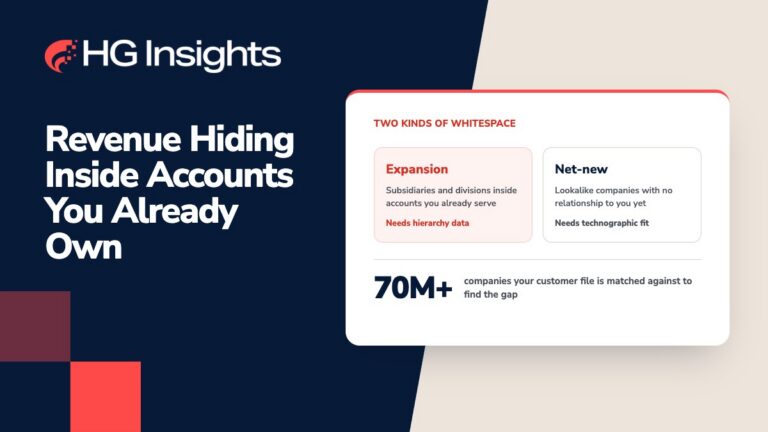
Whitespace inside the existing customer base is often the highest-yield pipeline in the plan and the easiest to miss. Generic ABM targeting focuses outward on new logos, which means expansion opportunities within current accounts frequently go unworked until a customer success conversation surfaces them by accident.
Mapping install and spend data against current customer usage reveals adjacent product gaps that ABM targeting alone overlooks. Teams that uncover whitespace opportunities in current accounts usually find expansion motion that has been available for quarters without anyone building a play around it.
The data to identify whitespace already exists in your install and spend intelligence. The step most teams skip is systematically applying that data to the existing customer base with the same rigor they apply to new account targeting.
Sales and marketing alignment holds when both teams work from the same account intelligence
Alignment fails when marketing measures MQLs and sales measures coverage. Those two metrics pull in different directions, and the resulting tension produces the familiar cycle of marketing complaining that sales ignores their leads and sales complaining that marketing sends them accounts that aren’t worth pursuing.
Shared account intelligence resets that conversation by giving both teams the same definition of a worthwhile account, with the same freshness, from the same system. The operational benefit is real, but the political benefit may be even larger: the account debate stops because both teams are looking at the same data.
When fit, intent, and engagement signals live in one place that both functions trust, handoffs improve because the context transfers with the account. Marketing doesn’t have to convince sales that an account is worth working. The data makes the case.
Campaign activation gets sharper when it’s informed by each account’s current context
Personalization scales when creative, messaging, and channel sequencing are informed by each account’s tech stack and current intent activity rather than a segment-level assumption about what that type of account might care about.
Outbound, paid, and content should trigger based on account-level behavior, not a campaign calendar. Teams that optimize ABM campaigns with account-level intelligence run fewer campaigns with higher response rates because every activation targets an account in the right state. The efficiency gain isn’t just about cost. It’s about relevance. An account that receives a campaign timed to its actual buying window and tailored to its actual technology environment is fundamentally more likely to engage than one that receives a scheduled campaign based on its industry and size.
Measuring ABM performance requires metrics that reflect what ABM actually does
Funnel metrics alone miss what ABM is trying to accomplish. ABM doesn’t optimize for lead volume. It optimizes for depth of engagement and conversion within a defined account set. The measurements that reflect program health are different from those that measure a demand generation program:
- Account engagement depth. Are you reaching more stakeholders within target accounts over time? Is engagement moving from passive content consumption to active conversations?
- Pipeline velocity on target accounts. Are target accounts progressing through stages faster than non-target accounts? Is ABM accelerating the buying process?
- Opportunity conversion by tier. Are 1:1 accounts converting at materially higher rates than 1:many accounts? If not, the tiering model may need recalibration.
- Revenue influenced by the program. Can you tie closed-won revenue back to the ABM activities and signals that initiated engagement? This is the metric that earns the program its budget.
Reports should connect results back to the fit and intent signals that triggered outreach, so the data loop closes rather than running open. When you can show that accounts with specific signal combinations convert at a measurably higher rate, you have the evidence to continuously refine your targeting.
HG Insights powers a smarter ABM strategy from account selection through activation
HG Insights delivers firmographic, technographic, IT spend, and contextual intent data inside one platform purpose-built for ABM precision. The Revenue Growth Intelligence Platform supports every stage of the motion, from ICP modeling and whitespace analysis to account scoring and campaign activation, with refresh cadences that match how fast each signal actually moves in the market.
For a closer look at how data intelligence connects to ABM execution, the Data-Driven Approach for ABM Marketing product brief details how these capabilities work together in practice.
Put data intelligence at the center of your ABM strategy. Get a 30-day checklist and ABM optimization know-how with our ABM Starter Kit.