
AI share of voice measures how often your brand shows up when buyers ask AI tools like ChatGPT, Perplexity, and Google AI Overviews about your category, compared to everyone else competing for that same answer. Search traffic used to be the whole scoreboard. Now a growing share of B2B research happens inside a chat window, and most marketing teams have no way to see whether their product is even in the running. This guide covers what the metric means, how to calculate it, what a good score looks like, and how to start tracking it.
Quick answer: AI share of voice is the percentage of AI-generated answers, across engines like ChatGPT, Perplexity, and Google AI Overviews, that mention or cite your brand compared to competitors in the same category. It’s calculated by dividing your brand’s mentions by total category mentions across a shared set of tracked prompts, then multiplying by 100.
What is AI share of voice?
AI share of voice is the metric that tracks how often a brand appears in AI-generated responses relative to its competitors. Instead of counting website visits or keyword rankings, it counts mentions and citations inside answers from ChatGPT, Claude, Perplexity, Gemini, and Google AI Overviews, then expresses your portion as a percentage of the whole conversation.
Most tools that report this number are actually counting two different things at once, and the distinction matters. A mention is any time an AI answer names your brand, whether the mention is flattering, neutral, or buried in a list of ten competitors. A citation is more specific: it’s when the model points to a source, usually with a link or an attribution, as the evidence behind its answer. A brand with a high mention count but a low citation rate is known to the model but not trusted enough to source directly, which is a different problem than not being known at all.
This whole discipline sits under generative engine optimization, or GEO: the practice of structuring content so AI systems can find, trust, and cite it. AI share of voice is the number GEO work is trying to move.
Why AI share of voice matters for marketing and GTM teams
Organic search used to be measurable in a straightforward way: rankings, clicks, conversions. That scoreboard is getting harder to read now that Google AI Overviews appear in 25% of searches on average, and that share has spiked as high as 47% in a given month (Conductor’s 2026 AEO/GEO Benchmarks Report), pushing organic listings further down the page even when a site still ranks well. Teams that can’t say whether they’re winning or losing inside that AI layer are defending a budget with half the picture.
This isn’t a channel marketing teams can watch from a distance either. HG Insights tracks a generative AI intent score for every company in its data, a measure of how actively that company is researching and buying generative AI tools. Companies running marketing technology score 42% higher on this measure than the average company, which means the same teams being asked to defend organic reach are, at the same time, ramping up their own AI investment faster than most of the market. Ignoring AI visibility as a metric while adopting AI tools internally is a hard position to defend in a budget review.
For SEO and organic search teams
SEO managers have spent years optimizing for a search engine that returned ten blue links. Now a meaningful share of those queries get answered directly on the results page, or never touch Google at all. There’s no established playbook yet for showing leadership where that traffic went or how to get it back, and “our rankings are fine” doesn’t answer the question anymore. AI share of voice gives that team an actual number to report instead of a shrug.
For demand gen and content teams
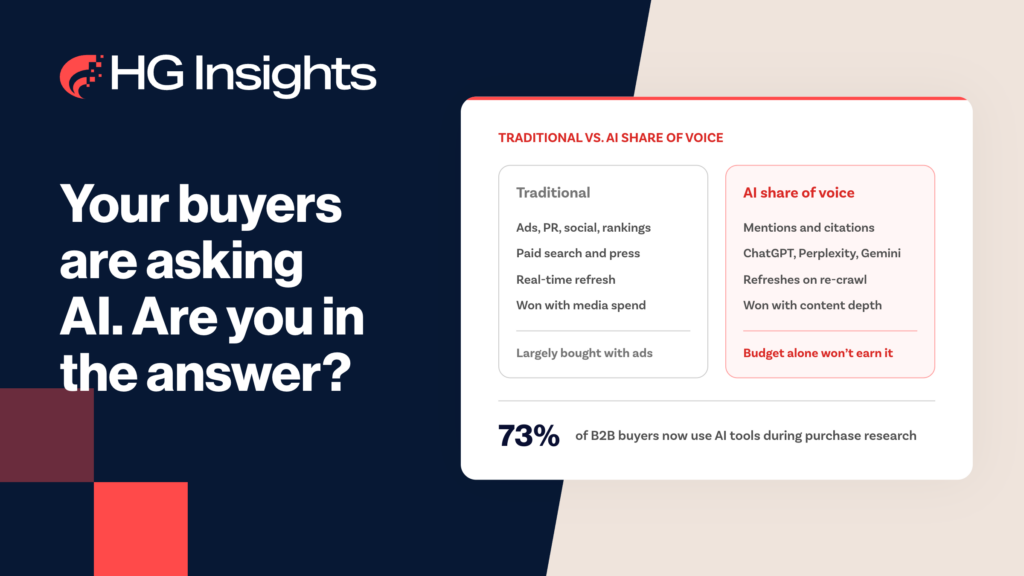
Buyers are doing more research before a vendor ever sees them. Seventy-three percent of B2B buyers now use AI tools during purchase research, up from 32% a year ago, and the traffic that does arrive from AI search converts at 14.2% versus 2.8% for Google organic (Averi Multi-Source Analysis, March 2026). That gap is pipeline being influenced by a channel most demand gen dashboards don’t track. If a product isn’t part of the answer when a shortlist forms, the attribution report will never show why.
AI share of voice vs. traditional share of voice
Traditional share of voice and AI share of voice sound like the same idea applied to a new channel, but they’re won differently. Traditional SOV totals mentions across paid media, PR, social, and search rankings, and a chunk of it can be bought outright through ad spend and distribution budget. AI share of voice can’t be purchased the same way. A model cites what it judges to be structured, verified, and trustworthy, so the path to a higher score runs through content depth and third-party validation, not media spend.
Dimension | Traditional share of voice | AI share of voice |
|---|---|---|
What it measures | Mentions across ads, PR, social, and search rankings | Mentions and citations inside AI-generated answers |
How it’s won | Media spend, distribution, publishing volume | Content depth, structure, and third-party verification |
Primary channels | Paid search, social, press, organic rankings | ChatGPT, Perplexity, Claude, Gemini, Google AI Overviews |
Can you buy it | Largely yes, through ad spend | No. Budget alone doesn’t earn a citation |
Refresh cycle | Real time, tied to campaign activity | Depends on how often AI crawlers revisit and re-index your content |
Both numbers matter, and tracking one without the other leaves a gap in the picture. But the mechanics behind AI share of voice are different enough that they need their own formula.
How is AI share of voice calculated?
AI share of voice is calculated by dividing your brand’s mentions across a set of tracked AI prompts by the total mentions of every brand in that category across those same prompts, then multiplying by 100. The formula holds steady across engines, but the inputs, which prompts you track and how you define a mention, determine whether the resulting number actually means anything.
AI share of voice (%) = (your brand’s mentions across tracked prompts ÷ total brand mentions across the same prompts) × 100
That formula is a reasonable starting point, but it treats a passing mention in position ten the same as a brand named first and cited with a link, which isn’t a fair comparison. More advanced tracking weights mentions by position within the answer and separates citations from plain mentions, since one predicts whether buyers recall your name and the other predicts whether the model treats you as a credible source worth sourcing directly. Some platforms also factor in the search volume behind a prompt, since owning a share of an answer nobody asks for counts for less than owning a share of one buyers ask constantly.
What counts as a good AI share of voice score?
There’s no universal passing grade, because the number is relative to how many competitors are being tracked in the same category. As a general guide, a share under 20% usually signals a brand that’s close to invisible in AI-generated answers for that space. Between 20% and 40% is a competitive position. Above 40% typically means category leadership. A 20% share is unimpressive for the largest player in a four-vendor category, and remarkable for the seventh player in a field of fifteen.
Raw percentage also matters less than where it shows up. A vendor can carry a strong share of voice on broad, top-of-funnel prompts like “what is [category] software” and still lose every competitive deal, because that isn’t where buyers are deciding. The more useful benchmark is share of voice on mid-funnel and deep-funnel prompts: comparisons, pricing questions, vertical-specific questions, the moments where someone is actively narrowing a shortlist. Winning ten broad awareness prompts is worth less than winning the one “[competitor] alternative” query that shows up right before a demo request.
How to measure and track AI share of voice
Tracking AI share of voice well takes more setup than running one prompt through ChatGPT and eyeballing the answer. A few practices, the same ones the GEO Monitoring Dashboard from TrustRadius by HG Insights is built around, separate a useful measurement program from a vanity number.
Build a prompt set that mirrors real buyer questions
Start from the questions your actual buyers ask, not a generic list of category keywords. That means comparison prompts, pricing prompts, “best for [vertical]” prompts, and alternative prompts, pulled from real search and conversation data where possible. A prompt set built around vendor-chosen topics instead of buyer language will overstate visibility on questions nobody is actually asking.
Track across more than one AI engine
ChatGPT, Perplexity, Google AI Overviews, Copilot, Claude, and Gemini don’t return the same answer to the same prompt, and buyers aren’t standardized on a single one. A share of voice number pulled from one engine is a partial view at best, and it can hide a real gap on the engine your buyers actually use.
Separate mentions from citations
Track the two counts independently rather than blending them into one score. A rising mention count with a flat citation rate usually points to a content trust problem, not a visibility problem, and the fix for each looks different.
Benchmark against named competitors, not just your own trend
A share of voice number only means something next to someone else’s. Track it against the specific competitors buyers actually compare you to, and against the broader category, so a quarter-over-quarter change tells you whether you gained ground or the whole category just got noisier.
Common mistakes when measuring AI share of voice
Chasing volume instead of funnel-relevant prompts is the most common error. High mention counts on broad “what is [category]” queries look good in a slide but rarely move pipeline, since that’s rarely the moment a buyer decides.
Tracking a single AI engine and treating it as the whole picture is another. Perplexity, ChatGPT, and Google AI Overviews often return different answers to the same question, so a strong number on one engine can mask a blind spot on another.
Ignoring sentiment and framing turns the metric into a pure counting exercise. Being mentioned isn’t automatically good if the surrounding context is inaccurate or unflattering. A rising mention count paired with declining sentiment is a warning sign, not a win.
Treating one snapshot as a trend overstates confidence in noisy data. AI answers shift as models retrain and content gets re-crawled, so a single week’s reading can swing for reasons that have nothing to do with your actual visibility. The trend line over several months is the number worth acting on.
How TrustRadius and HG Insights track AI share of voice
TrustRadius’s GEO Monitoring Dashboard was built around the gap most of the mistakes above create. Its Product and Category Monitoring tabs track up to 100 real buyer prompts a month across major AI engines, reporting brand mentions and Citation Share of Voice separately, and specifically weighted toward the mid-funnel and deep-funnel prompts, comparisons, pricing, alternatives, where buying decisions actually get made rather than broad category queries that inflate a number without moving pipeline.
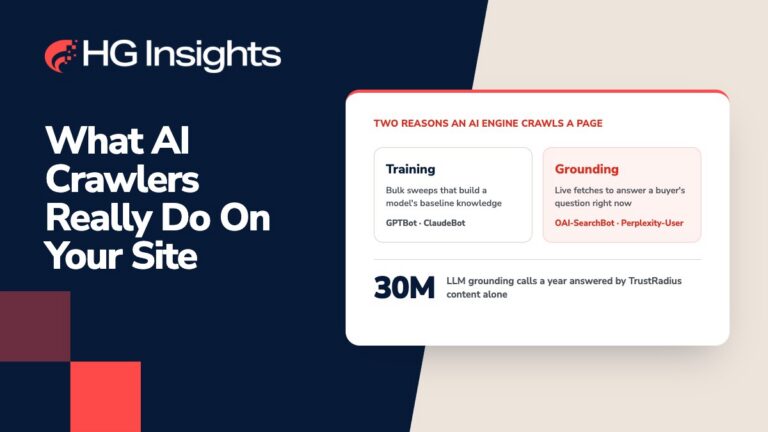
Every product page behind that data is enriched with HG Insights Contextual Intelligence: real technology install counts, market share, and industry vertical segmentation. That’s the structured, verified data AI models prefer to cite over raw text, which is part of why TrustRadius receives 60 million annual crawls from major AI engines and grounds 30 million LLM answers a year. A Crawler Analytics tab goes a step further, splitting every crawl into grounding (answering a live buyer question) versus training (feeding the model’s baseline knowledge), which shows whether AI attention is building before a single citation appears. See where your product currently stands with the GEO & AI Visibility Monitoring solution from TrustRadius by HG Insights, which already tracks this exact metric.
For teams that want the broader category context behind this number, AI visibility monitoring covers how that measurement layer works end to end. Readers ready to see live data instead of a framework can request a walkthrough of the GEO Monitoring Dashboard inside the TrustRadius Vendor Portal, where Citation Share of Voice, mentions, and crawl activity are all reported against named competitors.
Frequently Asked Questions
What does AI share of voice mean?
AI share of voice is the percentage of AI-generated answers that mention or cite a specific brand compared to its competitors across the same set of tracked prompts. It applies the logic of traditional share of voice to engines like ChatGPT, Perplexity, and Google AI Overviews instead of ads or press mentions.
How is AI share of voice calculated?
Divide your brand’s mentions across a set of tracked AI prompts by the total mentions of every brand in that category across the same prompts, then multiply by 100. More advanced versions weight mentions by position in the answer and separate citations from plain mentions.
Is AI share of voice the same thing as GEO?
No. Generative engine optimization, or GEO, is the practice of structuring content so AI systems can find, trust, and cite it. AI share of voice is the metric that shows whether that work is actually paying off.
What's a good AI share of voice score?
As a general guide, under 20% signals limited visibility, 20% to 40% is competitive, and above 40% typically indicates category leadership. The right benchmark depends on how many competitors are tracked in the category and whether the share comes from prompts buyers actually use to decide.
How often should AI share of voice be tracked?
Monthly tracking is a reasonable baseline, since AI answers shift as models retrain and content gets re-crawled. A single reading can swing for reasons unrelated to real visibility, so the trend across several months is more reliable than any one snapshot.