
Sales intelligence tools have become the connective layer between a company’s technology footprint, its buying signals, and the reps trying to act on both before a competitor does. B2B teams evaluating this category in 2026 aren’t comparing contact databases anymore. They’re comparing how well each platform turns technographic, intent, and spend data into an account a rep should call today.
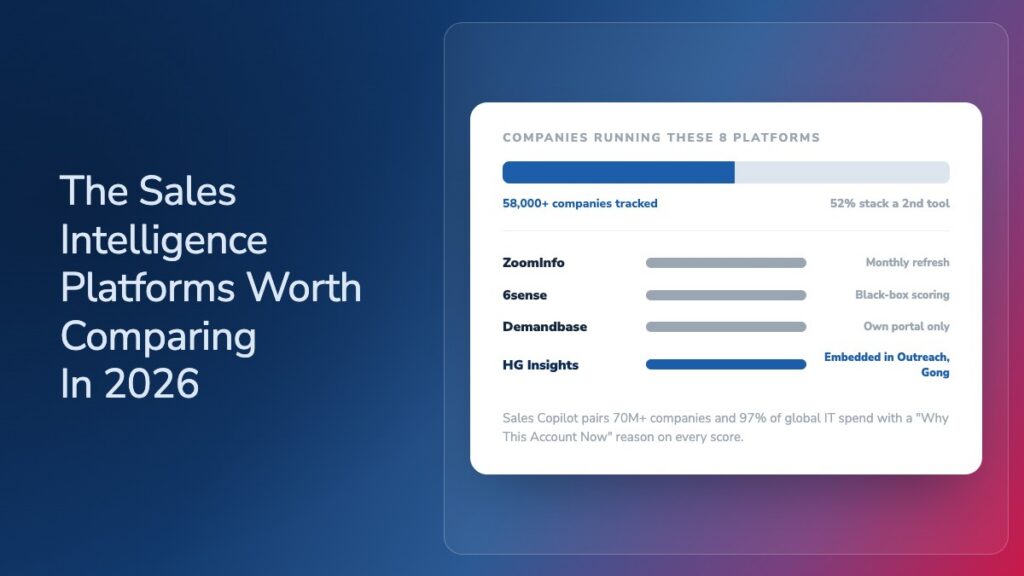
HG Insights data shows more than 58,000 companies currently run at least one of the eight platforms compared in this roundup, evidence that this category is far from settled. This roundup breaks down the strongest sales intelligence platforms and tools by GTM motion, from enterprise data consolidation to growth-stage execution.
Quick Answer: The strongest sales intelligence tools in 2026 span four use cases: ZoomInfo, 6sense, and Demandbase for enterprise data consolidation; Apollo.io, Cognism, and SalesIntel for growth-stage execution; Bombora for standalone intent signals, and HG Insights for installed-technology, IT spend, and contract-timing intelligence delivered through an embedded Sales Copilot; and LinkedIn Sales Navigator and Clay for account-based targeting. The right choice depends on GTM motion, not data volume alone.
What makes a tool “sales intelligence” (and how it differs from general AI sales tools)
Sales intelligence software combines company and contact data, technographic and intent signals, and account scoring into a single system reps use to prioritize outreach. It differs from general AI sales tools, which mostly automate email drafting or call summaries, because sales intelligence platforms answer a narrower question: which account should a rep contact right now, and why.
The core capabilities of a true sales intelligence platform
A sales intelligence platform starts with data: firmographic details, technographic install data, and contact records that stay current as companies change tools and headcount. On top of that sits signal detection, meaning the platform watches for intent surges, technology changes, funding events, or executive hires that suggest an account is entering a buying window. The best platforms then score and rank accounts using that combination of signals rather than a single data type, and they deliver the ranked list somewhere a rep actually works, not a portal they have to remember to check.
Forrester’s B2B Buying Signals Framework groups these inputs into seven distinct signal sets, spanning behavioral, content, and lifecycle data, which is roughly the taxonomy every serious vendor in this category has converged on.
Where sales intelligence tools diverge from general AI sales tools
General AI sales tools, the category covered in roundups of AI-enabled prospecting and email tools, mostly automate what a rep does after they already know who to contact: drafting a sequence, summarizing a call, or predicting which existing lead is likely to convert. Sales intelligence tools sit a step earlier in the funnel. Their job is telling a team which accounts and contacts deserve that attention in the first place, using data the rep couldn’t gather on their own. A team can run both categories side by side. The AI sales tools handle execution once a target list exists, while the sales intelligence platform is what builds and refreshes that list.
How this list evaluates sales intelligence platforms and tools
Every platform below was assessed against five criteria that consistently show up in how B2B teams actually run evaluations: signal breadth (how many first, second, and third-party signal types the platform ingests), data depth (whether technographic and spend data go beyond surface-level tech stack detection), workflow integration (whether intelligence reaches reps inside the tools they already use or requires a separate login), scoring transparency (whether reps can see why an account is ranked the way it is), and total cost of ownership relative to the GTM motion it’s built for.
Workflow integration matters because intelligence and execution tend to get bought together rather than as a substitute for one another. Across the companies HG Insights tracks running Outreach, Salesloft, or Gong, 52% also run a dedicated sales intelligence platform alongside. A platform built for enterprise data consolidation and one built for growth-stage execution are solving different problems, so this list groups tools by the motion they fit best rather than ranking them on a single scale.
Best sales intelligence platforms for enterprise GTM teams
These full-platform vendors aggregate broad signal sets and integrate deeply with the CRM and sales engagement stacks large GTM organizations already run.
ZoomInfo
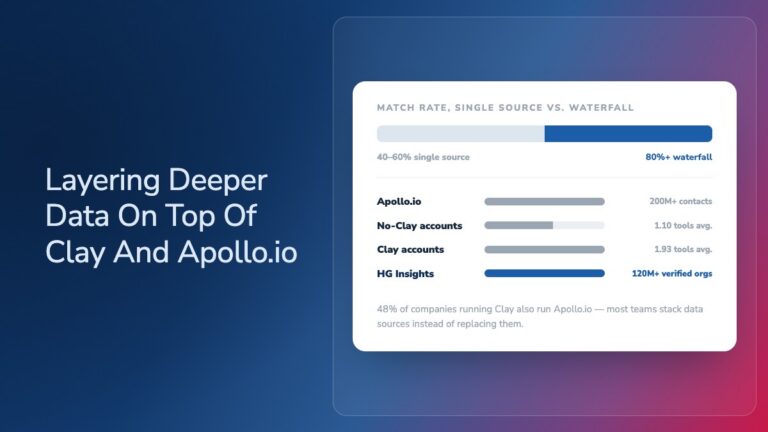
ZoomInfo’s core strength is scale: a contact database built on hundreds of millions of company-technology pairings and a broad integration footprint across CRMs and sales engagement platforms. Its Copilot, launched in 2023 and expanded into Copilot Workspace in 2025, pulls a rep’s book of business into one AI-assisted view, and Chorus adds conversation intelligence that most competitors in this list don’t have natively. The tradeoffs show up in intent accuracy and cost. A meaningful share of ZoomInfo users report frequent false positives on intent signals, and contact data refreshes monthly rather than continuously, meaning some records lag real-world job changes. Enterprise teams already standardized on ZoomInfo for contact data tend to layer in a second tool for technographic or spend-based signals.
6sense
6sense built its reputation on predictive buying-stage modeling. Its Signalverse processes signals across a large web and content network and classifies accounts into a stage of the buying journey before they’ve engaged a sales rep directly, which is genuinely useful for ABM-heavy enterprise teams running coordinated advertising and outbound. The most consistent criticism, showing up repeatedly in user reviews on G2, is that the scoring model functions as a black box. Reps can see that an account is prioritized without a clear, adjustable explanation of why, which weakens the trust and adoption on frontline sales teams even when the underlying prediction is accurate.
Demandbase
Demandbase pairs its DemandMatrix technographic data, covering tens of thousands of technologies and well over 100 million domains, with a native B2B advertising platform, making it the closest thing to a single ABM-and-sales-intelligence stack on this list. Dual scoring models let teams run separate qualification and pipeline-prediction logic for different segments. The complexity that comes with a platform built through several acquisitions shows up in its learning curve. Dashboards can bury the insight a rep needs under layers of navigation, and there’s no embedded copilot inside the rep’s sales engagement platform, so intelligence lives in Demandbase’s own portal rather than where outreach actually happens.
Best all-in-one sales intelligence tools for growth-stage teams
Growth-stage teams generally need contact data, intent signals, and execution bundled into fewer tools at a lower price point than enterprise platforms are built for.
Apollo.io
Apollo pairs a large contact database with a built-in sequencing engine, so data and execution sit in the same platform rather than requiring a separate outbound tool. Its March 2026 acquisition of Pocus was aimed squarely at closing the signal-depth gap, adding revenue intelligence and processing on top of what had been a breadth-first product. That integration is still maturing, and Apollo’s technographic data is derived from web crawling and job postings rather than proprietary collection, which puts a ceiling on how deep its signals go compared to platforms built around technographic data from the start. For teams that want data and outbound execution in one login at accessible per-seat pricing, it remains one of the more complete options in this tier.
Cognism
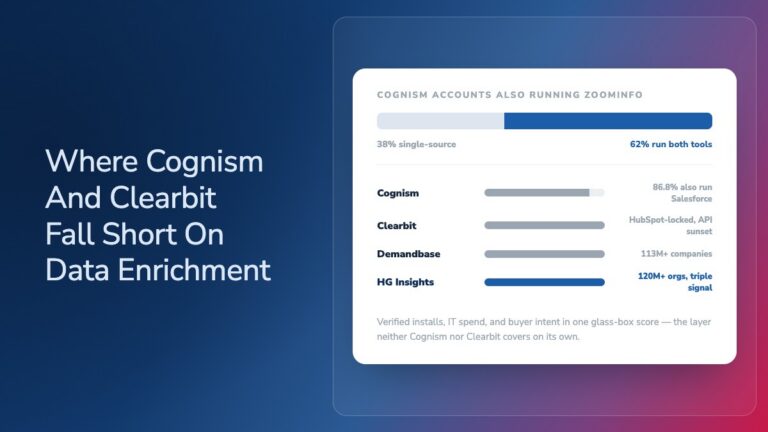
Cognism leads with data compliance and phone accuracy, which makes it a common choice for teams selling into Europe. Its Diamond Data phone verification and GDPR-first architecture solve a real problem that some competitors treat as an afterthought. Its intent layer, however, is resold Bombora data available through several other vendors in this list, so it isn’t a differentiator on its own, and its technographic data refreshes only annually, which is slow relative to how fast technology stacks actually change. Cognism fits teams whose primary pain point is verified contact data and compliance rather than signal depth.
SalesIntel
SalesIntel positions itself as a signal-first alternative to the larger contact database vendors, combining a human-verified contact database with a PredictiveIntent model that applies a confidence threshold to suppress false-positive account matches. Its ICPIntel and RepIntel tools bundle ideal-customer-profile modeling and daily account prioritization into the same subscription, and native integrations with Salesforce, HubSpot, Outreach, and Salesloft mean it slots into a growth-stage stack without much friction. It’s a reasonable fit for teams that have outgrown a bare-bones contact tool but aren’t ready for enterprise platform pricing.
Best sales intelligence tools for buyer intent and signal-based selling
These platforms are built specifically to detect and act on buying signals, rather than functioning primarily as contact databases with signals layered on top.
Bombora
Bombora is the closest thing this category has to an industry standard for intent data, built on a consent-based cooperative of thousands of publisher sites and recognized by Forrester as a leading intent data source. Its Surge scoring is transparent and well documented, which matters to RevOps teams that distrust opaque models. The limitation is scope: Bombora is a data provider, not a full workflow. It has no contact database, no scoring engine beyond intent, no embedded copilot, and its weekly refresh cadence means reps are acting on signals that are, at best, several days old by the time they reach a workflow.
HG Insights Sales Copilot
HG Insights approaches signal-based selling from a different starting point than most of the vendors above: proprietary technographic install data and IT spend intelligence with install data covering 70 million companies and 70,000 technologies, plus IT spend intelligence covering 97% of the global B2B ICT spend across 150+ categories, rather than a contact database or an advertising platform, as the foundation. No other platform in this roundup offers that combination natively. Sales Copilot unifies first-party signals like product usage and web activity with second-party signals like review-site and social engagement, and third-party intent and competitive-install signals, then layers in configurable signal weighting so admins, not a black-box algorithm, control how each signal type is scored. The copilot itself is embedded directly inside Outreach, Salesloft, and Gong Engage, meeting reps in the sales engagement platform they already use rather than asking them to check a separate dashboard, and every prioritized account comes with a “Why This Account Now” explanation tied to the specific signals that triggered it.
For GTM teams whose signal-based selling motion depends on knowing not just that an account is in-market but what they’re running and what they’re spending, seeing a demo of HG Insights Sales Copilot is a reasonable next step before comparing it against a pure intent-data or predictive-scoring vendor.
Best sales intelligence tools for account-based marketing and territory planning
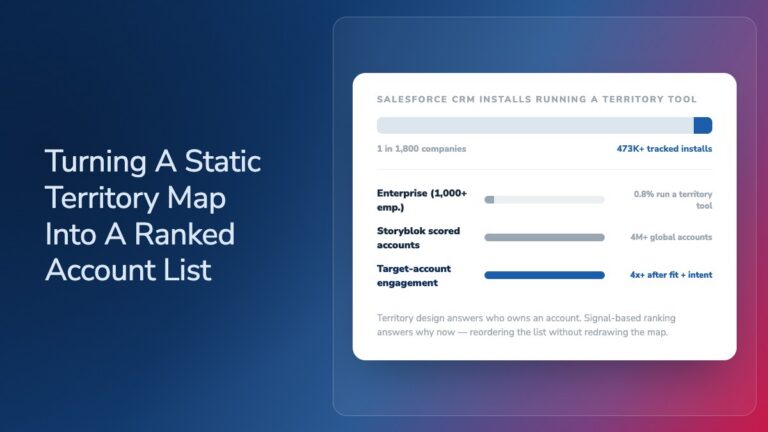
Territory planning and ABM programs need tools built around mapping named accounts and coordinating outreach across a buying committee, not just scoring individual leads.
LinkedIn Sales Navigator
Sales Navigator has moved well beyond a search tool. Its 2026 releases added Account IQ and Lead IQ for one-click company and person research, buyer intent signals pulled from more than 180 signal types, and a conversational search mode that lets reps describe a target account in plain language instead of stacking filters. Its Account Search mode, paired with more than 50 filter combinations across company size, industry, revenue, and headcount growth, makes it a strong fit for territory mapping specifically because it’s built on LinkedIn’s own relationship graph, giving reps visibility into warm paths into an account that data-only platforms can’t replicate.
Clay
Clay isn’t a traditional sales intelligence platform so much as a workflow layer that sits on top of one. It combines more than 150 data enrichment providers into a single interface and uses Claygent, an AI research agent, to pull unstructured information from the open web that a static database wouldn’t capture. For ABM and territory teams, its value is in building custom scoring and enrichment waterfalls specific to a defined account list, then feeding the enriched data into outbound sequencing tools. It requires more setup than a plug-and-play platform, which is the tradeoff for the flexibility to build exactly the enrichment logic a territory program needs.
How to choose the right sales intelligence platform for your GTM motion
The tools above solve different problems well, so the fastest way to narrow the list is to start with the GTM motion, not the feature list. An enterprise team consolidating five point tools into fewer platforms should weight integration depth and signal breadth over price. A growth-stage team should weight time-to-value and per-seat cost, since implementation speed matters more than a rare edge-case feature. A team running competitive displacement or account-based marketing needs technographic and spend depth specifically, not just contact accuracy.
Once GTM motion narrows the shortlist, the harder evaluation questions are about total cost of ownership across the tools an incomplete platform will still require, and whether the platform’s scoring is transparent enough that reps will actually trust and use it. HG Insights publishes a full evaluation framework for exactly this decision, walking through data quality, integration requirements, and buying-committee alignment step by step: see How to Choose the Right Sales Intelligence Platform in 2026.
For teams already past the buying decision, How to Track ROI and Performance in Sales Intelligence Programs covers how to measure whether the platform you picked is actually working.
Frequently Asked Questions
What is sales intelligence software?
Sales intelligence software combines firmographic, technographic, and intent data with account scoring so sales teams can identify and prioritize which companies to contact. It differs from a standard CRM by actively surfacing new signals, such as a technology change or funding event, rather than just storing records a rep already has.
What's the difference between sales intelligence and sales enablement tools?
Sales intelligence tools identify which accounts to target and when, using data and buying signals. Sales enablement tools help reps execute once a target is chosen, covering content management, coaching, and playbook delivery. Most GTM stacks use both, with intelligence data feeding the enablement workflow.
How much do sales intelligence tools cost?
Pricing varies widely by platform and company size. Growth-stage tools like Apollo.io and SalesIntel often start under a few hundred dollars per seat monthly, while enterprise platforms like ZoomInfo, 6sense, and Demandbase typically run from the low tens of thousands to over $100,000 annually depending on data scope and seats.
Which sales intelligence tool is best for enterprise teams?
ZoomInfo, 6sense, and Demandbase are the most common enterprise choices, each with a different strength: ZoomInfo for contact database scale, 6sense for predictive ABM scoring, and Demandbase for combined advertising and account intelligence. HG Insights is a strong fit for enterprise teams whose signal-based selling motion depends on technographic and IT spend depth specifically.
Can sales intelligence tools replace a CRM?
No. Sales intelligence tools are built to feed a CRM with enriched data, signals, and account scores, not to replace its record-keeping and pipeline management functions. Nearly every platform in this category integrates with Salesforce or HubSpot rather than competing with them.
What signals matter most when evaluating a sales intelligence platform?
The strongest platforms combine first-party signals like website and product usage, second-party signals like review-site engagement, and third-party intent data, then add proprietary data such as technographic install information or IT spend that competitors can’t easily replicate. Signal combination and freshness matter more than any single signal type.