
GTM teams comparing Clay alternatives and Apollo.io alternatives usually aren’t asking whether they need better data. They already know their CRM records are thin, their lead scores don’t hold up under scrutiny, and reps spend too much time guessing. This is written for RevOps and Sales Ops leaders in the growth segment who are past the “do we need enrichment” question and into “which tool actually closes the gap.” It covers where Apollo.io and Clay each hold up, where they don’t, and what HG Insights adds underneath both.
Quick Answer: For GTM teams outgrowing Apollo.io’s contact-first approach, HG Insights, ZoomInfo, and Cognism are the most common alternatives, each trading off price, coverage, and compliance differently. Clay is a different case: most teams don’t replace it at all. They keep Clay for workflow orchestration and add HG Insights underneath it for deeper, more accurate account and technology data.
Why GTM teams go looking for Apollo.io and Clay alternatives
By the time a growth-segment RevOps leader searches for a Clay alternative or an Apollo.io alternative, the underlying problem is rarely “we need enrichment.” It’s usually one of three things: the data behind their scoring model doesn’t hold up, the CRM record is still incomplete after enrichment ran, or the tool that felt cheap at $49 a month starts feeling thin once real evaluation criteria show up.
The most common complaint isn’t a missing feature. It’s underperforming scoring models: leads that look qualified on paper and fall apart on the call. Close behind that is incomplete CRM records, which recreate the exact busywork enrichment tools are supposed to eliminate. Sales reps still spend roughly a fifth of their time chasing down information that should already be in the record.
Apollo.io shows up specifically as an emerging, perceived lower-cost alternative among growth-segment accounts, particularly at companies already comparing ZoomInfo’s more aggressive pricing. That combination, a cheap entry point plus real evaluation pressure, is why “Apollo.io alternatives” and “Clay alternatives” are searches with commercial intent behind them, not idle curiosity.
Where Apollo.io works well, and where data enrichment teams hit its limits
Apollo.io earns its market share honestly. At roughly $49 a month, with a free tier to start, it gives growth-stage teams a database of over 200 million contacts, built-in sequencing, and enough firmographic detail to run a basic outbound motion without stitching together three separate tools. For a five-person sales team trying to get outbound moving fast, that’s a real advantage, and it’s why Apollo shows up so often on best-of lists next to ZoomInfo and Cognism.
The limits show up once a team moves from “send more emails” to “target the right accounts.” Apollo’s technographic data runs through a partner integration rather than its own verified install data, so it can tell you a company probably uses a category of tool, not how deeply it’s deployed or what it’s likely spending. Apollo’s technographic and firmographic data is widely reported to trail purpose-built technographic providers on accuracy, with limited governance or data lineage documentation, the kind of detail that matters once a data team, not just a sales rep, has to sign off on the source.
That’s the ceiling for VP RevOps and Sales Ops buyers evaluating Apollo against a real accuracy bar. It’s a strong contact tool for teams that need volume first. It’s a weaker fit once account-level precision, not contact count, is what’s actually blocking pipeline.
Where Clay works well, and why “alternative” doesn’t have to mean “replacement”
Clay solves a different problem than Apollo.io does. It’s not a data provider so much as an orchestration layer: an AI-driven workspace that pulls from more than 100 enrichment providers and lets RevOps and growth teams build custom waterfalls, research agents, and outreach workflows without writing code. Teams that adopt Clay well typically report doubling or tripling their enrichment coverage compared to relying on a single data source, since Clay’s whole design is stitching multiple providers together intelligently.
That’s also exactly why “Clay alternative” searches are more often about the data feeding Clay than about Clay itself. Clay is only as good as the providers it waterfalls through, and HG Insights is one of them. HG Insights and Clay have an official data partnership built on that idea: Clay handles the automation and workflow activation, and HG Insights supplies technographic, firmographic, and IT spend data that other providers typically can’t reach, the kind sourced from job postings, contracts, and technical documentation rather than a website scan.
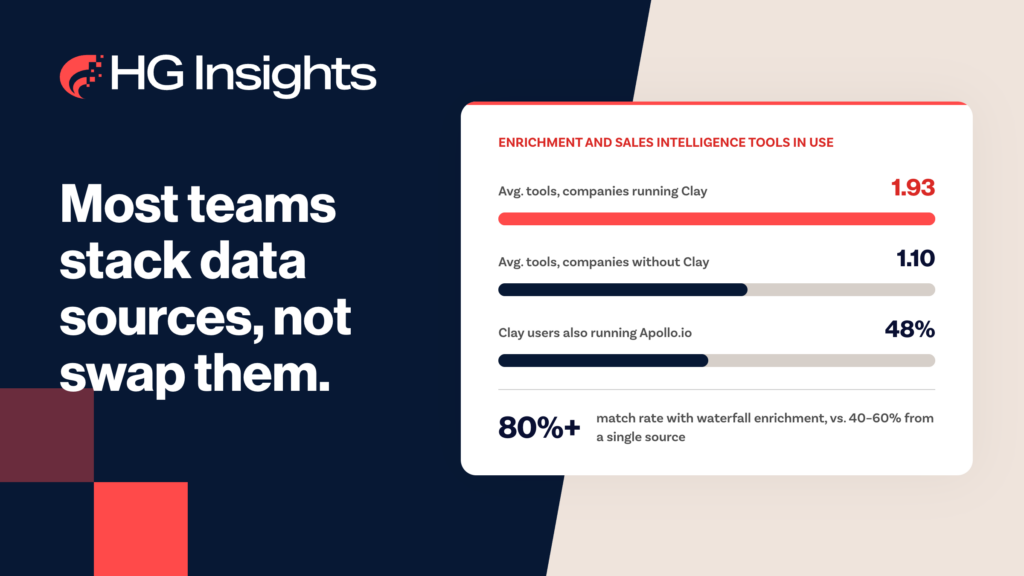
For a Sales Ops Manager, the real evaluation question is whether the data running through Clay is as good as it could be, not whether to replace Clay itself. HG Insights’ own technographic data backs that up: 48% of companies running Clay also have Apollo.io installed at the same time, keeping both rather than picking one. Most teams keep Clay for the workflow and look for a stronger data layer underneath it, which is a different search entirely from looking for an Apollo.io replacement.
Best data enrichment alternatives to Apollo.io for GTM teams
The strongest Apollo.io alternatives for B2B data enrichment split by what a team actually needs: HG Insights for verified technographic depth and IT spend intelligence, ZoomInfo for the largest contact database, and Cognism for phone-verified, compliance-heavy coverage across Europe. Which one fits depends on whether the gap is accuracy, contact volume, or compliance.
HG Insights: technographic depth Apollo can’t match
Apollo’s technographic data comes from a partner integration covering roughly 1,600 topics. HG Insights verifies technology installs across more than 120 million organizations directly, tracking deployment breadth, usage trends, and predictive IT spend, not just whether a tool is present. For a Sales Ops Manager building a scoring model, or a VP RevOps sizing a territory, that’s the difference between knowing a prospect uses a CRM and knowing which CRM, how widely it’s deployed, and when the contract is likely up for renewal. HG Insights isn’t a contact database first; it’s the data layer that makes contact data worth acting on, which is why it functions as the data enrichment answer to Apollo.io rather than a straight seat-for-seat swap.
ZoomInfo: the broadest contact database, at a broader price
ZoomInfo remains the default answer for teams whose main complaint with Apollo is contact volume and phone number accuracy. Its database is larger and more heavily verified, backed by a dedicated research team. The tradeoff is price: ZoomInfo’s entry point sits well above Apollo’s, and growth-segment teams comparing the two often find the jump hard to justify without a corresponding jump in what the data actually does for scoring or targeting. It’s a strong fit for teams whose bottleneck is genuinely “not enough verified phone numbers,” less so for teams whose bottleneck is account-level insight.
Cognism: built for compliance-heavy, Europe-facing pipelines
Teams selling into the EU, or anywhere GDPR and do-not-call compliance carry real legal weight, tend to land on Cognism because it verifies mobile numbers by phone and screens against national do-not-call registries rather than relying on scraped or purchased lists. It’s a narrower fit than Apollo or HG Insights, built for one problem: compliant outreach at scale in regulated markets. Teams outside that specific need rarely pick it as a first alternative.
How Clay and HG Insights work together instead of competing
The Clay and HG Insights partnership, announced in January 2025, is built on a simple division of labor. Clay handles automation, the AI research agents, the waterfalls, the outreach triggers. HG Insights supplies the underlying account intelligence: verified technology installs, predictive IT spend, contract timing, and buyer intent, data that’s harder to source because it comes from job postings, contract filings, and technical documentation rather than a website crawl.
HG Insights and Clay have been public about the thinking behind the deal: even the best orchestration platform is only as good as the data feeding it, and that data still has to be activated through the right automation and workflows to matter. Clay’s Head of Data Partnerships, Stefan Kollenberg, framed it from the other side: growth teams need to scale outreach without losing personalization, and that only works if the data behind it holds up.
In practice, a Sales Ops Manager doesn’t have to choose between Clay’s workflow flexibility and HG Insights’ data depth. Clay users can pull HG Insights data directly into their waterfalls to find companies running specific technology combinations, clean up domain-matching issues, or personalize outreach based on actual tech stack rather than a guess. It’s additive, not a migration. See the full Clay and HG Insights partnership announcement for the integration details, or go straight to the HG Insights data integration inside Clay.
What to evaluate beyond price: accuracy, governance, and match rate
Three factors separate vendors that hold up under scrutiny from those that don’t: whether the data is verified or inferred, whether the vendor can document where it came from, and whether the underlying architecture actually covers enough ground to be useful.
Accuracy: what the vendor verifies versus what it infers
Price comparisons are easy. Accuracy comparisons take more digging, because vendors rarely publish a consistent methodology. Apollo’s contact and technographic data leans on inference and partner feeds. HG Insights verifies technology installs directly against job postings, contracts, and technical documentation. Airbase’s VP of Marketing, Michael Freeman, put it plainly after evaluating six or seven data providers before switching: “When we came to HG, we went, wow! The accuracy. The coverage is great and the accuracy is great.” That gap between claimed and verified accuracy is exactly what a data team should pressure-test before signing anything.
Governance: who’s accountable for where the data came from
This is where Apollo’s biggest gap shows up for CDO and data architecture buyers: limited documentation on data lineage, sourcing methodology, and how records get verified, updated, or retired over time. A data team evaluating governance needs to know where each field came from and whether the vendor can produce an audit trail, not just whether a number looks right. HG Insights documents that provenance at the field level and uses a glass-box scoring approach that shows every input behind a score, so a data team can audit the source and the model instead of trusting either one blindly. For a Sales Ops Manager, that mostly matters once reps start ignoring scores or records they don’t trust.
Match rate: single-source ceilings versus waterfall coverage
A single enrichment source typically tops out around 40 to 60% match rates. Waterfall architectures, which sequence multiple providers so each field pulls from the best available source, push that closer to 80% or higher. This is the actual mechanism behind Clay’s value: it functions as an orchestration layer across many data sources, not a single better one. HG Insights’ technographic data shows this pattern playing out directly: companies running Clay use an average of 1.93 data-enrichment and sales-intelligence tools at once (Apollo.io, ZoomInfo, Cognism, or Clay itself), compared to 1.10 among companies without Clay, 76% more stacking of sources rather than trusting a single one. The same logic applies whether the underlying source is Clay’s 100-plus providers or HG Insights’ own enrichment pipeline feeding Salesforce and HubSpot directly.
Where HG Insights fits as the data layer under Apollo.io, Clay, or your CRM
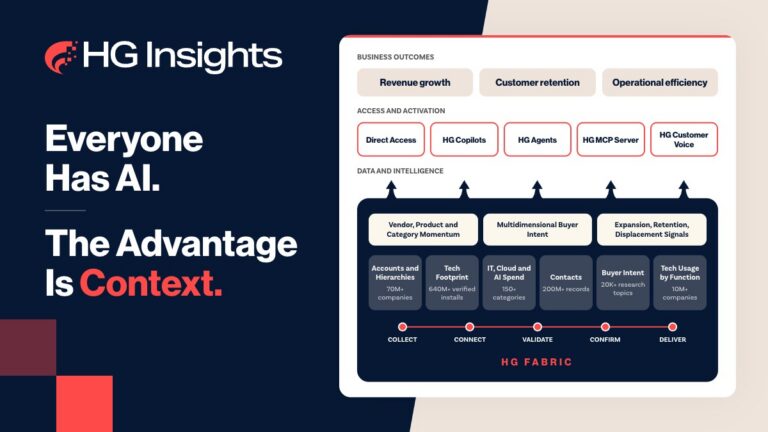
Whatever sits on top, Apollo, Clay, or a homegrown Salesforce workflow, the question underneath is the same: is the account and contact data feeding it actually accurate. HG Insights’ RGI Fabric delivers verified technographic installs across 120-plus million organizations, predictive IT spend, contract timing, and buyer intent through the same waterfall enrichment logic that powers Clay’s integrations, syncing directly into Salesforce, HubSpot, and Snowflake.
For teams that need contact-level data on top of that account intelligence, Smart Contact Enrichment adds verified emails and phone numbers through the same platform, validated in real time so a contact doesn’t go stale the month after it’s enriched, without a separate contact database subscription.
The point here isn’t switching away from Apollo or Clay. Whichever tool handles the workflow, the data underneath it should hold up to more scrutiny than a price tag. See how HG Insights’ Data Enrichment solution fits under your existing stack, or talk to us about pricing built for growth-segment teams rather than enterprise-only contracts.
Frequently Asked Questions
Is Clay a good alternative to Apollo.io?
Clay and Apollo.io solve different problems, so “alternative” is a loose fit here. Apollo bundles a contact database with outreach sequencing. Clay is an orchestration layer that waterfalls more than 100 data providers together. Teams often choose Clay specifically because it isn’t locked into one provider’s data the way Apollo is.
What is the best free alternative to Apollo.io?
Apollo.io’s own free tier is hard to beat on price, since it includes basic contact search and limited email credits at no cost. Free alternatives worth testing include Hunter.io for email verification and Snov.io for lightweight prospecting, though both trade breadth and account-level data for the lower price point.
Why do sales teams outgrow Apollo.io?
Most teams outgrow Apollo.io when they move from contact volume to account precision, needing to know how deeply a prospect has deployed a technology, what they’re likely spending, or when a contract renews. Apollo’s partner-based technographic feed doesn’t capture that depth.
Does HG Insights replace Clay?
No. HG Insights and Clay are official data partners, not competitors. Clay handles workflow automation and outreach orchestration. HG Insights supplies verified technographic, firmographic, and IT spend data that flows through Clay’s waterfall alongside its other provider integrations.
What should I evaluate besides price when comparing data enrichment tools?
Look past the sticker price to three things: how the vendor verifies accuracy versus infers it, whether the scoring or matching logic is documented enough for a data team to audit, and what match rate the platform actually achieves through single-source versus waterfall enrichment.