

Bad data is one of the most underestimated problems in go-to-market execution. It doesn’t appear as a line item on any performance report, yet it erodes pipeline, wastes budget, and misdirects the efforts of every revenue team that touches a CRM record. B2B data enrichment is the discipline of enhancing account and contact records with verified signals, including technographic installs, firmographic updates, IT spend data, and buyer intent, so GTM teams can make better decisions about who to target, when to engage, and how to prioritize.
This guide covers the enrichment fundamentals, data types, cross-functional use cases, common mistakes, and evaluation criteria that revenue leaders need to act on.
Quick Answer: B2B data enrichment is the process of enhancing existing CRM records with additional verified data points, such as technology installs, company firmographics, IT spend levels, and buyer intent signals, to give sales, marketing, and operations teams the context needed to target the right accounts at the right time and improve every downstream GTM motion.
In This Guide:
- The hidden cost of poor GTM data
- What B2B data enrichment is and how it differs from data cleansing
- The four types of enrichment data and what each one does
- How enrichment improves scoring, ABM, inbound routing, territory planning, and competitive displacement
- Common enrichment mistakes and how to avoid them
- What to look for in an enrichment solution
- How HG Insights delivers enrichment built for GTM execution
The hidden cost of poor GTM data is larger than most teams realize
When account records are incomplete or outdated, every downstream function operates on a flawed foundation.
- Campaign targeting hits the wrong accounts.
- Lead routing sends high-value prospects to the wrong reps.
- Territory assignments distribute coverage based on geography rather than actual opportunity.
The compounding effect is severe. Research from Gartner indicates that poor data quality costs organizations an average of $12.9 million per year.
The revenue impact accelerates over time because CRM decay is relentless. People change roles, companies restructure, direct dials go stale, and email addresses bounce, all while the CRM continues to display a full-looking database that obscures how much of it is no longer usable.
In high-turnover sectors like SaaS and technology, the degradation is even faster, which means the gap between what your CRM shows and what’s actually true widens with every quarter you go without refreshing records.
This isn’t a data team problem. It’s a GTM problem. Every campaign, every scoring model, and every territory plan that relies on unenriched records is making decisions with degraded information. The teams running those motions rarely know it until performance metrics start slipping.
What B2B data enrichment actually means
B2B data enrichment is the process of enhancing existing account and contact records in your CRM or GTM systems with additional verified data points from external sources. These data points typically include technographic installs, firmographic attributes, IT spend intelligence, contract timing, and buyer intent signals. The goal isn’t to add more fields for the sake of completeness. It’s to give revenue teams the context they need to prioritize, personalize, and act with confidence across every GTM motion.
The distinction between enrichment and data cleansing matters. Cleansing removes inaccurate, duplicate, or malformed records. Enrichment adds what was never there or has since changed. Most effective data quality programs run both processes together; cleansing without enrichment still leaves teams working with incomplete records, and enrichment without cleansing layers new data onto a corrupted foundation.
Data enrichment vs data cleansing
| Dimension | Data cleansing | Data enrichment |
|---|---|---|
| Core function | Removes inaccurate, duplicate, or malformed records | Adds verified data that was never there or has since changed |
| Problem it solves | Corrupted or messy existing fields | Incomplete or outdated account context |
| Typical actions | Deduping records, fixing malformed entries | Appending technographic installs, IT spend, and intent signals |
| Gap when run alone | Still leaves teams working with incomplete records | Layers new data onto a corrupted foundation |
| Best practice | Run both together as one data quality program | Run both together as one data quality program |
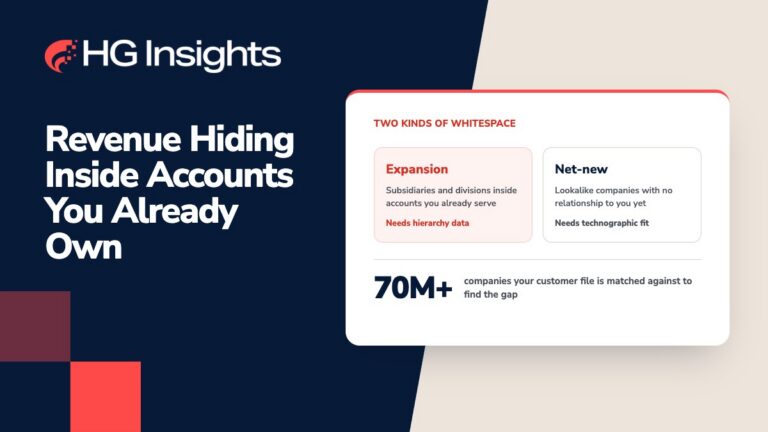
What separates meaningful enrichment from shallow record-filling is signal depth and refresh frequency. A platform that appends broad firmographic data once at onboarding delivers diminishing returns as market conditions shift. Continuous enrichment, where records are refreshed on a rolling cadence and validated against multiple sources, is what keeps GTM execution aligned with reality. HG Insights, for example, sources its technology install data from over 20 billion external data points across 120+ million organizations, with records refreshing on daily partial and monthly full sync cycles to keep every account current.
The four types of enrichment data and what each one does
Different data types reveal different dimensions of an account. Understanding what each one contributes helps your team evaluate where enrichment will produce the most immediate impact.
Technographic data reveals the technology environment inside each account
Technographic data, the record of which technologies an account currently uses, is one of the most actionable enrichment layers available. It reveals the tools and platforms running inside a target account, which enables sales teams to assess solution fit, identify competitive displacement opportunities, and tailor conversations around the buyer’s existing environment.
An account running a direct competitor’s product is a fundamentally different sales conversation than one with no comparable technology in place. That distinction shapes everything from messaging strategy to deal timeline, and it’s invisible without technographic enrichment.
Firmographic data keeps the foundational account profile current
Firmographic enrichment maintains company-level attributes; industry classification, employee count, revenue, headquarters location, and organizational structure. These attributes form the foundation of ICP matching, territory design, and account segmentation. When firmographic fields are incomplete or outdated, every filter and model built on top of them inherits that inaccuracy.
Firmographic data doesn’t change as rapidly as technographic or intent data, but it does change. Acquisitions, restructurings, revenue growth, and headcount shifts all alter the profile your team is working against. Periodic firmographic refresh ensures that segmentation and routing rules reflect the company as it exists today rather than when the record was created.
IT spend data confirms whether an account has the budget to buy
IT spend intelligence signals budget capacity and investment priorities at the account level. It answers a question that firmographics alone cannot; does this company have the financial commitment and investment trajectory to justify pursuing it?
Spend data separates accounts that look like a fit on paper from those with the financial capacity and technology investment posture to actually convert. Two companies with identical firmographic profiles can have radically different spending patterns in your category, and that difference determines whether engaging them is a productive use of your team’s time.
Intent data shows which accounts are actively researching your category right now
Intent data adds the behavioral layer by identifying which accounts are actively researching solutions in your category. When combined with fit signals like technographics and spend, intent data enables teams to act on timing and relevance simultaneously, engaging accounts that are both a strong match and demonstrably in-market.
Teams that use both fit and intent signals together build pipeline from accounts more likely to convert on shorter timelines. Intent without fit produces noise. Fit without intent produces a static list. The combination of both is where the highest-probability pipeline lives.
Enrichment raises the floor on every GTM function that depends on account data
Enrichment doesn’t improve just one motion. It strengthens every GTM function that depends on account records. Four applications consistently deliver the most measurable impact.
Scoring models become predictive rather than reactive
Account scoring models that rely only on behavioral signals like form fills or email clicks lack the fit context that separates genuinely high-potential accounts from those that just happen to be active. Enriching accounts with technographic and spend signals gives scoring models the substance to surface opportunities most likely to close, not just the most recently engaged.
Teams that build smarter scoring models with enriched account data typically see reps working shorter lists with higher strike rates, without adding headcount. The improvement comes from the model having enough context to distinguish between activity and genuine opportunity.
One enterprise team that combined HG Insights technographic install data with contract timing signals achieved a 3x improvement in target account accuracy, a 40% reduction in wasted outreach, and $2.3M in new pipeline from HG-sourced accounts in a single quarter.
ABM account lists reflect real conversion potential instead of broad filters
ABM programs built on unenriched lists target accounts based on broad filters like industry and revenue band. Those lists look right during planning but perform poorly because they lack real ICP fit signals. Enriched account data grounds ABM selection in technology environment, spend level, and competitive context, so campaigns reach accounts with genuine conversion potential rather than surface-level resemblance to your ideal buyer.
Teams that improve ABM account selection with enriched GTM data run tighter programs where marketing and sales align around shared criteria that reflect what’s actually happening at each account.
Inbound leads get qualified and routed in seconds rather than hours
Enriching inbound leads at the point of conversion gives sales teams immediate visibility into account fit before any manual research or discovery conversation. Routing logic powered by enriched data ensures high-fit leads reach the right rep immediately, reducing response time and preventing buyer intent from decaying while leads sit in a queue.
Teams that enrich and route inbound leads based on real fit signals compress the window between interest and informed engagement to minutes. That speed advantage translates directly into higher early-stage conversion rates.
Territory assignments reflect actual opportunity rather than geography
Territories designed without enriched data distribute coverage based on geography or headcount rather than actual pipeline potential. Enrichment enables territory assignments that reflect technology fit, spend capacity, and account density, so reps work where the highest-quality opportunity actually exists.
Teams that design territories around enriched account opportunity see quota attainment flatten across the team because every rep’s book of business reflects current market conditions rather than inherited assignments.
Competitive displacement gets sharper when powered by enriched install data
Competitor technology install data is one of the most directly actionable enrichment signals a sales team can access. It identifies exactly which accounts are running an alternative solution, which products are deployed, and in many cases when contracts are approaching renewal.
Sales teams that enter displacement conversations with this context close more competitive deals because they can tailor the narrative to the specific situation of each account. Instead of leading with generic positioning, a rep can speak directly to the limitations of a specific competitor’s product, the integration challenges the account likely faces, and the timing window where switching costs are lowest.
Teams that use enriched install data to drive competitive displacement move from opportunistic competitive selling to systematic displacement where every outreach is informed by verified competitive context. Pairing install data with intent signals makes the motion even more precise; an account running a competitor that is also actively researching alternatives represents a displacement opportunity with both context and urgency.
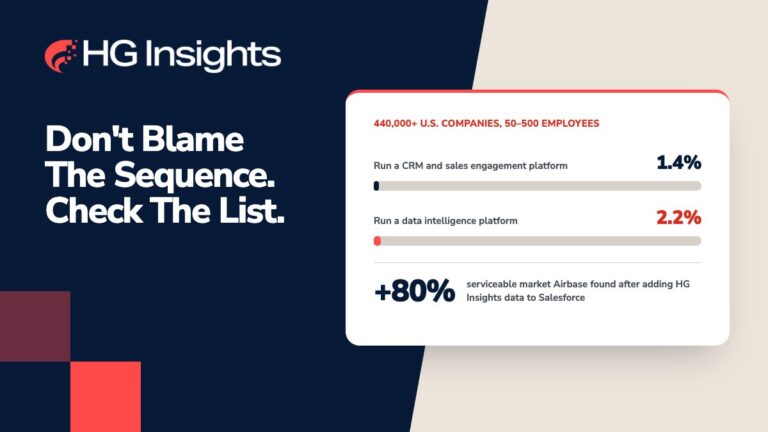
Airbase, a spend management platform, used HG Insights install data to identify accounts running competitor software — and their identified addressable market in Salesforce grew 80% overnight. Competitive displacement campaigns powered by that data delivered a 40% lift over historical baseline performance.
High-intent accounts surface faster when enrichment provides the fit context
Enrichment creates the account profile. Intent data identifies which of those enriched accounts are in an active buying cycle right now. Either signal alone produces an incomplete picture.
Teams that find high-intent accounts with enriched intelligence build pipeline from accounts that are both a strong fit and demonstrably ready to engage, which compresses sales cycles and improves win rates. The combination of enriched fit data and active intent signals consistently outperforms targeting based on either dimension alone.
Three enrichment mistakes prevent teams from realizing the full impact
Treating enrichment as a one-time event. Enriching data at onboarding and never refreshing it creates a false sense of quality while CRM decay quietly undermines every decision built on those records. Contact data starts degrading the moment it’s entered, and a database enriched in January is materially less accurate by June. Continuous enrichment is the only approach that keeps records aligned with market reality.
Keeping enrichment siloed in the data team rather than treating it as a GTM strategy. When enrichment lives in an operations silo, the intelligence it produces rarely reaches the teams who need to act on it daily. Sales reps keep doing manual research. Marketing keeps targeting broad segments. The enriched data exists, but it never enters the daily workflow where it would make a difference.
Relying on a single data source. No individual provider offers complete, accurate coverage across every geography, industry, and account type. Teams that depend on one source cap their coverage and accept whatever gaps that provider carries. Multi-source or waterfall enrichment approaches, where records are validated across several providers in sequence, consistently deliver higher match rates and better accuracy.
What to look for in a B2B data enrichment solution
Four criteria separate solutions that will improve GTM execution from those that will just add fields to your CRM:
- Signal depth. The platform should provide deep technographic, firmographic, spend, and intent data that supports real GTM use cases, not just basic company attributes.
- Refresh frequency. Continuous or near-continuous refresh cycles are the standard for fast-changing signals like installs and intent. Platforms that update quarterly or less frequently deliver diminishing returns as accounts and markets shift.
- Native CRM and workflow integration. Enrichment that lives outside your daily workflow rarely gets used consistently. The data needs to flow directly into the systems where reps prospect, marketers build campaigns, and ops teams design scoring models and routing rules.
- Multi-use-case coverage. A single enrichment layer should support scoring, ABM, inbound routing, territory planning, competitive displacement, and campaign targeting rather than requiring separate tools for each motion.
HG Insights is built for smarter GTM data enrichment
HG Insights enriches accounts with technographic installs, IT spend intelligence, buyer intent signals, and firmographic data so every record reflects a complete and continuously updated picture of each account. The platform integrates natively with leading CRMs and GTM systems, with data automatically synchronized and mapped to existing fields and workflows.
From inbound qualification to ABM execution, territory planning, and competitive displacement, HG Insights gives revenue teams the enriched data foundation that makes every GTM motion more precise and more predictable.
For teams evaluating how AI agents and automated workflows will depend on enrichment infrastructure, HG Insights also supports GTM infrastructure for AI agents, ensuring that enriched data feeds both human-led and AI-driven execution from the same trusted foundation.
Build a smarter GTM data foundation. Explore the Revenue Growth Intelligence Platform.
Frequently Asked Questions
What is B2B data enrichment and why does it matter for GTM teams?
B2B data enrichment is the process of enhancing existing CRM records with verified external data, including technographic installs, firmographic details, IT spend, and buyer intent signals. It matters because every GTM function, from scoring and routing to ABM and territory design, depends on accurate, complete account data to deliver results. Without enrichment, teams make decisions with degraded information that silently erodes pipeline quality and conversion rates.
How fast does B2B data decay in a typical CRM?
B2B contact data degrades steadily as people change roles, companies restructure, and technology environments shift. In high-turnover industries like SaaS and technology, the decay is especially aggressive. Without continuous enrichment, a significant portion of your CRM records can become outdated within a single year, which makes ongoing refresh cycles a necessity rather than a periodic maintenance task.
What is the difference between data enrichment and data cleansing?
Data cleansing removes inaccurate, duplicate, or malformed records from a database. Data enrichment adds new, verified information from external sources to make existing records more complete and actionable. Most effective programs run both processes together; cleansing alone still leaves incomplete records, and enrichment without cleansing layers new data onto a corrupted foundation.
How does data enrichment improve account scoring and lead routing?
Enrichment adds fit signals like technology installs, spend capacity, and firmographic attributes to scoring models, which helps surface accounts most likely to convert rather than just the most recently engaged. For routing, enriched data enables automatic assignment of high-fit leads to the right rep based on verified account characteristics, reducing response time and improving early-stage conversion rates.
What should I look for when evaluating a B2B data enrichment provider?
Prioritize signal depth, refresh frequency, and native CRM integration. Look for providers that offer deep technographic, firmographic, spend, and intent data with continuous updates. Avoid platforms that require manual exports or periodic batch uploads, as enrichment that lives outside daily workflows rarely gets adopted consistently. Multi-use-case coverage, supporting scoring, ABM, territory planning, and competitive displacement from a single layer, prevents the fragmentation that multiple point solutions create.