

Most B2B competitive strategies are built on a reasonable assumption: if you track what your competitors are doing closely enough, you’ll be ready when the market moves. The problem is that the most consequential competitive shifts don’t originate with your competitors. They originate with your buyers.
Budgets get redirected, technology priorities change, and entire segments begin gravitating toward a different category of solution. Your competitors are responding to the same forces you are. Your team gains an edge not by watching competitors more closely, but by reading the market signals both sides are racing to act on first.
That’s where market-level intelligence changes the game. When your team can see how install bases are shifting, where technology budgets are moving, and which segments are showing new patterns of buyer intent, you stop reacting to competitive shifts after they’ve hit your pipeline and start positioning ahead of them.
Market-level intelligence shows you the landscape, not just the players
Before getting into specific signals, it helps to clarify what market-level intelligence actually means in this context, because it’s broader than what most teams associate with competitive intelligence.
- Traditional competitive intelligence is account-focused or competitor-focused. It tracks what a specific rival is doing or how a particular deal was won or lost.
- Market-level intelligence pulls the lens back further. It combines install-base data, technology spend trends, and buyer intent signals to reveal how entire categories, regions, and segments are shifting over time.
This wider view is what makes it valuable for anticipating competitive change. A single account replacing a competitor’s product is a data point. A pattern of displacement across a vertical or geography is a market signal. A surge in buyer intent around an emerging technology category that overlaps with your competitor’s core offering is an early warning. These are the patterns that tell you where competitive dynamics are headed, not just where they are today.
When your team operates with this kind of visibility, competitive strategy becomes proactive rather than reactive. You’re not responding to shifts after they’ve impacted your numbers. You’re seeing them form and adjusting your positioning, your targeting, and your resource allocation while there’s still time to act.
Three categories of signals tell you where competitive dynamics are changing
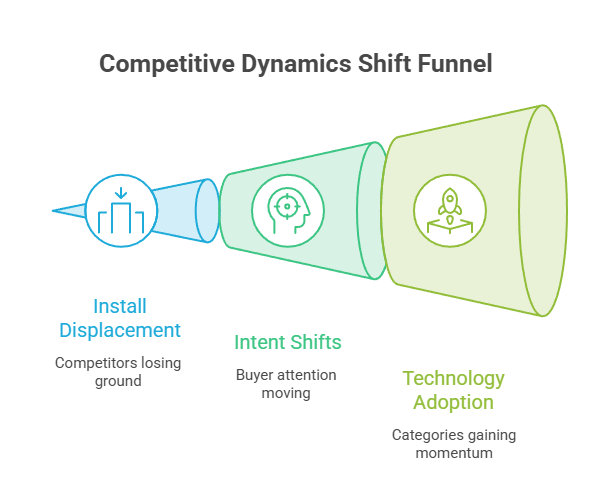
Not every data point qualifies as a competitive shift indicator. The signals that matter most are the ones that reveal structural changes in how the market is behaving, not just temporary fluctuations. Three categories consistently provide the earliest and most actionable view.
Install displacement trends show you where competitors are losing ground
Install-base data is one of the most direct indicators of competitive movement. When accounts begin replacing or phasing out a competitor’s technology, that displacement pattern tells you something that no product announcement or analyst report can: buyers are actively moving away from that solution.
Tracking competitive displacement with install data allows your team to identify where these transitions are happening at scale. You can see which competitor technologies are being removed, which segments and regions are leading the shift, and which replacement solutions are gaining traction.
What makes that visibility actionable is how HG classifies each install. Rather than logging a technology as simply present or absent, HG tracks install status: current means the technology is confirmed active at that account today, historical means the account recently stopped using it, and inferred means likely adoption based on compatible signals in the surrounding stack. Most technographic providers detect installs but don’t classify them by lifecycle status. That gap matters. A rep treating a historical install as a current one walks into the wrong conversation; and probably loses the deal for it.
For your GTM strategy, displacement trends open two distinct opportunities:
- Offensive positioning. When a competitor’s install base is eroding in a segment, you can create displacement messaging that speaks directly to the pain points driving the transition and prioritize outreach to accounts in active replacement cycles.
- Defensive awareness. If displacement trends show accounts moving away from a technology category you also compete in, that’s an early signal to evaluate whether the same pressure could affect your own installed base.
Teams that monitor displacement patterns consistently show up in competitive deals before the RFP is written.
Intent and engagement shifts across segments reveal where buyer attention is moving
Buyer intent data at the account level tells you which companies are researching your category right now. At the market level, intent patterns reveal something more strategic: where buyer attention is concentrating, where it’s thinning, and where it’s shifting toward new solution categories or vendor alternatives.
Prioritizing competitive signals with buyer intent allows your team to monitor these shifts across segments and regions. When intent activity surges in a vertical where your competitor has historically been strong, that’s a signal that accounts in that segment are actively evaluating alternatives. When intent in your own category declines in a region while rising in an adjacent category, that tells you the competitive battlefield may be moving.
These patterns help you make better decisions about where to concentrate campaign investment, where to adjust messaging, and where to deploy sales resources. Aligning your outreach to segments showing elevated engagement activity means you’re meeting buyer interest where it’s already building rather than pushing into segments where attention has moved on.
Technology adoption and spend changes signal where categories are gaining or losing momentum
Install displacement tells you what’s being replaced. Intent tells you who’s researching. Technology adoption and spend trends tell you where the money is moving at the category level, which is often the earliest signal of all.
When an emerging technology begins gaining adoption across a vertical while spending on an older solution category declines, that’s a structural shift in competitive dynamics. It may take quarters for that shift to show up in individual deal outcomes, but the pattern is already visible in how organizations are allocating their budgets.
Uncovering adoption trends using spend intelligence gives your team the ability to detect these category-level movements and layer them over specific verticals or geographies to refine your strategic planning. You can see where new technologies are gaining budget share, where legacy categories are contracting, and where spending patterns suggest a market is approaching a tipping point.
The data behind that capability is specific to HG. The RGI Fabric maps 25,000+ products and 11,000+ vendors across 240 million+ verified technology installs, refreshed continuously. That install foundation connects directly to HG’s IT spend intelligence; so your team isn’t estimating budget allocation from job postings or press releases. You can see where an organization is actively spending and how that allocation is shifting, at the account and segment level, from verified data. That combination of install depth and spend visibility is what separates category-level trend detection from category-level guesswork.
For competitive strategy, this intelligence is particularly valuable because it operates on a longer time horizon than intent or displacement data. Spend trends don’t just tell you what’s happening now. They show you the trajectory that’s likely to shape competitive dynamics over the coming quarters, giving you time to adjust positioning, product strategy, and resource allocation before the shift reaches full momentum.
Three market-level signals for anticipating competitive shifts
| Signal category | What it reveals | Time horizon |
|---|---|---|
| Install displacement trends | Where competitors are losing ground as accounts replace their technology | Near-term, transitions happening now |
| Intent and engagement shifts | Where buyer attention is concentrating, thinning, or moving to new categories | Near-term, active evaluation |
| Technology adoption and spend changes | Where category budgets are growing or contracting | Longer-term, quarters ahead |
Market intelligence changes how you approach competitive strategy
Having visibility into these signals is valuable. Knowing how to apply them across your GTM strategy is what turns intelligence into advantage.
The most immediate application is competitive targeting. When displacement trends, intent surges, and spend shifts all point to a competitor losing ground in a specific segment, that convergence of signals gives your team a high-confidence opportunity to pursue. You can build targeted outreach around the specific transition those accounts are going through, with messaging that addresses why they’re moving and positioning that speaks to what they need next.
The question most RevOps and sales teams ask at this point is whether they can trust the signals. It’s a fair question. Intent data platforms built on black-box scoring have produced real adoption problems: reps stop acting on prioritized lists when they can’t explain why a particular account ranked where it did. HG’s account scoring is transparent and auditable: each score reflects visible inputs your team can inspect, adjust, and connect to your actual sales motion. When a rep asks why a specific account is showing up as high-priority, there’s an explanation. That’s the difference between intelligence your team uses and intelligence that sits in a dashboard.
But market-level intelligence also informs less obvious competitive decisions.
It tells you when to update your product positioning because the technologies your buyers are comparing and the alternatives they’re considering have shifted.
It tells you when to refresh your sales plays because the competitive alternatives your reps are selling against have shifted.
It tells you when to hold your ground rather than chase a category trend that looks promising on the surface but doesn’t have the spend momentum to sustain growth.
The most effective competitive strategies aren’t built on reacting to what competitors announce. They’re built on reading the market signals that tell you where buyers are moving and why, then aligning your GTM execution to meet that movement with precision.
Competitive intelligence strengthens your highest-impact GTM motions
The applications for market-level competitive intelligence extend across the GTM functions where timing and targeting have the most direct impact on revenue.
Your market sizing and whitespace analysis get more accurate when you factor in competitive saturation. A segment that looks attractive based on TAM alone may be less appealing when install-base data shows that a well-entrenched competitor holds dominant share with low displacement activity. Conversely, a segment with moderate TAM but active displacement trends and rising intent may represent a higher-return opportunity.
Your territory design improves when you factor competitive dynamics into coverage models. Assigning reps to territories where competitive conditions favor your solution, where displacement is active, spend is shifting in your direction, and intent is building, gives them a stronger foundation for pipeline creation than territories drawn on geography alone.
Your ABM targeting performs better when account lists reflect current competitive signals rather than static firmographic profiles. Improving account focus with competitive market data allows your campaigns to reach accounts at the moment when competitive conditions make them most receptive to an alternative, which is a fundamentally different approach than targeting accounts simply because they match a profile.
When competitive intelligence is embedded across these motions, your GTM strategy becomes responsive to market conditions rather than anchored to assumptions about competitive positioning that may no longer hold.
For teams building AI-driven GTM workflows, HG Insights connects via MCP (Model Context Protocol), letting competitive signals — install status, spend movements, and buyer intent, flow directly into the agents and copilots your team already uses. No separate platform login, no manual export. Most major intelligence platforms have MCP connectivity now or will by late 2026. The differentiator is the data behind the connection. HG’s install classification, spend intelligence, and contract signal depth are what determine whether the intelligence those agents surface is worth acting on.
HG Insights helps your team see competitive shifts before they reach your pipeline
The RGI Platform is built on the RGI Fabric: 25,000+ products, 11,000+ vendors, and 240 million+ verified technology installs, classified by current, historical, and inferred status and refreshed continuously. IT spend intelligence and buyer intent signals layer on top of that install foundation, giving your GTM team a view of competitive dynamics that runs from category-level budget movements down to the specific account and technology. That depth is what makes it possible to detect shifts before they register in your pipeline numbers; not after.
HG Insights helps your revenue teams track displacement trends, monitor segment-level intent, and read spend-based competitive movements from one platform; with scoring your team can inspect, not just act on.
See how the RGI Platform tracks install displacement, spend shifts, and buyer intent signals across 25,000+ products: before competitive changes reach your pipeline. Schedule a demo with HG Insights.