

Market intelligence used to be a quarterly research exercise. Today it runs in the background of every GTM decision your team makes. The B2B companies pulling ahead right now aren’t the ones with the most data. They’re the ones acting on the right signals first.
Most GTM leaders already sense the shift. The harder question is what to do about it, specifically which capabilities a modern intelligence platform actually needs to move the needle on pipeline.
This guide breaks down what separates a best-in-class market intelligence platform from a generic data source, and how leading teams use one to win on competitive displacement, account scoring, signal-based selling, whitespace, and ABM.
In This Guide:
- Why standard data tools no longer meet GTM requirements
- What defines a best-in-class market intelligence platform
- How leading teams use intelligence for competitive displacement, market sizing, signal-based selling, account scoring, data enrichment, territory optimization, and ABM
- How HG Insights enables competitive outperformance
Your CRM tells you what happened; a market intelligence platform tells you what to do next
Your CRM tells you what your team has done. A firmographic list tells you what companies exist. Neither tells you what to do on Monday morning.
When a competitor is already three touches deep with an account that just renewed under your nose, the cost of static data is measured in lost deals, not stale records. Closing the gap between having data and acting on intelligence is now the baseline for any B2B competitive intelligence strategy. Teams that still rely on generic CRM data and basic firmographics to guide targeting are giving their competitors a head start on every account in the pipeline.
Depth, freshness, and integration separate a platform from a data list with a login
The best market intelligence tools combine technographic installs, IT spend data, contract intelligence, and buyer intent into a single view of each account, and they keep that view current. That combination is what turns a data source into a decision-making layer. HG Insights, for example, tracks technology install and spend signals across more than 100 million companies. It’s a scale that makes the difference between a data list and a live picture of the market. A platform with one signal type, no matter how accurate, still leaves your team guessing on the dimensions it doesn’t cover.
Integration is the other dividing line. If your analysts have to pull data manually and email it to reps, the half-life of that intelligence is about six hours. The platforms that produce measurable GTM impact are the ones that push signals directly into the CRM, sales engagement tools, and marketing automation platforms where your team already works.
For a deeper look at how market analysis connects intelligence to GTM execution, the distinction between platforms that inform and platforms that activate becomes clear.
Competitive displacement works when you know who runs what and when they’re evaluable
Displacement fails when teams can’t answer two questions: which accounts run a competitor’s product, and when those accounts are actually open to switching. Install data answers the first. Contract timing answers the second.
An account with 18 months left on a deal is a very different target than one 60 days from renewal, even though a list-based tool would treat them identically. With both signals working together, reps can build a competitive displacement strategy backed by real install data and enter conversations with genuine timing advantage.
Displacement plays built this way also tend to close faster because reps stop burning cycles on accounts that are locked in for years. The outreach reaches accounts during a window where changing vendors is a realistic conversation, not a theoretical one.
Most teams overestimate their coverage of best-fit segments until whitespace analysis proves otherwise
Most sales leaders believe their team covers the best-fit segment well. Most whitespace analyses prove otherwise.
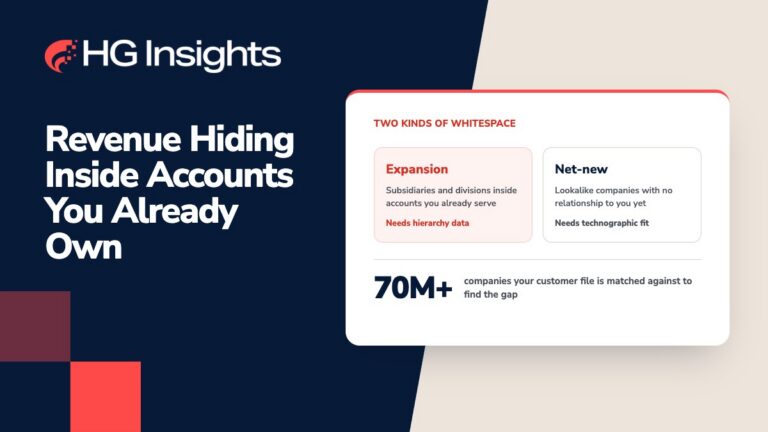
ICP-aligned accounts tend to cluster in familiar verticals, while adjacent segments with strong technographic fit sit untouched for quarters. Pairing market sizing with install data lets you map whitespace across your total addressable market and often reveals that next quarter’s pipeline doesn’t require a new segment. It requires finishing the one you’re already in. HG Insights maps spend signals across more than 140 IT product categories, which is what gives that whitespace analysis the specificity to actually redirect resources rather than just confirm assumptions.
That insight alone can redirect resources away from speculative expansion and toward high-confidence growth within segments where your team already has competitive positioning and proof points.
Intent data without context is noise; intent data with context is a priority list
Intent data on its own is noisy. Every vendor has a story about the prospect who researched their category for six weeks and bought from the other guy.
The fix is context. The best platforms layer buyer intent on top of technographics, firmographics, and spend, so a research spike gets interpreted against what an account already owns, what they’re spending, and whether they fit your ICP. That interpretation is what transforms a raw signal into an actionable priority.
Reps who prioritize accounts based on real buying signals consistently outperform peers working from cold lists because they engage accounts where fit and timing converge rather than treating every account with recent activity as equally worth pursuing.
Account scoring becomes a shared language when it’s built on signals that predict conversion
Scoring models fail when they’re built from whatever data happens to be in the CRM. They succeed when they’re built from fit data that predicts conversion, specifically install data, spend signals, and firmographic alignment.
Done well, an account scoring framework becomes a shared language between sales and marketing. Both teams work from the same prioritized list, which is most of the battle in B2B revenue alignment.
The quieter benefit is consistency. When sales ops tunes the model and marketing pulls from it, prioritization stops being a debate and starts being a workflow. Every rep works the same shortlist. Every campaign measures against the same criteria. The arguments about whose accounts are better go away because the data settled the question.
A CRM enriched once is a CRM that’s already going stale
CRM data decays significantly every year. A CRM enriched once at onboarding is meaningfully stale inside 12 months, and reps feel it in every outreach cycle. A rep emailing a former buyer at a former company isn’t running an outreach sequence; they’re running a margin drain.
A strong B2B data enrichment platform pushes fresh firmographic, technographic, and intent data into the CRM continuously, not as a one-time cleanup. Teams that enrich their CRM with accurate, up-to-date GTM data often see response rates climb before any new campaigns launch, because the existing outreach suddenly reaches the right people with current context.
Territory models built on geography alone don’t survive contact with modern B2B buying
Geography-only territories were a reasonable compromise before digital selling existed. They don’t survive contact with modern B2B buying behavior, where accounts in the same zip code can have completely different technology environments, spending patterns, and competitive contexts.
Intelligence-driven territory design uses account density, install data, and opportunity scoring to balance workload against real revenue potential. When you design territories based on where your best opportunities actually are, quota attainment across the team tightens and bottom-tier turnover tends to drop, because every rep has a book of business that gives them a realistic path to their number.
ABM programs live or die on target list quality, and intelligence is what makes the list right
A great creative strategy aimed at the wrong 400 accounts is a beautifully produced miss. ABM programs live or die on whether the accounts receiving that investment are actually worth it.
Platforms that connect intent, fit, and competitive context let ABM teams move past static tiering. Campaigns shift as signals shift. Teams that optimize their ABM program with account-level intelligence see engagement, meeting conversion, and opportunity velocity all improve because they’re finally concentrating spend where spending actually works.
The difference is usually seen on the pipeline report within a quarter or two, not a year, which makes the ROI case for intelligence-driven ABM significantly easier to defend.
HG Insights brings the full picture together in one platform
The four signals behind account outperformance
| Signal | What it reveals about an account | The GTM question it answers |
|---|---|---|
| Technographic installs | What the account runs, and whether the stack aligns with your solution | Does this account fit? |
| IT spend | Whether budget is moving in your category | Can they buy? |
| Contract intelligence | How close an account is to a renewal or switch window | When should we engage? |
| Buyer intent | What the account is actively researching | What should we say? |
Most platforms claim to cover everything and do one thing well. HG Insights brings together technographic installs, IT spend data, buyer intent, and contract intelligence inside a single Revenue Growth Intelligence platform, so your team sees the full picture of an account instead of four partial ones.
That context is what makes outperformance possible:
- Knowing the tech stack tells you if an account fits
- Knowing spend tells you if they can buy
- Knowing contract timing tells you when to engage
- Knowing intent tells you what to say
No single data source gives you all four. Stitching them together from point solutions is possible but expensive, and the signal decays in the handoffs between systems. A unified platform keeps the picture whole.
See what focused market intelligence looks like in practice. Explore the Market Analyzer to see how HG Insights helps GTM teams target the right accounts and move ahead of the competition.
Frequently Asked Questions
What is a market intelligence platform and how is it different from a CRM or data provider?
A market intelligence platform combines technographic, spend, intent, and contract data into a continuously updated view of accounts, then pushes that intelligence into the tools GTM teams already use. A CRM records what your team has done. A data provider hands you a list. A platform goes further by telling you what’s happening inside an account right now, which is the context action actually requires.
How do market intelligence platforms help B2B teams with competitive displacement?
Displacement requires knowing which accounts run a competitor’s product and when those accounts are evaluable. Technographic install data answers the first. Contract intelligence answers the second. With both, sales teams focus outreach on accounts inside their renewal window instead of broadcasting to an entire competitor install base, which lifts conversion and cuts wasted effort.
What types of data should a strong market intelligence platform include?
At minimum, a strong platform covers firmographics, technographic installs, IT spend data, buyer intent, and contract intelligence. Firmographics and installs show fit. Spend shows ability to buy. Intent shows in-market activity. Contract timing shows when to engage. Gaps in any of these force reps to guess, and guessing is where pipeline productivity dies.
How does market intelligence improve ABM performance?
ABM programs are only as strong as their target lists. Market intelligence sharpens the list by combining fit, intent, and competitive signals into a scoring model that prioritizes accounts worth real investment. It also keeps the list dynamic as signals shift, so marketing stops spending on cold accounts and sales stops chasing mismatched opportunities.
How often should market intelligence data be refreshed to stay competitive?
Continuously. Technographic changes, contract events, and intent spikes happen daily, so quarterly refreshes are no longer competitive. The best platforms update on ongoing schedules and push changes into the CRM and ABM stack as they happen. Teams relying on annual data drops are effectively making decisions on outdated snapshots.