

A B2B data enrichment strategy built on batch uploads and quarterly cleanup cycles can’t support the speed at which modern GTM teams need to operate. Markets shift between refresh cycles. Buying signals emerge daily. And AI systems now influence scoring, lead routing, and outreach decisions as they happen, not after a scheduled data update.
Manual enrichment simply can’t keep pace. The emergence of AI changes what’s possible by enabling continuous signal collection, reconciliation, and activation across thousands of accounts at a scale no human workflow can match.
In This Guide:
- Why traditional enrichment strategies fail at scale
- What an AI-ready enrichment foundation requires
- How to establish the right data foundation before automating
- GTM use cases that benefit from AI-powered enrichment: account scoring, ABM, inbound routing, high-intent detection, AI sales plays, and territory optimization
- Common mistakes when scaling enrichment with AI
- What to evaluate in a platform built for AI-driven enrichment
Why traditional enrichment strategies break down as you scale
Batch enrichment creates a structural lag between what your team knows about an account and what’s actually true in the market right now. When account volumes are small, that lag is manageable. As your target universe grows, it compounds across every downstream system: scoring becomes less accurate, segmentation drifts, and routing decisions reflect conditions that no longer exist.
The problem intensifies when AI enters the picture. AI systems don’t just use your data. They amplify it. When enrichment is current, AI models make better scoring decisions, suggest more relevant plays, and adjust prioritization based on real signals. When enrichment is stale, those same models amplify outdated signals, automate flawed assumptions, and execute plays against accounts that have already moved on.
The drag this creates is measurable: 21% of sales rep time is still spent researching incomplete data, and 78% of marketers rely on up to 12 separate data sources to build a complete customer view.
Scalable data enrichment for GTM requires real-time awareness, not periodic appends. The shift from batch to continuous enrichment isn’t a nice-to-have for teams adopting AI. It’s a prerequisite.
An AI-ready enrichment strategy is about building infrastructure, not adding fields
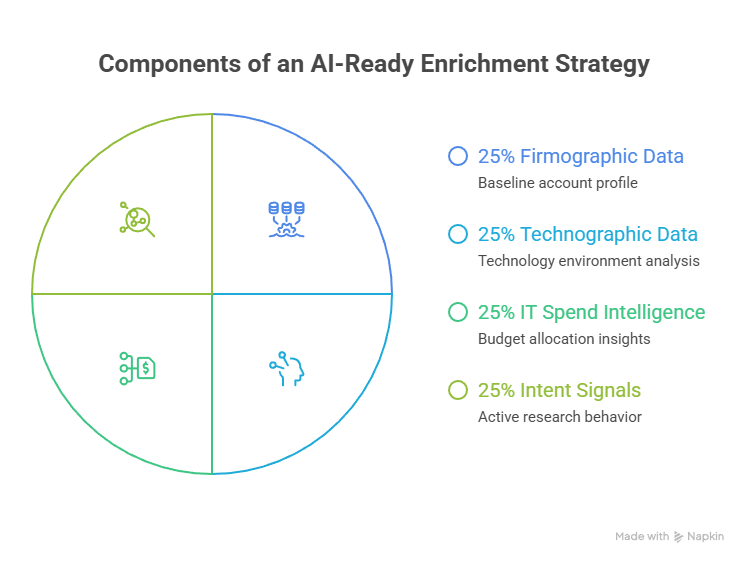
An AI-ready approach to enrichment goes well beyond appending more data points to CRM records. It establishes a signal-rich data layer that AI models and agents can interpret, act on, and learn from reliably.
That layer requires four categories of structured data, all refreshed continuously and connected to the systems where GTM execution happens:
- Firmographic data provides the baseline account profile: industry, revenue, headcount, geography.
- Technographic data reveals the technology environment: what’s installed, where the stack is maturing, and where gaps or transition points exist.
- IT spend intelligence shows where budget is flowing at the category level, confirming financial commitment.
- Intent signals surface active research behavior that indicates an account is moving toward a purchasing decision.
HG Insights tracks verified technology installs across 120+ million organizations, drawing from over 20 billion external data points, giving AI systems the signal depth they need to make reliable prioritization decisions at scale.
When these signals live inside your CRM, data warehouse, and sales tools rather than in a separate platform your team has to consult manually, enrichment becomes operational infrastructure. AI models can then prioritize accounts, suggest next-best actions, and adjust territory coverage based on intelligence that reflects current market conditions.
This is the foundational shift that defines how AI GTM data infrastructure is structured. Models are only as reliable as the data underneath them.
Audit your data foundation before you automate anything
Before layering AI-powered automation on top of your enrichment workflows, you need to know what you’re working with. Audit your current account data across three dimensions: accuracy, completeness, and signal diversity.
This step matters because AI amplifies whatever it finds. Clean, multi-signal data produces better scoring, targeting, and prioritization. Incomplete or inaccurate data produces those same outputs faster and at greater volume, which means flawed decisions scale along with everything else.
Every account record should contain, at minimum, technology install data, spend indicators, firmographic attributes, and intent activity. These are the inputs your scoring and targeting systems depend on. If those fields are sparse, inconsistent, or outdated, your AI systems will inherit those gaps.
When you enrich your account foundation with GTM-ready data signals, the priority is creating consistency across all four signal categories. Technographic enrichment deserves particular attention because technology adoption signals often predict expansion, competitive displacement, and budget shifts long before traditional engagement metrics surface them.
AI-powered scoring gets sharper when enrichment feeds it continuously
Static scoring models degrade as markets shift. A model that ranked accounts accurately last quarter may be surfacing the wrong priorities today if the underlying data hasn’t been refreshed.
HG Insights’ enrichment layer runs a daily partial sync for new and recently updated records and a monthly full sync across all matched accounts, so scoring models reflect current technology adoption, spend movement, and intent activity rather than last quarter’s snapshot.
AI-powered account enrichment changes this dynamic by enabling scoring models to ingest new installs, spending changes, and engagement signals on an ongoing basis rather than waiting for a quarterly data refresh. Enriched inputs shift scoring from generic ranking to contextual prioritization, where the model weighs not just who fits your ICP but who is showing financial momentum, technology transitions, and active research behavior right now.
To build AI-ready scoring models with enriched account data, your enrichment layer needs to feed scoring engines daily, not quarterly. The closer your enrichment cadence matches the speed at which market conditions change, the more reliable your prioritization becomes.
One additional benefit worth noting: explainable prioritization builds trust across RevOps and sales leadership. When your scoring model can show which specific signals drove an account’s rank, adoption improves because reps understand and believe in the recommendations they’re seeing.
ABM programs scale without losing precision when AI handles enrichment and activation
Manual target account lists are one of the most common bottlenecks in ABM programs. Building them takes time, and by the time they’re finalized, some accounts have already shifted out of your buying window while others that weren’t on the original list have moved into it.
AI-powered enrichment removes that bottleneck by continuously reprioritizing accounts based on live signals rather than fixed quarterly planning cycles. When enriched ICP fit is combined with intent data at scale, account pools become dynamic. Programs can expand their reach while simultaneously improving targeting precision because account selection is an ongoing, data-driven process rather than a point-in-time decision.
Teams that scale ABM with AI-powered enrichment and account intelligence consistently build programs that are both larger and sharper than those managed through manual processes.
Inbound lead enrichment should happen at the moment of conversion, not after
Inbound speed determines pipeline momentum. Every hour between a lead converting and a rep understanding whether that lead is worth pursuing is an hour where engagement likelihood declines.
Automated B2B data enrichment workflows solve this by enriching leads the moment they convert, attaching technographic, firmographic, and behavioral context instantly. Smart routing decisions then happen in seconds rather than after a round of manual research.
Teams that automate inbound lead enrichment and qualification at scale reduce misrouted leads and compress the time between interest and informed follow-up.
One nuance worth emphasizing: account-aware qualification matters more than lead-level qualification alone. A lead that appears early-stage based on individual behavior may actually represent a high-fit account with rising intent signals that deserves immediate attention. Enrichment at the account level ensures your routing logic captures that context.
AI can identify high-intent accounts across thousands of records simultaneously
Manual review of account-level signals can surface high-intent opportunities, but it can’t do so across your full target universe at the speed AI can. AI models trained on enriched behavioral and technographic signals scan thousands of records simultaneously, producing a continuously updated list of high-fit, high-intent accounts ready for engagement.
Organizations that surface high-intent accounts automatically with enriched AI signals gain earlier entry into buying cycles and align outreach with verified activity rather than waiting for a weekly or monthly reporting cycle to surface what the data already knew.
Revenue intelligence with AI becomes most practical when intent is layered with fit and spend indicators rather than treated as an isolated signal. Intent without fit creates noise. Fit without intent creates stale pipeline. The intersection of both, enriched by spend data that confirms financial capacity, is where the highest-converting opportunities live.
AI sales plays are only as good as the data feeding them
An AI-generated outreach sequence is worthless if it’s built on generic assumptions about the account. AI sales plays with enriched data produce better results because the plays reflect the actual situation of each account: what technology they run, which competitors are present, what research they’re conducting, and where their spending patterns suggest they’re headed.
When enriched account data feeds play execution, engagement rates improve because messaging is specific rather than templated. Teams that power AI sales plays with enriched account intelligence see stronger alignment between signal and action, which translates into higher response rates and more productive conversations.
Enrichment serves a dual purpose here. It identifies which accounts deserve a play and shapes how that play is executed. Both dimensions matter.
Territory models need to adapt as enriched data reveals shifting opportunity
Territories built on static assumptions drift as markets move. An account that looked low-potential six months ago may now be showing spend acceleration and active intent. A territory that appeared balanced at the start of the year may have shifted significantly as buying patterns changed across regions and verticals.
AI-powered territory planning uses continuously enriched spend, install, and firmographic data to redistribute coverage as account potential shifts. Organizations that optimize territory coverage with AI and enriched opportunity data move from equal distribution to opportunity-weighted allocation, where rep coverage follows verified potential rather than inherited assignments.
Dynamic territory logic built on enriched data tracks how markets change over time rather than locking coverage into the way things looked at the initial kickoff.
Two mistakes derail most enrichment-at-scale initiatives
Scaling enrichment with AI introduces significant leverage, which means mistakes also scale. Two patterns consistently prevent teams from realizing the full value of their investment.
Connecting AI tools to infrequently refreshed data. This is the most common and most damaging mistake. When AI operates on stale enrichment, it doesn’t just make outdated decisions. It automates them at speed and volume, which means flawed prioritization, irrelevant outreach, and misallocated resources propagate across your entire GTM motion before anyone notices the root cause.
Treating enrichment as a one-time infrastructure project. Teams that invest in enrichment during a CRM migration or platform launch and then reduce their commitment to ongoing refresh see rapid data decay. Enrichment is a continuous capability, not a project with a completion date. The market doesn’t stop changing because your implementation is done.
A third, subtler mistake is over-reliance on a single signal type. Effective AI-powered account enrichment blends firmographics, technographics, spend, and intent into a unified model. Any single signal in isolation produces a partial view that AI will treat as complete.
Evaluate platforms on three attributes that matter for AI-scale enrichment
When selecting a platform to support AI-scale enrichment, three attributes separate solutions that will grow with your needs from those that will become constraints:
- Continuous refresh cadence. The platform should update enrichment data frequently enough that your AI systems are always operating on current signals, not data that was accurate at the time of the last batch sync.
- Multi-signal depth. Firmographic, technographic, spend, and intent data should all be available within the platform. Single-signal solutions force you to stitch together data from multiple vendors, which reintroduces the fragmentation and inconsistency problems enrichment is supposed to solve.
- MCP compatibility and integration depth. The platform must integrate with your CRM, marketing automation, data warehouse, and AI orchestration tools. For teams building toward agent-driven GTM execution, MCP server compatibility ensures enriched data reaches AI systems natively rather than through manual pipelines.
B2B platforms built for AI data enrichment must support both human workflows and emerging agent-driven processes. Choosing a platform that handles only one side of that equation will limit your ability to scale as AI adoption accelerates across your GTM organization.
HG Insights is built for enrichment at AI scale
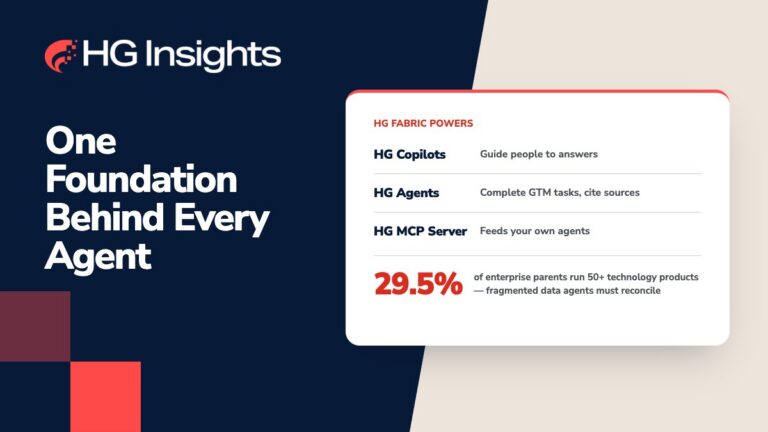
HG Insights delivers continuously refreshed technographic installs, IT spend intelligence, buyer intent signals, and firmographic attributes through a unified Revenue Growth Intelligence fabric. This GTM data fabric is designed to feed both human teams and AI agents, supporting scoring, ABM, inbound routing, high-intent detection, territory planning, and AI sales plays across your full stack.
With MCP server access and deep integrations across CRM, MAP, and orchestration tools, HG Insights enables scalable data enrichment for GTM that operates from a single trusted foundation. Your enrichment strategy scales with your AI adoption rather than becoming the bottleneck that holds it back.
Build your enrichment infrastructure for the AI-driven future. Explore HG Insights as your AI-ready enrichment foundation