

Most B2B companies in 2026 have data. Most have a strategy. Most have execution teams running campaigns, deals, and renewals. What separates the highest-performing companies from the rest is not which of these they have. It is whether all three operate as a single connected system.
The companies pulling ahead treat alignment as an operating model. Their data, strategy, and execution move together, with active feedback loops in every direction. The companies falling behind treat the three as separate functions, run by separate teams, on separate calendars.
This article walks through how aligned B2B companies actually work. It covers the three-pillar framework behind their growth, the operating model that holds it together, and the failure patterns that derail less mature organizations. By the end, you will know what alignment looks like in practice, where most B2B teams break down, and how to close the gaps in your own GTM motion.
The alignment problem in B2B today
Most B2B GTM organizations have an alignment problem. They might not call it that. They call it pipeline gaps, missed forecasts, sales-marketing tension, or “we need a better ICP.” The root cause underneath those symptoms is the same: data, strategy, and execution are not moving in sync.
Data lives across CRMs, marketing automation, billing systems, intent platforms, and spreadsheets. Across more than 440,000 companies tracked by HG Insights with Salesforce CRM installed, nearly 1 in 4 also runs HubSpot CRM in parallel; a direct signal of the fragmented data environment that makes GTM alignment so difficult.
Each system has a different owner, refresh cycle, and quality standard. Reconciling them takes weeks, and by the time the work is done, half the data is stale.
Strategy is set once a year. Markets shift, competitors release new products, and buyers change priorities. The strategy keeps running on last year’s assumptions until the next planning cycle.
Execution teams operate on ICP definitions and territory maps that have drifted from the actual market. Reps work accounts that no longer fit. Marketing programs target segments that have moved on. Customer success teams renew accounts that were misqualified at sale.
The result shows up everywhere. Pipeline is patchy. Win rates dip. Sales and marketing blame each other. CFOs ask why GTM spend is up but efficiency is down. The actual answer is alignment, but it rarely gets named that way.
Symptoms of misaligned versus aligned B2B companies
| Dimension | Misaligned company | Aligned company |
| Data | Multiple sources, no shared definitions | Single source of truth across GTM teams |
| Strategy refresh | Annual planning cycle | Continuous, informed by live data |
| ICP definition | Different per team | Shared and updated quarterly |
| Sales and marketing | Separate account lists | Same account list, same scoring |
| Pipeline | Volatile and hard to predict | Predictable and tied to signals |
| AI readiness | Limited, siloed by team | Native, exposed across the platform |
What alignment really means in 2026
Alignment is often discussed and rarely defined. The version that actually drives growth has three components.
First, a shared data foundation. Sales, marketing, RevOps, and customer success all work from the same view of accounts, contacts, installs, intent, and spend. There is one set of truth, not five.
Second, strategy that is continuously informed by that data. Market sizing, ICP definition, and segmentation are not annual exercises. They get refreshed as the data changes, with regular reviews and clear ownership.
Third, execution that closes the loop. Field activity feeds insight back into the strategy. Reps see the same signals marketing sees. Marketing sees what is converting and what is not. The data foundation absorbs everything and gets sharper with each cycle.
Alignment is an operating model, not a tool purchase. The companies that get this right treat their data platforms, strategic frameworks, and execution motions as one system. HG Insights is built for exactly this operating model: a single platform that connects installs, spend, intent, and contract data across every GTM function. They invest in the connective tissue, not just the surface tools.
AI agents have raised the stakes. When sellers, marketers, and operators rely on AI to surface insight and take action, the underlying data and strategy have to be aligned. A misaligned organization with AI is just faster at being wrong.
The three pillars of B2B GTM alignment
| Pillar | What it covers | Owners |
| Data foundation | Single source of truth for accounts, contacts, installs, intent, spend | RevOps, Data, IT |
| Strategy informed by data | Market sizing, ICP, segmentation, prioritization | Strategy, Product Marketing, Leadership |
| Execution that closes the loop | Account scoring, territory, plays, campaigns, customer feedback | Sales, Marketing, CS |
Pillar 1: a shared data foundation
The data foundation is where alignment either starts or stalls. Without it, the rest of the operating model collapses into reporting battles and version-control debates.
Top-performing B2B companies build their data foundation on a few principles. The first is one source of truth. Accounts, contacts, installs, intent signals, IT spend, and contract data live in a unified layer that every GTM team can access. Sales pulls from it. Marketing pulls from it. RevOps pulls from it. Disagreements about who owns the data list become rare because the list is the same.
Quality and freshness are non-negotiable. Stale data corrupts every decision downstream, so aligned companies treat data freshness as a service-level commitment, with refresh cadences documented and audited.
AI readiness is now a baseline rather than a differentiator. MCP server access, clean APIs, and agent integrations define whether your data can fuel the AI workflows that sellers and marketers expect.
HG Insights delivers this layer through the RGI Platform, combining technographic installs, IT spend, contract intelligence, and intent signals in a single dataset with native MCP server access, so every agent in your stack pulls from the same ground truth.
Internal sources also stay connected to external signals. Internal data tells you who you are doing business with. External signals like installs, intent, and contracts tell you what is happening in the market. Aligned companies stitch the two together rather than treating them as separate datasets.
HG Insights data shows that just 9% of companies running Salesforce or HubSpot CRM also have a cloud data warehouse (Snowflake or Databricks) deployed alongside it. For the remaining 91%, GTM data lives inside the CRM alone, disconnected from the analytics layer that alignment requires.
This is the layer most companies underinvest in. They buy workflow tools first, then try to retrofit a data foundation underneath. The result is dashboards on top of unreliable data, which is worse than no dashboards at all. GTM data infrastructure decisions belong at the start of the alignment journey, not at the end.
Pillar 2: strategy informed by data
Strategy in aligned B2B companies is not a planning document. It is a living view of the market, updated as the data changes.
Market sizing gets rebuilt continuously. Total addressable market, serviceable addressable market, and serviceable obtainable market are tracked against live install and spend data, not last year’s analyst report.
ICP definitions get tested and refined on a quarterly basis. The companies that consistently close as ideal customers are studied, and the ICP gets sharpened. Accounts that close but churn fast get flagged. The ICP is a hypothesis that data validates or invalidates.
Whitespace and competitive analysis become continuous workstreams. Aligned companies know which accounts run their products, which run competitors, and which run nothing yet. Displacement opportunities are tracked by contract end date and stack changes. Whitespace is sized by region, segment, and product line.
Segmentation supports prioritization rather than just describing the market. Each segment has a defined GTM motion, owner, and set of plays. Segments that underperform get reviewed and either fixed or deprioritized.
Prioritization decisions move from annual cycles to monthly or quarterly reviews. The strategy team becomes a data-driven function rather than a slide-producing function.
Annual planning versus continuous strategy refinement
| Activity | Annual planning model | Continuous strategy model |
| ICP review | Once a year | Quarterly with live data |
| TAM and SAM | Static analyst report | Refreshed against install and spend data |
| Whitespace mapping | One-time exercise | Ongoing workstream |
| Competitive intel | Periodic battlecards | Continuous tracking of installs and contracts |
| Segment performance review | Annual or skipped | Monthly with shared dashboards |
Strategy informed by data is the bridge between the foundation and the field. Without it, the data sits unused, and execution operates on assumptions that no longer hold. A data-driven GTM strategy gives strategy teams a permanent seat at the operating table.
Pillar 3: execution that closes the loop
Execution is where alignment shows up in revenue results. The third pillar separates B2B companies that talk about alignment from companies that actually achieve it.
Account scoring runs on real signals, not historical assumptions. Aligned companies score accounts using firmographic fit, technographic context, intent activity, IT spend, and engagement history. Reps receive a prioritized list, not a static target list.
Territory optimization replaces geographic instincts with data-backed assignment. Coverage is balanced based on opportunity density, not just zip codes. Reps work books that match their strengths and the market reality.
Sales and marketing share the same view of accounts. Marketing knows which accounts are in-market and routes them to the right plays. Sales sees the same signals marketing sees. Customer success knows which accounts are showing risk signals before churn happens.
Field execution data flows back into strategy. What is converting becomes a strategic input. What is not converting becomes a flag for the next ICP review. The loop closes, and the next cycle starts with sharper inputs.
AI sales agents act as the connective tissue at the rep level. They pull account context, surface relevant signals, and recommend next plays, so sellers spend less time researching and more time selling.
Examples of execution closing the loop
| Execution activity | Signal feeding it | Loop back to strategy |
| Displacement plays | Competitor installs plus contract end dates | Win rates inform ICP refinement |
| Whitespace expansion | Customer install gaps | Pipeline patterns inform segmentation |
| In-market account targeting | Intent signals plus engagement | Conversion data refines scoring models |
| Renewal at-risk plays | Stack changes and usage drops | Churn analysis informs ideal expansion profile |
| AI seller workflows | Full account context in real time | Engagement data refines messaging strategy |
Execution that closes the loop is what makes alignment self-reinforcing. Each cycle generates better data, sharpens strategy, and improves the next round of execution.
The operating model behind aligned B2B companies
Tools alone do not create alignment. The operating model does, and the companies that pull this off share a few traits.
RevOps acts as the connective tissue. The function owns the data foundation, the metrics layer, and the operational rhythms that keep sales, marketing, and CS in sync, and it is empowered to make calls that span teams.
Shared rituals keep everyone synchronized. QBRs, segment reviews, signal monitoring, and pipeline reviews run as cross-functional events with shared agendas. Each team brings the same view of the data and the same set of priorities.
Shared metrics keep the teams honest. Sales, marketing, and customer success measure themselves against shared revenue outcomes: pipeline created, pipeline accepted, pipeline closed, net revenue retention. Vanity metrics get pruned.
A single ICP runs across teams. When the ICP shifts, every team sees the change at the same time and adjusts together, rather than defending separate definitions.
AI agents get deployed intentionally. Aligned companies treat AI as a force multiplier and define the workflows agents support before they roll them out. They do not bolt agents onto broken processes.
Executive sponsorship holds it together. Alignment requires investment that crosses team boundaries, and without executive backing, the function that owns the budget wins while alignment stalls. Aligned companies have a CRO or COO who treats this as a top-three priority. Revenue operations alignment is the discipline that holds the operating model together as the company scales.
Common failure patterns to avoid
Misaligned companies tend to repeat the same mistakes. Recognizing these patterns is half the battle.
The first is treating data as a marketing initiative. When data is owned only by marketing, sales never trusts it. The data foundation needs cross-functional ownership and cross-functional governance.
The second is running planning cycles divorced from current data. Annual plans that ignore live signals are wishlists, not strategies. Aligned companies refresh strategic inputs on a regular cadence and build planning rituals around current data.
The third is buying tools without designing the process. Tools without an operating model produce dashboards no one uses. Process without the right tools produces meetings where teams argue about whose numbers are correct.
The fourth is letting sales and marketing run different ICPs. This is the most common failure pattern in B2B. Each team defends its definition, leadership tolerates the gap, and pipeline suffers. Aligned companies kill the gap on day one.
The fifth is underestimating AI readiness. Companies that treat AI as a side experiment lose ground to companies that bake AI into the operating model. By 2026, AI readiness is a baseline, not a differentiator.
The last is skipping the feedback loop. Many companies build the data foundation and the strategy layer but never close the loop with execution. Without the loop, alignment becomes a static plan rather than a living system.
How HG Insights powers alignment at scale
HG Insights is built for the alignment use case. The platform supports each pillar and the operating model that connects them.
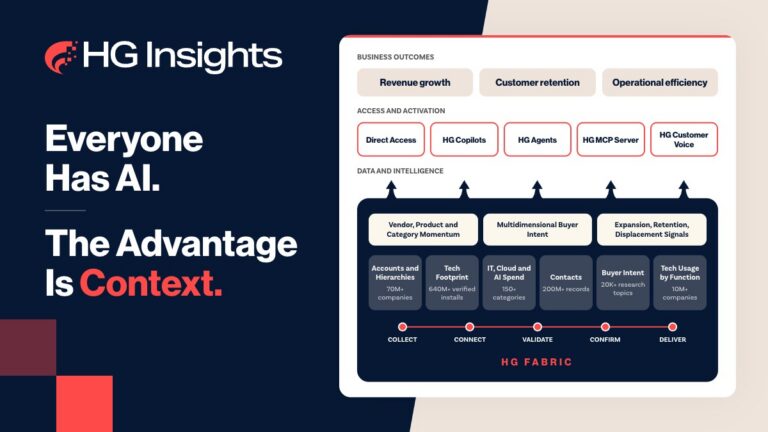
For the shared data foundation, the RGI Platform combines installs, IT spend, contract intelligence, intent signals, and customer voice in a single dataset. Sales, marketing, RevOps, and strategy work from the same data, not five different views of it.
For strategy informed by data, Market Analyzer supports market sizing, whitespace analysis, and competitive analysis on live data. Strategy teams refresh ICP and segmentation as the data evolves rather than waiting for annual planning.
For execution that closes the loop, Sales Co-pilot delivers account context, scoring, and recommended plays inside seller workflows. Data Studio runs predictive scoring models that inform territory, prioritization, and ABM motions. Customer Voice closes the loop with buyer feedback that feeds back into strategy.
AI-native infrastructure
The infrastructure is AI-native and a native MCP server expose alignment-grade data to AI agents in real time, so sales agents, marketing agents, and RevOps agents pull from the same source of truth.
That support runs across functions. RevOps gets the data and modeling backbone. Sales gets workflow integration. Marketing gets ABM and intent capabilities. Strategy gets market intelligence. The platform serves the operating model, not just one team’s tools list.
Enterprise B2B companies running global GTM motions already use HG Insights as the alignment backbone. The platform was designed to support all three pillars and the connective tissue between them. For B2B leaders evaluating GTM data platforms 2026 against the alignment framework in this article, HG Insights is the benchmark to measure others against.
Final takeaways for B2B leaders
The best B2B companies in 2026 do not win because they have better tools. They win because their data, strategy, and execution operate as one connected system.
Three principles guide the work:
- Build the shared data foundation first, before investing in workflow tools.
- Treat strategy as a living process informed by live data, not an annual document.
- Close the execution loop so field insights feed back into the next cycle of strategy.
The operating model matters more than any single tool. RevOps as connective tissue, shared rituals, shared metrics, and a single ICP across teams turn alignment from an aspiration into a daily practice.
AI raises the stakes. The companies that align data, strategy, and execution will compound their AI investments. The companies that do not will accelerate their misalignment.
Explore the RGI Platform to see how HG Insights connects data, strategy, and execution across your GTM motion, or request a demo to map the platform against your own use case.
Frequently asked questions
What does GTM alignment mean for B2B companies?
GTM alignment means data, strategy, and execution operate as a single connected system across sales, marketing, RevOps, and customer success. It includes a shared data foundation, strategy informed by live data, and execution that closes the loop back into strategy. Alignment is an operating model, not a tool purchase.
Why is data, strategy, and execution alignment important in B2B?
Alignment between data, strategy, and execution is among the strongest predictors of B2B revenue growth. Misaligned companies waste GTM spend, miss pipeline targets, and erode trust between functions. Aligned companies make sharper decisions, run more predictable pipeline, and compound their AI investments because the underlying data and strategy are coordinated.
What are the three pillars of B2B GTM alignment?
The three pillars are a shared data foundation, strategy informed by data, and execution that closes the loop. The data foundation creates one source of truth across GTM teams. Strategy continuously refreshes against live signals. Execution feeds field insights back into the next cycle of strategy. Each pillar reinforces the others.
How do the best B2B companies align sales and marketing?
The best B2B companies align sales and marketing by working from a single ICP, a shared account list, and a unified scoring model. Both teams pull from the same data, share the same metrics, and run cross-functional rituals like QBRs and segment reviews together. Marketing routes in-market accounts to sales, and sales feeds back what is converting so the next cycle of plays is sharper.
What is the role of RevOps in B2B GTM alignment?
RevOps is the connective tissue between data, strategy, and execution. The function owns the shared data foundation, the metrics layer, and the operational rhythms that keep sales, marketing, and customer success in sync. Empowered RevOps teams have authority to make decisions that span GTM functions, which is what allows alignment to scale.
How does AI change B2B GTM alignment in 2026?
AI raises both the value and the stakes of B2B GTM alignment. AI agents pull data and surface insight in real time, so the underlying data foundation and strategy must be aligned for AI to add value. A misaligned organization with AI is just faster at being wrong. Aligned companies compound their AI investments by exposing alignment-grade data to agents through MCP servers and clean APIs.
What are the most common B2B GTM alignment failures?
The most common failures are treating data as a marketing-only initiative, running annual planning cycles divorced from current data, buying tools without designing the operating model, and letting sales and marketing operate on different ICP definitions. Many B2B companies also build the data foundation and strategy layer but never close the loop back with execution, which leaves alignment as a static plan rather than a living system.