
A product manager at a mid-market SaaS company types a question into an AI assistant: “What are the best project management tools for distributed engineering teams?” Within seconds, the AI provides a detailed answer with links to three vendors. A fourth vendor, despite offering similar capabilities and having a strong customer base, is nowhere to be found. It isn’t ranked lower. It simply doesn’t appear.
That gap between cited and invisible is becoming one of the most consequential dynamics in B2B buying. And most vendors have no idea which side they’re on.
Quick Answer: AI engines cite vendors whose content is technically crawlable, structurally marked up with schema like FAQPage and Speakable, and backed by substantive third-party validation such as long-form verified reviews. Vendors behind login walls, with lazy-loaded content or thin review profiles, get skipped entirely, regardless of product quality.
The invisible vendor problem
The 2026 B2B Buying Disconnect Report from TrustRadius reveals a perception gap worth paying attention to. Seventy-six percent of vendors believe their company website is being used to train AI models. Forty-nine percent think user reviews feed into those models. Forty-six percent point to social media, forty-three percent to marketing collateral, and thirty-nine percent to third-party publications.
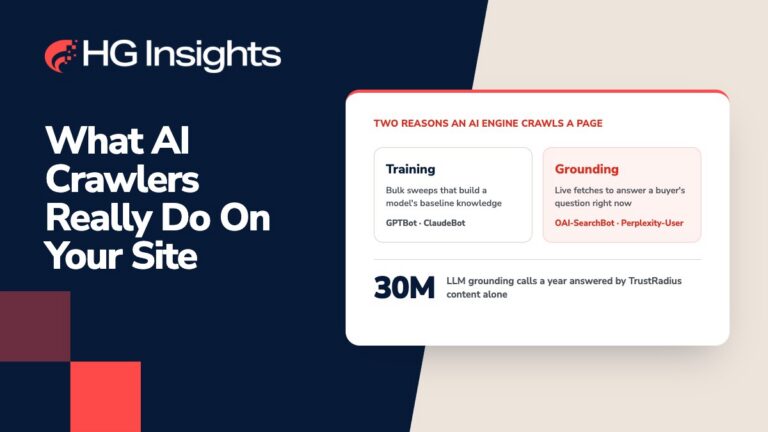
Most of those vendors are wrong about what matters, or at least wrong about the mechanism. AI engines do not treat all content equally. They favor content that meets specific technical and structural criteria: open crawlability with no login walls, DOM-rendered text that does not rely on lazy-loading, and structured schema markup that tells the model what the content means, not just what it says. A vendor’s website can be beautiful, well-written, and full of useful information. If it sits behind a JavaScript framework that renders on scroll, the AI never sees it.
Buyers trust AI citations, then verify them
Here is the part that makes this more than a technical curiosity. Buyers are actually clicking through on AI-generated citations. According to the same TrustRadius report, eleven percent of buyers use AI’s cited sources specifically to fact-check the answer they received. That percentage sounds modest until you consider the broader pattern: ninety-four percent of AI users fact-check in some form, and seventy-two percent do so always or very often.
Buyers are not passively accepting AI recommendations. They are using AI as a starting point, then following the citation trail to validate. If your company appears in that initial AI response, you get pulled into the buyer’s research orbit. If you don’t, you never enter the consideration set at all. The old SEO metaphor about page two of Google being a graveyard has a new equivalent: the vendor that AI simply does not mention.
Third-party reviews gained ground while analyst reports collapsed
The shift in where buyers go to validate is just as significant as how they start their search. Seventy-four percent of buyers consult user reviews during their buying process. Sixty-three percent specifically visit software review sites, up from fifty-eight percent a year earlier. Meanwhile, reviews hosted on a vendor’s own site fell from forty-six percent to forty-two percent.
Buyers are actively migrating their trust toward independent, third-party sources. And they are migrating away from some traditional ones at striking speed. Analyst reports dropped to just thirteen percent usage, a sixty-three percent decline since 2022. That is not a gradual erosion. That is a category losing relevance in real time.
For AI citation optimization in B2B, this creates a clear hierarchy. Content on independent platforms with strong editorial standards and open crawlability carries more weight, both with buyers and with the AI engines those buyers increasingly start their research in.
The architecture that gets cited
Not all review platforms are built for AI visibility. Most were designed for human browsers and still operate that way, with content behind registration forms, dynamically loaded on scroll, and structured primarily for visual display rather than machine readability.
TrustRadius GEO takes a different approach. Its content architecture is fully open to AI crawlers with no login walls blocking access. Pages are DOM-rendered, meaning content exists in the page source rather than loading through client-side JavaScript. FAQPage and Speakable schema markup give AI engines explicit signals about what each piece of content means and how it should be cited.
The review content itself matters too. TrustRadius reviews average four times the length of competing platforms, which gives AI engines substantially more context to work with when generating answers. Review Insights, an AI-powered layer, creates structured summaries in FAQPage schema, essentially pre-packaging the most useful information in the format AI engines prefer.
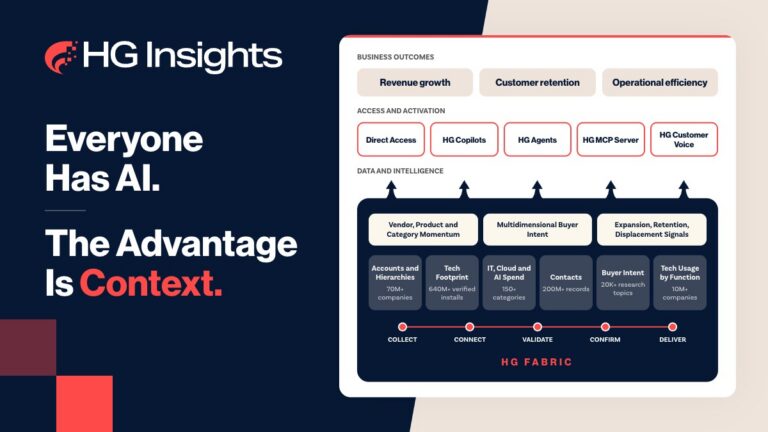
HG Insights data, including install counts, technology spend, and industry segmentation, enriches these pages further. That enrichment makes vendor profiles more authoritative and more useful to AI models trying to answer specific, high-intent buyer questions. Segment-specific pages, industry synthesis views, vertical comparisons, and custom FAQ pages give AI engines multiple angles from which to cite a vendor.
The audience reach is distinct too: seventy-five percent of TrustRadius visitors are unique to the platform, with only two percent overlap with PeerSpot, ten percent with Capterra, and eighteen percent with G2. Being present on TrustRadius means reaching buyers that other review platforms miss entirely.
Trust is declining, and that changes everything
Forty-seven percent of buyers say they trust online resources less than they did before. That number should alarm any vendor relying on self-published content as their primary digital presence. Buyers are not just shifting where they research. They are raising the bar for what counts as credible.
In a lower-trust environment, independent validation from third-party platforms carries disproportionate weight. The vendors who will remain visible, both to human buyers and to the AI engines those buyers rely on, are the ones whose presence on authoritative, crawlable, schema-rich platforms gives AI something worth citing.
Visible or invisible
The question facing B2B vendors is no longer just “are we ranking on Google?” It is: when a buyer asks an AI assistant about our category, do we show up in the answer?
That visibility depends on technical architecture, content substance, and independent validation, not on brand awareness or marketing spend. The vendors who invest in making their best content citable, verified, and structurally accessible to AI will be the ones buyers find first.
HG Insights helps B2B technology companies understand their markets with precision. See how TrustRadius GEO makes vendor content visible to AI engines and the buyers who rely on them.
Frequently asked questions
How do AI engines decide which vendors to cite in their answers?
AI engines prioritize content that is technically crawlable without login walls, rendered directly in the DOM rather than lazy-loaded, and marked up with structured data like FAQPage and Speakable schema. Substantive third-party reviews and authoritative data enrichment also increase the likelihood of citation.
Why are third-party review sites becoming more important for B2B buyers?
Sixty-three percent of B2B buyers now consult software review sites during their purchasing process, up from fifty-eight percent the prior year. At the same time, trust in vendor-hosted reviews and analyst reports has declined sharply, pushing buyers toward independent platforms with verified, editorial-quality content.
What is generative engine optimization for B2B vendors?
Generative engine optimization (GEO) is the practice of structuring vendor content so that AI answer engines can crawl, interpret, and cite it accurately. This includes open crawlability, schema markup, long-form review content, and data enrichment that makes pages authoritative enough for AI models to reference in buyer-facing answers.
Do buyers trust AI-generated product recommendations?
Most buyers treat AI recommendations as a starting point rather than a final answer. Ninety-four percent of AI users fact-check the results they receive, and seventy-two percent do so always or very often. Eleven percent specifically click on AI-cited sources to verify claims, making the quality of cited content a direct factor in buyer trust.
Author
-

Grace Wells is a seasoned marketing strategist with over a decade of experience leading marketing efforts for diverse brands. She is passionate about helping clients achieve their marketing, branding, and ROI goals through thoughtful 360 degree approach to campaign execution. Grace is a tech nerd and loves nothing more than reading up on the latest marketing technology trends. She enjoys advising her clients and customers on which tools will help move the needle for their business.