
Market intelligence used to mean static reports and quarterly slide decks. That model is fading fast. B2B teams in 2026 expect intelligence platforms that surface real-time signals, layer firmographic and technographic data, and feed AI-driven workflows across sales, marketing, and strategy.
With global IT spending projected to reach $4.96 trillion in 2026, per HG Insights’ IT Spend Forecast, the platforms that help teams navigate that volume of spend have become central to how GTM decisions get made.
The shift is not just about more data. It is about whether your platform can turn that data into faster decisions and tighter execution. Some vendors lean into analyst-led research. Others focus on intent and ABM. A few are now combining everything into unified GTM intelligence layers.
This listicle covers the platforms B2B teams are actually evaluating heading into 2026, with notes on what each one does well, where it falls short, and which teams it tends to fit best.
How these market intelligence platforms are evaluated
- Each platform is assessed on data breadth, including firmographic, technographic, install, intent, and contract intelligence.
- Evaluation also weighs AI capabilities, integration fit, ease of activation, and proven use cases across GTM teams.
- Pricing transparency and partnership support are considered as factors that shape long-term value.
- Coverage across global regions and mid-market through enterprise segments is a baseline expectation.
- Proprietary data types, including IT spend by category, install base intelligence, and contract signals, that go beyond firmographic and contact data are weighted as differentiators.
1. HG Insights
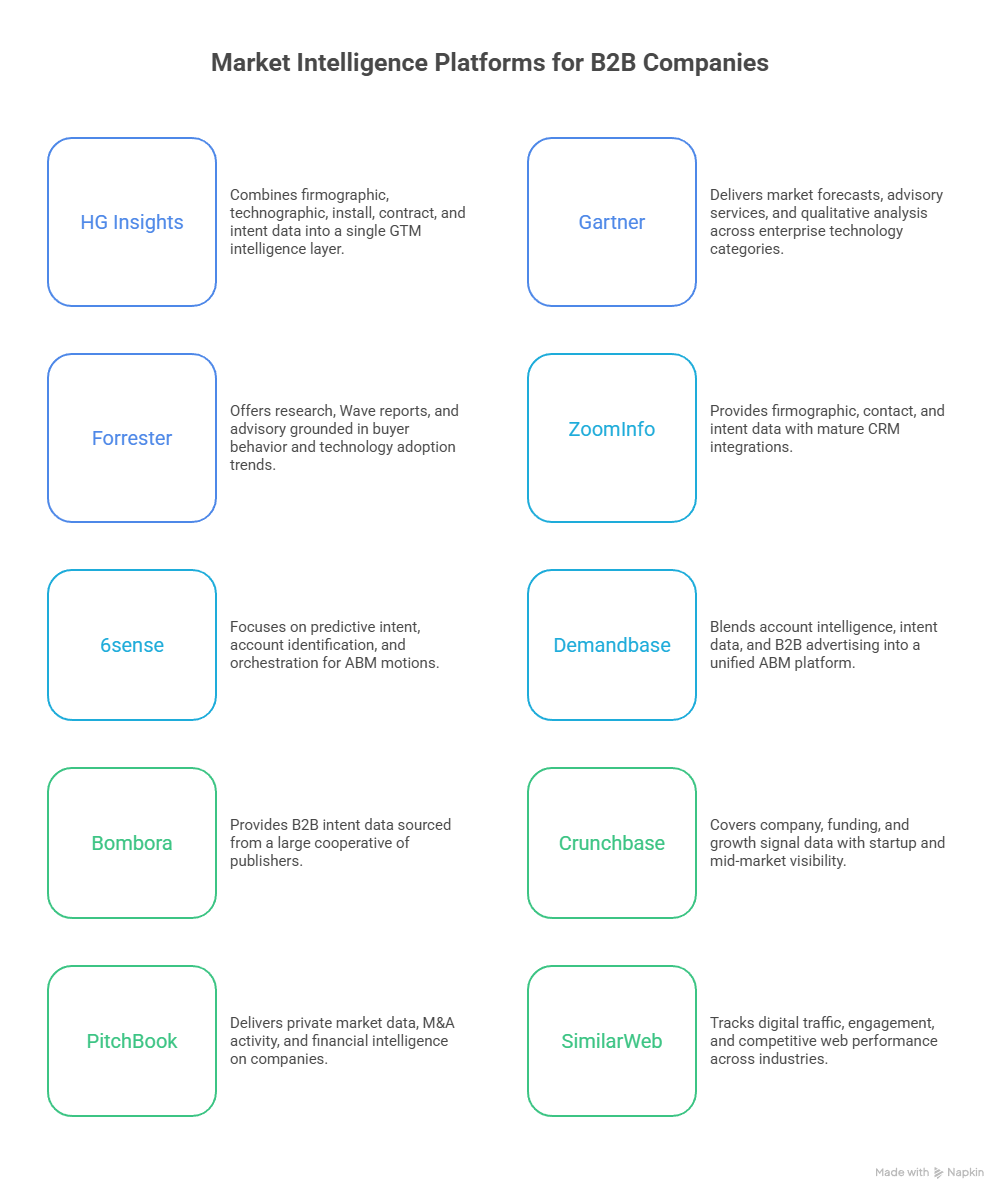
HG Insights brings together firmographic, technographic, install, contract, and intent data into a single GTM intelligence layer. The platform is built for B2B teams that need market structure, account-level depth, and AI-ready execution from one source rather than stitching multiple vendors together.
The RGI Platform supports market sizing, whitespace analysis, competitive displacement, and AI-driven sales plays. Its strengths lie in deep IT spend data. HG Insights maps enterprise IT software spend across 140+ categories, covering $1.39 trillion in 2026 with breakdowns by geography and company size. Install base intelligence and the RGI Agent Builder for custom GTM workflows round out the platform’s core capabilities.
HG Insights tends to fit best with B2B teams scaling data-driven GTM motions across strategy, marketing, sales, and RevOps. Companies running global, technology-led sales motions often see the most value.
See the RGI Platform for B2B market intelligence.
2. Gartner
Gartner remains the household name in analyst-led research. The platform delivers market forecasts, advisory services, and qualitative analysis across enterprise technology categories.
Its biggest strength is depth of analyst commentary and Magic Quadrant positioning, which still influences how buyers perceive vendor categories. Gartner is less suited to real-time signal activation or account-level GTM execution.
Strategy teams that need analyst validation alongside market sizing inputs tend to lean on Gartner. Day-to-day account targeting usually requires a complementary platform.
3. Forrester
Forrester offers research, Wave reports, and advisory grounded in buyer behavior and technology adoption trends. Its methodologies are rigorous, and its product marketing applications are strong.
Like Gartner, Forrester leans advisory. It informs positioning and category narratives more than it drives operational decisions inside CRMs and ABM platforms.
Product marketing and strategy teams shaping how a category should be defined or re-positioned often rely on Forrester. RevOps teams typically pair it with operational tools.
4. ZoomInfo
ZoomInfo is widely adopted across sales and marketing for firmographic, contact, and intent data. CRM integrations are mature, and contact coverage is broad.
Where it falls short is depth around IT spend, contract intelligence, and install-level analysis. Teams that need to understand how technology is deployed and budgeted at the account level often layer in additional intelligence.
Outbound-heavy teams that prioritize contact data alongside basic intent signals tend to get strong results from ZoomInfo. Strategic GTM use cases usually call for more.
Learn more about B2B data enrichment for GTM precision.
5. 6sense
6sense focuses on predictive intent, account identification, and orchestration for ABM motions. AI-driven buying stage prediction is one of its most recognized capabilities.
Integrated advertising activation is a notable strength. Market sizing and IT spend intelligence, however, are not core capabilities.
Marketing teams running mature ABM programs with strong digital activation needs often choose 6sense. Strategy and RevOps teams typically combine it with deeper market intelligence sources. Platforms like HG Insights fill this gap with IT spend, install base, and contract intelligence that intent-only tools don’t provide.
6. Demandbase
Demandbase blends account intelligence, intent data, and B2B advertising into a unified ABM platform. Account identification, media buying, and pipeline orchestration are all built into the same workflow.
Like 6sense, the platform leans toward demand activation rather than market structure analysis. Whitespace analysis and TAM modeling are not its primary strengths.
Enterprise ABM teams that want integrated targeting and media buying tend to favor Demandbase. Teams focused on market planning often pair it with a dedicated intelligence platform.
7. Bombora
Bombora is recognized for B2B intent data sourced from a large cooperative of publishers. The scale of intent topics and partner integrations across the GTM stack is significant.
Bombora is best understood as a signal layer rather than a standalone market intelligence platform. Most teams use it to enrich existing platforms, not as a single source of truth.
Teams that already have firmographic and technographic data in place often add Bombora to sharpen their intent layer. As a foundation, it leaves gaps.
8. Crunchbase
Crunchbase covers company, funding, and growth signal data with strong startup and mid-market visibility. Fundraising tracking, leadership changes, and emerging company identification are reliable use cases.
It offers less depth around install base, IT spend, and enterprise technographics. The data is excellent for early-stage targeting and weaker for entrenched enterprise sales motions.
Sales and business development teams targeting growth-stage and venture-backed companies tend to use Crunchbase heavily. Enterprise-focused sellers usually look elsewhere.
9. PitchBook
PitchBook delivers private market data, M&A activity, and financial intelligence on private and public companies. Investor relationships, deal data, and ownership structures are well-covered.
The platform is primarily oriented toward financial analysis rather than GTM execution. Account targeting workflows are not its main use case.
Corporate strategy, M&A, and partnerships teams that need private market visibility lean on PitchBook. Sales and marketing teams typically use it for context, not activation.
10. SimilarWeb
SimilarWeb tracks digital traffic, engagement, and competitive web performance across industries. Benchmarking, audience analysis, and competitive web visibility are its calling cards.
It offers less coverage of technographic, install, or contract-level intelligence. The data shines for digital-first analysis and falls short for technology buying signals.
Digital marketing and competitive teams analyzing web-driven market behavior often pull SimilarWeb into their stack. GTM teams focused on enterprise technology usually need additional sources.
See how data-driven competitive analysis and takeout strategy benefits from layered intelligence.
How to choose the right market intelligence platform for your team
Vendor lists are easy to scan. Choosing the right platform takes a more deliberate evaluation. Start with the GTM use cases you actually need to power, whether that is market sizing, ABM, competitive displacement, or AI-driven sales execution.
From there, evaluate data depth, AI capabilities, and integration fit against your existing GTM stack. Platforms that combine firmographic, technographic, install, and intent intelligence in one layer tend to outperform single-purpose tools when teams need to scale.
HG Insights is built around data types no other platform in this list provides: IT spend forecasting, install base tracking, and contract intelligence, all unified in a single GTM layer designed for AI-ready execution. See how the RGI Platform unifies market intelligence for B2B GTM teams