

An ABM list can appear well-organized on the surface and still overlook the companies showing the strongest signals of genuine purchase intent. Industry, revenue, employee count, and region create a clean spreadsheet, but they don’t reveal what an account runs, where budget is moving, or which buying signals deserve action.
Account-based intelligence closes that gap. Built on verified install data, market intelligence, IT spend, intent signals, and contract context, it turns ABM from a list selection exercise into a sharper revenue motion. Your team gets a clearer read on fit, timing, and competitive position before sales and marketing invest time in the account.
In This Guide:
- What account-based intelligence actually means for ABM teams
- Why install data is the missing layer in most ABM programs
- What market data adds beyond the install footprint
- How account-based intelligence sharpens targeting, segmentation, and play design
- Common mistakes that limit account-based intelligence
- How HG Insights powers account-based intelligence for ABM
Account-based intelligence answers three questions that firmographic data can’t
Account-based intelligence brings verified account-level data into one usable view. It combines install data, technographic intelligence, IT spend, buyer intent, and contract context so your team can answer three practical questions at once: Does the account fit your ICP in a way that actually matters? Is there a reason to act now? What vendor, technology, or market signal should shape the play?
Those questions matter because ABM breaks down when sales and marketing work from different assumptions. Marketing may prioritize engagement. Sales may prioritize known accounts. RevOps may prioritize scoring rules that looked sound six months ago. Account-based intelligence gives every team the same context, which makes prioritization easier to trust and act on.
For a deeper look at how account-based intelligence works as a framework, the distinction between having more data and having the right context for each account becomes clear.
The value isn’t in having another data feed. The value is knowing why an account deserves your next move.
Install data reveals how an account actually operates, not just how it looks on paper
Firmographics tell your team what an account looks like. Install data shows how the account actually runs.
Two companies can be in the same industry, revenue band, and employee range while running completely different technology stacks. One may use a platform that makes your integration story obvious. Another may already be locked into a competitor with no visible replacement signal. A firmographic model treats those accounts as similar. Your sales motion shouldn’t.
HG Insights tracks verified technology installs across 120+ million organizations, sourced from 20+ billion external data points, giving teams a precise view of what each account actually runs before the first conversation begins.
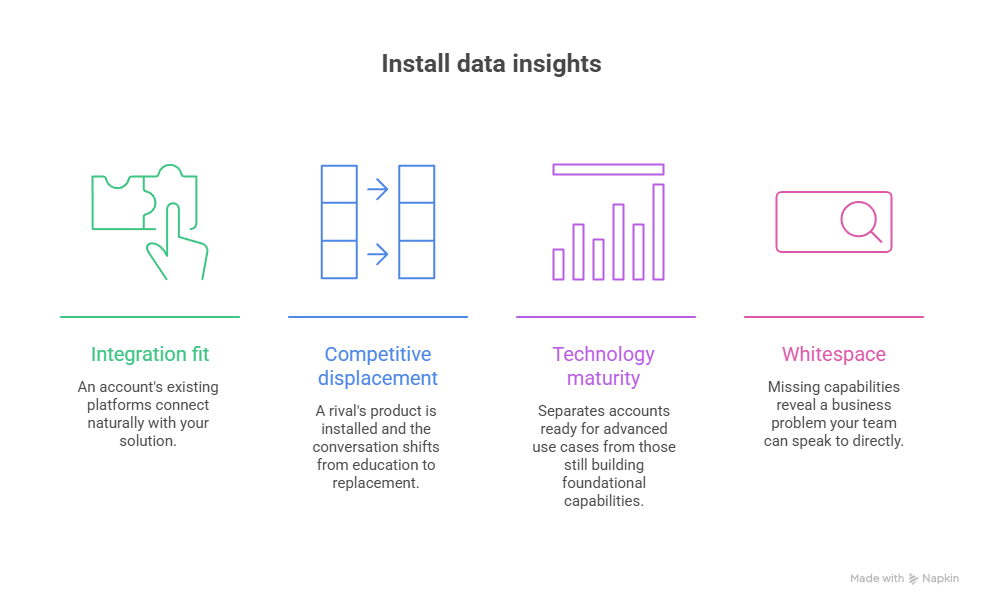
Install data helps your team identify:
- Integration fit where an account’s existing platforms connect naturally with your solution
- Competitive displacement opportunities where a rival’s product is installed and the conversation shifts from education to replacement
- Technology maturity that separates accounts ready for advanced use cases from those still building foundational capabilities
- Whitespace where missing capabilities reveal a business problem your team can speak to directly
Sales conversations become more specific and less dependent on generic personalization when the target list reflects stack reality. When reps know what technology an account runs before the first call, the conversation starts with credibility rather than discovery.
Market data adds the financial and behavioral context that install data alone can’t provide
Install data shows what’s already inside the account. Market data shows where attention, budget, and timing may be shifting.
IT spend intelligence helps your team understand whether an account has category-level investment potential. Intent data signals active research or evaluation behavior. Contract context can point to renewal windows, displacement timing, or vendor evaluation cycles. Together, these signals turn a static target list into a living view of where your team should focus.
The cost of getting this wrong is higher than most teams appreciate. Gartner has estimated that poor data quality costs organizations an average of $12.9 million annually. ABM programs feel that cost through weak scoring, wasted media spend, irrelevant outreach, and sales mistrust of the target list.
When your ABM program is built on verified install-base intelligence and market data, prioritization reflects real account potential rather than whichever company clicked the most recent email.
Account-based intelligence sharpens targeting by separating accounts that resemble your ICP from accounts that deserve action
A broad target account list can feel productive because it gives everyone a market to pursue. The real test comes later, when your team has to decide which accounts deserve budget, rep time, and executive attention.
Account-based intelligence filters the market through signals that actually affect buying potential. Stack patterns, category spend, competitor usage, intent activity, and historical win traits help your team separate accounts that merely resemble the ICP from accounts that warrant immediate investment.
The best ABM targets match your ICP and show signals that the buying window is opening. The distinction matters operationally:
- High-fit accounts with no activity belong in nurture programs that keep your brand visible until signals appear
- High-intent accounts with weak fit often create pipeline noise that wastes sales capacity
- High-fit accounts showing relevant intent, budget signals, and install patterns deserve accelerated engagement across marketing and sales simultaneously
Teams trust account intelligence when the path from signal to recommendation is visible and easy to understand. When reps can see why an account was prioritized, they act on it. When the logic is opaque, they ignore it.
Segmentation built on account intelligence changes the buyer experience
Segmentation is where account-level intelligence starts changing how buyers experience your outreach. When every account gets the same message, ABM becomes a smaller version of demand generation, just with a shorter list.
Your team can group accounts by current stack, complementary technology adoption, competitor usage, spend profile, and intent behavior. Each segment then gets a play that matches the account’s actual reality:
- Competitor users need migration messaging and proof around switching value
- Complementary tech adopters respond to integration and workflow improvement narratives
- Whitespace accounts often need category education before sales asks for a meeting
- High-fit, high-intent accounts need coordinated ad coverage, SDR outreach, and sales follow-up within the same window
When HG Insights account-based intelligence informs both ABM optimization and campaign execution, campaigns become focused plays rather than one broad push across the entire list. The buyer experiences outreach that reflects their specific situation, which is the difference between ABM that earns engagement and ABM that gets ignored.
Four mistakes consistently limit the value of account-based intelligence
Most of the time, weak account-based intelligence is just weak source data wearing a strategic label.
Relying on modeled or scraped install data. Inaccurate install data quietly distorts every downstream decision. A wrong competitor tag sends the wrong message. An outdated stack signal changes the score. A missing spend signal causes your team to overlook an account with real potential. Verified install data is the foundation. Everything built on unverified data inherits its inaccuracies.
Refreshing data too infrequently. Quarterly updates miss vendor changes, new buying signals, shifting budgets, and buying committee movement. Account conditions don’t wait for your next planning cycle. Your ABM data strategy needs a regular rhythm that matches how fast the signals actually move.
Treating intent data as a standalone signal. Research activity matters, but it produces the most value when paired with install-base intelligence, spend data, account fit, and first-party engagement. Without those layers, intent can push your team toward accounts that are active but poorly matched, which creates pipeline noise rather than pipeline quality.
Letting the target list go static after initial build. An ABM list built in January reflects January’s market conditions. By Q2, technology stacks have changed, budgets have shifted, and new buying signals have emerged. Regular refresh is what keeps account-based intelligence operational rather than historical.
HG Insights powers account-based intelligence that gives your ABM program a genuine edge
Trusted by 95% of Fortune 1000 B2B tech companies and all major hyper-scalers, HG Insights gives GTM teams the account-level data signals ABM needs to move from planning to action. Verified technology installs, IT spend intelligence, contract context, buyer intent, and market data help sales, marketing, RevOps, and strategy teams work from the same view of each account.
That shared view changes how ABM operates. Targeting gets sharper. Segments become more useful. Scores become easier to explain. Sales plays become more relevant because reps understand the account’s stack, spend profile, and buying signals before outreach begins.
The Revenue Growth Intelligence Fabric connects these signals into one unified data layer that powers account selection, scoring, segmentation, and campaign activation without requiring your team to stitch together data from multiple vendors.
Give your ABM program the intelligence that firmographics alone can’t provide. Explore the Revenue Growth Intelligence Platform.