

Your sales and marketing teams probably agree on the goal: grow pipeline, reach better accounts, move faster, and prove what’s working. Then the data gets involved.
Marketing sees engagement. Sales sees fit. RevOps sees reporting gaps. And leadership sees a forecast that keeps shifting because every team is working from a different account reality. Sales and marketing alignment breaks when teams share a revenue target but rely on disconnected signals to decide which accounts matter, when to act, and what success looks like.
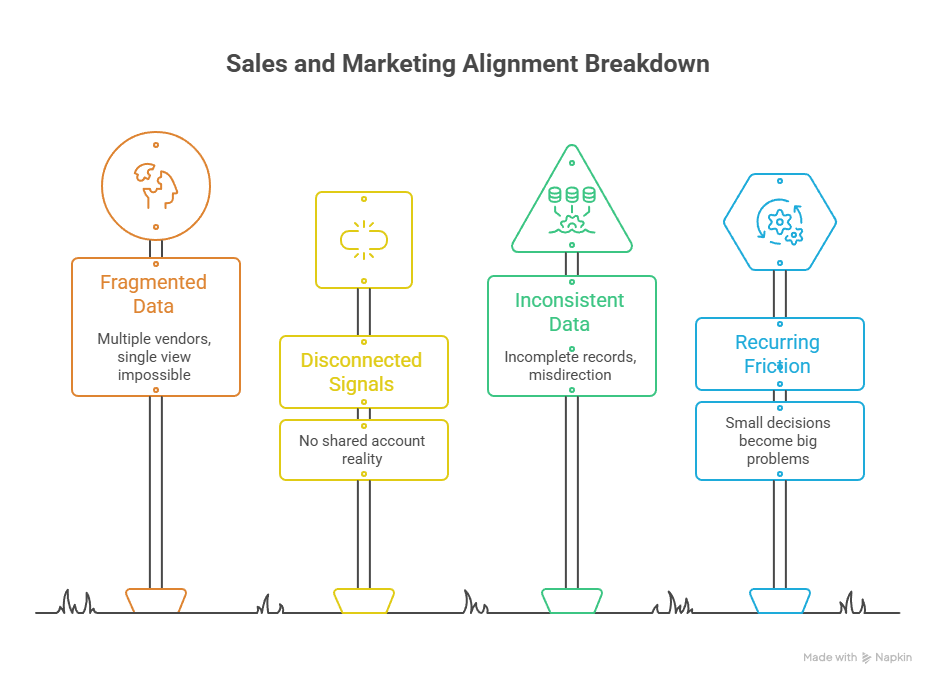
HG Insights data shows that 74% of the 2.2 million companies running both a CRM and marketing platform rely on tools from three or more different vendors: creating the exact fragmentation that makes a single account view impossible.
Shared data intelligence closes that gap. It gives your GTM teams a single view of firmographics, technographics, intent, install data, and pipeline movement, so alignment becomes something you can measure across targeting, scoring, handoffs, and reporting rather than something you hope happens in a weekly meeting.
This guide explains why sales and marketing alignment often breaks down and what shared data intelligence can do to fix it. You’ll learn how to build a shared ICP, unified scoring, and signal-based handoffs, and how to run ABM and reporting from one source of truth. It also shows how HG Insights helps bring sales and marketing together.
Revenue teams don’t drift because they disagree on growth; they drift because they bring different evidence into the room
Revenue teams rarely misalign because they disagree on direction. The problem is quieter than that. Each team brings different account evidence into the conversation and draws different conclusions from it.
Marketing may prioritize accounts with strong content engagement. Sales may push back because those accounts don’t match the ICP, lack buying signals, or already use a competing technology that changes the entire sales motion. RevOps gets stuck reconciling reports that are both technically accurate and operationally confusing.
According to Forrester research on B2B sales and marketing alignment, 82% of C-level B2B leaders said product, sales, and marketing were aligned, while 65% of sales and marketing professionals reported a lack of alignment between sales and marketing leadership. Strategy can look aligned from the top while execution stays messy on the ground, and that disconnect is where pipeline leaks.
Shared data intelligence means one account picture that every team trusts
Shared data intelligence gives your teams a unified account view they can trust. Firmographics, technographics, intent signals, install data, spend indicators, and engagement activity work together as one account picture rather than scattered across separate systems that each team interprets differently.
The CRM shows what your team has captured, not the full context behind an account’s buying potential. Sales and marketing both need to see why an account matters, what makes it a fit, which signals indicate demand, and what action should happen next.
When the evidence is shared, marketing doesn’t have to defend a score without context, and sales doesn’t have to dismiss campaign engagement as noise. Both teams are looking at the same signals and drawing conclusions from the same foundation. Unified GTM data and AI-driven insights make that possible by connecting every signal type into one account view your entire revenue team can work from.
Operating without a shared data layer turns small decisions into recurring friction
Disconnected data turns small GTM decisions into recurring friction. Marketing may call it pipeline creation, sales may call it noise, but RevOps has to reconcile the difference.
When account records are incomplete or inconsistent across systems, every handoff carries the risk of misdirection. Leads get routed based on partial attributes. Campaign audiences get built from criteria that don’t match what sales considers qualified. Pipeline reviews become data debates rather than strategy conversations.
The fix isn’t better communication. It’s a shared data layer that gives every team the same account context so the disagreements about data stop and the conversations about strategy can start.
A shared ICP gives your revenue team one standard for every targeting and prioritization decision
HG Insights data identifies nearly 400,000 companies worldwide running a CRM with no marketing platform alongside it; teams sharing a revenue target but starting from structurally different account views.
A shared ICP gives revenue teams one standard for targeting, scoring, handoffs, and pipeline reporting. When marketing and sales define “ideal customer” differently, every downstream decision inherits that misalignment.
Industry, company size, and region are useful starting attributes, but they don’t tell the full story. Your best-fit accounts also share technology patterns, spend behavior, install signals, buying triggers, and historical conversion traits that firmographic filters alone won’t surface.
A stronger ICP should account for:
- Firmographic fit (industry, revenue, headcount, geography)
- Installed technologies and competitor presence
- Spend indicators and budget direction
- Intent activity and research behavior
- Historical conversion patterns, cycle length, ACV, and retention signals
HG Insights surfaces each of these attributes through its Revenue Growth Intelligence Fabric, combining technographic install data, IT spend projections, cloud maturity indicators, and verified buyer intent from TrustRadius in a single account view; so your ICP is grounded in what accounts actually look like, not what you assume about them.
Evidence changes the tone of the conversation. Sales and marketing stop debating which accounts “feel right” and start pressure-testing which traits actually predict revenue potential. That shift from opinion to evidence is what makes alignment sustainable rather than aspirational.
Unified account scoring gives your teams a shared language for prioritization
Account scoring gives your revenue team a shared language for prioritization. When the scoring model is visible, logical, and trusted by both functions, it replaces the subjective arguments about which accounts deserve attention.
Strong scoring blends firmographic fit, technographic signals, intent behavior, install context, and value potential. Each team can see why an account rises in priority, why it stays low, and what signal should trigger action.
Predictive account targeting and scoring strengthens alignment because it connects campaign planning with sales prioritization. HG Insights’ scoring models are built to be fully transparent, pushing plain-language explanations of the top signals driving each score directly into the CRM so reps can see exactly why an account ranked high and act on that context immediately, rather than guessing at a black-box output.
The quieter benefit is that scoring eliminates a category of internal debate. When both teams work from the same model and can see which signals drive each score, the conversation shifts from “why is this account on my list” to “what should we do about this account next.”
Signal-based handoffs replace arbitrary stages with evidence that both teams respect
The lead handoff process breaks when it relies on labels no one trusts. An MQL that sales doesn’t believe was qualified creates friction. A stage change that marketing can’t see creates a black hole. Labels without evidence behind them produce handoffs that feel arbitrary.
Intent and engagement signals create a cleaner path. An account moves to sales because the behavior supports a real conversation, not because it crossed an arbitrary threshold.
Useful handoff signals include:
- Competitor research and vendor comparison activity
- Topic-level intent surges in your category
- High-value content engagement paired with strong ICP fit
- Technology install changes that create a new buying window
- Buying committee activity across multiple contacts at the same account
- Recent inbound activity from a high-scoring account
A sales and marketing SLA works best when both teams agree on the signal behind the handoff. Sales responds with context because the handoff came with it. Marketing sees which signals lead to accepted pipeline. RevOps measures where the process slows and which signals predict the strongest outcomes.
| Handoff signal | What it indicates | Recommended next step |
|---|---|---|
| Competitor research and vendor comparison activity | The account is evaluating options and a buying window is open. | Sales opens a displacement conversation while the account is in-market. |
| Topic-level intent surge in your category | Interest is rising before a formal search begins. | Marketing nurtures with category content, and sales prepares tailored outreach. |
| High-value content engagement paired with strong ICP fit | Fit and interest line up at the same time. | Route to sales for direct follow-up rather than continued nurture. |
| Technology install change | A new buying trigger has appeared in the account’s stack. | Sales reaches out with a use case tied to the new environment. |
| Buying committee activity across multiple contacts | The decision is moving beyond a single champion. | Sales maps the committee and coordinates multi-threaded outreach. |
| Recent inbound from a high-scoring account | Demand and fit are both confirmed. | Prioritize for fast follow-up ahead of lower-scoring inbound. |
ABM execution stays coordinated when both teams work from the same intelligence
ABM depends on account-based alignment. If sales and marketing work different lists, the program loses focus before it reaches the buyer.
According to HG Insights data, nearly half of all companies running marketing software use three or more separate tools, making the shared intelligence layer that keeps ABM campaigns coordinated with sales outreach even harder to maintain.
Shared account intelligence keeps targeting, messaging, timing, and outreach connected. Marketing can build segments around fit, intent, install data, and spend potential. Sales can use the same intelligence to guide account research, outreach angles, and follow-up timing.
When both functions operate from the same account view, the campaigns that marketing runs and the conversations the sales teams have reinforce each other rather than pulling in different directions. HG Insights makes this possible by combining competitive install data, cloud maturity signals, and first-party intent from TrustRadius to answer the question every ABM team needs answered: why this account, why now?
The difference can be seen in how the buyer experiences your outreach. When marketing and sales are working from the same intelligence, the buyer receives a consistent narrative across every touchpoint. When they’re not, the buyer gets mixed signals that undermine confidence in both teams.
Reporting and accountability improve when every team works from the same source of truth
Pipeline meetings should move decisions forward. They shouldn’t become arguments about whose dashboard is right.
Unified GTM data provides sales, marketing, and RevOps with a single reporting foundation. When every metric is built on the same account data, scoring logic, and segment definitions, the reports become trustworthy enough to act on.
Aligned pipeline reporting helps your team track:
- Conversion by account segment
- Pipeline movement by intent level
- Opportunity creation by score band
- Sales acceptance rate by source
- ABM performance by target tier
- Handoff speed and follow-up latency
Shared reporting changes accountability in a way that benefits both functions. Marketing sees which programs create sales-accepted opportunities. Sales sees which segments deserve faster follow-up. RevOps spots process gaps without having to rebuild definitions every quarter. The relationship between shared data and measurable accountability becomes even clearer when you see how smarter GTM alignment starts with unified market and buyer insight across the full revenue motion.
Shared data intelligence turns alignment from an aspiration into a repeatable operating model
When alignment is built on shared intelligence rather than shared intentions, it becomes operational rather than aspirational.
Faster handoffs happen because teams agree on readiness signals. Conversion improves when outreach reflects account fit and buying context. Forecasting gets cleaner when pipeline definitions, account scores, and reporting logic come from the same foundation. Sales and marketing alignment gets easier to sustain when every team can see the same account reality. Your cross-functional revenue strategy starts showing up in how your team selects accounts, builds campaigns, scores demand, routes leads, and reviews pipeline, not just in how they talk about working together.
HG Insights gives your GTM teams the shared intelligence they need to align around revenue
HG Insights brings firmographic, technographic, intent, install, spend, and market signals into one Revenue Growth Intelligence Platform. Marketing builds campaigns around accounts that show real demand. Sales prioritizes based on fit, technology environment, and buying activity. RevOps connects both through common scoring, cleaner reporting, and stronger pipeline visibility.
Give every team the same account reality. Explore the RGI Platform.