

In most cases, a pipeline weakens not from a lack of rep effort, but from B2B sales data that is inaccurate, outdated, or disconnected across systems.
Sales teams already spend only about 40% of their week selling, with the rest consumed by research, admin work, and tool management. When prospecting starts with weak sales prospecting data, every downstream step, from outreach to qualification, loses precision.
The timing problem compounds this further. Buying signals have a shelf life of 7 to 14 days. When prospecting data is stale or fragmented, reps don’t just target the wrong accounts; they often reach the right ones too late.
Revenue teams that rethink their pipeline development strategy around better data tend to see sharper prioritization, stronger messaging, and healthier conversion rates.
Why prospecting and pipeline suffer without the right B2B data
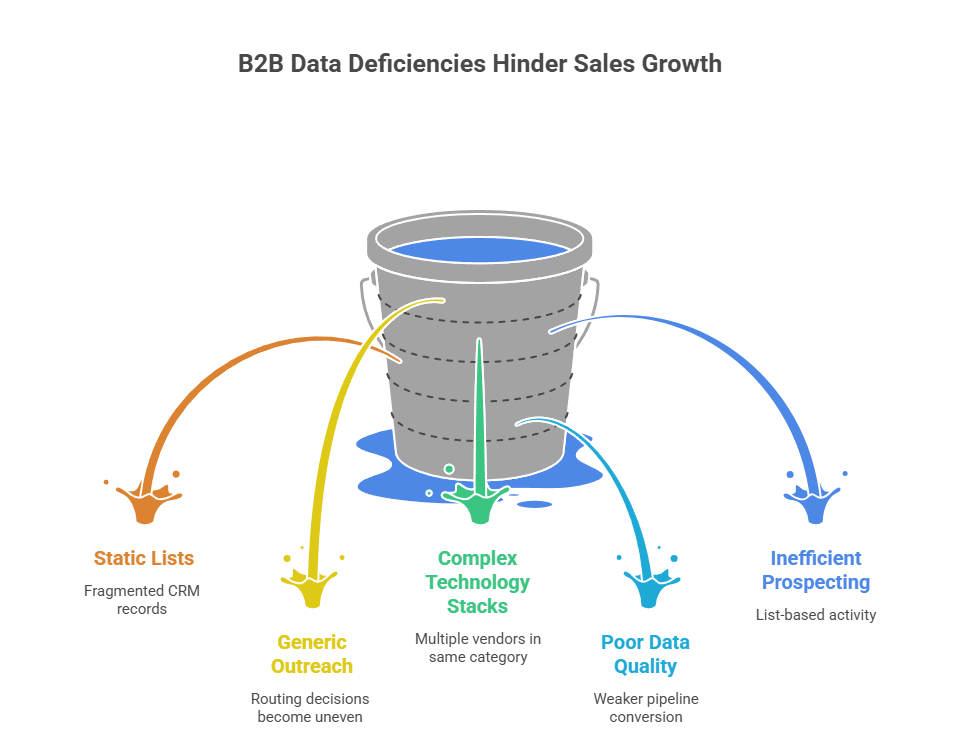
Many organizations still rely on static lists or fragmented CRM records. Without sufficient depth in account records, teams often fall back on generic outreach, and routing decisions become uneven and harder to trust.
According to HG Insights research, enterprise companies (10,000+ employees) average 150+ distinct technology products in their stack, with 65% running multiple vendors in the same category.
Poor data quality translates directly into weaker pipeline conversion because reps spend time on accounts outside the ideal profile or engage too early or too late in the buying cycle.
B2B sales intelligence becomes foundational at this stage by shifting prospecting from list-based activity to structured prioritization and positioning revenue intelligence as the operating layer behind scalable growth.
The types of B2B data that actually improve prospecting
Effective prospecting depends on three layers of intelligence: fit, context, and timing. Each serves a different purpose; together, they strengthen the quality of the sales pipeline.
Market and firmographic data for initial targeting
Market and firmographic data define the boundaries of your addressable market. Industry, company size, geography, and revenue bands help RevOps and sales determine which accounts belong in active coverage.
Clear ICP boundaries reduce wasted effort. In practice, tightening firmographic filters often increases meeting rates because reps stop pursuing marginal accounts. Firmographics answer a fundamental question: should this account be in play at all?
Account intelligence and technographics
Account intelligence deepens that picture. Technographics reveal installed technologies, IT spend patterns, and competitive footprints, which allows reps to speak with credibility rather than rely on surface-level messaging.
For example, across 890+ companies with Salesforce CRM installations, HG detects an average of 12 complementary technologies per account; creating natural conversation starters around integration, consolidation, or expansion.
If an account runs a competing platform, the sales conversation changes immediately. Outreach can reference integration gaps, migration risk, or contract timing.
That level of specificity only comes from technographic data with real depth. HG Insights tracks competitive footprints, technology installations, and IT spend signals across millions of accounts globally; giving reps context that goes beyond which platform an account uses to include how long they’ve used it, how much they’re likely spending on it, and when a contract window may be opening.
A unified account intelligence data fabric connects firmographics, technographics, spend intelligence, and competitive signals into one view; targeting, routing, and personalization improve as a result.
Having that level of GTM intelligence transforms prospecting from broad outreach into informed engagement.
Buyer intent data for timing and readiness
Fit and context matter; timing determines impact. Buyer intent data surfaces organizations actively researching categories, reviewing pricing, or comparing vendors.
Signal-based engagement replaces volume-driven outreach because when intent signals align with ICP fit, reps can act during live buying windows rather than rely on guesswork. High-quality buyer intent insights strengthen prioritization and help teams focus on accounts that demonstrate measurable interest.
Using B2B data to prioritize the right opportunities
Data becomes valuable when it changes where time and resources are allocated. Prioritization turns insight into action.
Predictive targeting and scoring
Predictive prospecting combines firmographic fit, technographics, buyer intent data, and historical win patterns to rank accounts by their likelihood of conversion.
The difference between a scored approach and a list-based one is measurable: organizations using AI lead scoring generate 138% ROI on lead generation versus 78% for teams without it: a 60-point gap that comes directly from dynamic, real-time prioritization. HG Insights’ Data Studio lets your team build and own those scoring models without a data science team or professional services engagement. Unlike other platforms, which require consulting engagements to customize scoring logic, Data Studio lets you train models on your own win/loss history, ICP criteria, and even product usage data; so prioritization reflects how your best customers actually buy.
The signal density matters: HG Insights captures 23M+ active buyer intent signals monthly across 8,400+ technology topics, enabling scoring models built on real-time research behavior rather than static firmographic assumptions.
Structured predictive account targeting and scoring provide sales with a ranked list of accounts most likely to convert, while RevOps gains a repeatable scoring framework tied to outcomes rather than assumptions.
Segment-based prospecting plays
Prioritization works best when paired with targeted plays. Segment-based prospecting aligns messaging with account reality and buying context, improving response rates and consistency across pipeline stages.
These aren’t generic segments: they’re displacement and timing plays built on verified technographic and spend signals. HG Insights’ competitive displacement use case is designed specifically for situations where knowing a competitor’s install, combined with contract timing, creates an actionable outreach window. The segments below map directly to that model:
- Competitor install combined with renewal timing
- High IT spend paired with rising category intent
- Modern tech stack plus expansion signals
- Legacy systems indicating modernization pressure
Executing at the segment level helps teams prospect more predictably and creates a steadier, more resilient pipeline over time.
| Target Segment | Signal Combination | The Play |
|---|---|---|
| Competitive displacement | Competitor install combined with renewal timing | Time outreach to the renewal window. Reference migration risk, integration gaps, and contract timing while the account is actively evaluating |
| Budget-backed intent | High IT spend paired with rising category intent | Prioritize accounts that have both the budget capacity and the live research. Lead with value framing matched to their spend band |
| Expansion-ready | Modern tech stack plus expansion signals | Position complementary or adjacent products. Accounts already growing their stack tend to buy more |
| Modernization pressure | Legacy systems indicating modernization pressure | Open with the cost and risk of aging infrastructure. Frame the conversation around an upgrade path, not a forced rip-and-replace |
Strengthening pipeline development with data-driven execution
A durable pipeline takes shape when sales, demand gen, and RevOps operate with consistent discipline and shared execution standards.
Align sales and marketing around shared data
Alignment is a performance differentiator. Research shows that 75% of high-performing teams report strong sales and marketing alignment, compared with 24% of low-performing teams. Shared definitions of ICP, scoring inputs, and segmentation logic reduce friction and improve collaboration.
The foundation for that alignment is a shared intelligence layer. When sales, marketing, and RevOps all operate from the same account data, ICP conflicts disappear and handoff quality improves. The HG Insights RGI Fabric is built specifically to serve as that shared layer, connecting firmographic, technographic, spend, and intent data into a single model your entire GTM team can trust.
When both teams rely on the same revenue intelligence foundation, targeting conflicts decrease and handoffs become cleaner.
Trigger-based prospecting and follow-up
Trigger events drive meaningful outreach. Intent spikes, technographic changes, competitive deployments, and contract milestones all signal account movement.
The velocity of these signals is accelerating: HG Insights processes 780K+ new technology detections weekly, surfacing contract changes, competitive deployments, and stack expansions in near real-time. Acting on these signals increases deal momentum because engagement aligns with active evaluation cycles.
Using a signal-based model strengthens high-intent lead generation and conversion without increasing outreach volume.
RevOps governance for data consistency
Governance standardizes how data feeds prospecting and pipeline workflows. Enrichment cadence, routing logic, scoring inputs, and QA processes should follow documented rules.
Clear RevOps use cases demonstrate how centralized intelligence supports accountability across systems. Consistent governance improves trust in data and reinforces sales pipeline quality.
Integrating B2B data into the GTM stack
Intelligence only drives results when embedded in daily workflows. The effectiveness of CRM, marketing automation, analytics, and AI copilots depends heavily on having synchronized data flowing reliably between each platform.
Effective GTM system integration workflows connect enrichment, scoring, and routing directly into operational systems. Manual research decreases, adoption improves, and scalable execution becomes realistic.
Revenue Growth Intelligence delivers greater impact when intelligence flows automatically rather than living in disconnected reports.
Measuring the impact of B2B data on pipeline performance
Revenue teams should evaluate commercial metrics rather than vanity indicators. Opportunity creation rate, conversion lift, pipeline velocity, win rate, and sales cycle length provide meaningful benchmarks.
Comparing a signal-driven approach against legacy list-based prospecting typically reveals stronger qualification and faster progression. Feedback loops between pipeline outcomes and scoring models refine predictive prospecting over time.
Strengthen prospecting and pipeline with unified B2B intelligence
Pipeline health is an output. When prospecting runs on disconnected tools and incomplete records, the problems show up downstream: in uneven routing, weak conversion, and reps working accounts that never had a real chance. Unified B2B data doesn’t fix effort. It fixes what the effort is pointed at.
HG Insights is the only GTM intelligence platform that combines technographic depth, IT spend modeling, and buyer intent signals with a no-code predictive modeling engine and standalone market analysis; giving revenue teams the intelligence to know which markets to build, which accounts to prioritize, and when to act.
Operationalize your pipeline development strategy with HG Insights. Schedule a demo today to learn how unified intelligence strengthens prospecting from the ground up.