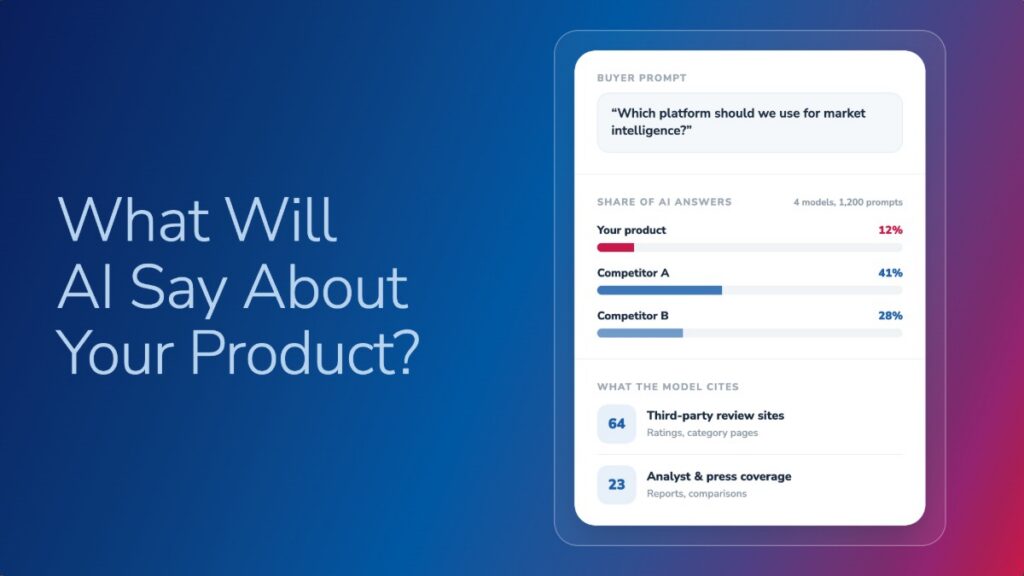
The way buyers research software is changing, fast. A growing share of buyers now start with an AI tool instead of a search bar. They ask ChatGPT which CRM fits a mid-market SaaS company. They ask Perplexity how Product A compares to Product B for enterprise security. And those AI systems answer by pulling from whatever authoritative, structured, third-party content they can find on the web.
That leaves every software vendor with one simple question: when a buyer asks an AI about your product, what does the AI find?
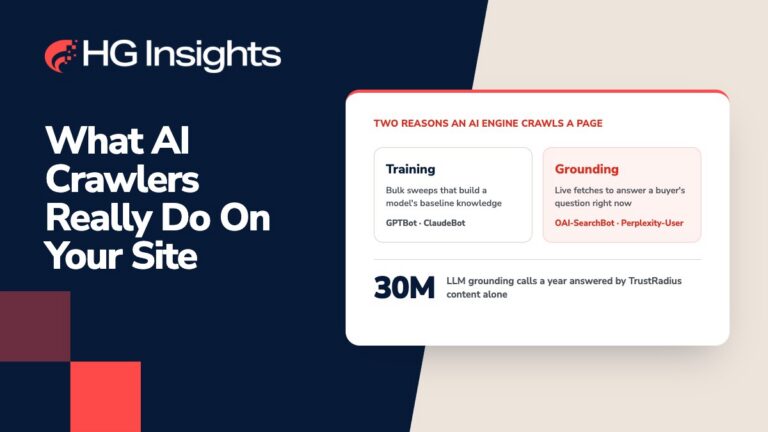
At HG Insights, we’re not guessing at the answer. We’re watching it happen with TrustRadius traffic data. This year, TrustRadius is on pace to be involved in over 60 million crawler interactions from major AI crawlers and to answer over 30 million buyer questions inside major AI search engines. AI crawler activity on our site is growing rapidly and already significantly outpaces real human visits.
That data has forced us to think about traffic in three categories now: human-led, agent-led on behalf of a human, and agent-only. Buyers haven’t abandoned review sites. But for many of them, an AI system now sits in front of the journey, shaping the shortlist before they land anywhere. Being present in that AI-generated answer is a different kind of presence than ranking for a keyword.
This is the story of what we’re building for that world, why our access to HG Intelligence data makes it possible, and how vendors can use it to run a real AI search strategy. It’s a long one, because the strategy only makes sense once you understand how AI systems actually consume content.
A buyer who asks “[Product A] vs [Product B] for enterprise security” has already decided they need a solution. They’re deciding which one. Being cited in that answer is worth more to pipeline than appearing in general category queries many times over. Our content infrastructure, from comparison and pricing pages to industry synthesis and FAQ deep dives, is built for the buyer moments that close deals.
Two ways AI uses your content
There are two distinct mechanisms at work, and both matter. Training is how models build their underlying knowledge of the world. AI models read enormous amounts of web content to develop their baseline understanding of products: what they do well, who uses them, how they compare to competitors, what buyers actually say about their value. These trained beliefs are persistent. A model that has absorbed a large body of TrustRadius reviews describing a product as the leader in its category for enterprise security will carry that association into future answers, even for prompts where it isn’t doing live retrieval. This is why verified, in-depth buyer reviews from an authoritative platform are among the highest-value training inputs at scale. Grounding is how modern AI engines answer live queries. When a buyer asks a question in real time, the AI does live web retrieval to find current, authoritative information to support its answer. The sources it chooses to cite are determined by content depth, domain credibility, verification quality, and schema structure. A page that is well-structured, schema-formatted, and built around verified buyer evidence is far more likely to be retrieved and cited than generic content. Our crawl data shows both model training bots and grounding bots crawling TrustRadius at significant and growing volume, simultaneously. That means our content is shaping what AI models believe during training and being cited in live buyer answers during grounding. Two compounding mechanisms, both working in the same direction. It also means generic review pages are no longer enough. Content optimized for human reading and keyword ranking is not the same as content optimized for machine retrieval and citation.The problem with the generic review page
Every major review platform has built essentially the same thing: a category page, a product page, a reviews page, a pricing page, a comparison page, an alternatives page. The same template, applied to every product in every category. These pages were designed for the average buyer. The problem is that the average buyer doesn’t exist. A VP of Engineering evaluating developer tooling has a completely different set of questions than a Head of Finance evaluating ERP. A financial services firm has different compliance concerns than a healthcare company. A fast-growing mid-market company has different priorities than an enterprise replacing an incumbent system. There has been an economics problem on top of this. A vendor with 2,000 reviews got the same content infrastructure as a vendor with 200. One review page. A lot of raw text behind it. A better star rating, but not a fundamentally better buyer experience. The generic model was built for a world where the goal was ranking for a keyword and presenting the aggregate view. It doesn’t work when an AI system is trying to answer a specific buyer’s specific question and needs structured, citable, persona-relevant content to do it.Why your own content isn’t enough either
Every B2B software vendor is now producing more content optimized for AI crawlability. That’s not wrong. It’s just structurally insufficient on its own. AI models trust and cite third-party sources more than vendor self-description. When a buyer asks “is this product good for enterprise security?”, the model doesn’t primarily cite the vendor’s website. It cites sources it judges to be independent, verified, and authoritative: review platforms, analyst reports, industry publications. Those sources carry authority signals that vendor content simply doesn’t. Vendors who invest only in optimizing their own content are optimizing a partial input into the AI’s perception of them. Vendors who also invest in the authoritative third-party sources AI models prefer to cite are shaping the full picture. This is the structural reason our position as a trusted third-party source for verified buyer reviews matters more in an AI-mediated world, not less.What we know that no other review platform knows
Here’s where our strategy departs from everyone else’s. TrustRadius has access to HG Insights Intelligence, the best dataset in the market on who is actually buying and using software. Real installation data, not survey estimates. Real spend signals. Real vertical and company-size profiles of the buyers who are in market for any given product. Most review platforms know what reviewers say. We also know who is using the software. That distinction changes what content can be built. When you know that the companies most commonly running a product are financial services firms of a certain size, or that mid-market healthcare is the fastest-growing segment, or that the largest competitive displacement is coming from a specific incumbent, you can build something more targeted than “what do buyers think?” You can build “what do buyers who look like you think?” HG data adds three layers that review content alone can’t: install counts by vertical and company size, vertical segments mapped to real buyer profiles, and growth trends. This structured market intelligence is exactly the kind of factual, third-party-verified information AI models prefer to cite when answering questions about market position, vertical fit, and competitive landscape.Turning raw reviews into structured answers
The second ingredient is our Review Insights engine, which changes the economics of what a review corpus can do. Instead of leaving reviews as raw text, the engine synthesizes them into structured content organized by topic: onboarding, integrations, customer support, pricing, security, specific use cases. It generates synthesis content at the topic level, the product level, and the buyer segment level, segmented using HG vertical data so the segmentation reflects real market structure. Everything is formatted in FAQPage schema that AI systems can read and cite directly, with zero extraction overhead. Review volume now compounds in a way it never did before. A large and growing review corpus doesn’t just mean a better aggregate score. It means more topic coverage, more segment-specific insights, more AI-citable pages, more structured answers to the specific questions buyers are asking. The more review depth a vendor has, the more of this can be built for them.A web of pages, not a page
Put HG Intelligence and the Review Insights engine together and something becomes possible that has never existed in the review space: a network of content pages segmented to the real buyers who are actually looking for each product. Instead of one generic product page, we build a structured set of pages that each speak to a specific buyer. What do reviewers in financial services say about this product? What do mid-market companies under a certain size say? What do buyers who switched from a specific competitor say? What do enterprises in healthcare say about compliance and security? The pages are built from actual reviewer language, enriched with HG’s install counts, spend signals, and vertical segments, and formatted for both traditional search crawlers and AI grounding engines. When a buyer asks a specific question, or when an AI system is looking for an authoritative source to cite, we have a page that directly answers it, built from verified buyer evidence. Every page is a permanent, indexed asset. It compounds a vendor’s authority on the exact questions buyers are asking, in the segments that matter most to the vendor’s ICP.Where this matters most: the middle and bottom of the funnel
We’re not trying to win every buyer query equally. The highest-value territory is the mid-funnel and deep-funnel stages where buyers are doing the serious work of comparison and decision.| Buyer stage | Query type | Why TrustRadius is built for this |
|---|---|---|
| Awareness | “What is [category]?” / “Best [category] tools” | Category pages, overall product summaries, broad review coverage |
| Mid-funnel | “[Product A] vs [Product B]” / “Best [product] for [vertical]” / “[Product] alternatives” | Comparison pages, industry-segmented review synthesis, and FAQ deep dives structured exactly for these queries |
| Deep funnel | “[Product] pricing” / “[Product] security compliance” / “[Product] ROI” / “[Product] for [specific use case]” | FAQ cluster pages, detailed review synthesis, HG install and spend data, and verified ROI reviews, at the specificity buyers need |
| Post-decision | “[Product] onboarding” / “[Product] implementation” | Review Insights and community content continue to provide cited answers after the decision |
The HG Insights GEO offering powered by TrustRadius: how vendors put this to work
Everything above is a platform investment in how the buyer experience works. Any product covered on TrustRadius benefits from better content infrastructure as we build it out. That’s the nature of a platform investment. But we’ve also built a full-stack offering for vendors who want to maximize and measure it: our GEO (generative engine optimization) offering. It’s a connected system of five components, from the strategic alignment that focuses investment on the right buyer queries, through review generation and content building, to the monitoring layer that makes the ROI story visible and concrete. Each component builds on the previous one, and together they form a continuous cycle that compounds over time.1. GEO monitoring dashboard
See exactly where you stand, and prove your investment is moving the number. The dashboard tracks your presence in real time across the major AI engines: ChatGPT, Claude, Gemini, Google AI Overviews, Microsoft Copilot, and Perplexity. Metrics cover TrustRadius mentions, citations, sentiment, citation Share of Voice versus competing review platforms, and brand mentions versus competitors. A Crawl Analytics tab shows which AI operators are crawling your pages, the split between grounding activity (live buyer queries) and training activity (model training), page-type breakdown, and competitive crawl share. Everything is filterable by product, category, prompt, and time period, built into the TrustRadius Vendor Portal and powered by Looker. This is the measurement baseline that makes every other GEO investment accountable. And because the content infrastructure is segmented by buyer persona and vertical, the monitoring is too. You can see which buyer segments are generating the most crawler and citation activity, not just an aggregate number. Share of Voice in AI responses is a metric your C-suite can read, and it maps directly to pipeline visibility.2. Setup and strategic alignment
Start focused: align on the buyer queries that actually influence decisions. Setup begins with a GEO gap analysis identifying which of your products have the highest AI interest relative to their current review coverage. This is the most concrete discovery asset for understanding where the opportunity is largest and the risk is highest. From there, we configure prompt selection and topics (the specific buyer queries to track and optimize against, chosen based on where buyers in your ICP are actually making decisions), select AI engines, and set location targeting across global markets. The result is a shared measurement baseline that aligns TrustRadius and your team on what winning looks like before any content investment begins. The single biggest risk in GEO is optimizing for the wrong thing: broad awareness queries that look good in a dashboard but don’t drive shortlist inclusion. Setup focuses investment on the mid-funnel and deep-funnel queries where buyers are deciding, and the shared baseline is what makes the ROI story meaningful at renewal.3. Review generation
Build the content signal AI engines trust most, at the prompts that matter. Reviews are the raw material every other component transforms. Our review campaign strategy is GEO-informed: collection effort is directed toward the prompts where review coverage is weakest relative to AI interest, as identified during setup. Custom review question deployment guides reviewers to address the specific topics that matter most for your target prompt set. Active campaign management and verified customer outreach keep the corpus growing against evolving prompts. TrustRadius reviews average significant depth per review, which is exactly the specificity AI engines need to extract citable, structured signal. Targeted collection drives citation authority for the specific buyer queries that matter, rather than just growing review count broadly. Verified, attributed reviews carry the authority signals AI models weight when selecting citations. And review depth directly determines how many buyer persona pages can be built and how specific the segmentation can get.4. Custom questions and Review Insights
Transform raw reviews into structured, AI-ready content. This component closes the gap between having reviews and having AI-citable content. Four Review Insights lenses do the work: Overall Summary, Question-Based Summary, Industry-Based Summary (using HG vertical segments), and Quote Selection. Custom review questions ensure the corpus addresses the high-value prompt areas identified in setup. Detailed Review Synthesis pages are segmented by topic and by HG vertical, with full quote sets in the DOM at page load, fully visible to AI grounding crawlers. All content is in FAQPage schema, so AI systems can parse and cite it directly with zero extraction overhead. Industry segmentation using HG vertical data means AI can cite TrustRadius for vertical-specific queries (“best [product] for financial services”) rather than only general ones. The expertise behind this synthesis is what makes TrustRadius a preferred citation source rather than just a repository of text.5. Execution: content and pages
Build the authority layer that makes TrustRadius the most citable source for your category. This is the other key buyer-site innovation we’re bringing to the reviews space. We take the data directly from Conductor, the platform behind our GEO monitoring, and translate it into the buyer pages and buyer content we create on your behalf. The topics and prompts you identify as important become the blueprint for custom buyer pages we call GEO-FAQ pages. These FAQ cluster pages are built from Conductor prompt data and organized into topic clusters with a four-layer structure: overall synthesis, top topics, topic synthesis, and all reviewer quotes, at the depth AI engines need to answer buyer questions with specificity. The key is that we’re building answer-ready content using intelligence about which topics and prompts will drive the most impact, then amplifying that story to buyers through both traditional and AI search. Each page is a permanent, indexed, AI-citable asset. FAQ cluster pages directly answer the queries buyers are asking AI tools at scale, built from verified reviewer language. HG data enrichment adds the market intelligence layer no other review platform can provide. Long-form content builds the topical authority AI engines weight for category-level queries. Every new page extends your presence into the specific buyer moments that drive decisions.How the five components connect
| Component | Creates | Feeds into |
|---|---|---|
| GEO monitoring | Baseline measurement and ongoing proof | Shows which prompts need more coverage; validates execution impact |
| Setup and alignment | Focused investment on the right queries | Directs review campaigns; sets the benchmark everything else measures against |
| Review generation | The raw content signal AI engines trust | Provides the corpus Review Insights synthesizes and FAQ pages draw quotes from |
| Custom questions and Review Insights | Structured, schema-ready, AI-citable content | Powers FAQ cluster pages and Review Synthesis pages |
| GEO Optimization Servces: content and pages | Durable citation authority at the query level | Reinforces the measurement baseline; creates the long-term compounding advantage |
What makes this different
Other review sites may show you a big citation number, or talk about their role in building your story with buyers in AI search. We believe our strategy is different in two specific ways. First, while we’re focused on driving broader visibility for as many queries, topics, and prompts as possible, we want vendors to define the set of topics and prompts that matter most to their business outcomes. We want to be a partner in building a winning buyer influence strategy: focused on the right types of buyers, the right product and topic areas, and the places where it matters most. Second, we take that information and customize our content strategy around those focus areas to amplify your message to buyers. Your TrustRadius buyer pages become an asset that aligns to your GTM strategy, and one that evolves as your strategy changes. This is what turns our buyer pages from a static listing into a controllable tool for executing your GEO influence strategy.Who benefits most, and what it costs you
Any product covered on TrustRadius, paid relationship or not, benefits as we build out this infrastructure. But vendors who partner with us get the deepest and most complete version of it, for two structural reasons. Review depth drives segmentation depth. The number of pages that can be built for a product, the number of buyer personas that can be covered, and the specificity of the content on each page are all direct functions of review coverage. A product with rich review depth across many customer types can have pages for financial services buyers, mid-market buyers, healthcare buyers, and more, each populated with real buyer language and verified evidence. A product with thin coverage can only go so far. Driving reviews isn’t just a GEO metric. It’s the raw material the platform runs on. Partners also get to see it working. Non-partners have content built from whatever reviews exist. Partners have content built from an active, growing corpus, plus full visibility through the Vendor Portal’s performance dashboards and the GEO monitoring layer: citation activity, crawler engagement, and Share of Voice broken down by buyer segment and prompt type. And the only required input from a vendor is reviews. We handle the content strategy, the segmentation logic, the synthesis engine, the page infrastructure, the schema formatting, and the GEO measurement. The more reviews you drive, the more your product benefits, and the more specifically the monitoring can tell you which buyer segments are engaging and which prompts are driving citations.The expertise layer
Our mission has always been to help B2B buyers make better decisions. In the AI era, that mission extends beyond TrustRadius.com. When AI models train on our content, the verified buyer language in it shapes the model’s understanding of the category, and every answer that model gives to every buyer who asks, anywhere. When AI grounding engines retrieve our content to answer a live query, they’re using TrustRadius as the authority that resolves the question. We’re not just influencing the buyer on TrustRadius.com anymore. We’re influencing the buyer wherever they’re asking the question. Every investment described here, the Review Insights engine, the segmented page infrastructure, the HG data enrichment, the schema formatting, the GEO offering, serves one goal: making TrustRadius the authoritative source AI models trust to answer the buyer questions that drive software decisions, wherever those questions are asked. The buyer journey has a new front door. We intend to be on the other side of it.Author
-

Grace Wells is a seasoned marketing strategist with over a decade of experience leading marketing efforts for diverse brands. She is passionate about helping clients achieve their marketing, branding, and ROI goals through thoughtful 360 degree approach to campaign execution. Grace is a tech nerd and loves nothing more than reading up on the latest marketing technology trends. She enjoys advising her clients and customers on which tools will help move the needle for their business.