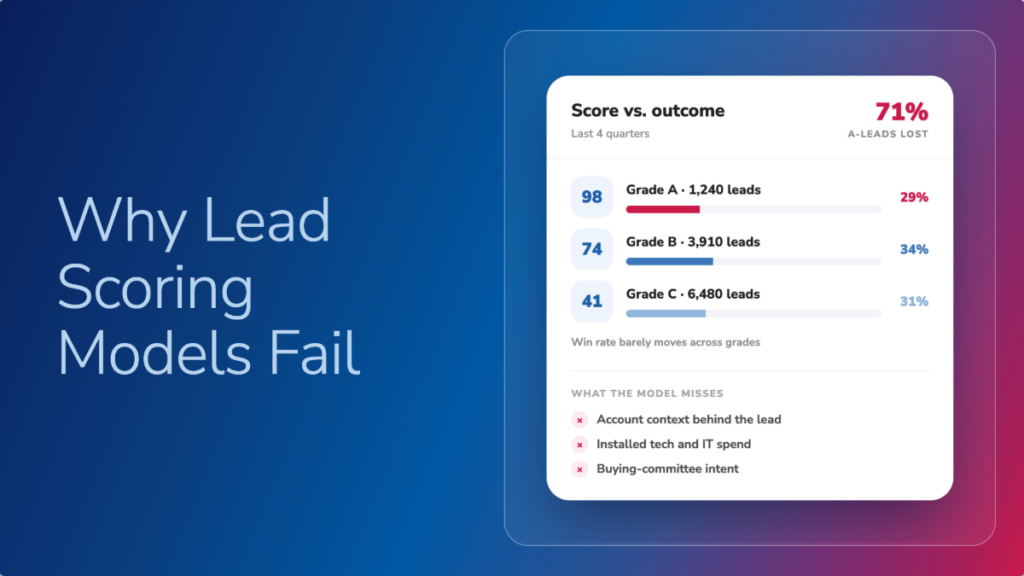
Most B2B lead scoring models don’t fail because the leads are bad. They fail because nobody on the sales team believes the number next to each name. A lead scores 91, a rep asks why, and the honest answer is usually “the model decided.” That answer doesn’t change behavior, and a scoring model nobody acts on isn’t really a scoring model. It’s a spreadsheet with extra math.
Quick Answer: Most B2B lead scoring models break down not because of bad data, but because the scoring logic is a black box even to the people using it. Reps ignore scores they can’t explain, near-threshold leads get skipped, and marketing keeps buying more signal to fix a trust problem, not a data problem.
The trust gap in modern lead scoring
Marketing Ops teams have spent years layering intent tools, technographic data, and engagement tracking onto their scoring models. The volume of signal keeps growing. Conversion from marketing-qualified lead to real pipeline usually doesn’t grow with it.
The reason is rarely the signal itself. It’s what happens after the score gets calculated. A rep opens a list sorted by score, sees a 91 next to one name and a 68 next to another, and has no way to know what actually produced those numbers. Was it job title? A pricing page visit? An intent spike from a data partner the rep has never heard of? When the model can’t answer that question, reps stop trusting the ranking and fall back on gut instinct, alphabetical order, or whatever landed in their inbox most recently.
This is where a lot of scoring investment quietly goes to waste. Teams add another data source hoping it improves accuracy, when the actual gap is that the existing signals were never explainable in the first place. More inputs into a black box just produce a more confident-looking black box.
Why explainable scoring is the foundation of a model reps trust
A scoring model earns trust the same way a good manager does: by showing its reasoning, not just its conclusion. That’s the practical difference between a black-box model and a glass-box one, and it’s worth breaking into its parts.
Glass-box scoring shows its work
A glass-box score gives a rep a number and the reasoning behind it. HG Insights builds this around two questions, scored separately.
Customer Fit asks who — does this account look like the kind of company that becomes a customer?
Likelihood to Buy asks when — is this account actively engaging today, or is the activity gone cold?
The two combine into a single Lead Grade, so a rep sees one number and, behind it, the specific signals that produced it, without opening a spreadsheet to reverse-engineer the logic. Sybill’s writing on B2B lead scoring makes the same point from the buyer’s seat: reps who can see which signals drove a score change their behavior based on it, while reps handed an unexplained number tend to ignore it entirely (Sybill). That single distinction, visible reasoning versus a verdict, is the difference between a model that gets used and one that gets quietly abandoned.
Fit quality matters more than fit volume
Most scoring models still lean on firmographic shortcuts: employee count, industry, revenue band. Those fields are easy to pull and easy to defend in a slide deck, but they’re a rough proxy for fit, not a measurement of it. A tighter definition of fit, one that accounts for the specific combination of technology stack, buying signals, and account behavior that actually predicts a good customer, surfaces accounts a firmographic filter alone would miss entirely.
Near-threshold leads are where trust actually breaks
Static scoring models treat a threshold like a wall. A lead at 74 gets nothing. A lead at 76 gets a phone call. In practice, the leads sitting just below the cutoff are often the ones about to move, and a model that can’t flag rising intent in that window quietly lets them go cold. Scoring that degrades or updates with real engagement, rather than sitting fixed until the next batch refresh, catches that movement before it’s gone.
How a trustworthy scoring model supports marketing, sales, and RevOps
Marketing Ops owns the model’s inputs and is usually the first to feel the trust gap, since a scoring model reps ignore makes every campaign look less effective than it actually was. Demand Gen Managers depend on the same trust to justify budget: a model leadership can’t explain is a model leadership eventually stops funding, regardless of how much signal sits behind it. RevOps carries the technical weight of keeping scoring fields synced correctly between the CRM and marketing automation platform, and an explainable model gives them a debugging path when scores look wrong instead of a black box to shrug at. Sales reps are the simplest case: they act on what they understand and route around what they don’t, which means an unexplainable model doesn’t get adopted so much as tolerated until someone builds a workaround.
Why don’t sales reps trust lead scoring models
Reps distrust lead scoring models when the score isn’t tied to visible reasoning. A number with no explanation reads as arbitrary, so reps default to their own judgment or ignore the ranking outright. Models that expose the specific signals behind each score, and update as real engagement changes, are the ones reps actually build their day around.
That gap between a technically accurate model and a model people use is rarely about the math. It’s about whether the math is legible to the person expected to act on it.
Build a lead scoring model your team actually uses with HG Insights
HG Insights’ Account Scoring runs on the Customer Fit and Likelihood to Buy models described above, combining technographic, firmographic, and behavioral signals into a Lead Grade built to be read, not just trusted on faith. Every score comes with the specific signals behind it, so a rep can see why an account ranks where it does instead of taking the number on authority. For Growth-segment teams already running scoring in Marketo, HubSpot, or Salesforce, Account Scoring layers into that existing workflow rather than replacing it, adding the explainability and fit precision most models are missing without asking anyone to rip out what already works.
The fit precision part isn’t theoretical. One customer, Gusto, used HG Insights’ lead scoring to bucket leads into high-scoring and low-scoring groups, then tested the difference directly with a real control group: high-scoring leads converted 15% better when a rep called, at 98% statistical confidence, while low-scoring leads showed no lift at all. That’s the same principle from the paragraph above in action, a rep-actionable score that tells reps where their time actually changes the outcome, and identifies the 35% of leads that convert just as well without wasted efforts.
See how HG Insights supports lead prioritization for Growth-segment teams.
The mechanics behind a model that holds up under scrutiny, what separates a real fit signal from a dressed-up firmographic filter, and how to audit your own scoring before your next planning cycle, are covered in full in The ABM Precision Playbook, Part 1: The Foundation. Get the playbook.
Frequently asked questions
What is a B2B lead scoring model?
A B2B lead scoring model assigns a numerical value to each lead based on signals like firmographic fit, technographic data, intent activity, and engagement history. The score is meant to rank leads by likelihood to convert, though the model only works if sales actually trusts and acts on the ranking.
What's the difference between black-box and glass-box lead scoring?
Black-box scoring produces a number without showing which signals created it, leaving reps unable to verify or explain the ranking. Glass-box scoring exposes the specific inputs behind each score, so a rep can see exactly why an account or lead ranks where it does.
Why do good leads still go cold even with a scoring model in place?
Leads often go cold near the qualification threshold, where static models treat a one-point difference as a hard cutoff. A lead scoring 74 may get no follow-up while a 76 gets a call, even though both are close enough to warrant attention.
Does adding more data sources improve lead scoring accuracy?
Not on its own. Additional intent tools and data feeds add more inputs to the model, but if the underlying scoring logic still isn’t explainable, more signal just produces a more confident-looking black box rather than a model reps trust more.
How is account fit different from firmographic filtering?
Firmographic filtering relies on broad fields like employee count or industry to approximate fit. A more precise fit model accounts for the specific combination of technology stack, buying behavior, and account-level signals that actually correlates with a good customer, which surfaces accounts firmographics alone would miss.
Author
-

Nik Koutsoukos brings over 25 years of product and marketing executive leadership to his role as VP of Product Marketing at HG Insights. He drives product GTM, customer and partner-marketing, and sales enablement to increase awareness, reach, adoption, and growth.
Prior to HG Insights, Nik held senior positions including VP of Product Marketing at SolarWinds, Chief Marketing Officer at Catchpoint, and VP of Product Marketing at Riverbed Technology, where he helped scale adoption of enterprise performance and observability solutions. Nik brings deep expertise in translating complex technology into compelling market value and partner-aligned growth. He holds a BSEE from Leeds Beckett University.