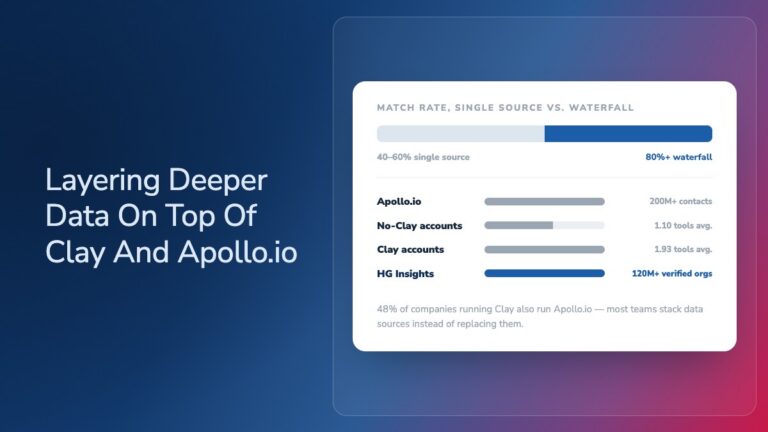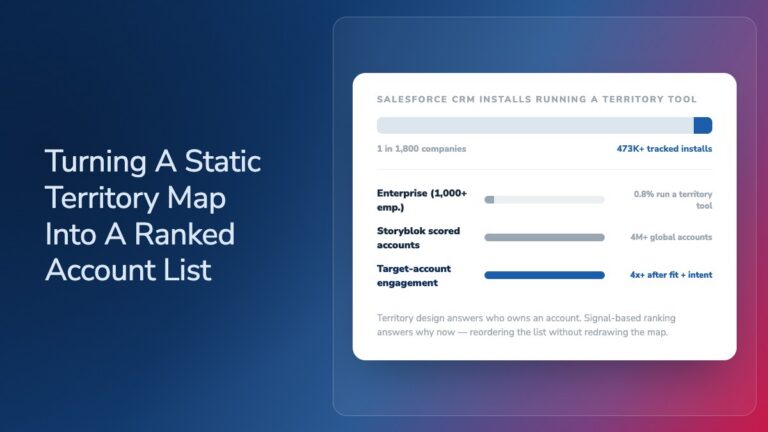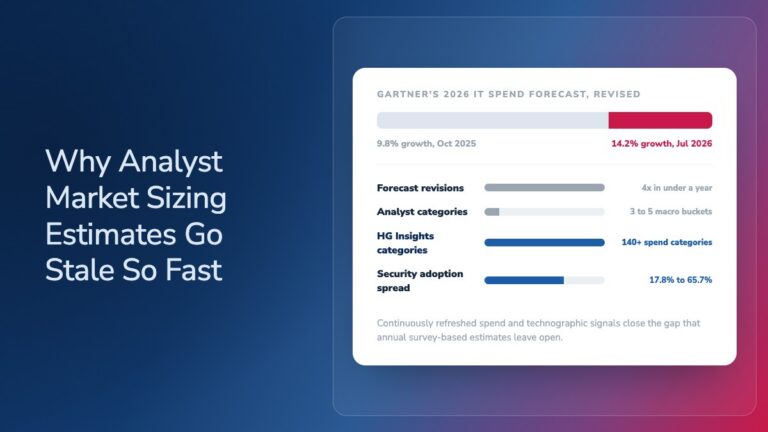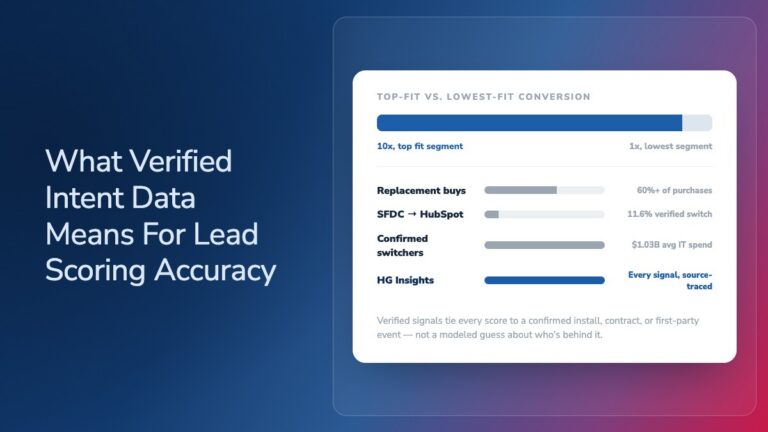
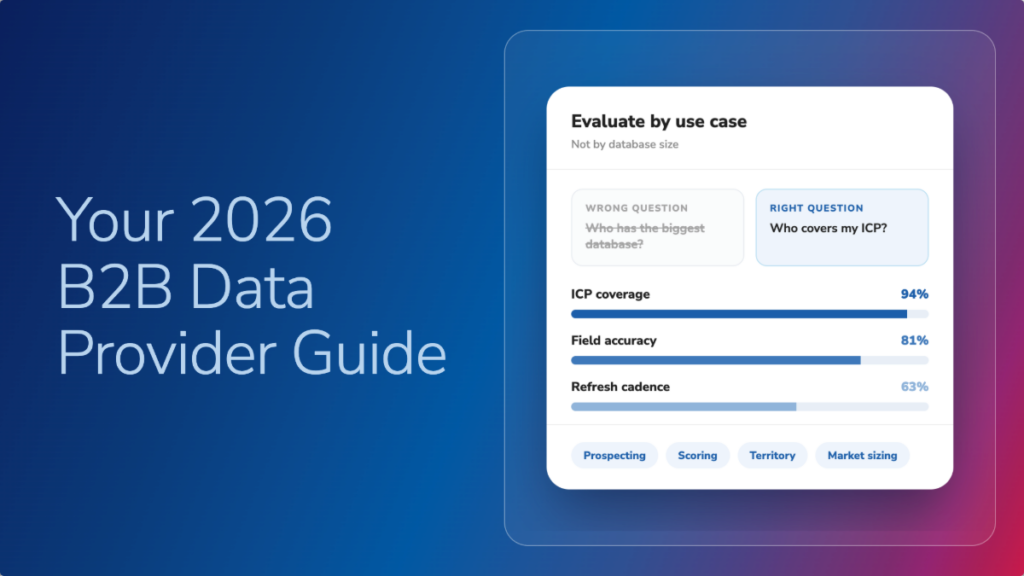
Most B2B data provider comparisons answer the wrong question. They rank platforms by database size or brand recognition, then leave you to figure out whether any of them actually covers your ICP. The result: six-figure annual contracts on data that matches 40% of your accounts and degrades faster than your team can use it.
This guide organizes B2B data providers differently. The category has fractured into four distinct data types (contact, firmographic, technographic, and intent), and a platform that leads on one often underperforms on the others. Before you evaluate any vendor, you need to know which data type your GTM motion actually requires. That question comes first.
Here’s what you’ll find:
- The six criteria that predict real-world data provider ROI
- Top providers segmented by use case, not by popularity
- A full comparison table
- How to match a provider to your GTM motion
Quick Answer: A B2B data provider is a platform or service that supplies structured intelligence about companies and business contacts to support sales, marketing, and revenue operations. The category spans four distinct data types: contact data (emails, phone numbers), firmographic data (company attributes), technographic data (technology install intelligence), and intent data (in-market buying signals). The right provider depends entirely on which data type your GTM motion requires.
Data provider vs. data platform: when the distinction matters
Some vendors sell raw data as an exportable asset or API. Others embed data inside a workflow platform. The choice between them is a workflow architecture decision, not a data quality comparison.
Choose a pure data provider if you have existing CRM and marketing automation infrastructure, want flexibility to layer multiple data sources, and are buying data for enrichment rather than a prospecting workflow. Choose a platform if you need prospecting tools, engagement sequences, and data in one system; if your team lacks RevOps bandwidth to manage integrations; or if you are earlier-stage and optimizing for speed to value over customization.
How we evaluated these B2B data providers
The most common mistake in data vendor evaluation is using database size as a proxy for fit. A provider with 300 million records that matches 35 percent of your ICP is a worse choice than a provider with 80 million records that matches 75 percent. The six criteria below predict real-world ROI. Database size is not one of them.
- Match rate
- Data freshness and decay rate
- Geographic coverage
- Compliance posture
- Integration compatibility
- Pricing model and total cost of ownership
Match rate
Match rate is the percentage of your account or contact list that a provider can return a verified record for. It is the single most important evaluation criterion and the one vendors are most reluctant to disclose.
How to test it before signing: ask the vendor to run a pre-sale match test against a masked version of your existing account list. Provide 250 to 500 records: company name, domain, and firmographic attributes, no personal data. Require they return match counts and matched percentage, not just a sample of matched records. A reputable provider will run this test at no cost.
The red flag is any vendor that declines the test, requests unusual conditions for running it, or responds with aggregate database statistics rather than performance against your specific accounts. That hesitation is the answer.
Data freshness and decay rate
Data freshness refers to how frequently records are re-verified and how quickly stale data is flagged or removed before it is served. The industry baseline for contact data decay is 25 to 30 percent annually. Job title changes alone account for a significant portion of this, driven by a job-change rate in professional roles that industry research estimates at roughly 20 percent annually.
What to ask any provider: How often is each data type re-verified? Do you flag records as “likely stale” before removing them, or does stale data remain in the database until it fails an outreach attempt? What is the average age of records in your database? Providers who cannot answer these questions with specific numbers are telling you something important about how seriously they take data quality.
Geographic coverage
Coverage counts by region are a marketing metric. Match rates by region are an operational one. US-centric providers, including historically Apollo and ZoomInfo, have substantially lower match rates and accuracy outside North America. For any company with significant EMEA or APAC pipeline, geographic coverage accuracy is a primary filter, not a secondary consideration.
For UK and EU buyers specifically: GDPR compliance is a legal requirement, not a feature. Verify that a provider’s data collection and storage practices are GDPR-compliant. The presence of a compliance page does not confirm compliant data practices. Ask for a Data Processing Agreement before the evaluation progresses.
Compliance posture
Minimum requirements for any provider serving enterprise B2B companies: GDPR-compliant data collection with documented lawful basis for processing EU personal data, CCPA compliance, and SOC 2 Type II certification. The questions to ask are specific: How is consent documented for contacts in the EU? What is your process for honoring data subject deletion requests? Do you carry cyber liability insurance?
One compliance gap that persists across the market: many providers are compliant in their own data practices but do not guarantee that customers are using the data compliantly. Your enterprise security and legal teams should assess data use compliance as a separate workstream from vendor compliance posture.
Integration compatibility
The depth of integrations matters more than the length of the integrations list. Native Salesforce, HubSpot, and Microsoft Dynamics integrations are the baseline. MAP integrations (Marketo, Pardot, HubSpot Marketing) and API access for custom enrichment workflows separate providers with genuine enterprise depth from those with shallow platform connections.
Watch for providers that offer native integrations only on higher pricing tiers, or that rely on middleware like Zapier for basic CRM sync. These are architectural limitations that will surface as operational friction after contract signature.
Pricing model and total cost of ownership
Three common pricing structures exist in this market: per-seat licensing, credit-based models, and volume-based data export. Credit-based models create the most common TCO surprises. The credit consumption rate for real-world use cases is frequently higher than what a sales cycle demo suggests.
Before committing, ask the vendor to model TCO against your actual use case in specific terms. “We need to enrich 10,000 accounts per quarter and prospect 500 new contacts per month” produces a more accurate annual cost estimate than standard tier comparisons.
The best B2B data providers in 2026
The best B2B data provider depends on the data type you need and the GTM motion you are running. The sections below are organized by use case. Several providers appear in more than one section where they genuinely serve multiple use cases, but the full list includes:
- Apollo.io
- Bombora
- Cognism
- Demandbase
- Dun and Bradstreet
- G2
- HG Insights
- LeadIQ
- Lusha
- Seamless.AI
- TechTarget
- TrustRadius
- UpLead
- ZoomInfo
- 6sense
Best for enterprise account intelligence and GTM strategy
If you are running an enterprise GTM motion, you need more than contact lists. You need account-level intelligence that informs territory design, ICP prioritization, competitive displacement strategy, and pipeline forecasting. The providers below lead on depth of account-level intelligence rather than volume of contact records.
- HG Insights
- ZoomInfo
- Demandbase
- 6sense
1. HG Insights
HG Insights is purpose-built for enterprise B2B technology companies that need to understand not just who a prospect is, but what technologies they run and whether they are likely in-market. Delivered through Market Analyzer and Sales Copilot within the RGI Platform, it combines technographic data with technology-specific intent signals to support account prioritization, TAM modeling, and competitive displacement programs. If you are a VP of Marketing, Demand Gen Director, or RevOps leader at a B2B technology company running ABM, territory planning, or competitive displacement, this is built for you.
2. ZoomInfo
ZoomInfo provides the deepest US contact and company data available, with particular strength in business hierarchy mapping, job change alerts, and conversation intelligence through its Chorus acquisition. It is the strongest fit for large enterprise sales teams with predominantly US GTM focus. Pricing for enterprise access typically starts at $20,000 or more annually, and international coverage quality drops meaningfully outside North America.
3. Demandbase
Demandbase leads on account-based marketing workflow, with strong intent data and website visitor identification via IP resolution. It is primarily a platform, not a pure data provider, making it best suited for marketing teams running ABM programs who want account intelligence and activation tooling in one place.
4. 6sense
6sense provides predictive AI for account prioritization, buying stage prediction, and technographic data as part of an ABM platform. It works well for enterprise revenue teams running account-based motions who want predictive scoring alongside company identification and technographic signals.
Best for technographic data and tech stack intelligence
Technographic data is the most underused signal in B2B GTM. It answers questions that contact data cannot: Is this account already running your competitor’s product? Are they building on a technology stack your product integrates with? Are they mid-migration from a platform you could displace? No other data type answers those questions. The leaders in this category are:
- HG Insights
- 6sense
- Bombora
1. HG Insights
HG Insights is the leading dedicated technographic data provider in B2B, tracking more than 100,000 technologies across 120+ million organizations, verified to 90 percent accuracy and drawn from over 20 billion external data points. For comparison, general-purpose contact platforms typically track 18,000 to 30,000 technologies. HG Insights’ coverage is more than three times broader, and the underlying methodology goes substantially deeper.
The differentiator is not just breadth but specificity. Unlike providers that detect binary technology presence (“this company uses Salesforce”), HG Insights surfaces deployment intensity: how deeply a technology is embedded across an organization, which departments run it, and whether usage is expanding or contracting. The platform also uses behind-the-firewall detection to surface signals that web-artifact analysis alone misses. Combined with technology-specific intent signals, you can identify not just that a company uses a given vendor, but that the same company is actively evaluating alternatives. No general-purpose intent provider replicates that targeting layer.
2. 6sense
6sense incorporates technographic data as a layer within its ABM platform. Coverage is strong for teams already running within the 6sense ecosystem, but it is not as deep as a dedicated technographic provider if you are building tech-stack-based ICP models or competitive displacement programs.
3. Bombora
Bombora captures some technology-use signals within its intent co-op data set. These signals work well as a complement to dedicated technographic data, not a replacement. Bombora’s strength is behavioral intent patterns; technographic precision is not its core capability.
Best for contact prospecting and SDR outreach
If your primary use case is building lists of verified contacts for outbound prospecting, the providers below lead on email accuracy, phone verification rates, and database size. Performance across this category varies significantly by geography, but the leading providers here include:
- Apollo.io
- Cognism
- ZoomInfo
- Lusha
- HG Insights
- LeadIQ
- Seamless.AI
1. Apollo.io
Apollo.io offers 275 million-plus contact records, a strong free tier, and built-in email sequences. It is the most cost-effective all-in-one option for SMB and mid-market teams running high-volume outbound, though data accuracy outside the US degrades meaningfully and email bounce rates run higher than premium verified providers. Starting price is approximately $49 per user per month.
2. Cognism
Cognism leads for EMEA coverage with phone-verified mobile numbers through its Diamond Data set, and a GDPR-compliant architecture built for the European market. If you have significant UK or European pipeline, or work in a compliance-sensitive organization where data lineage must be documentable, this is the go-to. Pricing is quote-based and typically starts at $15,000 or more annually for team access.
3. ZoomInfo
ZoomInfo holds the largest US contact database with the deepest direct-dial coverage and strong Salesforce integration. It is the strongest fit for large enterprise SDR teams focused on the US market. Pricing is enterprise-minimum and not publicly disclosed.
4. Lusha
Lusha delivers fast individual contact lookups via browser extension, which makes it well suited for reps prospecting through LinkedIn. It is less effective for bulk enrichment workflows. Approximately $22 per user per month.
5. LeadIQ
LeadIQ is built for LinkedIn-native SDR workflows and integrates tightly with Sales Navigator. If your prospecting motion is LinkedIn-first, this is where to start. Approximately $39 per user per month.
7. Seamless.AI
Seamless.AI offers AI-powered real-time search with a large record volume. Data quality reviews from users are mixed, with higher bounce rates reported compared to verified providers. It works for high-volume teams with tolerance for some data decay in exchange for record breadth and lower cost.
Best for intent data and in-market signal detection
Intent data identifies companies actively researching solutions like yours. The category ranges from broad third-party behavioral signals to publisher-specific content consumption signals to technology-specific evaluation activity. Match the signal type to your sales motion, and consider these vendors:
- Bombora
- TrustRadius
- HG Insights
- TechTarget
- G2
1. Bombora
Bombora remains the dominant third-party B2B intent data source, aggregating signals from more than 5,000 B2B publisher sites across hundreds of topic categories. It works well for broad in-market prioritization across any industry vertical and integrates natively into most ABM platforms. One important caveat: Bombora’s co-op model surfaces aggregated behavioral patterns, not individual-level activity. Use it as a prioritization signal, not an individual buyer trigger.
2. TrustRadius
TrustRadius delivers buyer intent signals sourced from its software review and comparison platform, where every user is professionally authenticated through LinkedIn or a verified work email. The result is named-buyer intent: you see not just which companies are researching your category, but which specific individuals are doing the research, a level of specificity that changes the outreach calculus for high-ACV sales motions where knowing the buyer’s title and company matters before the first outreach. The limitation is scope: these signals come exclusively from accounts already aware of the category and actively comparing vendors on the platform. Early-funnel accounts will not surface here.
3. HG Insights
HG Insights provides technology-specific intent signals that combine install base data with evaluation activity. Where Bombora tells you an account is researching a broad category, HG tells you that the same account currently runs a specific vendor and is actively evaluating alternatives. That level of specificity is not available from general intent providers. It is the right fit for B2B technology companies running competitive displacement or technology-specific ABM programs.
4. TechTarget
TechTarget offers publisher-based intent derived from content consumption by known IT decision-makers. Signal confidence is high because TechTarget knows who is consuming the content: registered users, not just company-level activity. It is the strongest fit for enterprise technology vendors targeting IT buyers.
5. G2
G2 Buyer Intent captures intent signals from review and comparison activity on G2. These are late-stage signals: accounts comparing your product against competitors on G2 are likely in an active evaluation. The limitation is scope: G2 intent only surfaces accounts already aware of the category and its players. You will not find early-stage in-market accounts here.
Best for EMEA coverage and global compliance
Most B2B data providers were built around US data infrastructure. EMEA coverage quality, particularly for UK, DACH, France, and the Nordics, is where the most significant accuracy gaps appear. For any company with European pipeline, GDPR compliance is a baseline requirement, not a differentiator. Some top options include:
- Cognism
- ZoomInfo
- Lusha
1. Cognism
Cognism is purpose-built for the EMEA market. GDPR compliance is architectural rather than retrofitted, and its phone-verified coverage for UK and European contacts leads the category. For UK-specific B2B data, Cognism is the clearest recommendation in the market.
2. ZoomInfo
ZoomInfo has improved EMEA coverage through acquisitions and data partnerships, but still trails Cognism for EU accuracy and phone verification quality. It remains the stronger choice for US-heavy GTM motions with selective EMEA requirements.
3. Lusha
Lusha provides reasonable European coverage with GDPR compliance. A viable option if you need individual contact lookups across both US and EU markets without managing two separate platforms.
Best for TAM modeling and market sizing
TAM modeling requires a fundamentally different data profile than contact prospecting. You need breadth of company coverage, accurate company-level attributes at scale, and (for technology-sector TAMs) the ability to segment your addressable market by technology install base. Most contact data providers are a poor fit for this use case. Here are the best providers for TAM modeling and market sizing:
- HG Insights
- ZoomInfo
- Dun and Bradstreet
1. HG Insights
HG Insights is the strongest option for technology-specific TAM modeling. Using Market Analyzer within the RGI Platform, you can size markets by technology install base, vendor category, and technology stack configuration, a capability no contact data provider replicates. The practical use case is precise: “How many companies in North America with 500 or more employees currently run SAP ERP and represent a plausible fit for our integration?” HG Insights answers that question. A list of verified contacts does not.
2. ZoomInfo
ZoomInfo provides strong firmographic coverage for company-level TAM models based on industry classification and company size. Less effective for technology-specific TAM segmentation.
3. Dun and Bradstreet
Dun and Bradstreet is the enterprise standard for global firmographic breadth, particularly for financial services and regulated industry segments. Business hierarchy data (subsidiary-to-parent mapping at global scale) is industry-leading. Best fit: enterprise TAM models where corporate structure and industry classification are the primary sizing dimensions.
Best for SMB and mid-market budgets
Not every GTM team has a six-figure data budget. These providers offer meaningful value for smaller teams or companies at earlier stages of go-to-market build:
- Apollo.io
- UpLead
- LeadIQ
- Lusha
1. Apollo.io
Apollo.io is the strongest all-in-one value play at this tier: large database, built-in engagement sequences, and a free tier that remains functional for individual users.
2. UpLead
UpLead emphasizes accuracy guarantees with real-time email verification at the point of export. Claimed accuracy is 95 percent or higher. Credit-based pricing starts at approximately $99 per month.
3. LeadIQ
LeadIQ offers accessible team pricing for LinkedIn-first SDR workflows without enterprise commitments.
4. Lusha
Lusha works well for individual reps who need fast contact lookups without a team license or annual contract.
B2B data provider comparison table
Use this table as a starting point. Match rates against your specific ICP will vary significantly from provider to provider, and the only reliable way to measure fit is a pre-sale match test against your actual accounts.
Provider | Primary data type | Best use case | EMEA coverage | GDPR compliant | Pricing model | Free tier |
HG Insights | Technographic + Intent | Enterprise account intelligence, TAM modeling, competitive displacement | Moderate | Yes | Quote-based | No |
ZoomInfo | Contact + Firmographic | Enterprise SDR, US market | Improving | Yes | Quote-based | No |
Apollo.io | Contact | SMB outbound, all-in-one | Limited | Yes | Per-seat, ~$49/mo | Yes |
Cognism | Contact (phone-verified) | EMEA prospecting, compliance | Best-in-class | Yes (purpose-built) | Quote-based | No |
Bombora | Intent | In-market prioritization | Moderate | Yes | Quote-based | No |
Lusha | Contact | Individual rep prospecting | Good | Yes | Per-seat, ~$22/mo | Yes |
LeadIQ | Contact | LinkedIn-first SDR teams | Moderate | Yes | Per-seat, ~$39/mo | Yes |
6sense | Technographic + Intent | ABM-led GTM, predictive scoring | Moderate | Yes | Quote-based | No |
Demandbase | Intent + ABM | Account-based marketing | Moderate | Yes | Quote-based | No |
Seamless.AI | Contact | High-volume US prospecting | Limited | Yes | Per-seat | Yes |
TrustRadius | Intent (named-buyer) | Late-stage intent, high-ACV sales | Global | Yes | Quote-based | No |
G2 Buyer Intent | Intent (review-stage) | Late-stage competitive intel | Global | Yes | Quote-based | No |
UpLead | Contact | SMB accuracy-focused | Moderate | Yes | Credit-based, ~$99/mo | No |
Dun and Bradstreet | Firmographic | TAM modeling, enterprise hierarchy | Global | Yes | Quote-based | No |
How to match a B2B data provider to your GTM motion
The right B2B data provider depends on your GTM motion as much as your budget. The same data that powers an effective ABM program is not necessarily the same data that powers a high-volume outbound motion. Here is how to match provider type to motion, based on the following teams:
- Outbound-first teams
- ABM-focused teams
- PLG and expansion-focused teams
- RevOps and data enrichment teams
Outbound-first teams
Your primary data need is accurate contact data with high match rates against prospecting lists and LinkedIn integration.
Recommended starting point by budget and geography: Apollo (budget and US-heavy), Cognism (EMEA or compliance-sensitive), ZoomInfo (US enterprise with existing Salesforce investment). Layer HG Insights technographic data on top for account prioritization, and Bombora intent signals for timing outreach to accounts showing active research activity.
ABM-focused teams
Your primary data need is account-level intelligence, intent signals, and company attributes for scoring and segmentation.
Recommended starting point: 6sense or Demandbase as the platform layer, HG Insights for technographic intelligence in account selection and scoring, and Bombora for broad in-market intent signals. The key distinction for ABM teams is the platform-versus-provider question. ABM motions typically require workflow tooling (ad targeting, account identification, stage progression) in addition to data, which points toward platforms rather than pure data providers.
PLG and expansion-focused teams
Your primary data need is technology install data to identify expansion signals within your existing customer base, and firmographic enrichment for product-led growth conversion scoring.
Recommended starting point: HG Insights for technographic signals that identify which free users or lower-tier customers work at companies with the right technology profile for expansion. The use case is specific: identify which accounts have the tech stack configuration that predicts conversion to a higher-tier plan or expansion to additional seats. RGI Fabric handles CRM enrichment natively, syncing HG’s technographic and intent signals directly into Salesforce, HubSpot, or Snowflake. No separate enrichment platform required.
RevOps and data enrichment teams
Your primary data need is CRM enrichment at scale, automated data hygiene, and multi-source waterfall strategy management.
Recommended starting point: design the waterfall architecture first. Primary contact provider based on your dominant market, specialty providers for technographic and intent data layers, and orchestration tooling to route records through providers in sequence. HG Insights’ API and RGI Fabric integrations make it a natural technographic layer in any waterfall stack, connecting to Salesforce, HubSpot, Snowflake, Marketo, BigQuery, and Outreach out of the box.
Build your account intelligence layer with HG Insights
The data gap that matters most for enterprise B2B technology companies is not contact coverage. It is account intelligence: knowing what technologies your target accounts run, whether they are in a buying cycle, and how to prioritize a large addressable market into a focused, high-confidence segment.
HG Insights is purpose-built for this. The RGI Platform, delivered through Market Analyzer, Sales Copilot, and the Prospecting Assistant, combines technographic data with technology-specific intent signals and surfaces those signals directly in your CRM and sales workflow via RGI Fabric. The result is an account intelligence layer that contact data providers do not offer: not just who to reach, but why to reach them, when the timing is right, and what to say when you get there.
Find out how HG Insights can sharpen your ICP, model your TAM, and identify the accounts most likely to displace. See the RGI Platform in action.
Frequently asked questions
What is a B2B data provider?
A B2B data provider is a company that supplies structured data about businesses and business contacts to support sales, marketing, and revenue operations teams. The data includes email addresses, phone numbers, company attributes, technology usage, and buying intent signals. The category spans four distinct types: contact data, firmographic data, technographic data, and intent data, each serving different GTM use cases.
What is the best B2B data provider for technographic insights?
HG Insights is the most comprehensive B2B data provider for technographic insights, tracking more than 100,000 technologies across 120+ million organizations, sourced from over 20 billion external data points, using behind-the-firewall detection methods that surface signals web-crawl analysis misses. Unlike platforms that include technographic data as a secondary feature, HG Insights is purpose-built for technology market intelligence.
How do I evaluate B2B data providers before buying?
Evaluate B2B data providers across six criteria: match rate against your specific ICP (require a pre-sale match test on 250 to 500 of your accounts), data freshness and re-verification cadence, geographic coverage accuracy by region rather than aggregate record count, compliance posture including GDPR and SOC 2 Type II, integration depth with your CRM and MAP, and pricing model transparency including total cost of ownership at your actual use volume. Match rate is the most overlooked criterion.
How do I test B2B data provider match rates before signing a contract?
Request a pre-sale match test: provide the vendor with a masked version of your ICP account list (company name, domain, and firmographic attributes, without personal data) and require they return matched record count, match percentage, and a sample of matched records for quality review. A reputable provider runs this test at no cost before contract. Any vendor that declines or responds with aggregate database statistics rather than match performance against your accounts is telling you something important about their confidence in their own coverage.
What is waterfall enrichment in B2B data?
Waterfall enrichment is a multi-provider data strategy in which a primary provider fills available fields first, and secondary providers are called only to fill the gaps the primary provider could not match. This achieves higher overall match rates than any single provider at lower total cost, because secondary providers process only unmatched records. A representative enterprise waterfall stack uses ZoomInfo for US contact data, Cognism for EMEA gaps, HG Insights for technographic data via RGI Fabric, and Bombora for intent signals.
How often should B2B data be refreshed?
B2B contact data should be re-verified at minimum every six months. Best-in-class providers re-verify continuously or monthly. Contact data decays at approximately 25 to 30 percent per year due to job changes, role transitions, and company restructuring. Firmographic data changes more slowly and should be refreshed quarterly. Technographic data can shift quickly during active IT evaluation and migration cycles, making freshness particularly important for time-sensitive use cases like competitive displacement targeting.
What B2B data providers are best for TAM modeling and market sizing?
TAM modeling requires breadth of company coverage and accurate company-level attributes at scale, a different requirement from contact prospecting. HG Insights is the strongest option for technology-specific TAM modeling, enabling market sizing by technology install base, vendor category, and tech stack configuration through Market Analyzer within the RGI Platform. ZoomInfo provides strong firmographic coverage for industry and company size-based models. Dun and Bradstreet is the enterprise standard for global company hierarchy. Contact-focused providers like Apollo and Cognism are generally poor fits for TAM modeling.