

The ABM tools market in 2026 looks substantially different from what most teams originally put in place. Account-based marketing platforms have expanded beyond campaign coordination into full GTM intelligence systems that influence how accounts are selected, scored, and activated across sales and marketing simultaneously.
That expansion has created a new problem for buyers. The category is crowded, the boundaries between platform types are blurring, and many organizations invest in new software expecting better engagement only to realize the real issue is the depth and freshness of the data powering their programs.
In This Guide:
- How the ABM tools market has shifted heading into 2026
- The four categories of ABM tools and what each does best
- How to evaluate platforms against your GTM requirements
- Individual platform profiles: HG Insights, Bombora, TechTarget, 6sense, Demandbase, Terminus, Madison Logic, AdRoll ABM, Metadata, Warmly, and Mutiny
- Use cases: signal-based selling, high-intent lead generation, competitive displacement, and AI sales plays
- How to future-proof your ABM stack for AI-driven execution
The ABM tools market has matured beyond campaign management
Early ABM adoption centered on targeted advertising and cross-channel campaign coordination. The platforms that defined the category five years ago were built to solve a specific problem: getting personalized ads and content in front of named accounts across multiple channels.
Today’s leading platforms are expected to do far more. Continuous account intelligence, AI-driven prioritization, and coordinated activation across marketing and sales have become baseline requirements for teams running serious ABM programs. The shift from campaign management to intelligence-driven execution is the defining trend heading into 2026.
That shift matters because of what’s coming next. As AI agents begin triggering outreach, adjusting prioritization, and executing account-based plays autonomously, the quality of the data feeding those systems becomes the single most important factor in program performance. Tools built primarily for advertising or surface-level engagement tracking will struggle to support the signal-based selling and accurate account scoring that AI-driven ABM demands.
Four categories of ABM tools define the market
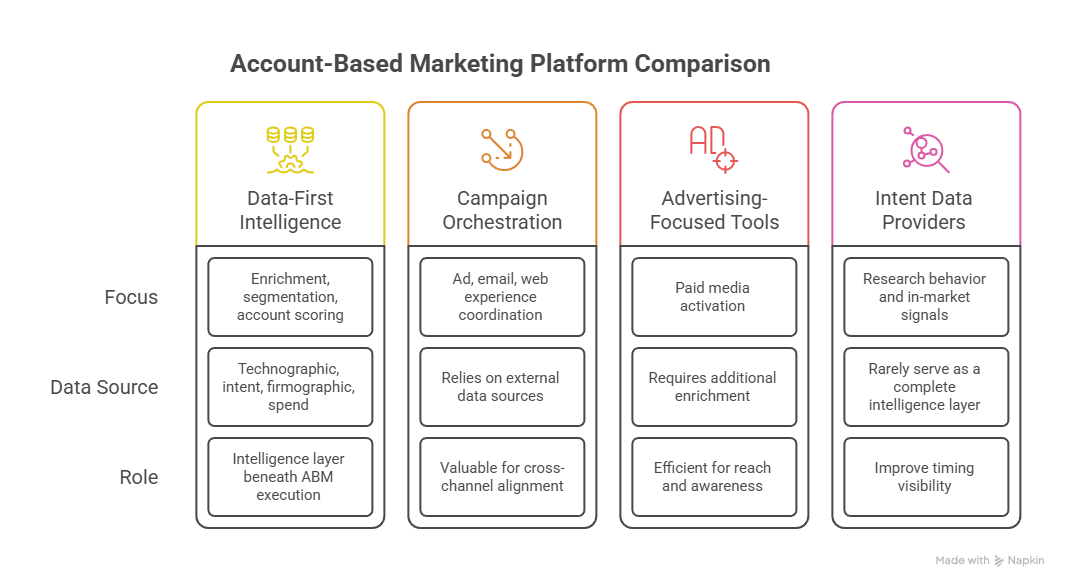
A useful comparison of account-based marketing platforms starts with understanding the different categories and the roles they play. No single platform leads in all four areas, and the right combination depends on the maturity and structure of your GTM motion.
Data-first intelligence platforms focus on enrichment, segmentation, and account scoring. They combine technographic data, intent signals, firmographic attributes, and spend insights to power targeting decisions. These platforms serve as the intelligence layer beneath ABM execution rather than managing campaigns directly.
Campaign orchestration platforms coordinate ads, email, and web experiences across channels. They’re valuable for cross-channel alignment but often rely on external data sources for the deeper account intelligence that drives precise targeting.
Advertising-focused tools are built around paid media activation. They automate targeting and testing for account-based advertising programs. Efficient for reach and awareness, though advanced use cases like competitive displacement or signal-based prioritization typically require additional enrichment.
Intent data providers surface research behavior and in-market signals. These platforms improve timing visibility by showing which accounts are actively researching topics in your category. They enhance targeting accuracy but rarely serve as a complete intelligence layer on their own.
The best ABM tools for your team depend on where you are in your ABM maturity. Early programs may prioritize orchestration to get campaigns running. Enterprise environments with complex GTM motions often need integrated intelligence and predictive scoring as their primary investment, with orchestration layered on top.
Evaluating ABM platforms requires looking beyond feature lists
The gap between how a platform performs in a demo and how it performs in production is often determined by four attributes that don’t show up well in a feature comparison:
- Signal depth. Does the platform provide the technographic, intent, spend, and firmographic data needed to support competitive displacement, inbound lead scoring, and AI sales plays? Platforms limited to engagement metrics lack the context for precise targeting.
- Data refresh frequency. Continuous updates support high-intent outreach and responsive prioritization. Static lists that refresh quarterly or monthly limit your ability to act on emerging signals.
- AI readiness. Modern ABM platforms should expose structured data through APIs and native integrations so intelligence flows into CRM, sales engagement, and AI orchestration systems automatically. Closed ecosystems that require manual data exports will become bottlenecks as AI adoption accelerates.
- Cross-functional usability. Tools that support marketing, RevOps, strategy, and sales teams reduce adoption friction and increase organizational impact. Platforms that require specialized operators create bottlenecks that limit how widely ABM intelligence gets applied.
Data-first intelligence: HG Insights
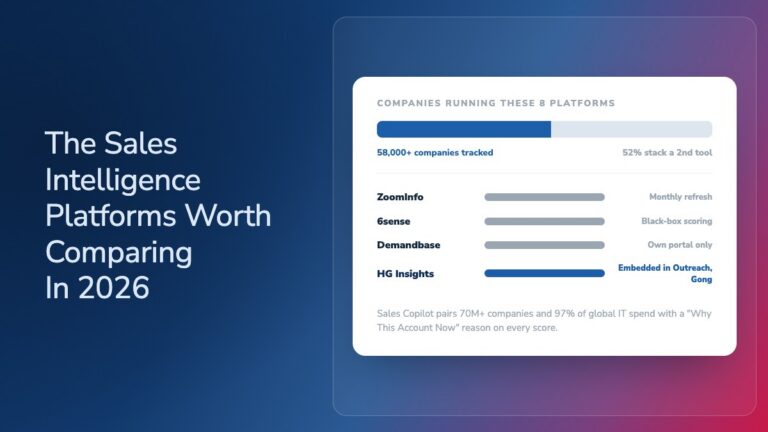
HG Insights approaches ABM as an intelligence problem at its core. The platform unifies technographic install data, IT spend intelligence, buyer intent signals, firmographic attributes, and contract timing within a continuously refreshed GTM fabric.
That unified structure supports account scoring, enrichment, competitive displacement, and ABM optimization with signal depth that many activation-first platforms have to source externally from multiple vendors. HG Insights’ RGI Agent Builder, MCP server access, and integration framework allow intelligence to flow directly into CRM systems and AI workflows without manual intervention.
If your ABM programs are underperforming despite strong execution, the issue is likely the data layer, not the campaign tools. HG Insights serves as the ABM data and intelligence foundation that gives those tools something better to work with.
Intent-driven platforms: Bombora and TechTarget
Bombora aggregates topic-level research activity across a large B2B data cooperative, providing broad coverage of intent signals that help teams identify accounts showing early buying interest. Its strength is the breadth of its data network, which captures research behavior across a wide range of business media properties.
TechTarget generates intent signals from its owned network of technology-focused editorial properties. This gives it strong signal quality within IT and enterprise technology buying audiences, where its editorial depth provides detailed insight into what specific accounts are researching. Its coverage is strongest within technology verticals and narrower outside them.
Both platforms enhance timing visibility and are most effective when paired with a broader intelligence layer that adds technographic, spend, and firmographic context to the intent signals they surface.
Predictive platforms: 6sense and Demandbase
6sense uses AI-driven buying stage prediction to identify accounts in active evaluation cycles before they engage with sales directly. It’s well-suited for teams with large total addressable markets where manual prioritization isn’t practical at scale. Its strength is surfacing hidden demand from accounts that haven’t yet raised their hand.
Demandbase combines account identification, intent data, and campaign orchestration within a single platform. Organizations that want ABM execution and account engagement managed within one interface rather than assembled across multiple tools often favor this structure. Its breadth makes it a practical choice for teams that want consolidated functionality.
Multi-channel orchestration: Terminus and Madison Logic
Note: Terminus was acquired by DemandScience and terminus.com now redirects to the DemandScience website. The platform no longer operates as a standalone product.
Terminus provided multi-channel ABM execution across display advertising, email, and web personalization, with an emphasis on coordinated campaign delivery. Teams evaluating multi-channel orchestration should account for this transition when assessing current vendor options.
Madison Logic centers on content syndication and ABM activation across a network of B2B media properties. It’s strongest for top-of-funnel awareness and mid-funnel engagement programs. Late-stage prioritization and competitive displacement use cases that require granular install-level data typically sit outside its core capability.
Advertising-focused platforms: AdRoll ABM and Metadata
AdRoll ABM (formerly RollWorks) offers accessible account-based advertising that integrates paid social and display campaigns with firmographic targeting. It’s a practical entry point for teams adding account-based advertising to their mix, though its reliance on third-party data sources can limit technographic depth for advanced use cases.
Metadata automates paid media experimentation for B2B marketers, reducing the manual effort required to manage and optimize campaigns. Its strength is execution efficiency rather than deep account intelligence, which means advanced targeting and scoring typically require a separate data layer.
Emerging and specialist tools: Warmly and Mutiny
Warmly deanonymizes website visitors in real time and routes warm outbound signals to sales reps, connecting visitor identity to firmographic and technographic context. It’s a strong fit for teams that want to act on website intent immediately rather than waiting for a prospect to fill out a form, though it performs best when paired with a broader account intelligence layer for prioritization upstream.
Mutiny functions as an AI agent for creating customer-facing content at scale — including 1:1 landing pages, deal rooms, and executive business cases tailored to specific accounts. It’s a strong fit for enterprise sales teams that need personalized collateral for high-value accounts, though it operates best alongside a separate intelligence source to identify which accounts warrant that investment.
ABM tools for signal-based selling and AI sales plays
Signal-based selling requires ABM tools that surface technographic, intent, and spend signals at the account level and deliver them to reps in the flow of daily sales activity rather than through a separate research interface.
AI sales plays depend on enriched account context to generate relevant outreach. The ABM tool feeding those plays needs to provide signal depth that goes beyond firmographic attributes and contact records. When enriched install data, spend trajectory, and active intent signals inform play execution, engagement rates improve because messaging reflects the actual situation of each account.
Teams operationalizing this approach can power signal-based selling and AI plays with account intelligence that flows into reps’ workflows automatically.
High-intent lead generation through ABM intelligence
The highest-converting ABM programs combine structural fit with verified intent. Accounts that match your ICP and are demonstrably in-market produce higher conversion rates at every stage of the funnel than accounts that meet only one of those criteria.
When high-intent accounts identified through ABM intelligence are routed directly into sales workflows, teams see shorter sales cycles and higher win rates because reps engage with timing and context rather than cold outreach. The ability to identify and convert high-intent accounts through ABM intelligence is one of the clearest differentiators between programs that generate pipeline and those that generate activity.
Competitive displacement powered by install-level ABM data
ABM tools that surface competitor technology installs at the account level give marketing teams the targeting precision to run displacement campaigns that speak directly to an account’s current technology context rather than relying on generic competitive messaging.
What sets HG Insights apart for competitive displacement is the granularity of that install data: product-level usage, office-level and department-level deployments, usage intensity scoring, and verification dates that indicate where a contract is in its renewal cycle. Most tools confirm whether a product is present. HG Insights answers how broadly it’s deployed, whether usage is rising or falling, and when the window to engage is likely to open.
The value compounds when install data is combined with contract timing signals. Accounts that are both running a competitor’s product and approaching a renewal or evaluation window represent the highest-probability displacement opportunities. Teams that run competitive displacement campaigns with install-level ABM data are able to consistently see stronger campaign performance because the targeting reflects verified competitive context.
Future-proofing your ABM stack for AI-driven execution
ABM programs powered by AI agents require a data layer that refreshes continuously and delivers structured, signal-rich account context that models can act on reliably without human curation between data update and execution.
Tools that can’t expose their data through APIs, MCP servers, or native integrations with AI orchestration platforms will become constraints as autonomous GTM execution matures. The platforms that remain relevant in an AI-driven ABM environment will be the ones that serve as intelligence infrastructure, feeding both human decision-makers and automated systems from the same continuously refreshed data layer.
When evaluating your current stack against this trajectory, the question to ask isn’t whether each tool has an AI feature. It’s whether each tool can deliver structured, current data to the AI systems that will increasingly drive your ABM execution.
HG Insights anchors a modern ABM stack in 2026
Account-based marketing platforms in 2026 succeed when they’re built on accurate, current intelligence. HG Insights delivers technographic installs, IT spend insights, buyer intent signals, firmographic attributes, and contract intelligence through a unified Revenue Growth Intelligence fabric designed for both human-led and AI-driven execution.
Whether the goal is sharper account selection, stronger competitive displacement, higher-converting intent targeting, or AI play activation, HG Insights provides the intelligence infrastructure that makes every other tool in the ABM stack perform better.
Strengthen the intelligence layer powering your ABM programs. Explore how HG Insights powers ABM targeting from account selection to campaign activation.