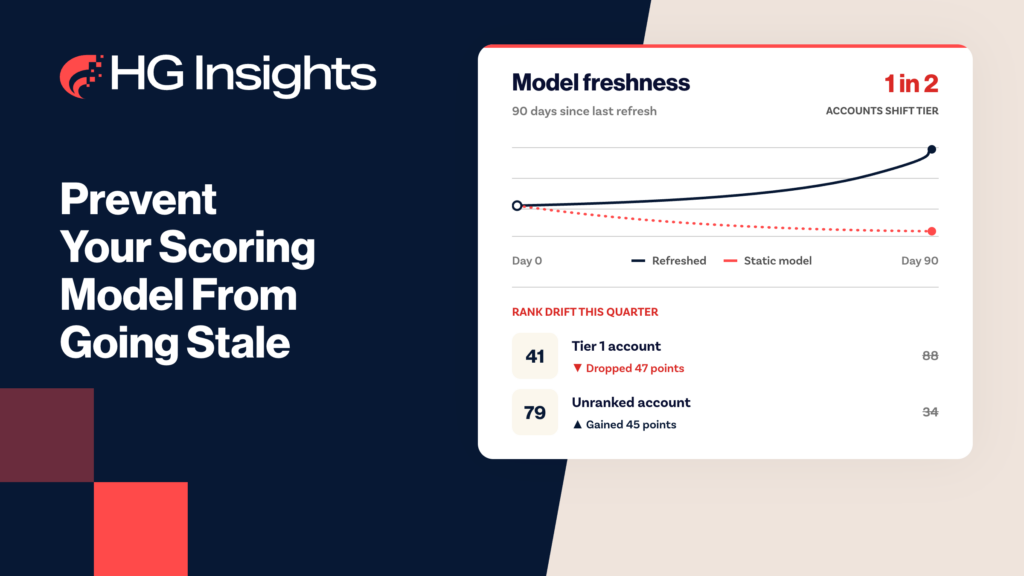
Building a scoring model is the easy part of B2B lead prioritization. Marketing Ops teams spend weeks getting the fields right, running the numbers, and shipping a ranked list to sales. Three months later, half that list has never been touched, and nobody can say whether the rankings are still accurate. The model didn’t fail. The habit of actually working it never got built.
Quick Answer: B2B lead prioritization breaks down after scoring, not during it, because a ranked list is a snapshot, not a workflow. Without a routine for who works which accounts and when, a scored list decays into a spreadsheet nobody opens after the kickoff.
The gap between a scored list and a working list
Every quarter, a version of the same meeting happens. Marketing Ops presents a newly scored or refreshed account list. Sales leadership nods, the list gets dropped into a shared view, and everyone agrees this is the priority list going forward. Then the actual follow-through never gets defined: who checks it daily, what happens when a high-scoring account goes quiet, how new intent signals get folded in without waiting for the next full refresh.
Six weeks later, reps are back to working leads in whatever order they arrived, and the scored list sits untouched next to a dozen other tabs. This isn’t a scoring accuracy problem. The rankings might still be right. It’s a coverage problem: nobody owns the list on an ongoing basis, so it stops being a live tool and becomes a one-time export.
Marketing Ops and Demand Gen Managers usually notice this first, because they’re the ones fielding the “is this list still current” question. RevOps and SDR leads feel it differently: they inherited a list with no clear rule for how to work it, so they build their own ad hoc process on top, and the original scoring gets treated as a rough filter rather than the actual prioritization tool it was meant to be.
Why a coverage habit matters more than another refresh cycle
Fixing this isn’t about scoring the list more often. It’s about building a routine that keeps the list meaningful between refreshes, and that routine has a few specific parts worth naming.
Raw intent signal needs interpretation before it means anything
An intent spike on its own doesn’t tell a rep what to do. A spike from a company that’s a poor fit is noise. A quiet account that’s actually a strong fit but hasn’t shown recent activity might be closer to a buying window than the intent data alone suggests. Turning raw signal into a decision requires reading it against fit, not just reacting to volume, and most teams never build that interpretation step into their process.
Every scored account needs an assigned play, not just a rank
A ranked list tells a rep which accounts matter more. It doesn’t tell them what to actually do with account 14 versus account 40. Splitting the list into a small number of clear plays, based on how strong the fit is and how active the intent is, gives reps and SDRs a specific action for each segment instead of one long list sorted by a number nobody remembers the logic behind.
Sales and marketing need to work from the same list, not two versions of it
When marketing keeps its own version of the scored universe and sales works from an export that’s already a few weeks stale, the two teams end up making different calls about the same accounts. A single shared, continuously updated list, rather than a periodic handoff, is what keeps both teams pointed at the same targets.
MarketMuse, an HG Insights customer, saw this play out directly. A prior scoring setup never earned enough trust for sales to act on it, and the two teams lacked a shared definition of what actually counted as a good lead. Once they moved to reports filtered against historical conversion data, sales gained confidence in the scores and MarketMuse generated 2x more qualified opportunities, with the team estimating they could have saved 6 to 12 months had they brought HG Insights in sooner.
How a coverage routine supports marketing, sales, and RevOps
Marketing Ops gets the only real way to prove the scoring model’s ROI beyond the initial rollout, a list that’s actually being worked on, not a one-time export.
Demand Gen Managers get a defensible answer when leadership asks whether the account list is still driving the pipeline, instead of pointing at a stale spreadsheet.
RevOps gets a clear, ongoing system to maintain, keeping the list synced and routed correctly instead of a one-time integration project.
SDR and sales development leads feel the absence of a routine most directly: without assigned plays, they default to working whatever surfaces first, which quietly undoes the entire point of scoring the list.
Why isn’t my sales team working the scored list
Sales teams stop working a scored list when there’s no ongoing routine for using it: no assigned owner, no defined play per segment, and no process for folding in new intent signals between refreshes. The list becomes a one-time reference instead of a daily tool, and reps revert to working whatever lead or account is easiest to reach.
That’s a workflow gap, not a data gap, and it’s the reason plenty of accurately scored lists still underperform their potential.
Build a coverage routine your team actually uses with HG Insights
HG Insights’ Account Scoring is built for exactly this gap. Its Likelihood to Buy model recomputes multiple times a day as new engagement signals come in, so the “who’s active right now” half of the list stays current without a manual refresh. Its Customer Fit model stays intentionally stable, it only moves when an account’s actual firmographic or technographic profile changes, so reps aren’t chasing a number that shifts for no reason. Every scored account carries a segment label, a 0–100 score, a visual indicator, and a plain-language list of the specific signals behind it, pushed directly into Salesforce, HubSpot, or Marketo Account Scoring plugs into that existing view rather than asking anyone to adopt a separate system That’s what actually closes the gap this blog post opened with: reps stop working a list top-to-bottom once they can see why one account outranks another, not just that it does.
See how HG Insights keeps scored lists current for Growth-segment sales teams.
The specific mechanics of turning a scored list into a working coverage routine, including how to split accounts into distinct plays and keep sales and marketing aligned on one shared universe, are covered in full in The ABM Precision Playbook, Part 2: Activation. Get the playbook.
Frequently asked questions
What is B2B lead prioritization?
B2B lead prioritization is the process of ranking leads or accounts by likelihood to convert, then routing sales attention toward the highest-priority ones first. Scoring produces the ranking, but prioritization only works if there’s an ongoing process for actually working that ranking.
Why does a scored account list go stale?
A scored list goes stale when nobody owns keeping it current between refresh cycles. New intent signals, account changes, and engagement shifts happen continuously, but if the list only updates quarterly and nobody’s tracking movement in between, the ranking drifts out of sync with reality.
What's the difference between scoring and activation?
Scoring produces a ranked list based on fit and intent signals. Activation is the ongoing process of actually working that list: assigning plays, updating priorities as new signals come in, and making sure sales and marketing are acting on the same version of the list.
How should sales split up a scored account list?
Rather than working one long list top to bottom, most teams get better results splitting accounts into a small number of plays based on fit strength and intent activity, so a high-fit, high-intent account gets a different action than a high-fit, quiet one.
Why do sales and marketing end up with different priority lists?
This usually happens when each team maintains its own version of the scored universe instead of working from one continuously updated list. A stale export handed from marketing to sales drifts out of sync with the live model marketing is actually looking at.
Author
-

Nik Koutsoukos brings over 25 years of product and marketing executive leadership to his role as VP of Product Marketing at HG Insights. He drives product GTM, customer and partner-marketing, and sales enablement to increase awareness, reach, adoption, and growth.
Prior to HG Insights, Nik held senior positions including VP of Product Marketing at SolarWinds, Chief Marketing Officer at Catchpoint, and VP of Product Marketing at Riverbed Technology, where he helped scale adoption of enterprise performance and observability solutions. Nik brings deep expertise in translating complex technology into compelling market value and partner-aligned growth. He holds a BSEE from Leeds Beckett University.