
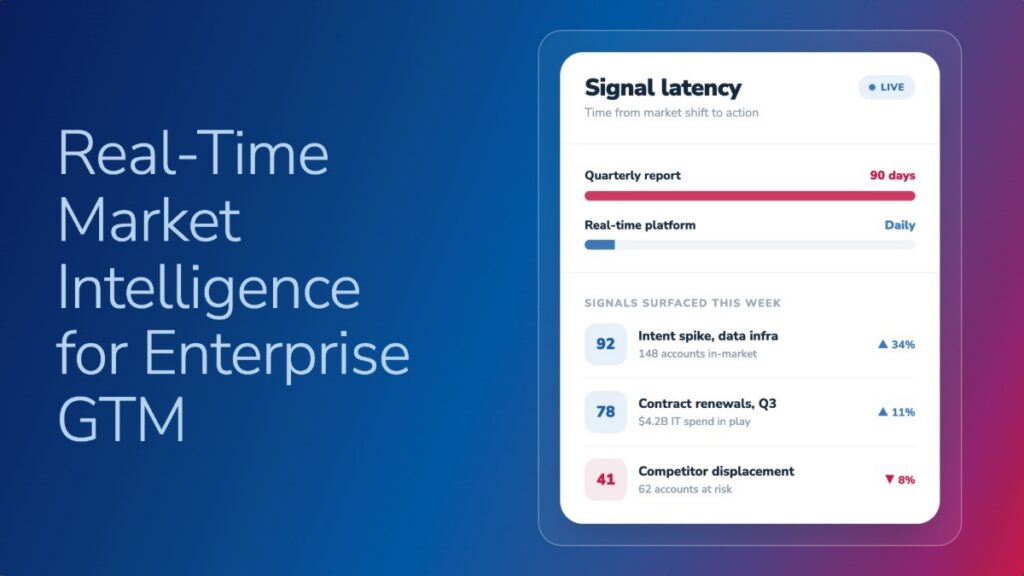
Quarterly market reports used to be enough. They are not anymore. Enterprise GTM teams in 2026 are operating on cycles that move faster than any deck can keep up with, and the platforms that win are the ones surfacing signals as they happen, not weeks later.
The cost of delayed intelligence shows up everywhere. Pipeline windows close before reps see them. Competitive moves get noticed after the deal is already lost. ABM campaigns target accounts whose buying intent has already shifted.
This listicle covers the real-time market intelligence platforms enterprise teams are actually evaluating. For a wider view that includes mid-market and growth-stage options, see our breakdown of the best market intelligence platforms for B2B companies. This piece narrows to enterprise GTM and to one variable: how fast signals arrive.
How we evaluated these real-time market intelligence platforms
Not every platform that claims real-time intelligence delivers it equally. The criteria below apply consistently across all ten platforms, focused on what enterprise GTM teams actually need from intelligence, not what vendor marketing says they provide.
- Signal freshness, refresh frequency, and how quickly insights surface to GTM teams are the primary criteria.
- Depth is assessed only in terms of what gets refreshed: whether firmographic, technographic, install, contract, and intent data all move continuously, or whether only some of them do.
- Integration with CRM and orchestration tools, plus AI-driven activation, determines whether a fresh signal reaches a rep or stops at a dashboard.
- Enterprise scale, global coverage, and compliance posture are treated as baseline requirements.
- Proven use cases across signal-based selling, ABM, and competitive response are weighted heavily.
Speed is one axis. The same vendor set ranked by data coverage and accuracy produces a different order, and both matter in an enterprise evaluation.
The ten platforms reviewed are:
- HG Insights
- 6sense
- Demandbase
- ZoomInfo
- Bombora
- Clari
- Gong
- Salesforce Data 360
- Snowflake Marketplace
- Crunchbase Enterprise
1. HG Insights
HG Insights delivers real-time signals across firmographic, technographic, install, contract, and intent data, all in one layer. Most enterprise teams piece this kind of coverage together from three or four vendors. HG Insights consolidates it.
IT spend data and contract intelligence are continuously refreshed, which means renewal windows, displacement opportunities, and budget shifts surface as they happen. Signal-based account prioritization runs directly on top of that data. HG Insights data shows that 46% of enterprise companies running 6sense also have Demandbase ABM/ABX deployed alongside it — a measure of how often teams layer overlapping platforms rather than consolidating on one.
The RGI Platform connects intelligence into CRM, ABM, and AI-driven sales play workflows, so signals do not stop at a dashboard. Enterprise GTM teams that need unified, refreshed intelligence powering both strategy and execution tend to see the strongest fit.
See how signal-based account prioritization works in production.
2. 6sense
6sense is built around real-time predictive intent and AI-driven buying stage modeling. Account identification is fast, and the orchestration layer is well-developed for ABM motions at enterprise scale.
Where it falls short is depth around IT spend, install base, and contract intelligence. The platform is optimized for demand activation, not for understanding the underlying market structure.
Enterprise marketing teams running mature ABM programs with strong digital activation needs tend to choose 6sense. Strategy and RevOps teams often pair it with deeper market intelligence.
3. Demandbase
Demandbase blends real-time account intelligence, intent, and B2B advertising into a unified ABM platform. Account identification accuracy holds up well at enterprise scale, and pipeline orchestration is built into the same workflow.
Real-time signals here lean toward demand activation. Whitespace analysis, TAM modeling, and IT spend depth are not its calling cards.
Enterprise ABM teams that want integrated targeting alongside media buying gravitate toward Demandbase. Teams focused on broader market planning typically pair it with a dedicated intelligence platform.
Learn how ABM optimization with real-time intelligence sharpens enterprise targeting.
4. ZoomInfo
ZoomInfo refreshes firmographic, contact, and intent data frequently, with broad coverage at enterprise scale. CRM integration depth and the size of its intent signal network are both notable strengths.
Real-time depth around IT spend, install base, and contract data is more limited. Teams trying to model technology investment patterns in real time often need additional sources.
Outbound-heavy enterprise teams that need continuous contact and basic intent refresh get strong returns from ZoomInfo. Strategic GTM use cases usually require more.
5. Bombora
Bombora appears as a standalone install at just 0.3% of enterprise companies in HG Insights’ global dataset — reinforcing its position as an enrichment layer most teams add on top of an existing stack rather than deploy as a primary platform. The scale of intent topics and refresh cadence make it a foundational signal layer for many enterprise stacks.
It is not a complete enterprise intelligence platform on its own. Coverage outside intent is intentionally narrow, and most teams use Bombora to enrich an existing platform rather than to replace one.
Enterprise teams that already have firmographic and technographic data in place often add Bombora to sharpen the intent layer. The signal quality is real, but the scope is focused.
6. Clari
Clari focuses on real-time revenue intelligence, pipeline visibility, and forecasting. AI-driven deal insights and activity capture give sales leadership a continuous read on where pipeline actually stands.
External market data such as IT spend, technographics, or contract intelligence is not part of the platform. Clari is designed to make sense of internal pipeline activity, not the broader market.
Enterprise sales leadership teams prioritizing real-time pipeline and forecast accuracy lean on Clari. Most pair it with an external market intelligence platform — HG Insights is a common complement for enterprise teams that need unified technographic, spend, and intent signals powering their top-of-funnel prioritization.
Learn how to activate real-time signals at the rep level with AI-driven sales plays for enterprise GTM.
7. Gong
Gong captures real-time conversation intelligence from calls, meetings, and email exchanges. AI-driven deal risk insights, coaching analytics, and pipeline signal extraction are all core strengths.
External market intelligence such as install data or intent is outside Gong’s scope. Its real-time signals come from inside the buyer-seller conversation, which is a different lens entirely.
Enterprise sales organizations using conversation data to refine plays and forecasts get the most value. Gong typically sits alongside a market intelligence platform rather than replacing one.
8. Salesforce Data 360
Salesforce Data 360 unifies real-time customer and account data across enterprise systems. Native CRM integration, identity resolution, and Einstein-driven activation make it a strong internal data layer.
External market signals such as IT spend, install data, or contract intelligence are not built in. Those still need to come from partner sources or dedicated intelligence platforms.
Enterprise teams already standardized on Salesforce that need a unified internal data layer benefit most. External intelligence has to be layered on separately.
9. Snowflake Marketplace
Snowflake Marketplace gives enterprise teams real-time access to a wide range of third-party data providers, all flowing directly into the warehouse. Flexibility and scale are unmatched.
It is an infrastructure layer, not a packaged GTM intelligence platform. Turning marketplace data into activated GTM workflows requires internal data engineering and modeling work.
Enterprise data teams building custom intelligence pipelines with multiple vendors get the most value. GTM teams that want activation out of the box usually need a layer above this.
10. Crunchbase Enterprise
Crunchbase Enterprise delivers real-time company, funding, and growth signal data across global markets. Fundraising tracking, leadership change alerts, and emerging company identification are reliable use cases.
Coverage thins out around enterprise install base, IT spend, and contract data. The platform is strongest at the top of the funnel and weaker for entrenched enterprise sales motions.
Enterprise teams targeting growth-stage and venture-backed accounts at scale rely on Crunchbase. Mature enterprise targeting usually needs to combine it with deeper intelligence sources.
Take a look at how competitive analysis and takeout strategy benefits from layered real-time signals.
How to choose the right real-time intelligence platform for enterprise GTM
The phrase real-time gets used loosely. The first step in any evaluation is defining which signals actually drive your GTM decisions, then pressuring vendors on freshness and depth in those specific areas. Generic refresh claims rarely hold up under that scrutiny.
From there, prioritize platforms that combine real-time intent with firmographic, technographic, install, and contract data. Single-purpose tools can fill a gap, but unified intelligence reduces lag, conflict, and integration overhead at enterprise scale.
Validate integration depth with your CRM, ABM, and orchestration stack before committing. HG Insights is built for enterprise GTM teams that need unified, real-time intelligence powering both strategy and execution.
See how HG Insights unifies real-time market intelligence for enterprise GTM.
Frequently asked questions
What is buyer intent data?
Buyer intent data is a set of behavioral signals that reveal when a company is actively researching or evaluating a purchase. It includes content consumption patterns, search activity, website engagement, and topic research spikes collected from publisher networks, review platforms, and first-party digital properties. Intent data providers aggregate these signals to identify accounts showing elevated buying behavior before they contact a vendor.
How do buyer intent data providers collect signals?
Third-party intent providers like Bombora aggregate content consumption data from publisher co-ops, tracking which topics B2B audiences research across thousands of websites. Review platforms like TrustRadius and G2 capture signals from buyers actively comparing software options. Technographic providers like HG Insights derive signals from technology install data, IT spend, and contract timing. First-party signals come directly from a company’s own digital properties, such as pricing page visits and demo requests.
What is the best buyer intent data provider?
There is no single best provider for every team. Bombora leads for broad third-party category intent. 6sense and Demandbase lead for predictive ABM orchestration at enterprise scale. HG Insights is strongest for competitive displacement programs that require technographic, spend, and contract timing signals alongside behavioral intent. The right answer depends on whether you’re building awareness campaigns, ABM programs, or competitive displacement workflows and where you need signals delivered in your tech stack.
How does buyer intent data differ from technographic data?
Intent data captures what a company is researching right now. Technographic data captures what technology a company currently runs, how much they spend on it, and how intensively they use it. Technographic data is structural and persistent; intent data is behavioral and time-sensitive. The most complete account intelligence combines both: technographic data confirms the account is a fit, while intent data confirms the timing is right.
What are the main types of buyer intent signals?
Buyer intent signals fall into three main categories. First-party signals come from your own digital properties, including pricing page visits, demo requests, and content downloads. Second-party signals come from partner platforms, primarily software review sites like G2 and TrustRadius. Third-party signals come from external publisher networks and data co-ops that track content consumption behavior across the broader web. Each type offers different specificity, coverage, and freshness, and the most effective intent data programs layer all three.