
Account prioritization only works if the scoring behind it holds up under scrutiny. Most vendors ask revenue teams to trust a score without showing the math: which signals fed it, how they were weighted, why one account outranks another. At HG Insights, we score every account with a documented, glass-box model built on fit, need, and intent signals, and we publish that methodology instead of hiding it. For sales leadership, RevOps, and data/analytics teams running outbound and account-based programs, that transparency is what turns a score into something a rep will actually act on.
Quick Answer: Account prioritization is the practice of ranking B2B accounts by fit, need, and intent, so sales leadership, RevOps, and data/analytics teams running outbound and account-based programs focus effort on the accounts most likely to convert, before those accounts ever touch the CRM. HG Insights powers this with AI Outbound Scoring, ranking accounts across its full company universe using technographic, IT spend, firmographic, and intent signals, then exposed to reps as a transparent, editable score rather than a black-box number. Once an account enters the pipeline, the Customer Fit and Likelihood to Buy models take over to keep that score current as engagement builds.
Why we’re publishing our account scoring methodology
Most content about account scoring describes what it is, not how it actually works inside a specific platform. This post is the next layer down: the actual mechanics behind how HG Insights scores and prioritizes B2B accounts, written by the team that built the model.
We’re publishing this because the people asking the hardest questions about account prioritization, data scientists, analytics leads, and RevOps architects, don’t want a marketing description of scoring. They want the feature list, the weighting logic, and the reasoning behind every number. Competing platforms tend to treat that reasoning as proprietary and keep it behind a black box. We treat it as the product. A scoring model that can’t survive a technical audit from the person who has to trust it isn’t ready to run a revenue team’s pipeline.
The signal layers our models score: fit, need, intent, and engagement
Account prioritization inside HG Insights runs on two connected models. AI Outbound Scoring ranks HG’s full universe of more than 50 million companies by three signal layers, Fit, Need, and Intent, surfacing net-new targets for outbound and account-based programs before they ever touch the CRM. Once an account is in play, Customer Fit and Likelihood to Buy take over to keep the score current as engagement builds.
AI Outbound Scoring: finding net-new accounts before they touch the CRM
AI Outbound Scoring ranks HG Insights’ full universe of more than 50 million companies, most of which have never touched your CRM, across three signal layers.
- “Fit” answers can they buy, using company size, industry, revenue, IT spend, geography, and multinational presence.
- “Need” answers do they need it, using competitor installs, product overlap, displacement signals, and how long a company has run its current technology.
- “Intent” answers are they looking now, using topic-level research activity and buyer intent pulled from TrustRadius.
The three layers combine into a composite tier from A to F, and most teams route only A- and B-tier accounts to sellers or marketing campaigns. Because the model scores HG’s full company universe rather than a fixed CRM list, tiers update as target companies’ tech stacks and intent signals shift, not on a set daily or weekly cycle.
The Customer Fit model: is this the right company
Once an account clears AI Outbound Scoring and lands in your CRM, two more models keep its score current. The Customer Fit model answers a static question, is this the right type of company, using firmographic data (industry, size, geography, revenue) and technographic data (which products an account already runs). Scores land in four bands: Very Good (85 to 100), Good (70 to 84), Medium (50 to 69), and Low (0 to 49), and they stay relatively stable because a company’s tech stack and firmographic profile don’t shift hour to hour.
The Likelihood to Buy model: is now the right time
The Likelihood to Buy model answers a different question, is now the right time, using behavioral engagement signals tracked against accounts already on your target list: website activity and marketing campaign interactions. Because buying readiness moves fast, this model recomputes multiple times a day rather than daily or weekly like most competing platforms. Layered on top is buyer intent pulled from TrustRadius research and peer review activity, giving the model a third, independently sourced read on where an account sits in its evaluation.
Why fit, need, and intent have to score together
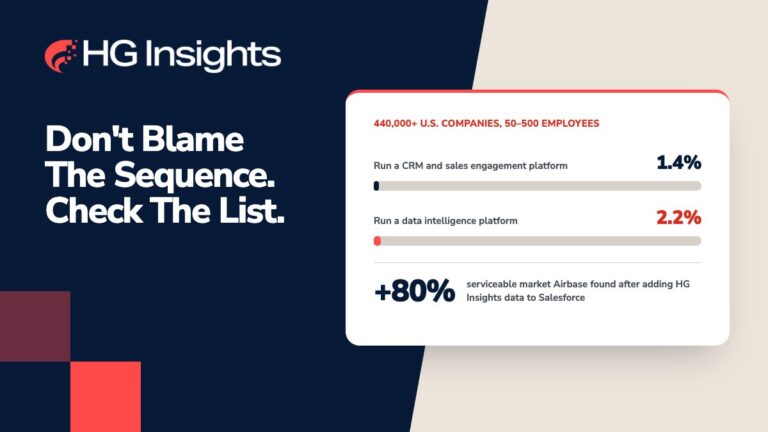
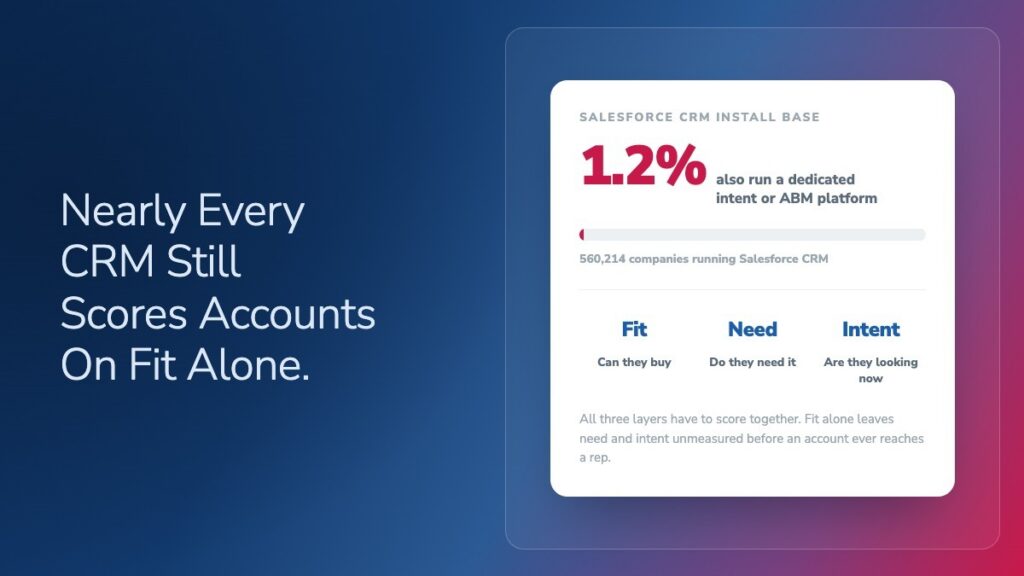
None of AI Outbound Scoring’s three layers, fit, need, intent, is sufficient alone. A company that matches your ICP perfectly but shows no displacement opportunity and no research activity isn’t worth prioritizing yet. A company spiking on intent but sitting outside your ICP isn’t worth the effort either. HG Insights’ own install data shows how rarely companies operationalize more than one layer today: of the 560,214 companies running Salesforce CRM, only 1.2 percent also run a dedicated intent or ABM platform like 6sense, Demandbase, or Bombora. Nearly the entire CRM install base is still scoring accounts on fit alone, with no systematic way to layer in need or intent before an account ever reaches a rep. Account prioritization only works when all three layers score together, which is why AI Outbound Scoring combines them into a single tier instead of shipping three separate lists for a rep to reconcile.
Where IT spend and technographic data enter the scoring equation
Technographic and IT spend data, which feed the Fit and Need layers of AI Outbound Scoring, is where HG Insights’ scoring diverges most from the rest of the market. We score install age (how long an account has run a given product), product intensity (how deeply embedded that product is), cloud maturity (the share of an account’s stack that’s cloud-deployable versus on-prem), and vendor penetration (how many vendors touch a given category at that account). Layered on top is category-level IT spend data: current spend, spend trajectory, and minimum spend thresholds that flag whether an account can plausibly afford what you sell.
Most competing scoring platforms can’t replicate this layer because they don’t own the underlying data. ZoomInfo tracks more than 30,000 technologies but only at a binary, installed-or-not level; there’s no install age, no spend trajectory, no penetration signal to weight. 6sense’s technographic data is partner-sourced rather than proprietary. Demandbase’s DemandMatrix acquisition gets closer but still doesn’t match the granularity of install age, intensity, or vendor penetration as native scoring inputs.
An account prioritization matrix has to answer a harder question than whether a company uses compatible technology. It has to answer whether that technology relationship is deepening or eroding, and whether the account’s spend can support a deal. IT spend and technographic depth are what let AI Outbound Scoring answer that, which is why this layer sits at the center of the scoring equation instead of functioning as a supplementary filter.
How we weight and combine signals into a single account score
HG Insights’ AI Outbound Scoring weights work the same way but through a different interface: an operator adjusts disqualifiers, point values, tier conditions, and the relative weight of Fit, Need, and Intent through a conversational AI agent chat, rather than a spreadsheet or a ticket to an analytics team.
For example, an account with more than $10 million in category IT spend, four-plus years running a competitor’s product, and a spike in topic-level research activity would land in the A tier under a standard weighting; an operator who wants displacement signals to count for more than raw spend can say so in the chat and watch the tier recompute. Adding a new dimension to the model is a conversation, not a schema change.
Tiers update automatically as target accounts’ signals shift, so reps always see the current ranking instead of last week’s list, rather than waiting on a fixed daily or weekly refresh cycle.
What glass-box scoring means, and why we show our work
Every account scored by AI Outbound Scoring surfaces a composite tier from A to F, the underlying Fit, Need, and Intent sub-scores, and a plain-language list of the top signals, positive and negative, that produced the tier, all visible through the scoring interface instead of buried in a formula. A rep or analyst looking at a scored account doesn’t just see “B-tier.” They see why: which technographic signals counted for it, which firmographic and intent factors counted against it, and what would move the tier.
This is what separates glass-box scoring from the black-box approach most competitors ship. 6sense’s own product documentation states plainly that Profile Fit can’t be adjusted by the customer directly; changing the model requires a professional services engagement priced around $12,000. ZoomInfo’s Account Fit Score offers no per-record signal explanation at all. Demandbase comes closest, generating SHAP and Granger causality explanations in its own interface, but those explanations are read-only. A Demandbase user can see why an account scored the way it did; they can’t touch the weights that produced it.
HG Insights is read-write. An operator adjusting AI Outbound Scoring can see every signal driving a tier and change the weight behind it directly through the conversational agent interface, no support ticket or data science request required.
That distinction matters more than it sounds: a black-box score with more inputs is still a black box, just a more confident-looking one. Account prioritization only earns a sales team’s trust when the team can verify it, not just receive it.
How reps and RevOps use the score for account prioritization
AI Outbound Scoring is only useful if the teams downstream of it can act on it without translation. Sales reps use the score to decide which accounts get outbound effort this week and which get nurtured; the visible signal list tells them what to lead with in an opener, a recent technology change, a spend increase, a spike in topic-level research activity, rather than a generic pitch. RevOps uses the same score to configure territory assignments and account distribution, since a transparent score is one they can defend when a rep or a leader questions why an account landed where it did.
Marketing Ops uses the Fit, Need, and Intent breakdown to decide which accounts get active ABM investment versus lower-priority nurture, and Data/Analytics teams use the model as a foundation they can extend, pulling the same technographic and spend signals into their own custom models instead of starting from raw data. Joe Hannum, Senior Manager of Customer Intelligence and Analytics at Hyland Software, describes the effect directly: “The technographic data, competitive insights, and IT spend information all feed into our ICP scoring model. This allows us to prioritize accounts effectively for each play and ensure sales and marketing are aligned.”
Cockroach Labs built a similar workflow inside Salesforce. As Ryan Kelly, VP of Growth Marketing, put it: “Being able to pipe in all these different data sources into a centralized platform and have that show up in Salesforce in a way that the reps can leverage. That’s the secret sauce with HG Insights.” Teams that want to build or extend a model like this on their own data can configure it directly in HG Insights Data Studio.
Where our methodology differs from black-box scoring platforms
Where ZoomInfo, 6sense, and Demandbase fall short
ZoomInfo, 6sense, and Demandbase all embed scoring inside broader GTM platforms, and each has real strengths: ZoomInfo’s contact database, 6sense’s intent signal volume, Demandbase’s ABM orchestration. None of them, though, combines proprietary technographic depth with operator-adjustable weights and per-record explanations the way HG Insights does. 6sense’s scoring refreshes daily at best; ours recomputes behavioral scores multiple times a day, which matters because a buying window that opens on a Tuesday can close by Thursday if nobody notices.
These black-box relationships also tend to be old ones. Across the install base HG Insights tracks, companies running 6sense, Demandbase, or Bombora have held those platforms for 39 months on average, and 52 percent have run them for three years or more. Most of the market isn’t evaluating black-box scoring for the first time; it’s stuck with it.
How one HG Insights customer closed the gap
One HG Insights customer, a mid-market B2B infrastructure and security software company that had already built its commercial motion around 6sense, ran into exactly this gap. 6sense’s intent signals carried no contract timing data, no behind-the-firewall technographic depth, and no transparent scoring for the account prioritization work its team needed for competitive displacement and government-sector deals. The company kept 6sense for demand generation and added HG Insights specifically for displacement, building a custom glass-box scoring model in Data Studio weighted by contract age, install age, IT spend trajectory, and hiring signals. One quarter later: a 3x improvement in target account accuracy, a 40 percent reduction in wasted outreach, $2.3 million in new pipeline attributed to HG-sourced accounts, and 90 percent rep adoption of the new scoring model.
Why rep adoption is the metric that matters
That last number is the one worth sitting with. Rep adoption is the metric every black-box vendor struggles with, because reps don’t act on scores they can’t explain to themselves, let alone to a prospect. An account prioritization model earns adoption by being auditable, not just accurate.
See how HG Insights’ Sales Copilot puts Customer Fit and Likelihood to Buy in front of reps at the point of outreach. Request a walkthrough to see the model scored against your own accounts.
Frequently asked questions on how HG Insights scores and prioritizes accounts
What is account prioritization in B2B sales?
Account prioritization is the practice of ranking target accounts by fit, need, and intent so sales and marketing teams focus limited time on the accounts most likely to convert. It replaces manual, assumption-based targeting with a documented score reps can act on immediately, rather than guessing which accounts deserve outreach this week.
What's the difference between account scoring and account prioritization?
Account scoring is the model that assigns a number or grade to an account based on fit, need, intent, and engagement signals. That’s what AI Outbound Scoring, the model this piece is about, measures before an account ever reaches the CRM. (Customer Fit and Likelihood to Buy handle scoring separately once an account is already in the pipeline.) Account prioritization is what a team does with that score: ranking accounts, assigning territories, and deciding where reps spend time. Scoring produces the input; prioritization is the operational decision built on it.
What signals should an account prioritization model include?
A useful outbound model combines firmographic data (industry, size, geography), technographic data (installed products, install age, vendor penetration), IT spend intelligence (category spend and trajectory), and intent signals (research activity and buying-stage indicators) to rank net-new accounts before they enter the CRM. Behavioral engagement on target accounts (website activity, campaign interactions) then layers on once an account is already on a target list. Models relying on a single signal type, intent alone or firmographics alone, tend to produce more false positives.
What is glass-box scoring, and why does it matter for account prioritization?
Glass-box scoring means every signal behind an account’s score is visible and every weight is adjustable by the operator, unlike black-box models that output a number with no explanation. It matters because sales reps only act on scores they can explain to themselves, and glass-box models let RevOps validate and defend the score instead of taking it on faith.
How many accounts should a rep prioritize at once?
Most mid-market teams find reps can realistically work 50 to 150 scored accounts at a time before effort spreads too thin to be effective. The right number depends on deal complexity and sales cycle length, but the principle holds across segments: a rep working a shorter, ranked list outperforms one working a long, unranked one.
How is HG Insights' account scoring different from ZoomInfo or 6sense?
HG Insights combines proprietary technographic and IT spend data unavailable to either competitor with operator-adjustable scoring weights across both AI Outbound Scoring and the CRM-based Customer Fit and Likelihood to Buy models, which push per-record signal explanations directly into the CRM once an account is in the pipeline. ZoomInfo’s Account Fit Score and 6sense’s Profile Fit both function as black boxes; neither lets customers see or edit the signals driving a given score.