
Intent data types fall into more buckets than most B2B teams realize, but the split that actually changes how a scoring model behaves is verified versus unverified. Verified intent data traces back to a real account through a confirmed source: an installed technology, a contract event, or direct first-party engagement. Unverified intent data infers interest from broader signals, like keyword co-op panels or IP-to-account resolution, without confirming the account behind the signal is real. Get that distinction wrong, and every score built on top of it inherits the same uncertainty.
Quick Answer: Intent data splits into two core types: verified and unverified. Verified intent data is tied to a confirmed source, such as installed technology, contract activity, or first-party behavior, so both the account and the signal are established facts. Unverified intent data comes from inferred sources like third-party keyword panels or IP matching, where the account behind the signal is estimated rather than confirmed.
What is intent data, and why does verification matter
Intent data is behavioral or firmographic evidence that a specific account is actively researching or evaluating a purchase. Most explanations of intent data stop at where the signal originates: first-party (your own site, product, or CRM activity) versus third-party (content consumption tracked across a publisher network, or activities taken on a particular website like reading reviews on TrustRadius). That split is useful, but it skips a harder question. A signal can be first-party and still be wrong if the account match behind it is loose. It can be third-party and still be trustworthy if the source confirms which company actually generated it.
Verification is what separates a usable signal from a plausible guess. An unverified signal says a company in your target industry showed some interest somewhere. A verified signal says this specific account took this specific action, and here’s the source that proves it. For a RevOps or marketing ops leader running an inbound scoring program, that difference decides whether the resulting score is something a sales rep can trust or something they’ll quietly ignore.
Verified intent data: what it is and where it comes from
Verified intent data ties a behavioral or transactional signal to a confirmed account identity, backed by a source that can be checked. It doesn’t rely on modeled probability to guess who’s behind the activity.
Confirmed technology and install signals
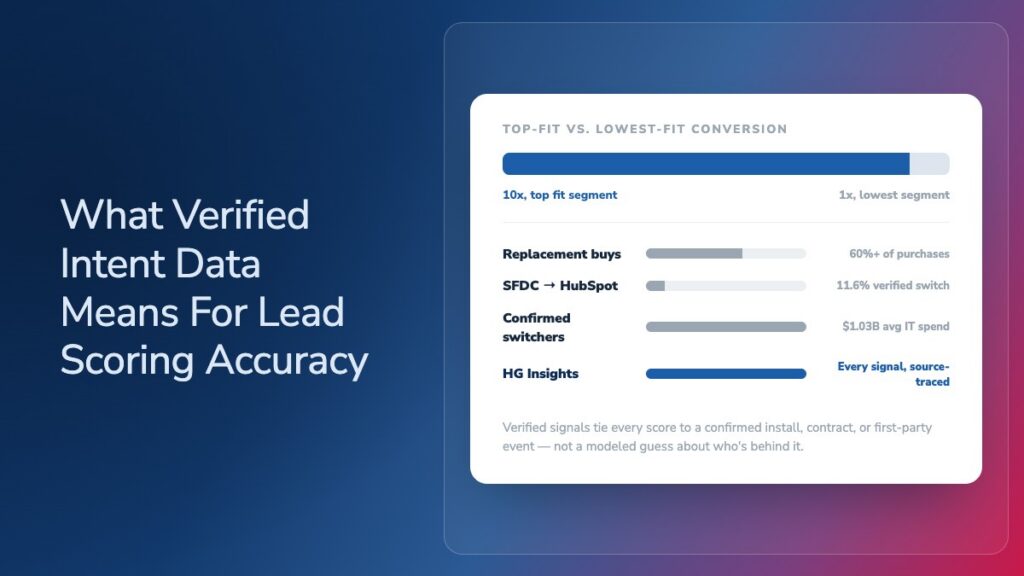
Technographic data shows which specific tools a company runs today, sourced from job postings, public documentation, DNS records, or vendor-confirmed installs rather than survey responses. Because the install is tied to a verifiable account, it functions as intent when a competitor’s tool disappears from a company’s stack or a new category of tool appears. Over 60% of B2B software purchases are replacements, according to Prospeo’s 2026 technographic data guide, which makes install-level change one of the most reliable timing signals available and one of the least modeled correctly by teams still relying on self-reported tech stacks. HG Insights data shows exactly this kind of change in progress today: among large U.S. companies running Salesforce CRM, 11.6% also carry a HubSpot CRM signal confirmed within the past 12 months, a live snapshot of accounts actively evaluating a switch that a one-time survey would never catch.
Contract and spend-based confirmation
Renewal dates, procurement filings, and IT spend trajectories are verifiable because they come from records, not inference. A contract nearing expiration, or spend in a category climbing quarter over quarter, confirms both that the account exists and that a buying window is opening. This is the layer that turns a generic “company might be interested” signal into “this account has a documented reason to act in the next two quarters.” The pattern shows up clearly in HG Insights data: large U.S. companies that show both an incumbent Salesforce signal and a newly active HubSpot signal carry an average modeled IT spend of roughly $1.03 billion, about 5 times higher than the $202 million average among otherwise similar companies running Salesforce alone. A verified technology change and a real budget increase tend to arrive together, which is exactly why spend data works as a confirmation layer rather than a standalone signal.
First-party engagement tied to a known account
Product usage, form fills, and website behavior are verified when the visitor resolves to a real, identified account rather than an anonymous IP range. First-party data carries an inherent advantage here: the account identity usually isn’t in question, only the interpretation of the behavior.
Unverified intent data: what it is and where it breaks down
Unverified intent data infers a signal without confirming the account behind it, which means the error shows up downstream, in the score, not upstream where it could be caught.
Third-party keyword and topic panels
Co-op intent networks aggregate content consumption across a publisher panel, then map topic surges back to a company using firmographic modeling rather than direct confirmation. The topic-level signal can be real while the account attribution is loose, especially for large enterprises where dozens of business units share an IP footprint or a domain.
Third-party activities
Some websites capture buyer activities that take place on their site and sell them back to vendors for ABM, ad targeting, and account scoring. For example, when a buyer evaluates a vendor’s pricing on TrustRadius, that is delivered back to the vendor as a high-intent signal for sales and marketing follow up.
IP-to-account resolution
Reverse IP lookup assigns anonymous website traffic to a company based on the IP address it came from. Shared office buildings, VPNs, ISPs, and remote work all break this assumption regularly, producing a company name attached to traffic that may belong to an employee, a contractor, or an unrelated business sharing the same network block.
Aggregated co-op data without account confirmation
Some intent providers roll up activity across a research panel and report a directional surge for an industry or segment rather than a specific, name-checked account. That’s still useful for market-level awareness, but it isn’t the kind of signal a lead or account scoring model should treat with the same weight as a confirmed install or a first-party form fill.
How verified vs. unverified intent data changes lead scoring accuracy
Marketing ops: trust erodes before accuracy does
For marketing ops teams, the practical effect shows up in trust, not just accuracy. A scoring model fed unverified signals will occasionally rank the wrong account highly, and once a rep chases two or three of those dead ends, they stop trusting the score entirely, whether or not the underlying math improves later. Verified inputs don’t guarantee a perfect model, but they remove one whole category of failure: the account genuinely doesn’t exist as described.
Data science: explainability is a feature-engineering problem
For the data science stakeholders who sit alongside ops in enterprise evaluations, the distinction is a feature engineering problem. A tree-based or weighted scoring model can only be as explainable as its inputs. When a signal traces to a confirmed source, a data scientist can show exactly why a node in the model split the way it did. When it doesn’t, the model’s explanation ends at “the vendor’s algorithm said so,” which is a harder sell internally and a slower path to adoption. Analyst research backs this concern directly: in Forrester’s 2026 Buyer Insights study, 19% of buyers using AI-assisted tools reported feeling less confident in their decisions because of unreliable AI output, a gap that transparent, source-backed scoring is built to close. HG Insights covers the mechanics of that trust problem in more detail in the hidden flaw in most B2B lead scoring models.
Sales: time saved is time not spent re-qualifying
For sales, the downstream effect is time. Reps working a list built on verified signals spend less time re-qualifying accounts a scoring model already got wrong. HG Insights’ own Customer Fit scoring shows leads in the top fit segment converting at roughly 10 times the rate of leads in the lowest segment, a gap wide enough that a handful of misclassified accounts at the top of the list has an outsized cost on rep time and pipeline forecasting alike.
Signs your intent data needs verification
A few patterns tend to show up before a team realizes their intent layer has a verification problem, and they’re worth checking against your own pipeline before the next model refresh:
- Sales routinely disputes or ignores accounts flagged as high-intent, especially when asked to explain why.
- A meaningful share of “hot” accounts turn out to be the wrong company, a subsidiary, or a business unit that isn’t actually the buyer.
- Your provider can describe the topic or category behind a signal but can’t name the specific source that confirms the account.
- Match rates or account resolution accuracy aren’t reported anywhere in your vendor’s documentation.
- Scoring output can’t be traced back to an individual signal when a rep or manager asks “why did this account score this way.”
Any one of these on its own might be noise. Two or three together usually mean the underlying intent layer is doing more guessing than confirming.
What to ask an intent data provider about their verification process
Before adding or renewing an intent data source, ask how the provider confirms an account behind a signal, not just how it detects the signal itself. Four questions surface most of what matters:
- What’s the underlying source of the signal, and can it be independently checked?
- What’s the account match rate, and how is it measured?
- How often does the data refresh, and what’s the decay window before a signal is considered stale?
- Can a user trace an individual score back to the specific signal that produced it?
HG Insights’ Buyer Intent capability is built around that last question specifically. Every account signal in the platform ties back to technographic, contract, or first-party evidence, and Data Studio’s scoring models are designed to be readable rather than opaque, showing which inputs drove a given score rather than hiding the logic behind a black box. See how HG Insights’ Buyer Intent data feeds verified, technographic-backed signals into account and lead scoring, or request a walkthrough of Data Studio’s glass-box scoring to see the model logic directly rather than taking a vendor’s word for it.
Frequently Asked Questions
What is verified intent data?
Verified intent data is a buying signal tied to a confirmed source, such as an installed technology, a contract event, or first-party engagement, where the account behind the signal has been established rather than inferred. It contrasts with unverified intent data, which estimates account identity through modeling or aggregation.
How do you know if intent data is accurate?
Ask the provider for its account match rate and the specific source behind each signal type. Accurate intent data can be traced to a checkable origin, such as a confirmed install or a first-party interaction, rather than a probability score with no visible source behind it.
Why does intent data quality matter for lead scoring?
A scoring model is only as reliable as its inputs. Unverified signals introduce accounts that don’t actually match the buying behavior described, which shows up later as reps distrusting scores, wasted outreach, and a model that’s hard to explain or defend internally.
What's the difference between first-party and third-party intent data?
First-party intent data comes from your own website, product, or CRM activity and usually has a confirmed account identity attached. Third-party intent data comes from external publisher networks or co-op panels and requires additional verification to confirm which account actually generated the signal.
Are unverified intent signals worth using at all?
Unverified signals can still be useful for broad market or category-level awareness, where directional trends matter more than pinpoint account accuracy. They become a liability when treated with the same confidence as verified signals inside an account or lead scoring model that drives direct sales outreach.