
Firmographic data sits underneath almost every GTM decision your team makes. It shapes segmentation, scoring, routing, territory planning, ABM audiences, and TAM models, so your evaluation has to go past database size. Pick the wrong provider, and the damage spreads fast.
Working with poor company data wastes budget, breaks segments, and hands your reps scoring models they don’t trust. B2B firmographic data providers vary widely in accuracy, coverage, depth, and workflow fit. The real test isn’t how a vendor looks on paper. It’s how each provider’s data performs once it hits your CRM, your scoring model, your ABM programs, and your sales workflows.
Why firmographic data quality shapes GTM outcomes
Firmographic data defines which accounts match your ICP, how territories get built, which accounts enter campaigns, and how inbound demand gets prioritized. The most advanced scoring logic in the world still depends on the basic account facts being right.
When employee count, revenue, industry, location, or hierarchy data is wrong, every downstream motion inherits the flaw. Sales chases poor-fit accounts. Marketing builds audiences that miss the right segments. RevOps burns time explaining why the numbers don’t match reality.
The harder problem is that most teams can’t see the cost. Gartner reports that 59% of organizations don’t measure data quality, which means many can’t put a number on what bad data is costing them. For firmographic data evaluation, that blind spot is the whole game. You can’t fix what you never measured.
What firmographic data should actually cover
At minimum, firmographic data should include industry, employee count, annual revenue, company location, ownership type, and company size. Those fields support basic segmentation and enrichment. Complex GTM planning needs more.
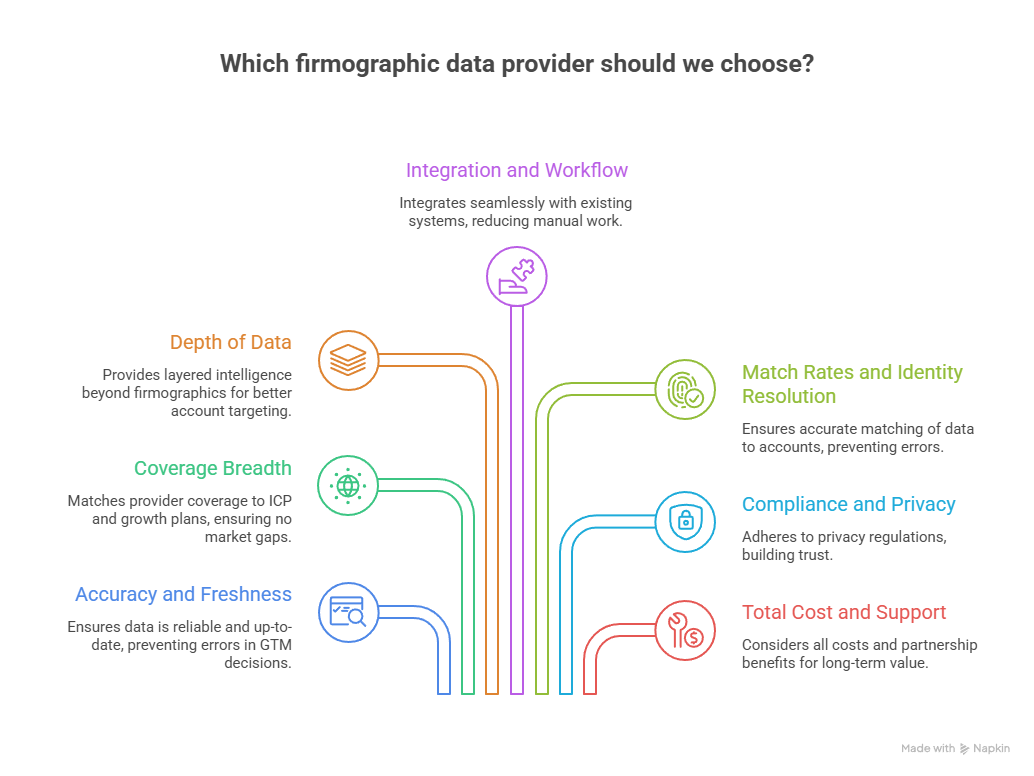
Stronger firmographic data vendors provide parent-subsidiary mapping, branch locations, global entity coverage, and hierarchy context. Parent-child relationships matter because budgets, buying committees, procurement rules, and installed technologies often sit across connected business units. Miss the hierarchy and you misread the account. HG Insights, for instance, layers firmographic attributes alongside technographic and organizational hierarchy data, so parent-subsidiary relationships inform account scoring rather than creating blind spots in it.
Global coverage matters just as much. A provider that performs well in U.S. enterprise software accounts might fall short in EMEA mid-market, APAC subsidiaries, or privately held companies. Your B2B data provider comparison should reflect the markets your team actually sells into, not the ones the vendor happens to cover best.
Evaluating data accuracy and freshness
Accuracy tells you whether the data is right. Freshness tells you whether it’s still right. You need both.
Ask each provider how often records are refreshed, which fields update most frequently, and how accuracy gets measured against reliable sources. Revenue estimates, employee bands, industry classifications, and corporate hierarchy data should each have a clear sourcing and validation process behind them.
Stale firmographic data inflates TAM models and distorts pipeline forecasts. A company that downsized, merged, changed markets, or changed ownership shouldn’t keep moving through your scoring model as if nothing happened. Bad data also creates sales drag when reps spend their time researching or correcting unreliable records, a risk Salesforce flags in its guidance on data validation practices.
There’s a simple test for this. Give providers a sample of messy CRM records and compare match quality, field accuracy, and hierarchy resolution. For teams using B2B data enrichment for GTM precision, that test shows whether enrichment actually improves account decisions or just fills empty fields.
Coverage breadth and global reach
Measure coverage against your ICP, not the provider’s largest advertised number. A giant database doesn’t help if it misses your target industries, regions, or company-size bands.
Match provider coverage to your current segments and your growth plans. If your team is expanding into new regions, moving into mid-market, or targeting specialized verticals, ask for proof of coverage in those exact areas before you sign anything.
A coverage gap limits pipeline expansion quietly, which is what makes it dangerous. Marketing struggles to build quality ABM audiences. Sales recycles familiar account lists because the next market tier looks thin. HG Insights tracks verified technology installs across more than 120 million organizations, drawing from over 20 billion external data points, which means coverage gaps in key segments are less likely to go undetected. When Airbase evaluated providers for back-office software coverage, switching to HG Insights grew their identified serviceable addressable market by approximately 80% overnight, according to Michael Freeman, VP of Marketing at Airbase. Good firmographic data sources should support where your GTM motion is going, not just where it already works.
Depth beyond firmographics
Fit data tells your team which accounts resemble your best customers. It doesn’t tell them which accounts are showing buying signals, running competing technographic data, approaching renewal windows, or increasing spend in your category.
That’s where layering changes the picture. Technographic data adds context around installed technologies. Intent data shows active research behavior. Contract and spend intelligence help your team read timing, wallet potential, and competitive pressure.
Layered intelligence turns basic enrichment into real account targeting, helping sales and marketing prioritize on fit, readiness, and revenue potential rather than fit alone. For teams building predictive account targeting and scoring, firmographics should work alongside technographic, intent, install, and spend signals, not stand on their own.
Integration and workflow fit
Great data loses its value when it sits outside the systems your team uses every day. Your provider should integrate cleanly with your CRM, marketing automation platform, data warehouse, BI tools, reverse ETL workflows, and sales engagement systems.
Your evaluation should cover data delivery, field mapping, update frequency, API access, and governance controls. Clean integration cuts manual work and keeps enriched records current in production. Poor integration creates delays, duplicate records, and stale scoring inputs.
Ask specifically how enrichment updates flow into live workflows. If refreshed account data doesn’t reach routing, scoring, segmentation, and campaign tools quickly, your team is still operating on yesterday’s view of the market, no matter how good the underlying data is.
Match rates and identity resolution
High match rates are a baseline expectation, not a selling point. Identity resolution quality is where the evaluation gets serious.
Weak matching attaches the right-looking data to the wrong account. Duplicate companies stay unresolved, subsidiaries map incorrectly, leads route to the wrong owner, and account scores blend activity across unrelated entities. Each of those failures looks small and compounds fast.
Strong identity resolution accounts for company names, domains, aliases, locations, acquisitions, and parent-child structures. Ask vendors to run a match test against your CRM, then review the misses and the questionable matches rather than the headline number. The edge cases tell you far more than the match rate on the slide.
Compliance, privacy, and data governance
Firmographic data still needs careful governance. Your team should understand how each provider sources data, documents permitted use, manages opt-outs, and supports privacy requirements across regions.
Ask about GDPR, CCPA, and other regional privacy rules that affect enrichment, outbound, and reporting workflows. B2B marketing rules also vary by region. The UK ICO notes that some business-to-business marketing activity may rely on legitimate interests when the proper test applies.
Governance also shapes trust inside your own company. Sales, marketing, RevOps, legal, and analytics all need confidence that provider data is usable, explainable, and managed responsibly. Without that, adoption stalls regardless of data quality.
Total cost, support, and partnership fit
The cheapest provider isn’t always the lowest-cost choice. Total cost includes implementation time, CRM cleanup, field mapping, API work, user adoption, support, and ongoing data validation.
A stronger partner helps your team test data quality, tune workflows, and adapt as your GTM motion changes. That support matters because provider evaluation doesn’t end at contract signature. Your team will need help with onboarding, hierarchy questions, coverage gaps, enrichment logic, and new use cases as they come up.
Treat the selection of a firmographic data provider like a GTM infrastructure decision, not a procurement shortcut. The difference shows up in time to value.
How HG Insights compares as a B2B firmographic data provider
HG Insights combines firmographic data with technographic, install, contract, spend, and intent intelligence, giving your team deeper context for account selection and prioritization.
Working from that connected view helps revenue teams move past static company attributes toward account intelligence that supports segmentation, scoring, market sizing, ABM, and pipeline planning. The RGI Platform for unified B2B data intelligence connects those signals into a single GTM data layer, giving teams a shared, accurate way to assess account fit, opportunity, and market movement.
The best B2B firmographic data providers help teams move beyond cleaner CRM fields toward better decisions about which accounts deserve attention. When firmographic data is accurate, fresh, connected, and layered with stronger market signals, your GTM motion runs on account intelligence your team can trust. See how HG Insights compares for your team