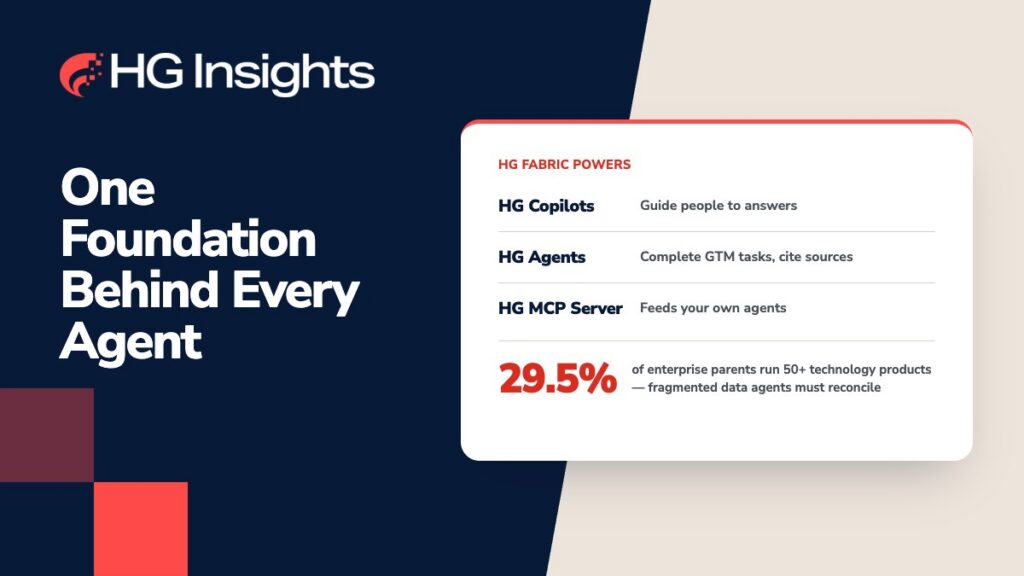
HG Fabric is the intelligence foundation of the Contextual Intelligence Platform. It connects technology installations, spend, intent, accounts, buying centers and contacts, tracks change over time, and reveals signals that AI agents and GTM teams can act on with confidence.
Why does AI execution depend on the intelligence beneath the agent?
AI is now embedded in go-to-market workflows. Copilots help teams research and decide; agents prioritize accounts, build audiences, draft outreach, and execute repeatable work. The opportunity is real, but decision quality depends on more than the automation.
The difference is the intelligence beneath the agent. When the underlying information is fragmented, incomplete, or disconnected from its history and relationships, an AI system can produce a plausible answer without recognizing what is missing or inconsistent. At scale, that turns a data-quality problem into a decision-quality problem.
The Contextual Intelligence Platform addresses this challenge by giving people and AI agents a shared, trusted understanding of markets, accounts, and buyers. Fabric is the intelligence foundation that makes that possible. For the broader market case, see [the Contextual Intelligence platform perspective](link to the Contextual Intelligence POV post).
Why does data fragmentation pose a greater risk in an agentic world?
GTM information is typically distributed across technology-install records, spend data, firmographics, corporate hierarchies, buyer activity, contacts, CRM data, and research sources. The scale is measurable: 29.5% of enterprise parent companies (18,326 of 62,197 tracked global headquarters with 1,000 or more employees) run 50 or more technology products. (Source: HG Insights internal data, October 2026.)
Each source can be useful on its own. The problem emerges when they describe the same company differently, leave out the relationship between a subsidiary and its parent, or provide a signal without the history needed to interpret it.
What goes wrong when agents act on fragmented data?
People can sometimes catch these gaps through experience, judgment, and discussion. AI automation systems move faster. They may rank an account without recognizing that a spending record belongs to a parent company, treat a research signal as a new-logo opportunity when the account already owns the product, or generate a campaign from duplicates and partial definitions.
The question is not whether an agent can retrieve data. It is whether the information it uses is connected, current, traceable, and meaningful enough to support the decision at hand.
What is the HG Fabric?
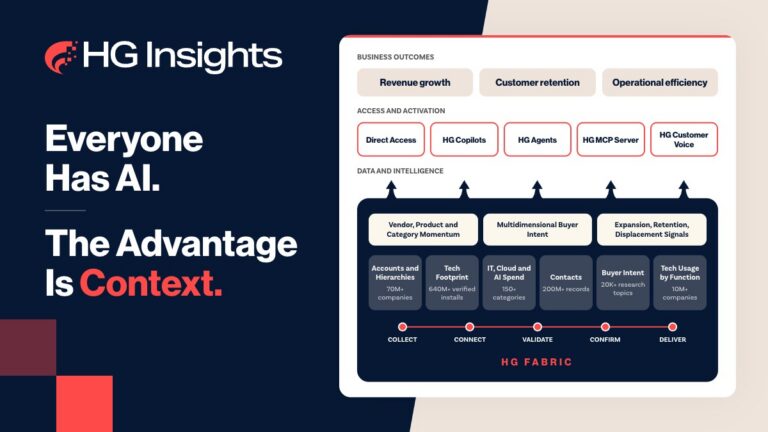
HG Fabric is the intelligence foundation of the Contextual Intelligence Platform. It connects HG data across sources, tracks change over time, and computes signals that teams and agents can act on. It brings technology installations, spending, intent, corporate hierarchies, buying centers, contacts, and historical changes into a governed context around shared company identities and corporate family structures.
Fabric can be licensed independently and delivered through APIs or Direct Feed into a customer’s warehouse, CRM, applications, or models. It also powers the platform’s activation paths: HG Copilots, HG Agents, and HG MCP Server.
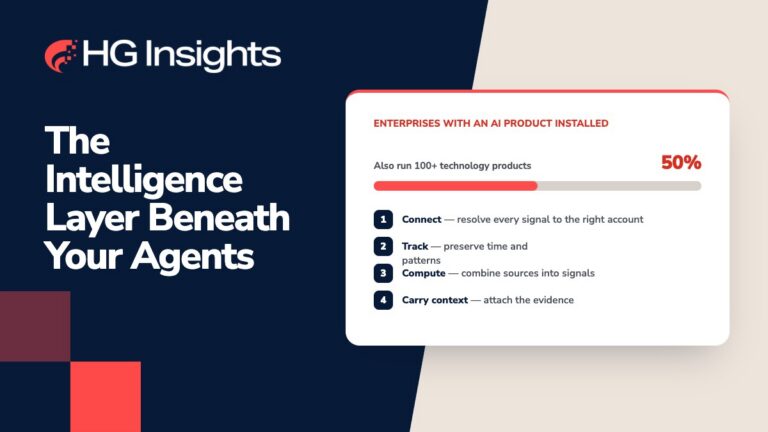
Connect
Fabric resolves signals to a shared company identity and corporate hierarchy. This gives teams and systems a more reliable picture of the organization behind an account, including the relationships among subsidiaries, parents, products, spending, and buyers.
Track
Fabric preserves the time dimension of intelligence. It helps users and agents distinguish a durable pattern from a momentary event by showing what changed, when it changed, and how the account or market has evolved.
Compute
When information is connected, Fabric can generate signals that no single source provides. For example, buyer research becomes more useful when interpreted alongside technology ownership, competitive footprint, hierarchy, and timing.
Carry context
Fabric carries the evidence and relationships needed to interpret an output. That makes recommendations more reviewable and helps people and agents understand what the signal is and why it matters.
How does HG Fabric turn data into decisions-ready intelligence?
A raw intent data record may indicate that an account is researching a category. Context changes the decision, as the same research activity points to a different motion depending on what the account already owns:
What the account already owns | What the same research signal suggests |
|---|---|
No relevant technology footprint | A new-logo opportunity |
The product itself | An expansion opportunity |
A competitor’s product | A potential displacement motion |
This is the distinction between activity and decision-ready intelligence. Fabric connects each signal to the account, market, and evidence needed to determine the appropriate action.
How do HG Copilots, HG Agents, and HG MCP Server use HG Fabric?
Fabric is designed to make the same trusted intelligence useful across people-led and agentic workflows.
- HG Copilots: Guide people to answers inside familiar GTM workflows. Market Analyzer, Data Studio, and Sales Copilot help teams research markets, prioritize accounts, build audiences, engage buyers, and make informed decisions using Contextual Intelligence.
- HG Agents: Complete defined GTM tasks and return source-cited outputs that teams can review and use. They apply Fabric intelligence to work such as account research, buying-committee mapping, list building, account scoring, contact discovery, and outreach preparation.
- HG MCP Server: Brings trusted HG intelligence into customer-built agents and MCP clients. It gives organizations a way to use the same underlying context in the AI systems and workflows they are already building, with one intelligence source behind every use case.
What does HG Fabric enable?
More precise growth motions
Teams can prioritize markets, accounts, and buying groups using a clearer view of fit, need, technology ownership, buyer activity, and change. That supports more relevant new-logo, expansion, and displacement motions.
More coordinated customer decisions
A shared intelligence foundation helps Sales, Marketing, Customer Success, RevOps, and data teams work from consistent account definitions and evidence. It can improve how teams identify opportunity, risk, whitespace, and the next action to take.
More accountable automation
When agents act on connected intelligence and return source-cited outputs, teams have a stronger basis for review, governance, and improvement. Fabric’s aim is accountable action grounded in evidence, rather than autonomous activity for its own sake.
What should enterprises require from an intelligence foundation?
As AI becomes part of consequential revenue workflows, enterprises will look beyond model access and workflow automation. They will need intelligence with traceable sources, consistent identities and taxonomies, visible uncertainty, and a reviewable record of how recommendations and actions were produced.
Fabric provides that foundation. It enables the Contextual Intelligence Platform to serve a common intelligence layer across systems, teams, and agents, so decisions can improve without forcing every workflow to solve the same data problem again.
The path forward: from faster activity to explainable action
Agents act faster than teams can review, so what they work from decides whether that speed helps or hurts. Fabric turns connected information into context, and HG Copilots, HG Agents, and HG MCP Server put that context to work in the tools teams already use.
Frequently Asked Questions
What is the HG Fabric?
Fabric is the intelligence foundation of the Contextual Intelligence Platform. It connects technology installations, spending, intent, corporate hierarchies, buying centers, contacts, and historical changes around shared company identities, so people and AI agents can work from the same connected, current and traceable context.
Why do AI agents need connected intelligence?
Automated systems act faster than people, so they can turn gaps into confident action. An agent may rank an account without seeing that a spending record belongs to a parent company, or treat research activity as a new-logo opportunity when the account already owns the product. Connected intelligence closes those gaps.
How does Fabric help GTM teams interpret an intent signal?
Fabric connects the signal to what the account already owns. With no relevant technology footprint, the research may point to a new-logo opportunity. If the account already uses the product, it may suggest expansion. If it runs a competitor, it may point to displacement.
How can customers access HG Fabric?
Fabric can be licensed independently and delivered through APIs or Direct Feed into a customer’s warehouse, CRM, applications, or models. It also powers HG Copilots, HG Agents, and HG MCP Server, which put the same intelligence into people-led and agentic workflows.
What does the HG MCP Server do?
HG MCP Server brings HG intelligence into customer-built agents and MCP clients. Organizations can use the same underlying context in the AI systems they are already building, with one intelligence source behind every use case.
What should enterprises require from an intelligence foundation for AI agents?
Enterprises will need traceable sources, consistent identities and taxonomies, visible uncertainty, and a reviewable record of how recommendations and actions were produced. That record lets teams review, govern and improve automated work.
Author
-

Nik Koutsoukos brings over 25 years of product and marketing executive leadership to his role as VP of Product Marketing at HG Insights. He drives product GTM, customer and partner-marketing, and sales enablement to increase awareness, reach, adoption, and growth.
Prior to HG Insights, Nik held senior positions including VP of Product Marketing at SolarWinds, Chief Marketing Officer at Catchpoint, and VP of Product Marketing at Riverbed Technology, where he helped scale adoption of enterprise performance and observability solutions. Nik brings deep expertise in translating complex technology into compelling market value and partner-aligned growth. He holds a BSEE from Leeds Beckett University.