

HG Agents
HG Agents is for sales, marketing, and customer success teams that want to automate account research and context gathering instead of doing it manually. Someone hands off a company, a market, or campaign criteria to HG Superagent, which coordinates the right specialist agents and returns a cited deliverable they can act on the same day.
HG Agents is the pre-built agent product offering of the HG Insights Contextual Intelligence Platform. Each agent runs on HG Fabric intelligence, orchestrates ten or more data calls per run, and returns a finished, source-cited output such as an account brief, buying committee map, or target list to sales, marketing, and customer success teams.
What GTM problems do HG Agents solve?
Account research does not scale with headcount
Researching one target enterprise account takes up to 60 minutes, so it only happens for a short priority list and not for the rest of the target market. So sales reps end up working whichever accounts they have time for, not necessarily the ones that deserve attention this quarter.
Most AI agents rely on an unproven data foundation
Teams are building agents faster than they're building out the account intelligence underneath them. They are thin on technographics, spend, and buying-center detail. Speed isn't the constraint. Access to trusted and governed data is, and most agent rollouts don't have it.
Your agents give confident, wrong answers
Agents can't see what their data is missing, so they fill gaps with plausible guesses. HG Agents draw from trusted and governed HG Contextual Intelligence, where every record connects to one company and every answer traces to its source.
Nobody can check the work
An AI output that cannot be traced back to a source is an output a revenue leader cannot defend in a pipeline review. Teams either re-verify every claim manually, which removes the time saving, or they quietly stop trusting the tool.
What does HG Agents include?
Hierarchy type: Agent product inside the HG Insights Contextual Intelligence Platform
Primary users: Sales, marketing, demand gen, ABM marketing, customer success teams, and the GTM leaders
Jobs performed: Account research, buying committee mapping, list building, scoring, contact discovery, outreach
Data inputs: HG Fabric technographics, IT and cloud spend, buyer intent, Functional Area Intelligence, corporate hierarchy, contacts, and install history
Delivery channels: Slack, Microsoft Teams, the HG MCP App, or the customer's own application
Orchestration: HG Superagent routes a request to the right agent; agents can also be invoked through HG MCP Server
Deployment: Cloud (SaaS)
Security and compliance: GDPR and CCPA, with prompt injection screening and a per-run audit trail
Commercial model: Credit-based consumption. HG Superagent is included with HG Agents
What do HG Agents do?

Runs a library of pre-built agents
HG Agents offers a library of pre-built agents covering account research, buying committee mapping, list building, scoring, contact discovery, and outreach. The Account Research Brief pulls 30 or more data points across firmographics, technology stack, IT spend, Functional Area Intelligence, contacts, etc. in roughly 90 seconds.

Routes requests through HG Superagent
HG Superagent reads a plain-language request, routes it to the right specialist agents, and puts the result together, so no one has to know which agent to call or how to phrase it. A rep asks a question the way they'd ask a colleague, and the answer comes back formatted.

Cites every material claim to its source
Every HG Agents output traces each material claim back to the HG Insights data source that produced it instead of a summary with no source behind it. A sales leader can defend a prioritization call, a RevOps team can audit a score, and a security reviewer can follow the audit trail, without re-verifying the work by hand.

Delivers into channels teams already use
HG Agents return finished work through Slack, Microsoft Teams, the HG MCP App, or directly inside the customer's own application. Individual agents can also be invoked from a customer-built agent through HG MCP Server, HG Insights' implementation of the Model Context Protocol. The output is given where the account conversation is already happening, so there's no new tool to adopt.
Why does HG Agents matter?
When research stops being the bottleneck, coverage stops being a function of available hours. A rep can act on every account that deserves attention this quarter, not just the ones that made the priority list.
HG Superagent takes a plain language request and routes it to the right specialist HG Agent, so a team gets the benefit of the full agent library without learning each one individually.
Unsourced AI answers get double-checked before anyone acts on them, which is a time-consuming process. In contrast, cited outputs are easier to trust and acted on with confidence.
Slack, Microsoft Teams, the HG MCP App, or a customer's own application, so there's no new tool to learn or adopt without losing the context.
How do HG Agents work?
A user submits a company, a market definition, or campaign criteria in plain language. There is no need for schema, SQL, or prompt engineering. HG Superagent reads the request and routes it to the specialist agents that are needed for the job.
The HG Agent pulls firmographics, technographics, spend, intent, and the rest of the relevant HG Fabric signals in a single run, so the user never needs to search for the data source manually.
A finished brief, buyer committee map, scored account list, or outreach sequence arrives in Slack, Microsoft Teams, or the HG MCP App, with every claim traceable to the data behind it.
What workflows does HG Agents support?
Cited brief covering firmographics, technology stack, IT spend, Functional Area Intelligence, and contacts, built from 30 or more data points in minutes.
Stakeholder map with buying roles, influence levels, and a recommended engagement approach per person.
A list of target accounts built from the criteria marketing sets such as product, geography, revenue, and company size.
Account ranking across ICP fit and intent signals for campaign prioritization.
Get the right contacts for the accounts as a ready-to-use spreadsheet.
A seven-email personalized outreach sequence grounded in account facts.
Personalized outreach emails written from HG Insights account data.
Beyond the pre-built agents, HG Insights maintains a marketplace of more than 60 GTM workflows and more than 60 supporting skills, searchable by role and by GTM challenge. Custom agents can be built for a specific motion outside that library and run the same way, so the pre-built set is a starting point rather than a limit.
Who are HG Agents for?
Target audience
HG Agents enables RevOps, marketing, ABM, sales, and customer success teams to automate complex tasks.
Difference from generic AI assistants
An AI bot or assistant has access to whatever data is available in the public domain and by default infers what it cannot retrieve. HG Agents directly access HG comprehensive, trusted and governed Contextual Intelligence which combines accounts, technology installs, IT and cloud spend, product usage by role and department, verified contacts. Vendor, product and category account footprint and adoption velocity 15 years of history, then returns a comprehensive and attributed output.
Which use cases are supported by HG Agents?
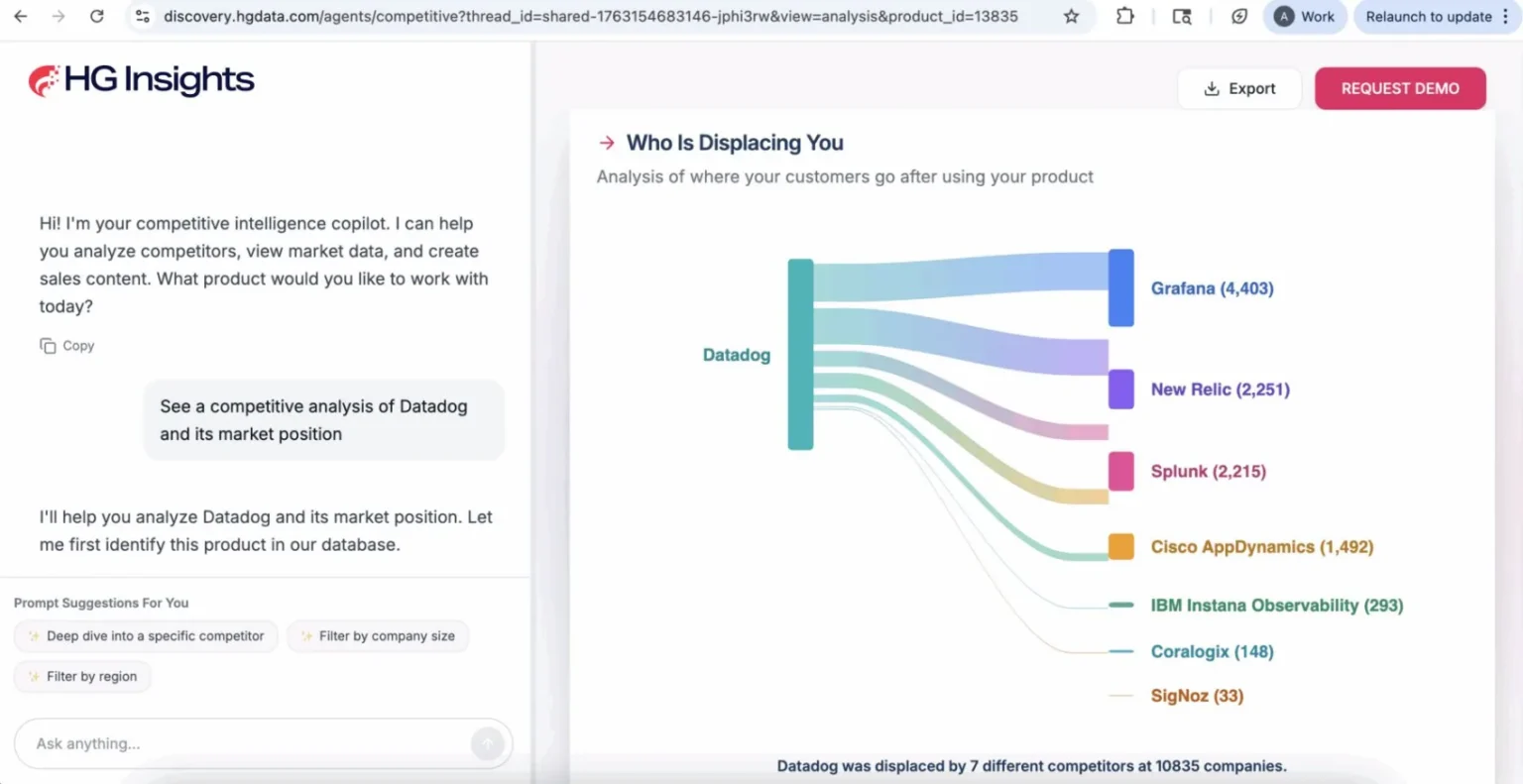
HG Agents surfaces which competitor a target account runs, how long the install has been in place, and which stakeholders own it, so displacement campaigns go to accounts where the timing is real rather than to a broad category list.
Learn More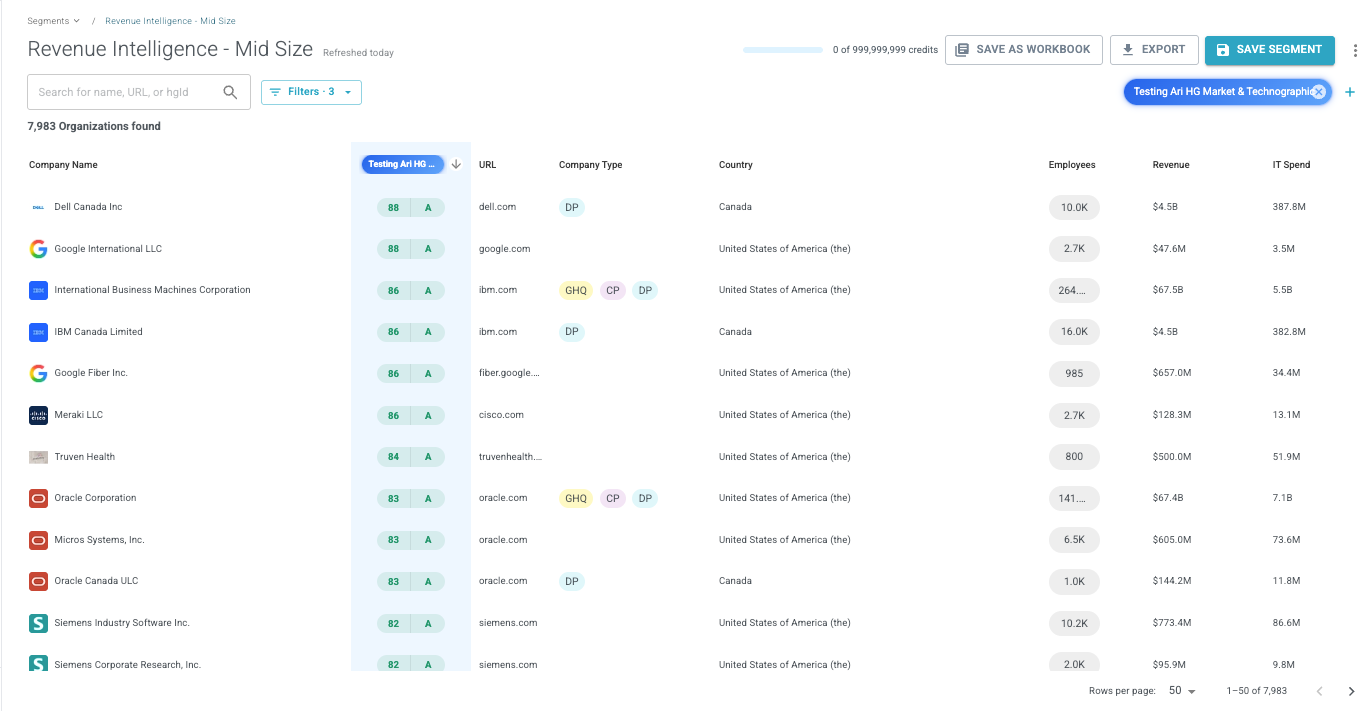
The Campaign Account Scorer ranks an account list on ICP fit and intent signals and shows the signals behind each rank. Campaign owners prioritize with a defensible account list instead of a static one.
Learn More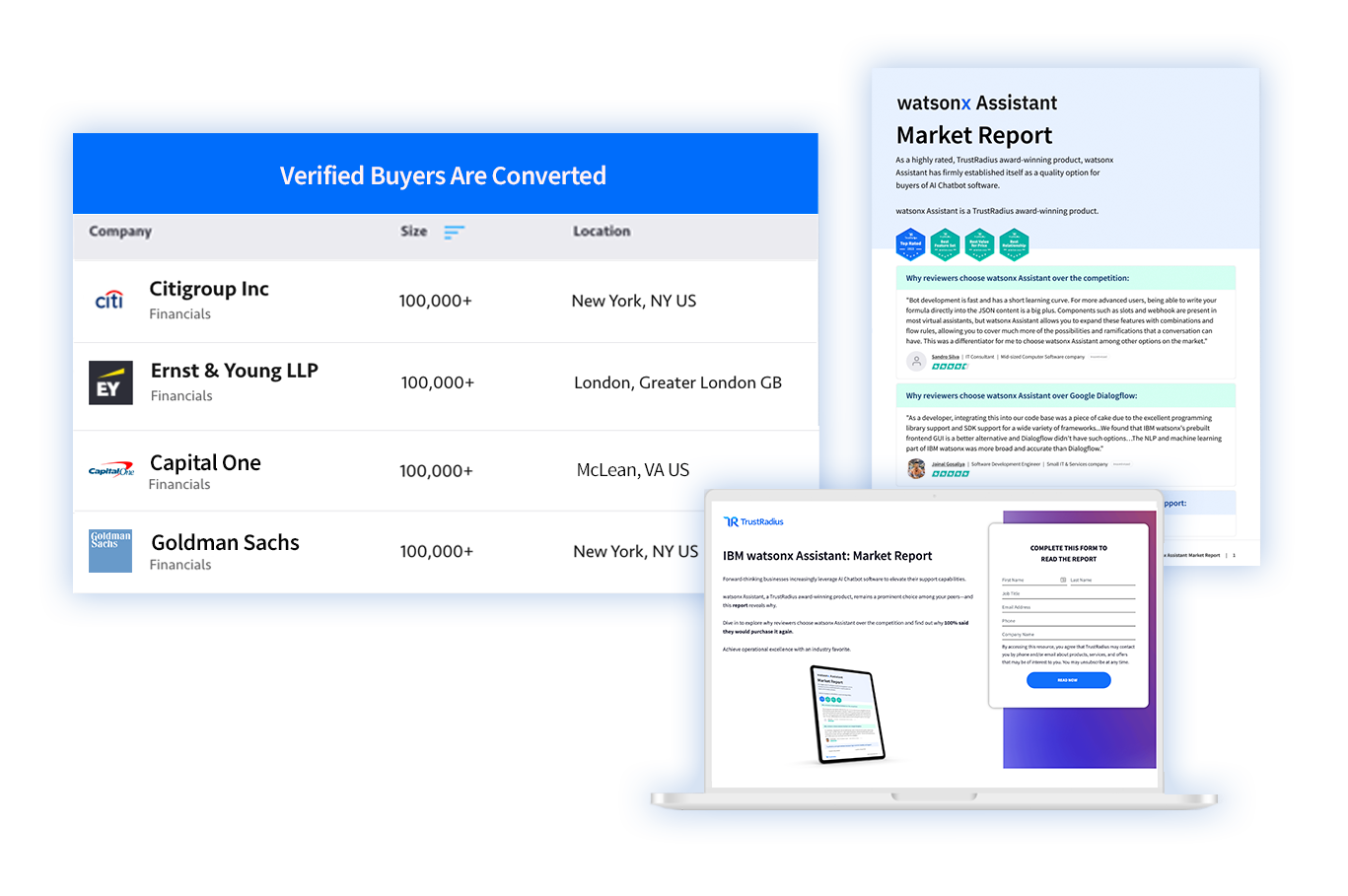
HG Agents connects buyer intent with what an account already owns, then finds the people inside the department that owns it. Outreach reaches the buying center rather than a job title that matched a filter, resulting in increasing conversion rates.
Learn MoreWhich products work with HG Agents?

Customer-Built Systems
HG MCP Server follows the open Model Context Protocol standard. Any MCP-compatible agent framework, including customer-built agents on LangChain, CrewAI, or custom platforms can invoke HG data tools or HG Agents directly. Artifacts can also be delivered to Slack, Microsoft Teams, or pulled into any application via API.

HG Fabric
Fabric is the data foundation behind every HG Agents output. Alongside HG Agents, it delivers the same signals into a warehouse or CRM by feed or API, so an agent artifact and a scored CRM record share one set of definitions.

HG MCP Server
HG MCP Server exposes HG Insights Contextual Intelligence and other connected data to any MCP-compatible client. Alongside HG Agents, a customer-built agent can call an HG agent as one step in its own workflow.