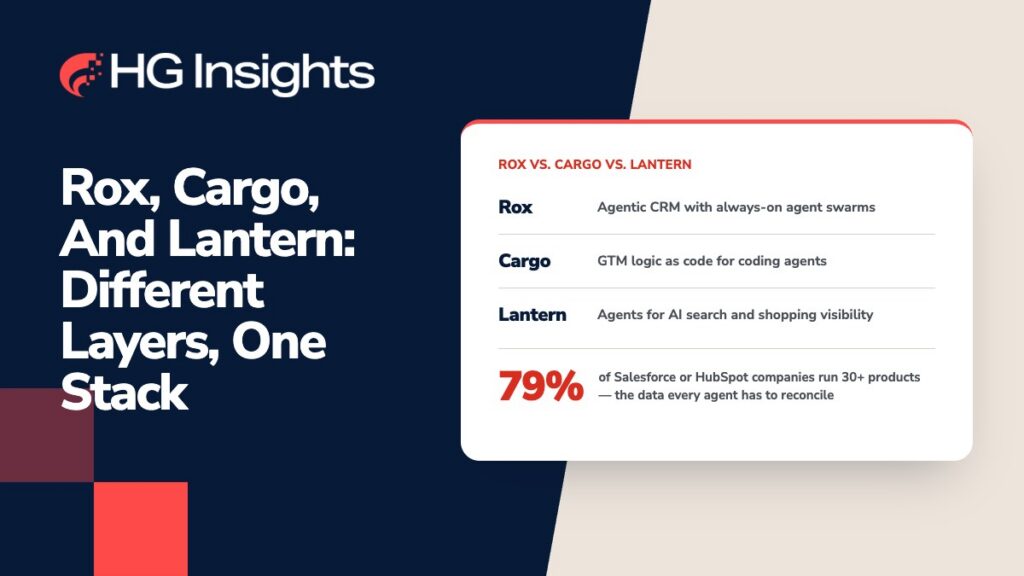
Rox AI, Cargo, and Lantern keep showing up in the same conversations about agentic GTM infrastructure, and they are not building the same thing. Rox is an agentic CRM. Cargo is a data layer for coding agents. Lantern builds agents for AI search and AI shopping visibility. Teams that treat “agentic GTM” as one category end up comparing tools that barely compete with each other. Here is what each one actually does, where they overlap, and the one dependency all three share.
Quick Answer: Rox is an agentic CRM that runs AI agent swarms against existing accounts inside Salesforce or HubSpot. Cargo is developer-first GTM infrastructure that lets coding agents write and run go-to-market logic. Lantern builds autonomous agents that monitor and improve brand visibility in AI search and AI shopping results. None of the three directly compete with each other.
Three different bets on what “agentic GTM infrastructure” means
The phrase gets used as if it describes one market. It does not. Rox is betting that the CRM itself gets replaced by a swarm of always-on agents. Cargo is betting that GTM logic should be written and run the way application code is, by engineers, in a repository, with agents as the execution layer. Lantern is betting that AI search and AI shopping are becoming distribution channels in their own right, and that someone needs to manage visibility inside them the way SEO teams manage visibility in Google.
The stakes are real even if the category definitions are messy. The global agentic AI market is projected to reach $10.29 billion in 2026 and grow at a 41.91% CAGR toward $169.22 billion by 2034, and Gartner expects 40% of enterprise applications to include task-specific AI agents by the end of 2026, up from under 5% today. A CTO or RevOps leader evaluating any one of these three vendors needs to know which bet they are actually making, because the switching costs and failure modes are completely different depending on the layer. HG Insights tracks this shift across tens of millions of companies’ technology, spend, and intent signals, which is where the account-level data cited throughout this piece comes from.
Rox: an agentic CRM running always-on agent swarms per account
Rox is an agentic CRM. Founded in 2024 by New Relic’s former chief growth officer, it deploys hundreds of AI agents per account that monitor activity across Salesforce, HubSpot, and other connected systems, research prospects, and update records without a rep touching them. Rox reached a $1.2 billion valuation in March 2026, led by General Catalyst with Sequoia among its backers, on a reported $8 million in annual recurring revenue.
What the agent swarm actually does
Rox positions itself less as a CRM replacement and more as a layer that plugs into the CRM a company already runs. Agents watch accounts continuously instead of waiting for a rep to open a record, flagging changes, drafting updates, and surfacing research that would otherwise sit in someone’s inbox. The pitch is that reps spend less time on data entry and more time on the conversations only a human can have.
A valuation ahead of its revenue
An $8 million ARR business valued at $1.2 billion is a huge bet for a company this early. That gap says more about investor appetite for agentic CRM as a category than it does about Rox’s current traction. Buyers evaluating Rox should ask the same question any early-stage vendor invites: what happens to roadmap and support if growth doesn’t catch up to the valuation on the timeline investors expect.
Cargo: GTM infrastructure and data models built for coding agents
Cargo is go-to-market infrastructure built for coding agents rather than for marketers or RevOps generalists. A team declares its GTM logic as a TypeScript repository, and Cargo’s four primitives, agents, plays, tools, and data models, run it against a unified layer spanning CRM data, product analytics, and third-party enrichment. Backed by Y Combinator’s S23 batch, Cargo markets itself as a Clay alternative built for engineers.
GTM as code, not as workflow
Where most GTM tools expose a visual workflow builder, Cargo exposes a CLI, a developer SDK, and a “Skills” system that gives coding assistants like Claude Code and Cursor pre-loaded knowledge of Cargo’s command patterns. Agents are autonomous workers that research and qualify accounts; plays are always-on deterministic workflows triggered by live signals; tools are reusable GTM functions callable from the UI, an API, or an agent. The whole workspace lives in version control, which means GTM logic gets code-reviewed the same way application logic does.
Who Cargo is actually built for
This is the clearest signal that Cargo is not competing with Rox or Lantern. Its own job postings and product language target founding engineers and technical RevOps builders, not demand gen or sales leadership. HG Insights technographic data shows that 35% of U.S. companies with 50 or more employees running Salesforce or HubSpot also run a modern cloud data warehouse like Snowflake or Databricks, exactly the CRM-plus-warehouse pairing Cargo’s “GTM as code” model assumes a buyer already has in place. A company without an engineering team willing to own a TypeScript repository of GTM logic is not Cargo’s buyer, regardless of how the category gets described in a vendor roundup.
Lantern: autonomous agents for AI-search and AI-commerce visibility
Lantern builds autonomous marketing agents that monitor how a brand appears across ChatGPT, Gemini, Perplexity, and Claude, then take action to improve what they find. Its newer agentic commerce platform targets AI-driven shopping traffic. Lantern’s own launch materials put that traffic up 4,700% year over year, accounting for roughly three-quarters of new product searches. Those are Lantern’s own numbers; nobody outside the company has independently verified them yet. Lantern is not a CRM and not a data layer. It is a visibility and optimization layer for a channel that barely existed two years ago.
One caveat worth naming
“Lantern” is a common enough name that search data for “lantern ai” is not reliable evidence of demand for this specific company; at least one unrelated business in a different market uses a similar name. What is confirmed through public reporting and the company’s own site is that Lantern runs a Monitor Agent that evaluates what changed in a brand’s AI search position after every scan and decides independently what to do about it. Beyond that, confirm the details directly with the vendor before you rely on them.
Rox vs. Cargo vs. Lantern: three different layers of the agentic GTM stack
Laid side by side, the differences are less about which agent is smarter and more about which problem each company decided to own.
Vendor | What it replaces or extends | Primary buyer | Backing |
|---|---|---|---|
Rox | The CRM’s manual update and research work | VP Sales, RevOps | |
Cargo | A visual GTM workflow builder | Founding engineers, technical RevOps | |
Lantern | Traditional SEO monitoring and content ops | Marketing, SEO/GEO leads |
A company could reasonably run all three at once without redundancy: Rox managing account-level CRM work, Cargo running the custom GTM logic a technical team wants to own in code, and Lantern watching how the brand shows up in AI search. None of them is a drop-in substitute for the others, which is exactly why naming them separately matters more than lumping them under one “agentic GTM” label.
The dependency all three inherit: the data their agents reason over
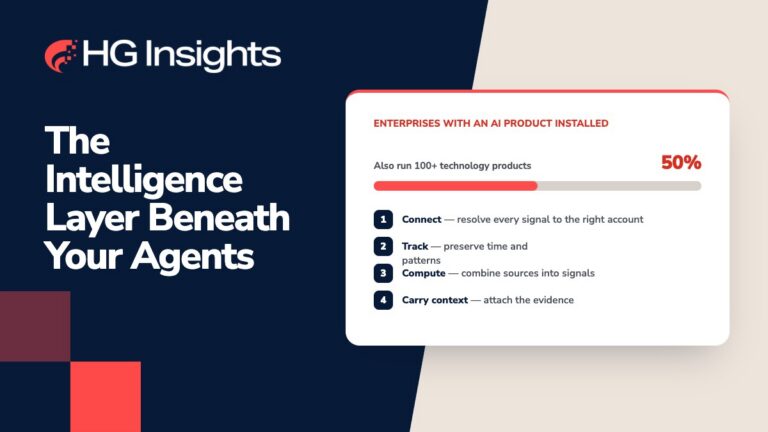
HG Insights technographic data shows that 79% of U.S. companies with 50 or more employees running Salesforce or HubSpot carry 30 or more distinct products in their current technology stack. That is the fragmented environment any agent built on top of a CRM, a data model, or a visibility tool has to reconcile before it can reason about an account reliably.
Every agent among these three is only as useful as what it can see. Rox’s agents reason over whatever is already in the CRM. Cargo’s agents reason over whatever a team has modeled in its data layer. Lantern’s agents reason over search and commerce signals specific to AI engines. None of the three has built a proprietary technographic, firmographic, or IT spend data foundation of its own, and that is consistent with a broader pattern: competitive research into the agent-infrastructure market found that most vendors in this space pair agent orchestration with third-party or aggregated data rather than data they own outright.
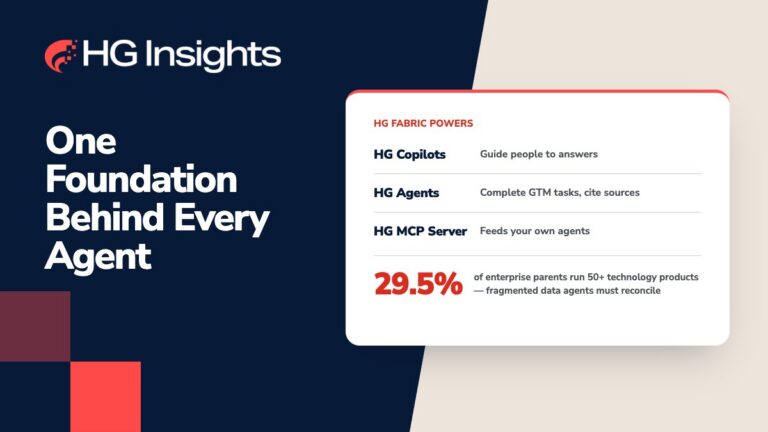
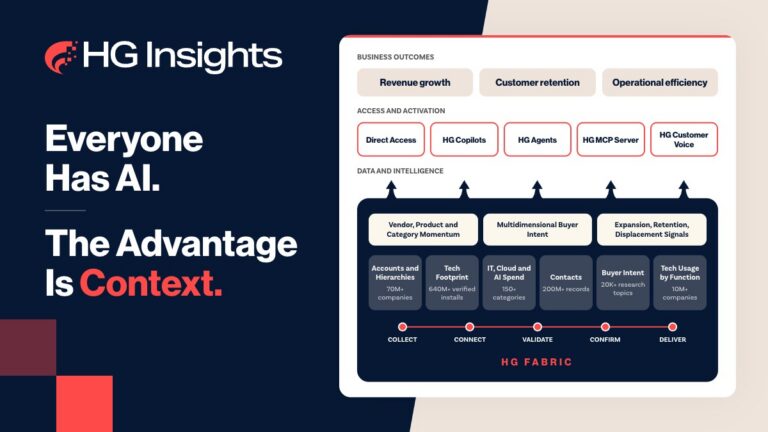
That is the layer HG Insights sits in, underneath tools like these rather than in competition with them. HG Fabric unifies firmographic, technographic, IT spend, contract, and intent data under one identifier, and it is exposed through an MCP server so agents built on Rox, Cargo, Lantern, or a custom stack can query verified technology intelligence directly. See how HG Agents and HG MCP Server give technical teams a data foundation for agentic GTM.
What to check before adding any of these to your stack
The evaluation framework for judging whether an agentic GTM vendor is production-ready, whether MCP support is real versus marketing language, whether the vendor owns its data, whether pricing is transparent, is already covered in detail in our blogs on agentic GTM and AI agent infrastructure. What’s specific to Rox, Cargo, and Lantern is matching the vendor to the actual job. Rox suits a team that wants its existing CRM augmented, not replaced, and that can tolerate working with an early-stage vendor whose valuation is running well ahead of its revenue. Cargo suits a team with engineers willing to own GTM logic in a repository, not a marketing or sales org looking for a no-code tool. Lantern suits a team that already has SEO or content operations in place and wants a dedicated layer for AI search and AI commerce specifically, rather than a general-purpose agent platform.
None of the three provides a full contextual intelligence platform like HG Insights. This is a comparison of an adjacent layer of the agentic GTM stack. For technical evaluators comparing where a data layer should sit relative to Rox, Cargo, or Lantern, HG Insights offers a demo of its MCP Server and HG agents built specifically for that conversation: book a technical walkthrough.
Frequently Asked Questions
What is Rox AI used for?
Rox is used as an agentic CRM layer that runs AI agents against existing accounts inside Salesforce or HubSpot. The agents monitor accounts continuously, research prospects, and update CRM records automatically, reducing the manual data entry and research work that otherwise falls on sales reps.
Is Rox AI a CRM?
Rox is positioned as an agentic CRM, but it functions more as a layer that plugs into a CRM a company already runs rather than a full replacement for Salesforce or HubSpot. It deploys AI agent swarms that work on top of existing CRM data and workflows.
What does Cargo do for GTM teams?
Cargo gives GTM teams a way to declare go-to-market logic as a TypeScript repository that coding agents can write and run. It unifies CRM, product, and enrichment data into one model and executes GTM work through agents, plays, and tools built for engineers rather than no-code users.
How do Rox, Cargo, and Lantern compare?
Rox, Cargo, and Lantern occupy different layers of the agentic GTM stack rather than competing head-to-head. Rox augments the CRM with always-on agents, Cargo lets engineers build GTM logic as code, and Lantern manages brand visibility in AI search and AI shopping results.
Are Rox, Cargo, or Lantern competitors to HG Insights?
No. They operate as an adjacent layer of the agentic GTM stack, building agents and workflows, while HG Insights provides the underlying verified data foundation those agents can reason over through its MCP server.
Author
-

Nik Koutsoukos brings over 25 years of product and marketing executive leadership to his role as VP of Product Marketing at HG Insights. He drives product GTM, customer and partner-marketing, and sales enablement to increase awareness, reach, adoption, and growth.
Prior to HG Insights, Nik held senior positions including VP of Product Marketing at SolarWinds, Chief Marketing Officer at Catchpoint, and VP of Product Marketing at Riverbed Technology, where he helped scale adoption of enterprise performance and observability solutions. Nik brings deep expertise in translating complex technology into compelling market value and partner-aligned growth. He holds a BSEE from Leeds Beckett University.