Contextual Intelligence is a complete, trusted, connected picture of markets, accounts and buyers, expressed as decision-ready signals for people and AI. It resolves each signal to the right company, preserves time and evidence, and combines sources so GTM teams know what matters, why it matters now and what action fits.
In go-to-market, contextual intelligence is distinct from the leadership concept of the same name and from contextual advertising. It is the intelligence layer that sits beneath a team’s copilots and agents.
Why AI advantage is shifting from automation to intelligence
On October 6, HG Insights introduced the Contextual Intelligence Platform: a shared intelligence foundation designed to help go-to-market teams and AI agents work from verified context, understand what matters and act with greater precision. The launch reflects a larger market shift. As access to AI becomes ubiquitous, competitive advantage will increasingly come from the quality, depth and relevance of the intelligence beneath it.
Every enterprise will have access to advanced models, copilots and agents. The models will improve, and the cost of automation will continue to fall. But access to intelligence will remain uneven. Revenue teams still operate across disconnected applications, fragmented, isolated data and partial views of customers and markets, resulting in decisions made without the full picture. AI does not eliminate those gaps. Without dependable context, it can amplify them.
The prior era rewarded more data, more dashboards and more applications. The emerging era will reward systems that establish verified context, interpret it, coordinate action and connect that action to business results. In that environment, the central question is no longer whether an organization has AI. It is whether its people and agents are working from a trusted, shared understanding of the market, its opportunities and its hazards.
AI scales action. Context determines whether that action is precise, explainable and useful.
The risk of acting without context
Most GTM environments were assembled one application at a time. Marketing, Sales, Customer Success, RevOps and AI systems often operate from different data, definitions and priorities. Accounts are matched differently, buying groups are interpreted differently, and important changes arrive without the history needed to explain them.
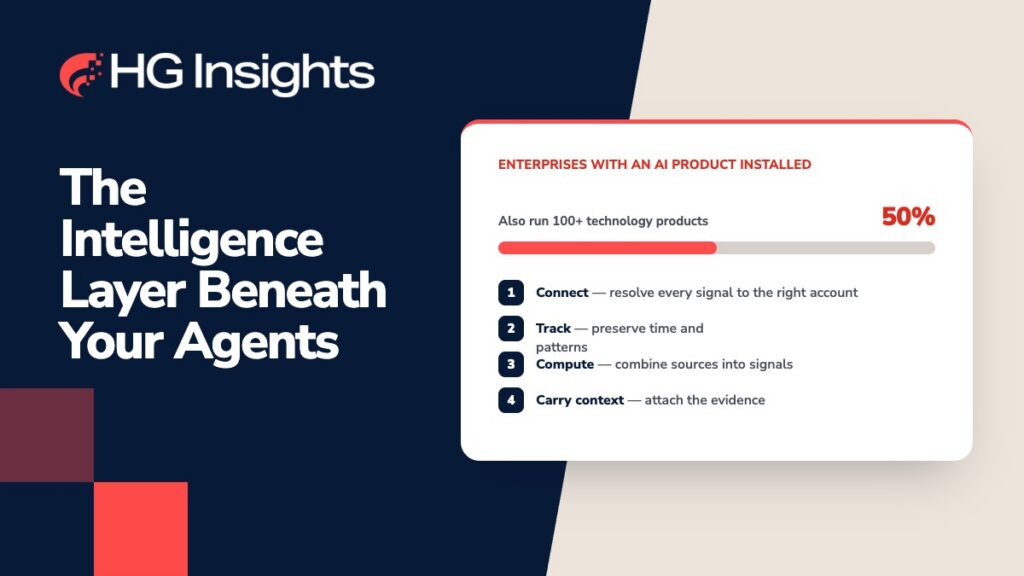
The scale of the problem is measurable. Among the 19,764 enterprises (global headquarters with 1,000 or more employees) that have at least one AI product installed, 50% also run 100 or more technology products. AI is being added to sprawling stacks, where every additional application is another place for data, definitions and priorities to diverge. (Source: HG Insights internal data, October 2026.)
Connecting systems moves data between applications. Context explains what the data means, how it relates to other signals and how much to trust it.
Humans can compensate for ambiguity through judgment and conversation. Agents can turn the same ambiguity into confident action at scale. That raises the enterprise quality bar from more signals to trusted context, relevance, provenance and accountability.
What is contextual intelligence in GTM?
Contextual Intelligence is a complete, trusted, connected picture of markets, accounts and buyers, expressed as decision-ready signals for people and AI. It preserves the relationships, timing and evidence that give information meaning.
How does contextual intelligence work?
Operationally, four capabilities make context usable:
- Connect: Resolve each signal to the right company, account and corporate hierarchy.
- Track: Preserve time so users and agents can distinguish a durable pattern from a momentary event.
- Compute: Combine multiple sources to create signals a team can act on, rather than isolated observations.
- Carry context: Attach the evidence and relationships needed to interpret, review and trust each output.
Those capabilities convert a stream of disconnected observations into a shared understanding. A technology installation becomes more useful when it is connected to ownership, spend, product relationships, buyer research and timing. A spike in activity becomes more meaningful when it is compared with a company’s history, category dynamics and likely decision process.
This is the distinction between signal volume and decision quality. More data can describe more activity. Contextual Intelligence helps a revenue system decide which activity matters, why it matters now and what action is appropriate.
From foundation to outcomes: the strategic model
The operating capabilities of Contextual Intelligence create a strategic progression: Foundation, Precision, Activation and Outcomes. They describe how trusted information becomes measurable business value.
Stage | What it means |
|---|---|
Enterprise Trust | A trusted, governed and complete picture of accounts, markets and buyers grounded in traceable evidence. |
Precision | Identity, taxonomy, relationships and time turn raw signals into context that supports a decision. |
Activation | The right context reaches people and agents inside the workflows where decisions happen. |
Outcomes | Actions connect to pipeline, retention, productivity and cost-to-serve so teams can learn. |
Enterprise Trust
Enterprise revenue systems need a dependable foundation that scales accurate, governed identities, consistent definitions, traceable sources and a clear view of what is known. A foundation makes evidence, freshness and confidence visible enough for people and agents to use responsibly, even when a signal is uncertain.
Precision
A strong foundation becomes useful when it is connected to the right entities and interpreted in context. Identity resolution, taxonomy, relationship mapping and time-series analysis help distinguish noise from a meaningful change in an account, market or buying group.
Activation
Intelligence creates value only when it reaches the point of decision. Activation brings context into the applications, models, copilots, agents and workflows where teams already work. Activation improves the quality of decisions across the existing revenue system without adding another destination.
Outcomes
The final standard is business impact. Intelligence and agent activity should connect to pipeline, conversion, retention, productivity and cost-to-serve. That connection makes performance observable and creates the feedback needed to improve future decisions.
What is in the Contextual Intelligence Platform?
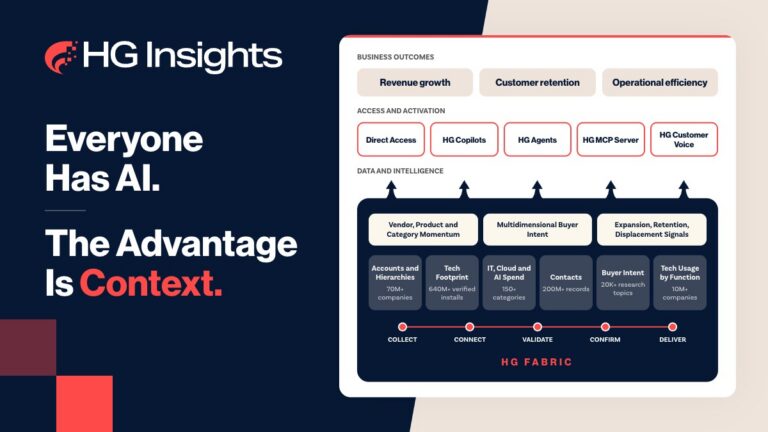
The HG Insights platform is designed to make the same trusted intelligence useful across human and agentic workflows. The architecture begins with the Contextual Intelligence Fabric and extends through three activation paths.
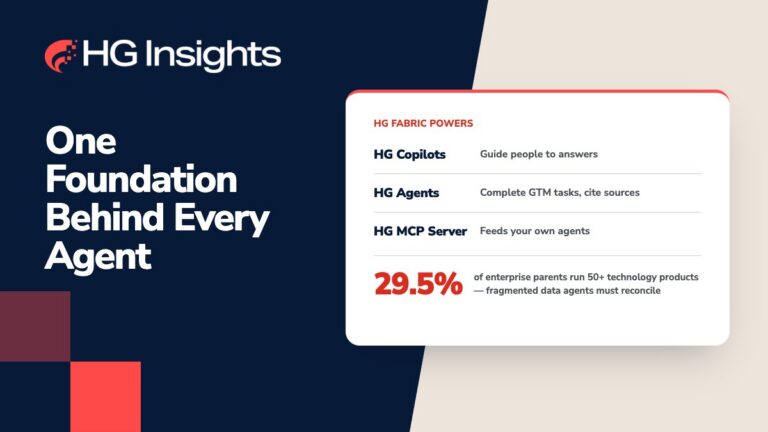
- HG Fabric: this is where Contextual Intelligence lives and it’s the shared foundation that resolves market, company, account, buyer, product, spend, buyer intent signals into one consistent context. It can also be licensed independently through API or direct feed.
- HG Copilots: Agentic workflows guide for teams, helping them interpret intelligence, conduct research and make smarter decisions that result in positive revenue outcomes.
- HG Agents: Execution for defined GTM work, completing tasks and returning source-cited outputs that teams can review and use.
- HG MCP Server: Access for customer-built agents, bringing HG contextual intelligence, with its provenance intact, into the agentic systems enterprises create themselves.
HG Fabric is the intelligence foundation. HG Copilots help people interpret it. HG Agents complete defined work. The HG MCP Server makes the same context available to customer-built agents. Together, they allow organizations to adopt agentic workflows without creating a new intelligence silo for every use case.
One intelligence foundation can support many workflows, without forcing every workflow into one application or one model.
Why HG Insights is built to deliver it
HG Insights brings together longitudinal technographic intelligence, verified buyer behavior through TrustRadius, governed identity and taxonomy, and an ecosystem-independent point of view. The combination creates a foundation that is difficult to recreate quickly because its value comes from the relationships among those assets. Today, enterprises of any size rely on HG Insights to grow revenue, boost efficiency and improve retention.
Market and technology context
HG has spent more than a decade structuring and validating intelligence about technology adoption, spend and change. That history helps revenue systems interpret current signals against a longitudinal view of companies, products and markets.
Verified buyer perspective
TrustRadius adds direct evidence of how practitioners research, compare and evaluate technology. Those signals can illuminate buyer activity that occurs before a vendor relationship or CRM record exists. Enriched with market and account context, buyer behavior becomes more useful for prioritization and decision-making.
Independent intelligence across ecosystems
CRM-native intelligence is valuable, but it is necessarily shaped by activity inside a particular ecosystem. An independent intelligence layer can extend that view with market activity, technology adoption and spending patterns from outside it.
The independent layer complements the CRM, cloud platform or model by supplying a broader, verified picture that can travel across systems. This model-independent design allows customers and partners to use contextual intelligence wherever they build.
A cumulative advantage
The advantage compounds as intelligence is connected, interpreted, activated and measured. Market and buyer evidence improves context. Context improves decisions. Decision outcomes reveal where the intelligence and reasoning should become more precise. Over time, that cycle can strengthen the foundation for every subsequent workflow.
What does contextual intelligence enable across the revenue lifecycle?
Contextual Intelligence is valuable because it can support a common decision model across growth, retention and operations. The use cases may differ, but the underlying requirement is the same: a trusted understanding of the account, the market and the evidence behind an action.
- Revenue growth: Teams can prioritize markets, accounts and buying groups with a clearer view of fit, need and intent; identify change signals earlier; improve seller-to-account matching; and connect next-best actions to the outcomes they are intended to influence.
- Customer retention and expansion: Customer teams can identify risk and whitespace earlier by combining account structure, technology change, buyer research and market context. A shared intelligence layer also helps Sales and Customer Success coordinate interventions rather than working from competing definitions of customer health.
- Operational efficiency: Agents can automate repeatable research and workflow tasks while returning source-cited outputs for review. Shared context reduces duplicate data work, lowers the need to reconcile systems manually and helps enterprises add automation without multiplying governance problems.
What should enterprises require from an intelligence layer?
As AI becomes embedded in mission-critical revenue workflows, enterprises will evaluate intelligence platforms on more than breadth. They will require ownership, lineage, provenance, explainability, governance, secure delivery and operational reliability.
A trusted intelligence layer should make sources and transformations traceable, keep identities and taxonomies consistent, support policy-aware access and give teams a reviewable history of recommendations and actions. It should also make uncertainty visible. Explainability belongs in the context from the start, because teams need it to make a decision responsibly.
The enterprise standard is therefore a verifiable intelligence fabric that people and agents can use safely in consequential workflows, however many signals it holds.
The goal is not autonomous activity for its own sake. It is accountable action grounded in evidence.
Five commitments for the agentic GTM era
- Expand and govern the foundation. Continue increasing coverage while improving quality, lineage, matching, freshness and explainability.
- Turn contextual reasoning into decision services. Make repeatable GTM decisions easier to embed in human and agentic workflows.
- Connect AI activity to measurable outcomes. Move beyond pilots and activity counts toward observable impact on growth, retention, productivity and cost-to-serve.
- Deliver across customer ecosystems. Deepen APIs, MCP access, marketplaces and native integrations so customers can use the intelligence wherever they build.
- Make agentic decisions observable and explainable. Carry evidence, context and action history forward so teams can review, govern and improve automated work.
The next decade will be defined by context
Digitizing work gave revenue teams more systems. Automating it is giving them more agents. Both raise the same question: what is each system and each agent working from? Teams that can answer with verified, explainable context, and who measure what happens next, will see automation turn into revenue outcomes.
HG Insights is building the intelligence layer beneath that future: a shared foundation that helps people and agents work from verified context, understand what matters and act with precision.
Frequently Asked Questions
What is contextual intelligence in go-to-market?
Contextual Intelligence is a complete, trusted, connected picture of markets, accounts and buyers, expressed as decision-ready signals for people and AI. It preserves the relationships, timing and evidence that give information meaning, so GTM teams can decide which activity matters and what action is appropriate.
How is contextual intelligence different from having more data?
More data can describe more activity. Contextual Intelligence helps a revenue system decide which activity matters, why it matters now and what action is appropriate. It does this by resolving signals to the right company, preserving time, combining sources and attaching the evidence behind each output.
What are the four capabilities of contextual intelligence?
Connect resolves each signal to the right company, account and corporate hierarchy. Track preserves time so patterns can be told apart from momentary events. Compute combines multiple sources into signals a team can act on. Carry context attaches the evidence and relationships needed to interpret, review and trust each output.
How does contextual intelligence support AI agents?
Agents can turn ambiguous data into confident action at scale, so they need verified context, provenance and accountability. The HG MCP Server brings trusted HG intelligence into customer-built agents, and HG Agents return source-cited outputs that teams can review and use.
What should enterprises require from an intelligence layer for AI agents?
Enterprises should require ownership, lineage, provenance, explainability, governance, secure delivery and operational reliability. A trusted layer makes sources and transformations traceable, keeps identities and taxonomies consistent, supports policy-aware access, gives teams a reviewable history of actions and makes uncertainty visible.
Can the HG Fabric be used on its own?
Yes. The Contextual Intelligence Fabric is the shared foundation that resolves market, company, account, buyer, product, spend, intent and review signals into one consistent context, and it can be licensed independently through APIs or direct feeds. Copilots, Agents and the MCP Server extend it into workflows.
Author
-

Nik Koutsoukos brings over 25 years of product and marketing executive leadership to his role as VP of Product Marketing at HG Insights. He drives product GTM, customer and partner-marketing, and sales enablement to increase awareness, reach, adoption, and growth.
Prior to HG Insights, Nik held senior positions including VP of Product Marketing at SolarWinds, Chief Marketing Officer at Catchpoint, and VP of Product Marketing at Riverbed Technology, where he helped scale adoption of enterprise performance and observability solutions. Nik brings deep expertise in translating complex technology into compelling market value and partner-aligned growth. He holds a BSEE from Leeds Beckett University.