
What is B2B market segmentation?
B2B market segmentation is the process of dividing your Total Addressable Market (TAM) into smaller, defined groups of companies that share common characteristics. These characteristics can include industry, company size, technology usage, buying behavior, or stage in the purchasing journey.
The purpose is straightforward: rather than marketing to thousands of potential accounts with a single generic message, segmentation allows sales and marketing teams to craft campaigns that speak directly to a specific group’s pain points, priorities, and buying triggers.
B2B segmentation differs from simple list filtering. Filtering removes irrelevant accounts. Segmentation organizes the remaining accounts into audiences that can be engaged with distinct, tailored strategies. When done well, it becomes the foundation of any account-based marketing (ABM) program.
Why B2B market segmentation matters
Without segmentation, B2B teams default to broad outreach. This approach wastes budget, dilutes messaging, and produces inconsistent results. Segmentation solves this by ensuring that every campaign, email, and sales conversation is designed for a specific type of buyer.
Short-term impact: Companies that segment their outreach typically see measurable improvements in email open rates, click-through rates, ad engagement, and time-on-site metrics. These gains come from relevance. When a message reflects a prospect’s actual situation, they pay attention.
Long-term impact: Over time, segmentation compounds. Marketing teams develop sharper positioning. Product teams receive clearer feedback loops from well-defined customer groups. Sales cycles shorten because reps spend less time qualifying and more time closing. Customer retention improves because onboarding and support can be tailored to each segment’s needs.
The bottom line is that segmentation turns a broad market into a prioritized, actionable pipeline. It is the difference between consistently acquiring customers and burning through budget on accounts that were never going to convert.
The 5 core methods of B2B market segmentation
Most B2B organizations rely on five proven segmentation methods. Each method offers a different lens for understanding your market, and the strongest go-to-market strategies layer multiple methods together.
1. Firmographic segmentation
Firmographic segmentation groups companies by structural attributes such as industry, annual revenue, employee count, geographic location, and organizational structure. Picture firmographics as the B2B equivalent of demographics in consumer marketing.
Common firmographic variables include:
Industry or vertical (SaaS, financial services, healthcare, manufacturing), company size by headcount or revenue, headquarters location and regional presence, ownership structure (public, private, PE-backed), and growth stage (startup, scale-up, enterprise).
Firmographic data is widely available, easy to collect, and provides a solid foundation for initial market filtering. However, firmographics alone lack behavioral context. Two companies can look identical on paper but have vastly different buying timelines. That is why firmographics work best as a starting layer, refined by technographic or intent data.
Example: A cybersecurity vendor might start by targeting financial services companies with 500 to 5,000 employees headquartered in North America. This creates a manageable universe before applying deeper segmentation.
2. Technographic segmentation
Technographic segmentation categorizes companies based on the technologies they use, including software platforms, cloud infrastructure, development tools, CRM systems, and hardware environments.
This method is especially valuable for technology companies because it reveals compatibility opportunities, competitive displacement potential, and technical maturity. If a prospect uses a tool that integrates with your product, that is a natural entry point. If they use a competitor’s product, that signals both awareness of the category and a potential switching opportunity.
Technographic data reveals: Current tech stack composition, recent technology purchases or migrations, gaps in a prospect’s toolset that your product could fill, and technical sophistication that influences messaging complexity.
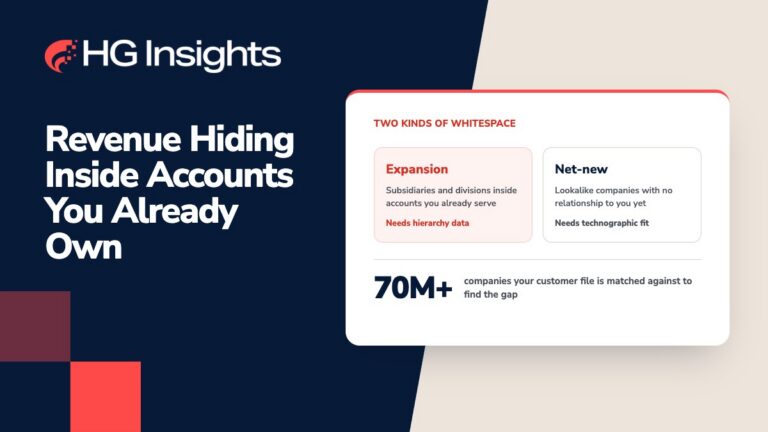
HG Insights technographics tracks technology usage across more than 25 million companies, with a total of 240 million verified installations across 25,000+ products and 11,000+ vendors. This gives GTM teams the breadth to segment well beyond the enterprise tier. HG also classifies each account relationship as a whitespace opportunity (no vendor in the category), an expansion opportunity (a complementary product already installed), or a displacement opportunity (a direct competitor installed). Each requires a different message and sales motion.
Example: A data analytics platform could segment its market by companies currently using legacy on-premise BI tools versus those already using cloud-native solutions. Each group requires different messaging: one focused on modernization benefits, the other focused on advanced capabilities and consolidation.
3. Intent segmentation
Intent segmentation identifies companies that are actively researching topics, solutions, or competitors relevant to your product. It relies on behavioral signals drawn from first-party data (your website, content engagement) and third-party data (external research activity tracked across the web).
This is arguably the highest-impact segmentation method because it surfaces timing. A company that matches your firmographic and technographic criteria but is not actively researching a solution is a future opportunity. A company that is actively consuming content about your product category right now is an immediate opportunity.
Types of intent signals include: Visits to your website or competitor websites, downloads of relevant research reports or analyst content, searches for category-specific keywords, engagement with review sites like TrustRadius, and increased activity from multiple stakeholders at the same company (a signal of buying committee formation).
Not all intent signals carry the same weight. Upstream signals like keyword searches and web content consumption indicate early curiosity. Downstream signals are more valuable: they capture verified buyers comparing products, reading pricing pages, and reviewing competitors on TrustRadius. HG Insights’ Buyer Intent draws on this downstream behavior directly, surfacing granular context like pricing views and competitive research rather than generic topic spikes — because a company in a keyword cluster is a very different opportunity than one where three buying committee members reviewed you and a competitor in the same 30-day window.
Example: A project management software company tracking intent data might discover that a cluster of mid-market manufacturing firms are researching “enterprise project management” and “resource planning software.” These accounts get prioritized for outreach because their behavior indicates active evaluation.
4. Persona segmentation
B2B purchases are rarely made by a single individual. Most involve a buying committee of three to ten stakeholders, each with different priorities, concerns, and evaluation criteria. Persona segmentation ensures your messaging resonates with each role involved in the decision.
Common B2B personas in a buying committee include: End users who care about ease of use and daily workflow impact, IT leaders who evaluate security, integration, and implementation complexity, finance stakeholders who scrutinize ROI, total cost of ownership, and contract terms, and C-suite executives who focus on strategic alignment and competitive advantage.
A campaign that speaks only to the CFO’s priorities will fail to engage the IT director. A message optimized for the end user will not address the procurement team’s concerns. Persona segmentation allows you to create parallel tracks of content and outreach that address each stakeholder’s unique perspective.
Example: A human capital management (HCM) platform selling to mid-market companies might run one content track focused on compliance and reporting for HR directors, a second track on integration and data security for IT, and a third track on workforce productivity for the COO.
5. Journey stage segmentation
Not every qualified account is ready for the same conversation. Journey stage segmentation organizes accounts by where they sit in the buying process, ensuring that your outreach matches their current level of awareness and engagement.
The six stages of a typical B2B buying journey:
Qualified: The account fits your Ideal Customer Profile (ICP) but has no awareness of your brand. Outreach should focus on education and category-level thought leadership.
Aware: The account knows your brand exists but is not engaging. Marketing should focus on building credibility and relevance through targeted content.
Engaged: The account is interacting with your content (visiting your site, downloading assets, attending webinars) but has not shown active purchase intent. Nurture campaigns and personalized follow-ups work well here.
Marketing qualified account (MQA): The account is showing clear in-market signals. This is the handoff point where marketing and sales should collaborate on direct outreach.
Opportunity: A buying committee is actively evaluating solutions and approaching a purchasing decision. Sales-led engagement with tailored proposals and stakeholder mapping is critical.
Customer and post-sale: The account has purchased and is now in onboarding, adoption, or renewal phases. Segmentation here supports retention, cross-sell, and upsell strategies.
Example: An account in the “Engaged” stage should receive case studies and product comparisons. That same account, once it reaches “MQA” status, should receive a direct call from a sales rep with a personalized value proposition. Sending a sales pitch to an “Aware” account or a blog post to an “Opportunity” account is a misallocation of effort.
How to Segment Your B2B Market: A 3-Step Framework
Knowing the methods is important, but execution is what drives results. The following three-step framework translates segmentation theory into a repeatable process.
Step 1: Distill Your TAM Into a Target Market
Your Total Addressable Market is the broadest definition of every company that could potentially buy your product. Marketing to the full TAM is impractical because the volume is too large and the relevance too low.
Start by applying your ICP’s firmographic criteria to filter the TAM into a manageable target market. Define the industries you serve best, the company sizes where your product delivers the most value, and the geographies where you can realistically sell and support customers.
This step typically reduces your addressable universe by 60% to 80%, leaving you with a focused target market that reflects where your product has the strongest fit.
Step 2: Build Your Target Account List (TAL)
Your target market is still too broad for personalized outreach. The next step is to build a specific Target Account List: a named set of companies your team will actively pursue.
Three proven approaches for building a strong TAL:
- Clone your best customers. Analyze your highest-value, longest-retaining customers. Identify the firmographic, technographic, and behavioral traits they share. Then find lookalike accounts in your target market that match those traits. This approach grounds your TAL in real performance data rather than assumptions.
- Apply predictive analytics. Use AI-powered scoring models and historical CRM data to rank accounts by their likelihood to convert. These models identify patterns that manual analysis often misses, such as combinations of company size, technology usage, and growth trajectory that correlate with closed deals.
- Prioritize active buying signals. Layer intent data onto your list to surface accounts that are currently in-market. An account that fits your ICP and is actively researching your category should be ranked higher than a perfect-fit account showing no buying behavior.
Step 3: Segment and prioritize your audiences
With your TAL built, divide accounts into campaign-specific audiences by combining multiple segmentation methods.
A practical example: You might create an audience of C-suite executives (persona) at mid-sized financial services firms (firmographics) that are researching cybersecurity solutions (intent) and currently use a legacy competitor’s product (technographics) in the early evaluation stage (journey stage). This audience receives a fundamentally different campaign than a group of IT directors at enterprise healthcare companies exploring your category for the first time.
Once audiences are built, assign them to engagement tiers:
- Top-tier accounts with the strongest fit and intent signals receive one-to-one, highly personalized outreach.
- Mid-tier accounts receive one-to-few campaigns customized at the segment level.
- Lower-tier accounts receive scalable, one-to-many automated campaigns.
This tiered approach ensures your highest-value opportunities receive the most attention while lower-priority accounts still receive relevant engagement.
Building multi-signal audiences across separate tools creates data consistency issues and slows execution. HG Insights’ Revenue Growth Intelligence (RGI) Platform lets GTM teams define, score, and export layered segments (technographic fit, spend signals, and Buyer Intent combined) and push them directly into CRM and ABM platforms. This allows sales and marketing to work from the same data from the start.
B2B vs. B2C market segmentation: Key differences
Segmentation is foundational in both B2B and B2C marketing, but the execution differs in several important ways.
Decision-making complexity. B2C purchases are typically made by one individual or a household. B2B purchases involve a buying committee with multiple stakeholders who must reach consensus. This means B2B segmentation must account for multiple personas within a single account.
Sales cycle length. B2C sales cycles are often minutes to days. B2B sales cycles commonly span weeks to months, sometimes exceeding a year for enterprise deals. Journey stage segmentation becomes essential for maintaining relevance across a longer decision timeline.
Purchase risk and investment. B2B purchases carry higher financial stakes and professional risk. A poor software decision can affect an entire organization. This raises the bar for personalization and trust-building, making segmentation more critical for delivering the right message at the right time.
Data sources. B2C segmentation leans heavily on demographic and psychographic data. B2B segmentation relies on firmographic, technographic, and intent data that describes organizational behavior rather than individual consumer preferences.
Common B2B segmentation mistakes to avoid
Even experienced teams make segmentation errors that undermine campaign performance. Watch for these common pitfalls.
Relying on a single segmentation method. Firmographic data alone cannot tell you when an account is ready to buy. Intent data alone cannot tell you whether an account is a good fit. Layering multiple methods produces segments that are both relevant and timely.
Building segments that are too broad. A segment of “all technology companies in the United States” is not actionable. Effective segments are specific enough to support tailored messaging but large enough to justify dedicated campaign investment.
Ignoring post-sale segmentation. Many teams focus segmentation exclusively on acquisition and neglect existing customers. Segmenting your customer base by usage patterns, contract value, and expansion potential unlocks significant revenue through retention, cross-sell, and upsell.
Setting segments and forgetting them. Markets shift, competitors evolve, and buying behavior changes. Review and update your segments quarterly to ensure they reflect current market conditions and business priorities.
Failing to align sales and marketing on segment definitions. If marketing defines a segment one way and sales interprets it differently, handoffs break down and pipeline quality suffers. Shared segment definitions and regular calibration meetings keep both teams aligned.
Start building smarter segments today
Refining your TAM into a prioritized Target Account List and well-defined audiences is not optional for competitive B2B organizations. It is the foundation of efficient growth.
By replacing broad, generic outreach with data-driven segmentation, your teams can engage the right accounts at the right time with messaging that resonates. The framework is clear: filter your TAM, build your TAL, segment your audiences, and prioritize your resources toward the accounts most likely to convert. The companies that segment with discipline close deals faster, retain customers longer, and build more predictable revenue pipelines.
See how HG Insights’ RGI Platform helps GTM teams build data-driven account segments using technographics, spend signals, and verified Buyer Intent — then activate them directly in your ABM and CRM tools. Book a personalized demo to see how it works with your ICP.
Frequently asked questions about B2B market segmentation
What is the best B2B segmentation method?
There is no single best method. The most effective B2B segmentation strategies combine multiple approaches. Intent segmentation is often the highest-impact starting point because it identifies accounts with active buying behavior, but it should be layered with firmographic and persona data to ensure fit and message relevance.
How many segments should a B2B company create?
Most B2B organizations perform well with three to eight primary segments. Fewer than three suggests insufficient differentiation. More than eight often creates operational complexity that outpaces a team’s ability to execute tailored campaigns for each group.
How often should B2B market segments be updated?
Quarterly reviews are a strong baseline. However, segments driven by intent data may need more frequent updates because buying behavior can shift rapidly. Firmographic segments tend to be more stable and may only need annual review.
What tools are used for B2B market segmentation?
Common tools include CRM platforms (Salesforce, HubSpot), intent data providers (Bombora, 6sense, Demandbase), technographic databases (BuiltWith, HG Insights), sales intelligence platforms (ZoomInfo, Apollo), and ABM platforms that aggregate multiple data sources into a unified segmentation workflow.
How does B2B segmentation support account-based marketing?
Segmentation is the foundation of ABM. It determines which accounts to target, how to group them into campaign audiences, and what messaging to deliver at each stage. Without segmentation, ABM devolves into broad outreach with an account-based label.