
Your reps aren’t underperforming because they lack effort. They’re underperforming because the data guiding their prospecting decisions is sending them to the wrong accounts at the wrong time with the wrong message. Your sales teams already spend only about 40% of their week actually selling, with the rest consumed by research, admin work, and tool management. When the B2B data underneath that 40% is inaccurate, outdated, or disconnected across systems, even the selling time gets wasted on accounts that were never going to convert.
The solution isn’t more activity. It’s better information at the point where prospecting decisions get made. When you rebuild your pipeline development strategy around stronger B2B data, you get sharper prioritization, more relevant outreach, and healthier conversion rates, not because reps changed their behavior but because the data changed which accounts and signals their behavior was directed toward.
In This Guide:
- Why prospecting and pipeline suffer when data is incomplete
- The three layers of intelligence that improve prospecting: fit, context, and timing
- How to prioritize opportunities using predictive targeting and segment-based plays
- Strengthening pipeline development through alignment, trigger-based engagement, and RevOps governance
- Integrating B2B data into your GTM stack for scalable execution
- Measuring the impact on pipeline performance
Prospecting breaks down when reps can’t trust the data guiding their decisions
Many organizations still rely on static lists or fragmented CRM records to drive prospecting. Without sufficient depth in B2B data and account records, reps default to generic outreach because they don’t have enough context to say anything specific. Routing decisions become uneven because the attributes that should guide assignment are incomplete or inconsistent.
The consequences show up in every pipeline metric. Reps spend time on accounts outside the ideal profile because the data didn’t filter them out. Outreach arrives too early or too late in the buying cycle because there’s no signal layer to indicate timing. And opportunities that should have been caught go unworked because the records that would have surfaced them were missing the fields that matter.
Meanwhile, buyers are forming preferences long before speaking with sales. Research indicates that 95% of buyers select from vendors already on their Day One shortlist. If your reps aren’t reaching the right accounts with relevant context before that shortlist solidifies, the prospecting effort is already behind.
Three layers of intelligence determine whether prospecting produces pipeline or activity
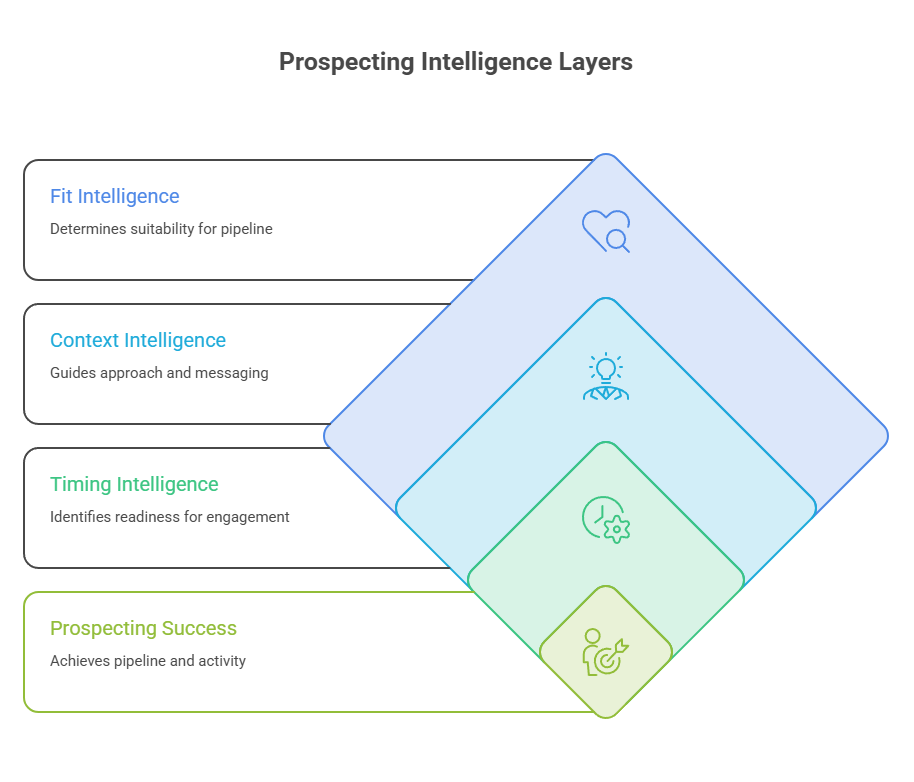
Effective prospecting depends on three distinct layers of intelligence, each serving a different purpose. When all three are present, prospecting becomes structured and repeatable. When any one is missing, the motion degrades.
Fit intelligence tells you whether an account belongs in your pipeline at all
Market and firmographic data define the boundaries of your addressable market. Industry, company size, geography, and revenue bands help RevOps and sales determine which accounts deserve active coverage and which ones don’t justify the time.
Clear ICP boundaries reduce wasted effort in a way that’s immediately measurable. Tightening firmographic filters often increases meeting rates because your reps stop pursuing marginal accounts that look plausible but lack the structural alignment that predicts conversion. Fit intelligence answers the most basic prospecting question: should this account be in play at all?
Context intelligence tells you how to approach each account
Fit gets an account onto the list. Context determines how your rep approaches it. Technographic data reveals installed technologies, IT spend patterns, and competitive presence, which allows reps to engage with specificity rather than generic messaging.
When your rep knows an account runs a competing platform, the conversation changes immediately. Outreach can reference integration gaps, migration risk, or contract timing. When they can see spend allocation in your category, they understand the scale of opportunity before the first call. A unified account intelligence data fabric connects firmographics, technographics, spend intelligence, and competitive signals into one view so reps get that context without toggling between platforms.
The depth behind that view is what differentiates it. HG’s RGI Fabric covers 25 million+ companies, 25,000+ products, 11,000+ vendors, and 240 million+ verified technology installs. Each install is classified by status: current means the technology is confirmed active today, historical means the account recently stopped using it, and inferred means likely adoption based on adjacent signals. That classification changes what your rep says on the first call. A prospect who stopped running a competing tool six months ago is in a different conversation than one actively using it; and most enrichment providers can’t tell the two apart.
Timing intelligence tells you when an account is ready to engage
Fit and context establish whether and how to approach an account. Timing determines whether the outreach will land. Buyer intent data surfaces organizations actively researching your category, reviewing pricing, or comparing vendors right now.
When intent signals align with ICP fit, reps can act during live buying windows rather than relying on cadence-based outreach that may arrive months before or after the account is actually evaluating options.
The catch is that most teams already have intent data. In practice, intent data adoption often stalls before it produces results. In our internal conversations with enterprise B2B teams, the pattern is consistent: signals that live outside the daily workflow don’t get acted on, and models that can’t explain their outputs don’t get trusted.
The organizations getting results are the ones where signals route automatically to the rep when a buying event fires. HG Insights buyer intent is designed for that motion, not as a report your team remembers to check. Buyer intent insights give prospecting a temporal dimension that transforms it from volume-driven activity to signal-driven engagement.
Predictive targeting and segment-based plays turn data into prospecting action
Having the right data matters. Knowing how to use it to change prospecting behavior is what produces pipeline.
Predictive targeting ranks accounts by conversion likelihood, not just fit
Predictive prospecting combines firmographic fit, technographic context, intent signals, and historical win patterns to rank accounts by their probability of converting. Rather than relying on contact-heavy point systems that reward activity over opportunity, AI-driven models evaluate account-level patterns and surface high-propensity opportunities.
Predictive account targeting and scoring gives your sales team a ranked list of accounts most likely to convert while giving your RevOps team a repeatable scoring framework tied to outcomes.
One thing that reliably kills AI-scored prioritization is opacity. When a model can’t explain why a particular account ranked high, RevOps stops trusting it and reps stop using it. HG’s account scoring is transparent and customizable. Each score reflects visible, auditable inputs your data team can inspect, adjust, and align to your actual sales motion; not a vendor’s assumptions about what a good account looks like. That’s a direct contrast to black-box scoring approaches that produce a number without an explanation. When your team can see what’s driving every score, adoption follows.
The shift for your reps is practical: instead of working a flat list from top to bottom, they start each day knowing which accounts the data says are worth their time.
Segment-based prospecting plays align messaging with account reality
Prioritization is more effective when paired with targeted plays that match messaging to the specific situation of each account segment. Segment-based prospecting improves response rates and creates consistency across pipeline stages because outreach reflects what’s actually happening at the account rather than a one-size-fits-all value proposition.
Four data-driven segments consistently produce strong prospecting results:
- Competitor install + renewal timing. Accounts running a competing platform whose renewal window is approaching. HG maps competitor installs down to install date, which means your team can time outreach to the contract period rather than guessing. Displacement campaigns built this way convert at roughly 3x the rate of standard account-based outreach.
- High IT spend + rising category intent. Accounts allocating significant budget to your category and showing active research behavior. Outreach focuses on solution fit and timing.
- Modern tech stack + expansion signals. Accounts with mature, compatible infrastructure showing signs of growth or new technology adoption. Outreach focuses on integration value and use case expansion.
- Legacy systems + modernization pressure. Accounts running aging infrastructure where industry trends or competitive dynamics are creating pressure to upgrade. Outreach focuses on risk reduction and operational improvement.
The competitor timing play depends on a capability most enrichment providers don’t have: install date tracking. Knowing that an account runs a competitor is useful. Knowing when they likely signed up, and therefore when their contract window opens, is the difference between generic outreach and a timed displacement play.
Executing at the segment level helps your team prospect more predictably and creates a steadier, more resilient pipeline over time because each segment has its own messaging track, qualification criteria, and conversion benchmarks.
Four data-driven prospecting segments and how to approach each
| Segment | Defining signals | Outreach focus |
|---|---|---|
| Competitor install and renewal timing | Running a competing platform with an approaching renewal window | Time a displacement play to the contract period (converts at roughly 3x standard account-based outreach) |
| High IT spend and rising category intent | Significant category budget plus active research behavior | Solution fit and timing |
| Mature tech stack and expansion signals | Compatible infrastructure showing growth or new adoption | Integration value and use case expansion |
| Legacy systems and modernization pressure | Aging infrastructure under upgrade pressure | Risk reduction and operational improvement |
Durable pipeline takes shape when sales, marketing, and RevOps execute with shared discipline
Better data improves individual prospecting decisions. Sustained pipeline quality requires that improvement to be consistent across teams and embedded in operational processes.
Shared data eliminates the alignment gap between sales and marketing
Alignment isn’t just a management talking point. Research shows that 75% of high-performing teams report strong sales and marketing alignment, compared with 24% of low-performing teams. The gap almost always traces back to whether both teams are working from the same account definitions, scoring inputs, and segmentation logic.
When sales and marketing operate from the same intelligence foundation, targeting conflicts decrease, handoffs become cleaner, and the accounts marketing generates for pipeline actually match what your sales team considers worth pursuing. Alignment built on shared data is structural rather than dependent on meetings and goodwill.
Trigger-based prospecting replaces cadence-based outreach with signal-driven engagement
Cadence-based prospecting treats every account the same: same sequence, same timing, same number of touches regardless of what’s happening at the account. Trigger-based prospecting changes that by using specific account events to initiate and time outreach.
Intent spikes, technographic changes, competitive deployments, and contract milestones all signal that something has shifted at the account. Acting on those triggers increases deal momentum because engagement aligns with active evaluation cycles rather than an arbitrary schedule.
Signal-based models for high-intent lead generation and conversion strengthen pipeline without increasing outreach volume because each touchpoint is timed to an account event rather than a calendar date.
RevOps governance standardizes how data feeds prospecting and pipeline workflows
Without governance, data-driven prospecting becomes inconsistent. One rep uses intent signals to prioritize. Another ignores them. Scoring thresholds vary by team. Routing logic reflects whoever last edited the rules rather than a documented standard.
RevOps governance standardizes enrichment cadence, routing logic, scoring inputs, and QA processes so every prospecting motion runs on the same rules. Clear revenue operations use cases demonstrate how centralized intelligence supports accountability across systems. Consistent governance improves trust in data and reinforces pipeline quality because every team knows the rules are the same.
Intelligence only drives results when it’s embedded in your daily workflow
The best prospecting data in the world produces nothing if it lives in a platform your reps don’t open. The effectiveness of your CRM, marketing automation, analytics, and AI copilots depends on having synchronized data flowing reliably between each system.
Effective GTM system integration workflows connect enrichment, scoring, and routing directly into the operational systems where your reps and marketers work every day. Manual research decreases because the data is already in the record. Adoption improves because intelligence arrives in the tool, not alongside it. Scalable execution becomes realistic because every new enrichment signal automatically updates scoring, routing, and prioritization across the stack.
Measure prospecting impact through commercial outcomes, not activity metrics
Revenue teams should evaluate prospecting improvements through metrics that connect to commercial results rather than volume indicators. The metrics that reveal whether better data is actually producing better pipeline include:
- Opportunity creation rate. Are enriched, signal-driven prospecting motions generating more qualified opportunities per rep?
- Conversion lift. Are accounts sourced through predictive targeting and segment-based plays converting at higher rates than accounts from legacy list-based prospecting?
- Pipeline velocity. Are deals moving through stages faster when reps engage accounts with full context and timing signals?
- Win rate. Are signal-driven opportunities closing at higher rates than opportunities sourced without enriched intelligence?
- Sales cycle length. Is the time from first touch to closed-won compressing as reps engage accounts during active buying windows?
Comparing signal-driven prospecting against legacy approaches across these metrics typically reveals stronger qualification and faster progression. Feedback loops between pipeline outcomes and scoring models refine predictive targeting over time, which means the improvement compounds rather than plateaus.
Strengthen prospecting and pipeline with unified B2B intelligence
Pipeline health reflects the quality of the B2B data feeding it. When prospecting runs on disconnected tools and incomplete records, inconsistency follows. When it runs on unified intelligence that combines fit, context, and timing into every account record, prioritization becomes repeatable and every stage of execution gets sharper.
The foundation for all of it is the RGI Fabric: 25 million+ companies, 25,000+ products, 11,000+ vendors, and 240 million+ verified technology installs, classified as current, historical, or inferred and refreshed continuously. HG Insights layers IT spend intelligence and buyer intent data on top of that install foundation, then uses AI-driven scoring to surface accounts by actual conversion probability. Fit, context, and timing live in one view; not patched together from separate platforms.
Your revenue teams get account prioritization grounded in verified signals, segment plays tied to real install data, and outreach triggers that fire on account events instead of arbitrary cadences.
Operationalize your pipeline development strategy with the data your prospecting deserves. Schedule a demo with HG Insights.