

Driving revenue in multi-faceted B2B environments is more challenging than ever. Longer sales cycles, larger buying committees, and tighter budgets make efficiency a strategic necessity.
Modern enterprise sales tools go beyond traditional automation, delivering actionable intelligence that helps teams prioritize high-value accounts, align go-to-market execution, and achieve measurable improvements in sales productivity, pipeline velocity, and overall revenue performance.
The need: why sales efficiency is critical in enterprise GTM
Enterprise selling demands significant time, coordination, and expertise. Without structured prioritization and unified intelligence, your teams risk spending time on accounts that lack readiness, fit, or revenue potential.
Long sales cycles, competitive markets, and resource constraints make efficiency a strategic imperative. Modern enterprise sales tools must go beyond simple automation. They need to increase win rates, reduce wasted effort, and accelerate deal timelines. By leveraging verified sales intelligence for enterprise performance, GTM teams can focus outreach on accounts with the highest potential rather than relying on static lists. When account prioritization is data-driven, coverage models become more precise, and revenue acceleration follows naturally.
The pillars of a high-impact enterprise sales tool
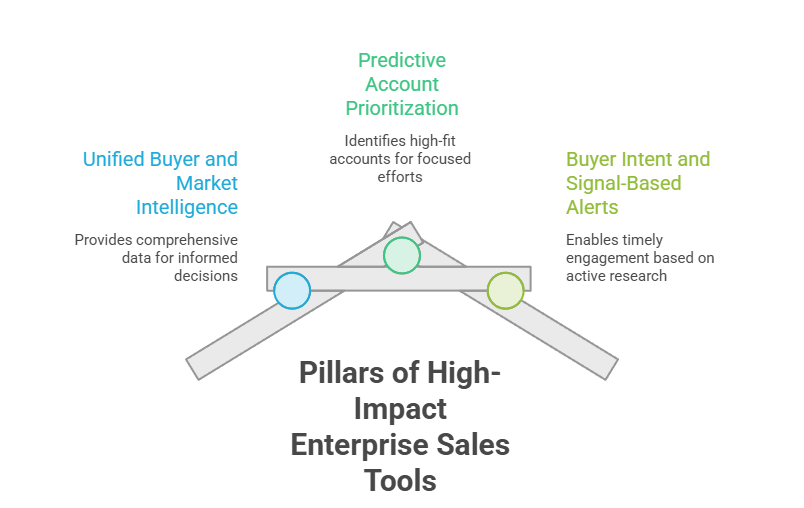
To deliver measurable efficiency gains, enterprise sales tools must combine intelligence, automation, and workflow integration. High-impact solutions empower teams to act on the right accounts, at the right time, with maximum precision.
Unified buyer and market intelligence
Effective enterprise sales starts with visibility across multiple data dimensions: firmographics, technographics, install base intelligence, and IT spend signals. When these datasets are unified within a sales intelligence platform, GTM teams gain actionable context around buying triggers, expansion readiness, and competitive positioning.
HG Insights’ Revenue Growth Intelligence Fabric draws on billions of data points, covering technology installs, cloud consumption trends, IT spend, contract timing, and buyer intent signals, all continuously updated and unified within a single GTM framework. That means revenue teams aren’t just working with technographic snapshots; they’re working with spend-level context, renewal windows, and product intensity signals.
Integrated intelligence enhances CRM-driven insights, helping sales and RevOps teams identify accounts that align with the ideal customer profile and show active modernization signals. This shared intelligence strengthens GTM sales enablement and ensures coordinated execution across enterprise teams.
Predictive account prioritization
Enterprise pipelines often include thousands of accounts spanning industries and geographies. Without predictive tools, prioritization is subjective, inconsistent, and resource-intensive.
AI-powered scoring models evaluate conversion history, ICP alignment, technology environments, spend capacity, and buyer intent. With HG Insights, AI scoring highlights high-fit accounts so reps can focus on the right accounts, which drives adoption and consistent execution across the team.
By focusing resources on accounts with measurable readiness, sales teams reduce wasted effort, improve efficiency, and maximize pipeline velocity. Predictive account prioritization at scale transforms large, complex pipelines into actionable opportunities.
HG Insights customers report a 45% increase in sales quota achievement, a 10x rise in lead-to-opportunity conversions, and a 49% increase in revenue from target accounts after implementing predictive account scoring.
| Metric | Result |
|---|---|
| Sales quota achievement | 45% increase |
| Lead-to-opportunity conversions | 10x increase |
| Revenue from target accounts | 49% increase |
Buyer intent and signal-based alerts
Timing is critical in enterprise sales. Identifying accounts actively researching your category allows teams to engage with precision and relevance, rather than relying on static outreach.
Leveraging intent signals for enterprise sales execution enables signal-based sales engagement, aligning communication with real buying activity. Alerts trigger timely outreach across account hierarchies, reducing time-to-first-touch and increasing the likelihood of meaningful interactions that accelerate deals.
Operationalizing efficiency: sales tools that fit GTM workflows
To drive measurable results, sales intelligence must integrate directly into the systems your teams use every day. Insights that remain separate from CRM, marketing automation, or sales engagement platforms create friction and reduce effectiveness.
Modern enterprise sales tools embed predictive scoring, enrichment, and account intelligence directly into operational workflows. HG Insights delivers this through Sales Copilot, which surfaces AI-generated account briefs, signal-based playbooks, and Contact Intelligence directly inside Salesforce, Gong, Outreach, Salesloft, and HubSpot. It allows reps to prospect online, without requiring them to switch tools.
This integration enables automated lead routing, campaign enrollment, and outreach sequences that adapt dynamically as account signals update. By connecting intelligence to execution, teams can prioritize accounts, reduce manual effort, and engage with precision.
Embedding predictive insights across your RevOps technology stack ensures alignment across sales, marketing, and operations, transforming static data into actionable guidance. This approach elevates traditional sales automation into a system of guided execution, strengthening sales process optimization, accelerating pipeline movement, and maximizing revenue impact.
Sales enablement with context-driven coaching
Effective sales enablement goes beyond static content libraries, it empowers managers with real-time, contextual insights that drive actionable coaching. Performance improves when guidance is informed by verified account intelligence, enabling reps to engage strategically rather than reactively.
With signal-aligned sales enablement, managers gain visibility into account needs, purchase signals, and recommended engagement strategies. When sales managers align coaching with buyer intelligence, teams increase B2B sales productivity, drive consistent execution across enterprise accounts, and accelerate pipeline performance.
Measuring the ROI: efficiency gains that matter
Enterprise leaders need clear, measurable proof that sales tools drive tangible results. Tracking the right metrics ensures teams can quantify efficiency improvements and optimize GTM execution.
Key performance indicators include:
- Time to first contact: Reduce delays in engaging high-value accounts.
- Pipeline velocity: Accelerate deals through prioritized, intelligence-driven outreach.
- SQL conversion rates and win rates: Validate that predictive scoring and account prioritization increase deal success.
- Sales productivity: Measure reps’ efficiency when guided by actionable intelligence.
Efficiency gains are strongest when integrated intelligence, combining predictive scoring, technographics, and buyer intent, is applied across teams. Revenue outcomes should never be attributed to sales tools alone; true impact comes from aligning insights with strategy, account fit, and timing.
Why HG Insights powers the most effective enterprise sales teams
HG Insights delivers a unified sales intelligence platform that combines intent signals, technographics, spend trends, and install base data into a single GTM framework. By embedding predictive scoring, signal-based sales engagement, and CRM-integrated insights directly into workflows, HG Insights enables enterprise teams to prioritize high-value accounts, align sales and RevOps, and accelerate pipeline performance at scale.
See how Thomson Reuters uses HG Insights as a core part of their sales intelligence stack, combining HG’s external signals with their own internal data to identify when to engage. Watch the customer story video.