
Choosing the wrong competitive intelligence solutions costs B2B teams more than budget. It costs pipeline velocity, rep confidence, and quarters of GTM execution built on incomplete data. The competitive intelligence platform market has expanded rapidly, and distinguishing tools that deliver account-level GTM value from those offering surface-level trend reports has become a critical skill for revenue leaders. This post provides a practical evaluation framework covering data depth, use case fit, integration requirements, and the mistakes that derail most platform decisions.
Quick Answer: A competitive intelligence solution is a platform that surfaces account-level signals about competitor technology installs, spend behavior, contract timing, and market positioning, then connects those insights directly to CRM workflows and sales execution tools so GTM teams can act on intelligence rather than just collect it.
The real cost of choosing the wrong platform
Most teams don’t realize they’ve picked the wrong competitive intelligence solution until the damage is done.
The symptoms show up gradually:
- Reps stop logging into the platform
- Marketing builds target lists from stale data
- Pipeline attribution becomes impossible to trace back to competitive signals
Misaligned platforms create hidden operational drag. When a platform doesn’t match the depth or specificity your team needs, the workaround is always the same: manual enrichment, spreadsheet gymnastics, and bolted-on point solutions to fill data gaps. Each workaround adds cost, latency, and error to a process that was supposed to be streamlined.
A 2026 Forrester survey found that most competitive intelligence teams operate with five or fewer people supporting hundreds or even thousands of stakeholders across sales, marketing, and product. When your team is that lean, there’s no capacity to compensate with manual effort.
The second-order effect is worse. When intelligence doesn’t reach reps in the flow of their work, it might as well not exist. Adoption drops, leadership questions the investment, and the organization slides back to gut-feel targeting. The platform selection decision ripples across every downstream GTM motion.
What competitive intelligence solutions actually do
A true competitive intelligence platform does far more than aggregate industry news or track competitor website changes. It surfaces account-level signals, including competitor product installs, technology spend patterns, and contract timing, then attaches those signals to the specific accounts reps are already working.
The distinction matters. Many tools in the market focus on messaging monitoring, battlecard management, or social listening. Those are valuable capabilities for product marketing and enablement teams.
But they do not answer the foundational GTM questions that drive pipeline:
- Which accounts are running a competitor’s product?
- How much are they spending?
- When does their contract come up for renewal?
Account-level competitive intelligence, including technographic data and IT spend signals, gives sales and marketing teams a concrete starting point for every displacement conversation, territory plan, and ABM campaign.
The best competitive intelligence solutions connect this context directly into the systems teams use daily. Intelligence that lives in a standalone dashboard gets checked once and forgotten. Intelligence that surfaces inside Salesforce, Slack, or a sales engagement platform gets acted on.
How to evaluate competitive intelligence solutions
| Evaluation criterion | What to ask the vendor | Why it matters |
|---|---|---|
| Data freshness and depth | How current and granular are the signals, down to product and spend level? | Stale or shallow data sends reps into conversations with outdated assumptions |
| Integration and workflow fit | Does it connect natively to your CRM, engagement, and AI tools? | Intelligence stuck in a standalone dashboard gets checked once and forgotten |
| Use case coverage | Does it support displacement, sizing, prioritization, and enrichment? | Single-use tools recreate the fragmentation they were meant to fix |
| Scoring transparency | Can you trace and adjust why an account scored high? | Opaque scores lose rep adoption and fall short of coming explainability rules |
The core evaluation criteria every team should apply
Data freshness and signal depth
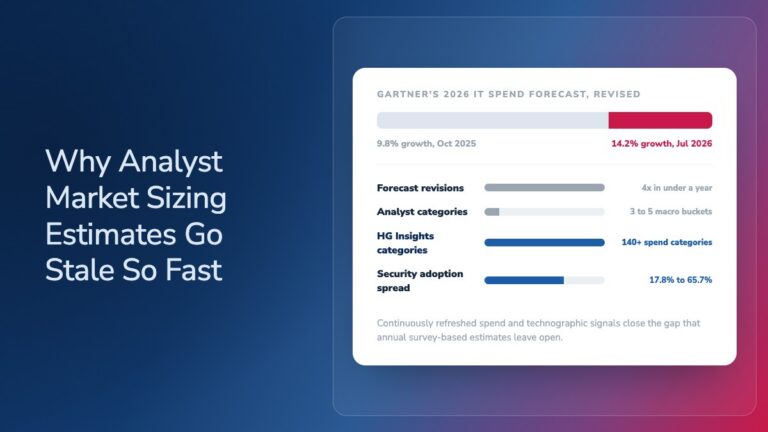
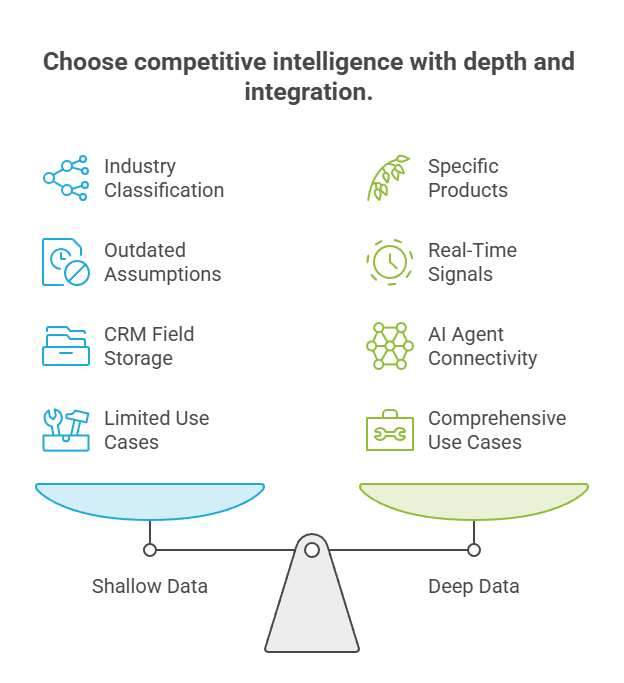
The first question to ask any competitive intelligence vendor is not “how many data points do you have” but rather “how current are those signals and at what level of granularity?” A platform that tracks millions of companies at a shallow level, covering industry classification and general size, provides less GTM value than one that reveals the specific products installed, the estimated annual spend on those products, and the contract renewal window. Freshness compounds this gap. Competitive arenas shift faster than most teams realize, and data that is even a quarter old can lead reps into conversations with outdated assumptions.
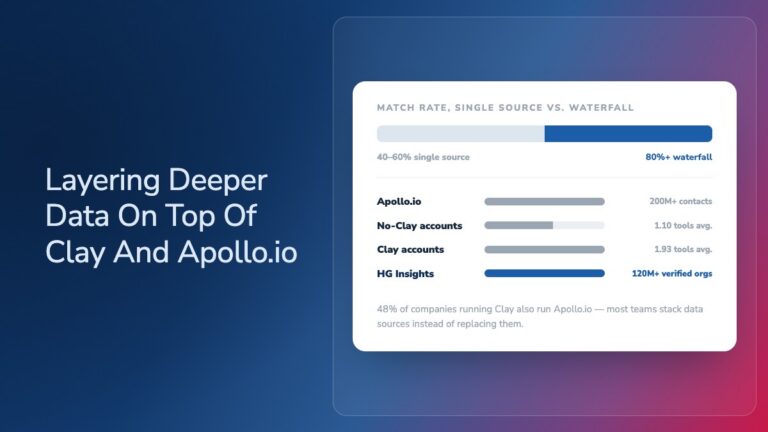
HG Insights’ RGI Fabric covers more than 25 million companies, 25,000+ products, and 11,000+ vendors, with over 240 million verified tech installs. That coverage isn’t there to impress in a demo. It exists because detecting a specific product inside an account’s stack, rather than just identifying a vendor relationship, requires that level of depth. Knowing a company runs Salesforce is table stakes. Knowing which specific products they’ve deployed, at what spending level, and how long they’ve been running them is what makes a displacement conversation credible and a territory plan defensible.
Integration and workflow fit
The second criterion separates platforms that get adopted from those that collect dust. Ease of integration with your existing CRM, sales engagement tools, and marketing automation stack determines whether competitive insights reach the people who need them.
Native integrations with Salesforce, HubSpot, and Snowflake reduce friction at the CRM and data warehouse level. The emerging battleground is MCP connectivity, where platforms are racing to pipe competitive intelligence directly into AI agents and LLM workflows rather than just CRM fields.
HG Insights’ MCP server connects RGI Fabric data directly to the AI tools your team already uses, including Claude and other LLM-based agents. That means verified technographic installs, IT spend, buyer intent, and contract signals are available to AI agents in real time, not just stored in a CRM field waiting to be looked up. What sets HG’s apart is what sits behind the connection: 240 million verified tech installs and bottom-up IT spend data that no ad platform or contact database can replicate.
Use case coverage
Not every team needs the same thing from a competitive intelligence platform. Evaluate whether the solution supports your highest-priority GTM motions:
- competitive displacement
- market sizing and whitespace analysis
- signal-based account prioritization
- data enrichment, and territory
- ABM planning
A platform that excels at one use case but requires workarounds for others will create the same fragmentation it was supposed to eliminate.
Competitive displacement: knowing who to target and when
The highest-ROI application of competitive intelligence is displacement, targeting accounts that are currently running a competitor’s product and engaging them with a compelling reason to switch. Platforms that surface competitor technology installs at the account level give sales teams a concrete, defensible starting point for these conversations.
Renewal timing signals transform displacement from opportunistic to systematic.
HG Insights estimates contract renewal windows from install date signals tracked across 25,000+ products. When your team sees that a target account’s contract with a specific competitor is likely to expire in the next two quarters, that’s not an educated guess. It’s derived from verified install data, updated continuously as those signals change.
When you know an account’s contract expires in Q3, they can build a nurture sequence that arrives before the prospect enters an active evaluation, not after the deal has already been awarded. This timing advantage compounds across hundreds of accounts. Build smarter competitive displacement plays with install and contract data.
Without account-level install data and contract intelligence, displacement campaigns default to spray-and-pray outreach with generic messaging. The difference in conversion rates between these two approaches is not marginal.
Market sizing and whitespace: where opportunity hides
Competitive intelligence is more than attacking a rival’s installed base. It is equally valuable for identifying the segments where competition is weakest and addressable demand is highest. The right platform helps teams map competitive density across geographies, industries, and company sizes so they can focus expansion efforts where the probability of winning is greatest.
Whitespace analysis paired with competitive data reveals accounts that fit the ICP but have not yet adopted any solution in the category, or accounts where a competitor’s penetration is shallow enough to create a realistic displacement opportunity.
When you combine these two lenses, competitive presence and whitespace opportunity, build territory plans with higher expected conversion rates and lower cost-per-acquisition. Identify underpenetrated markets with whitespace analysis.
What a competitive intelligence platform actually does
A competitive intelligence platform collects, analyzes, and delivers account-level data on competitor technology installs, IT spend, buyer intent signals, and contract timing, then distributes those insights into CRM and sales workflows so revenue teams can prioritize accounts, time outreach, and execute displacement campaigns with precision.
That definition separates the category from adjacent tools like social listening platforms, which track brand mentions and sentiment, and enablement platforms, which manage battlecards and sales content.
Competitive intelligence solutions sit upstream of both. They provide the foundational account data that makes battlecards specific, campaigns targeted, and territory plans defensible.
The platform should also layer behavioral signals on top of structural data. Intent signals, tracking which accounts are actively researching alternatives, combined with technographic and spend data, reveal accounts that are both a strong fit and actively in-market.
This combination lets reps prioritize based on readiness rather than arbitrary criteria like company size or industry vertical to act on buyer signals before your competitors do.
How competitive intelligence drives alignment across GTM functions
If you’re on the marketing side, competitive intelligence sharpens your campaign targeting. Instead of building ABM lists from firmographic data alone, marketing can layer in competitive install data and intent signals to identify accounts where the messaging will resonate most, the ones actively using a competitor and showing signs of evaluating alternatives.
For your sales reps, the value shows up in prioritization and conversation quality. Reps armed with account-level install data, spend estimates, and renewal timing walk into calls with context that differentiates them from every other vendor who opens with a generic discovery question. This shifts the conversation from qualification to value articulation.
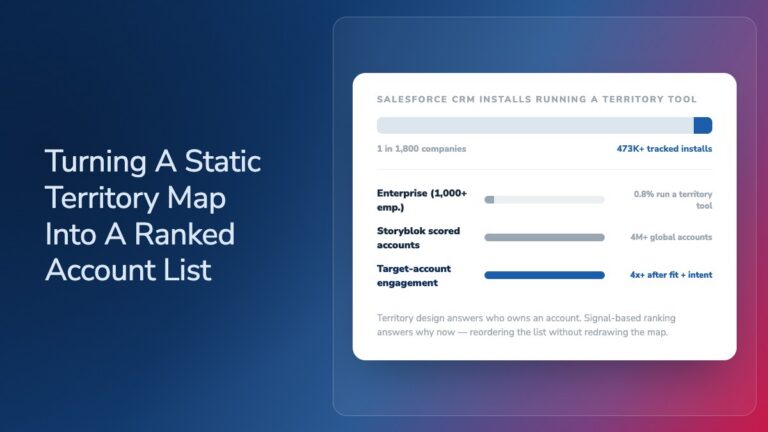
If you’re in RevOps or strategy, the platform gives you the connective tissue between market sizing, territory design, and pipeline forecasting. When competitive intelligence feeds directly into scoring models and territory assignments, the entire GTM engine operates from a consistent, data-informed foundation to align territory coverage and ABM strategy around competitive opportunity.
Account scoring and data enrichment: the operational foundation
Scoring models built on competitive intelligence, including install data, spend signals, firmographic fit, and intent, create prioritization logic that is consistent and repeatable across the entire revenue organization. Without these signals, scoring defaults to simplistic criteria that miss the accounts most likely to convert.
What the inputs are matters. What the model does with them matters just as much.
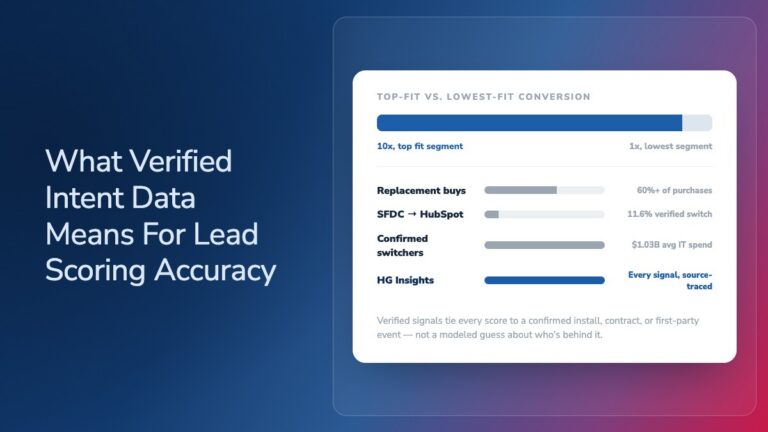
Most scoring platforms treat their methodology as proprietary. Your reps get a number, not a reason. That opacity has a direct cost: reps who can’t trace why an account scored high default to their own judgment and stop acting on the model. It isn’t a trust problem. It’s a design problem.
HG Insights uses transparent, auditable scoring. Every account score connects back to the specific signals that drove it, and your data science team can inspect, adjust, or override any input. For rep adoption, that visibility is the difference between a score that gets acted on and one that sits in a dashboard. For enterprise teams, it matters for another reason: EU AI Act explainability requirements begin phasing in September 2026, making transparent scoring a business requirement rather than just a differentiator.
HG Insights’ Data Studio brings propensity modeling to teams without a dedicated data science function. You define the ICP criteria, the fit signals, and the weighting logic; the model builds the score from HG’s underlying install, spend, and intent data. No SQL required. No custom model training. No implementation consultant. The result is a scoring layer your team actually owns, which means your RevOps leader can update the model when your ICP shifts instead of waiting on a vendor roadmap.
Continuous data enrichment is the silent requirement that most evaluation processes overlook. CRM records decay at an estimated fifteen to twenty-five percent per year. A competitive intelligence platform is only as useful as the accuracy of the account data it enriches. Platforms that provide ongoing enrichment, refreshing technographic installs, updating spend estimates, and correcting firmographic drift, ensure that competitive signals are always attached to current account records. Keep your account data accurate and enriched automatically.
Common mistakes teams make when selecting a platform
Platform selection mistakes rarely look like mistakes at the time. They surface months later, after contracts are signed and the team has built workflows around a tool that can’t actually support them. The three errors below account for most of the avoidable friction in competitive intelligence platform decisions.
Confusing data volume with data depth
The most frequent error is evaluating platforms based on breadth of data coverage without testing the depth and freshness of signals at the account level. A database with millions of company records sounds impressive until you discover that the competitive install data is twelve months old or limited to top-level vendor identification without product-level granularity.
Skipping integration requirements until after you sign
The second mistake is failing to assess integration requirements before signing a contract. A competitive intelligence tool that requires manual exports or custom API development to connect with your CRM means the intelligence will not reach the reps who need it. Adoption dies not because the data is bad, but because accessing it requires too many clicks.
Buying for one use case when your GTM needs several
The third, often overlooked, mistake is buying a platform optimized for a single use case when your GTM strategy requires multiple motions. A tool that excels at battlecard management but cannot support market sizing, territory planning, or account scoring forces the team to stitch together point solutions, recreating the fragmentation problem.
Build your competitive intelligence foundation with HG Insights
HG Insights delivers technographic installs, IT spend data, buyer intent, and contract intelligence in one unified platform purpose-built for B2B GTM execution. The RGI Platform combines Market Analyzer Copilot for AI-driven market sizing and competitive analysis, Data Studio for no-code propensity modeling, and Sales Copilot for actionable account-level recommendations, all connected to the same deep intelligence layer.
With native CRM integrations and MCP server access, HG Insights brings competitive signals directly into the tools your team already uses. See how HG Insights helps revenue leaders build competitive GTM strategies grounded in account-level intelligence.