A trusted, explainable account score is a real milestone. It is also not the finish line. A scored list and a working list are two different things, and the gap between them is where most precision selling programs quietly stall.
Quick Answer: A scoring model only produces pipeline once it’s activated: accounts selected by propensity instead of geography, movement-over-time data watched continuously instead of refreshed once a quarter, and reps, managers, and RevOps all working from the same current picture. Without activation, a good model still decays into a list nobody fully works.
The difference between scored and prioritized
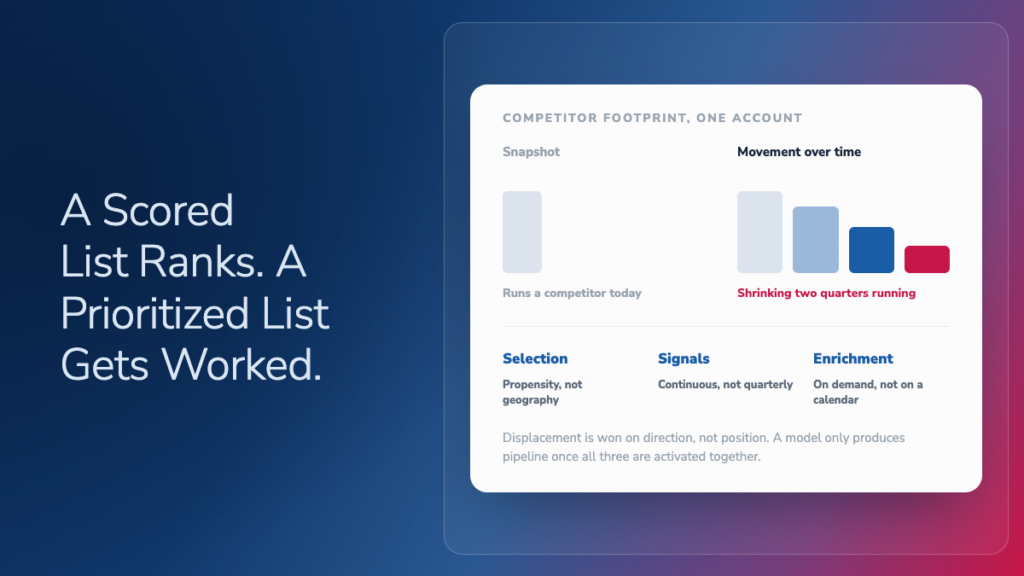
A scored list ranks accounts by a number. A prioritized list tells a rep what to do on Monday. The gap between the two is context: which accounts are moving now, what changed, which play fits, who to contact. A lot of teams build the first and stop, then wonder why adoption never took.
Account selection changes when it runs on propensity
Territories built on geography and headcount alone distribute names evenly and opportunity unevenly. Territories built on propensity give each rep a patch with a comparable density of genuinely high-fit accounts, and let RevOps run a what-if before committing rather than redrawing lines on a map.
The same shift changes three other decisions most teams still make on gut feel:
- New-business targeting. Net-new accounts get ranked by fit and surfaced only once timing is actually live, so the list is qualified and current rather than qualified once and decaying since.
- Competitive displacement. Which accounts are running a weakening competitor, and which of your own accounts a competitor is quietly encroaching on, both become visible instead of invisible.
- Expansion. The install base gets treated as a propensity opportunity too, not just a renewal date on a calendar. Expansion is often the highest-return motion in the business and the worst-instrumented, because the intelligence effort usually goes to net-new instead.
One real pattern worth naming here: a sales org built around focusing effort on better-fit accounts rather than spreading it evenly across a flat list saw a marked improvement in performance simply by concentrating attention where the propensity was actually highest. Sharper selection, not more effort, was the lever.
Seeing the switch before it’s a switch
Most account intelligence is a snapshot. It tells you what’s true about an account today, which is useful but misses the most actionable thing about a competitive situation: the direction it’s moving.
A snapshot says an account runs a competitor’s product. Movement-over-time data says the competitor’s footprint inside that account has been shrinking for two quarters, adjacent spend is rising, and the pattern looks like the early stage of a switch. That’s the difference between a photograph and a film, and displacement is won or lost on which one you’re looking at.
The same signals that flag a competitor’s account becoming available also flag when one of your own accounts is starting to drift: usage softening, adjacent evaluation activity, a renewal approaching with falling engagement. Protecting an account before churn risk becomes visible is worth as much as winning a new one, and it costs far less selling time than replacing what you lost.
The quiet cost of refreshing everything on a calendar
Most account and contact data is still refreshed in batches, on a schedule, whether or not each account actually needed updating. That creates three costs. Staleness, because for most of the quarter the picture is out of date. Waste, because enrichment spend gets distributed evenly across every account including the thousands that never mattered. Fragmentation, because sources pulled at different times produce conflicting records that tax selling effort all over again.
The alternative is enrichment that follows the signal instead of the calendar: an account quiet for a year doesn’t get re-enriched for no reason, and an account that just showed real buying signals gets enriched now, right inside the workflow when sales engages. The budget doesn’t get bigger. It just stops being spent on accounts that never changed.
What actually has to be true for reps, managers, and RevOps at once
Activation only works if it changes the day for all three seats, not just one.
For the rep, it means starting Monday with a worked queue instead of a blank research task: the account brief already built, a suggested play attached, the right contacts already surfaced. The hours that used to go into pre-meeting research come back as selling time.
For the sales manager, it means one-to-ones become conversations about judgment instead of interrogating whose data is right. The manager can see which accounts are stuck and why, and whether a pipeline gap is a coverage problem or an execution problem, without a quarter of digging to find out.
For RevOps, it means the foundation stays current without manual rebuilding, which frees up the strategic time that used to disappear into maintenance. Territories, displacement targets, and expansion opportunities become live views instead of once-a-year set pieces.
None of this lands automatically. A model that tells a veteran rep their instinct was wrong is a hard message, and adoption is a change-management job as much as a data one. The practical path is to prove it on one segment first, let the reps who tried it tell the rest, and give it a quarter before it governs the whole team.
What actually runs it
The connective tissue across all of this is AI, not bolted on as a feature, but running as the layer that aggregates signals, keeps the score explainable, and prescribes the next play, continuously, across the whole account base, by Monday morning. It’s what turns account selection, movement-over-time data, and on-demand enrichment from three separate capabilities into one connected motion instead of six disconnected tools.
We built the full 90-day build and 365-day operating playbook for this, what changes for reps, managers, and RevOps, how to sequence the first quarter, and how account selection, time series data, and smart enrichment come together into an activation layer, into a paper for the sales and RevOps leaders who own the number.
Frequently Asked Questions
Why isn't my scored account list turning into pipeline?
A scored list ranks accounts by a number, but a prioritized list tells a rep what to do next. Without account selection built on propensity, movement-over-time signals, and on-demand enrichment, a scoring model stays a static export instead of becoming a working system reps actually use.
What's the difference between a scored list and a prioritized list?
A scored list is a ranking. A prioritized list adds context: which accounts are surfacing now, what changed, which play fits, and who to contact. That context is what turns a number into something a rep acts on without re-checking it.
How does movement-over-time data help with competitive displacement?
A snapshot tells you an account runs a competitor’s product today. Movement-over-time data shows whether that competitor’s footprint is shrinking, whether adjacent spend is rising, and whether the account is entering a displacement window, letting a team reach an account while dissatisfaction is still forming instead of after a competitive evaluation is already underway.
Why does batch enrichment cost more than it looks like?
Batch enrichment refreshes every account on a fixed schedule regardless of whether it changed, which means most of the quarter runs on stale data while budget gets spent evenly across accounts that never mattered. On-demand enrichment ties spend to actual signals, keeping the accounts in motion current while leaving the rest alone.
Author
-

Nik Koutsoukos brings over 25 years of product and marketing executive leadership to his role as VP of Product Marketing at HG Insights. He drives product GTM, customer and partner-marketing, and sales enablement to increase awareness, reach, adoption, and growth.
Prior to HG Insights, Nik held senior positions including VP of Product Marketing at SolarWinds, Chief Marketing Officer at Catchpoint, and VP of Product Marketing at Riverbed Technology, where he helped scale adoption of enterprise performance and observability solutions. Nik brings deep expertise in translating complex technology into compelling market value and partner-aligned growth. He holds a BSEE from Leeds Beckett University.