Your reps have never had more tools. A CRM to run the deal, a fit tool to size the account, an intent tool to time the outreach, an enrichment tool to fill in the gaps, maybe a competitive intelligence source on top of all of it. Each one has an opinion about which account matters right now. None of them agree, and nothing reconciles the disagreement for the rep.
Quick Answer: The fragmentation tax is the cost of turning disconnected account data, intent signals, CRM history, and competitive intelligence into a picture a rep can actually act on. Reps pay it by adjudicating between systems instead of selling. RevOps pays it by rebuilding the prioritization model every quarter instead of governing one that holds.
What a rep’s Monday actually looks like
A rep opens the week with a list. The list came from somewhere: a scoring model, an intent feed, a marketing handoff, a territory plan, some combination nobody can fully reconstruct. Next to the list sits a CRM with its own view of which contacts matter, an enrichment tool with a third view, a competitive intelligence source with a fourth. None of these systems agree, and none explain themselves. The rep’s first job becomes adjudication: deciding which version to believe before doing any actual selling.
That adjudication work is what HG Insights calls the fragmentation tax in its new research on sales and RevOps precision, and it is paid in the one currency a revenue organization cannot print: selling time.
What the tax actually costs, in hours
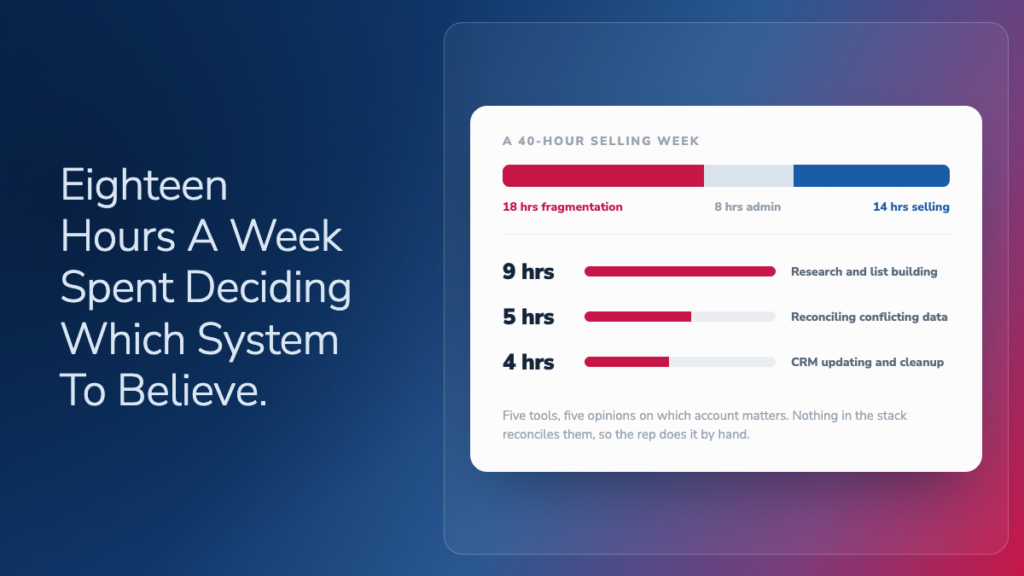
One illustrative breakdown of a 40 hour selling week found 18 hours lost to fragmentation alone: 9 hours on account research and list building, 5 hours reconciling conflicting data across systems, and 4 hours updating and cleaning the CRM. That left only 14 hours for the thing the rep was actually hired to do, sell, next to 8 hours of internal meetings and admin. Proportions will vary by team and segment, but the shape of the problem holds across most Growth-stage sales orgs: research is necessary, reassembling it by hand every week is not.
RevOps absorbs a parallel version of the same tax. Instead of governing a prioritization model that holds, RevOps ends up rebuilding it every quarter as inputs drift: a new intent source gets added, an enrichment vendor changes its schema, a fit score gets recalibrated. That reconciliation work happens manually, in spreadsheets and side conversations, because nothing in the stack is actually doing it.
Where the tax shows up
It tends to surface in three places.
Missed opportunities. An account is moving. The buying group is expanding, a competitor’s renewal window is opening, product usage is climbing. But the signal sits in a system the rep doesn’t check, or it’s buried under fifty other signals that look identical and aren’t weighted. The opportunity never announces itself, and a missed opportunity leaves no trace in the pipeline.
Wasted cycles. The opposite failure: a rep spends a chunk of the week on an account that looked active because one noisy signal fired, with no real buying motion underneath it. Fragmented intelligence produces both errors at once. It hides real opportunities and manufactures false ones.
Eroded trust. The most corrosive of the three. When the data is wrong often enough, reps stop trusting it and fall back on instinct or last year’s territory. The intelligence stack is still being paid for. It just isn’t being used anymore, because trust doesn’t come back with a better dashboard. It comes back only when the intelligence is consistently right.
One real pattern the research points to: at Gusto, roughly a third of the leads sellers were given went unworked, not because the leads were bad, but because the intelligence behind them wasn’t good enough for reps to act on with confidence. That’s not a lead-quality problem. It’s a trust problem, and trust problems don’t get fixed by adding a sixth data source on top of the five that already don’t agree.
Why more tools isn’t the fix
The instinct when a scoring model feels unreliable is to add another input, another enrichment layer, a second opinion from a different vendor. It rarely helps and often makes things worse, because more inputs into an unreconciled stack just means more disagreement for a rep to sort through by hand.
The gap isn’t signal volume. Most Growth-segment teams already have plenty of signal scattered across their stack. The gap is that nothing combines it into one explainable number a rep can act on without re-checking it, and that nothing is teaching RevOps which weight to trust when two sources disagree.
What actually closes the gap
Closing the fragmentation tax takes a connection layer, not another tool stacked on top. HG’s research names this the Contextual Intelligence layer: a single layer that weights fit, timing, and readiness to act against each other and hands the rep one picture instead of five separate ones, continuously refreshed instead of rebuilt every quarter.
The other half of the fix is how that picture gets ranked. A black-box score gives a rep a number with no visible reasoning, and “the model says so” doesn’t survive contact with a skeptical sales team. A white-box score shows its drivers: this account is high priority because the buying group expanded, spend in your category is climbing, and a competitor’s renewal window is open. That’s an answer a rep can act on and argue with, which is exactly what makes them trust it.
We put the full research behind this, what we’re calling the Precision Revenue Stack (Fit, Timing, Action), the Contextual Intelligence layer underneath it, and why white-box scoring is the design choice that decides whether a team trusts the model at all, into a paper for the sales and RevOps leaders who own the number.
Frequently Asked Questions
What is the fragmentation tax in sales?
The fragmentation tax is the cost of running a CRM alongside several disconnected intelligence tools that each produce a separate opinion about account priority. Reps pay it by manually reconciling conflicting sources before acting on a score. RevOps pays it by rebuilding the prioritization model whenever one of the underlying inputs changes.
How much selling time does fragmentation actually cost?
One illustrative model of a 40 hour selling week found 18 hours lost to fragmentation: account research and list building, reconciling conflicting data, and CRM cleanup, leaving only 14 hours for actual selling. Proportions vary by team, but the pattern of research and reconciliation crowding out selling time holds broadly.
Why doesn't adding more sales tools fix the fragmentation problem?
More tools add more signal, but without a layer that reconciles those signals into one explainable score, reps are left with more inputs to manually weigh rather than a clearer answer. The fix is connection, not addition.
What is white-box predictive scoring?
White-box predictive scoring shows the specific signals and weights that produced a score, rather than returning a single number with no visible reasoning. Reps and RevOps can see why an account scored where it did, tune the weights when something’s off, and validate the score against what has actually closed, which is what makes a score something a team trusts enough to act on.
Author
-

Nik Koutsoukos brings over 25 years of product and marketing executive leadership to his role as VP of Product Marketing at HG Insights. He drives product GTM, customer and partner-marketing, and sales enablement to increase awareness, reach, adoption, and growth.
Prior to HG Insights, Nik held senior positions including VP of Product Marketing at SolarWinds, Chief Marketing Officer at Catchpoint, and VP of Product Marketing at Riverbed Technology, where he helped scale adoption of enterprise performance and observability solutions. Nik brings deep expertise in translating complex technology into compelling market value and partner-aligned growth. He holds a BSEE from Leeds Beckett University.