
An MCP server is the piece of infrastructure that lets an AI agent reach into a real business system, like a CRM or a spend database, and pull back accurate information on demand. GTM and RevOps leaders are hearing the term constantly now that AI agents are showing up in pipeline research, account scoring, and outreach. Understanding what an MCP server actually does, and why it’s different from the API it often sits in front of, is the first step toward an AI agent strategy built on real data instead of a chatbot’s best guess.
Quick Answer: An MCP server is a lightweight connector that lets an AI agent request live data or actions from an external system, such as a CRM, spend database, or file store, through one shared, standardized protocol. Instead of building a custom integration for every tool an agent needs, developers point the agent at an MCP server and the connection is already built.
What is an MCP server, in plain English
Think of an MCP server as a universal power adapter for AI agents. Without one, an agent needs a separate, custom-built plug for every system it touches: one integration for the CRM, another for the spend database, another for the support desk. An MCP server gives it a single standard socket instead. The underlying AI model does the work of interpreting what you’re asking in plain language and picking the right tool with the right parameters; the MCP server just receives that already-structured call, runs it against the underlying system, and hands back a clean, structured answer.
The protocol behind that socket is called Model Context Protocol, or MCP. Anthropic introduced it in November 2024, and OpenAI and Google DeepMind had adopted it within a year. By December 2025, governance had moved to the Agentic AI Foundation under the Linux Foundation, according to Model Context Protocol’s own documentation. That fast, near-universal adoption is why the term now comes up in vendor conversations about ChatGPT, Claude, Copilot, and Cursor: MCP has become the common language AI systems use to talk to the tools a revenue team already runs.
Why MCP servers matter now for AI agents in GTM and RevOps
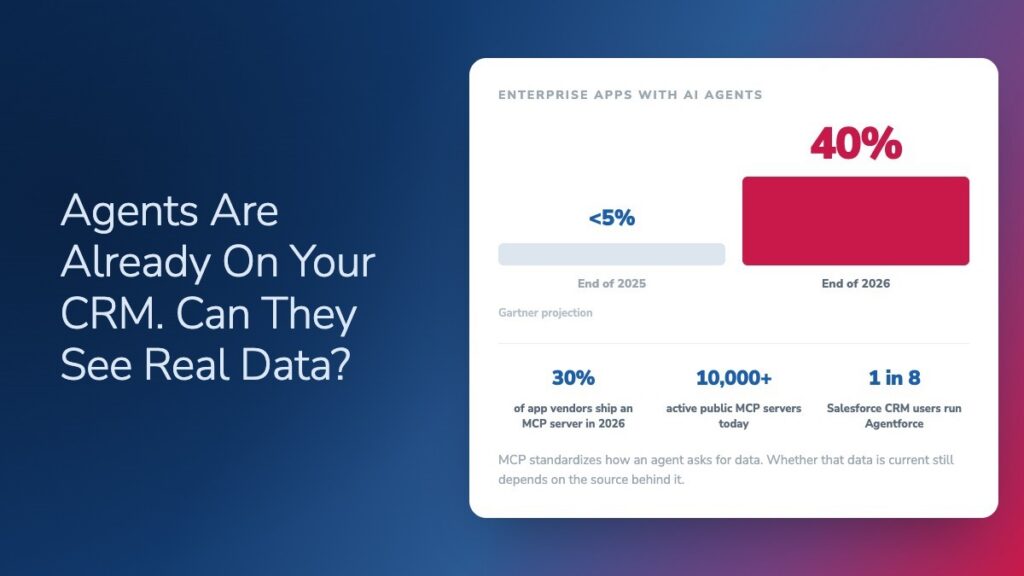
The shift is already showing up inside the tools GTM teams use every day. HG Insights install data shows nearly 1 in 8 companies running Salesforce CRM have already layered a Salesforce Agentforce agent on top of it, whether for sales, service, marketing, commerce, or field service. Agentic AI isn’t a future-state pitch for these teams; it’s already sitting on top of their CRM.
The volume of MCP servers in production has gone from a developer curiosity to enterprise plumbing in about two years. Forrester expects 30% of enterprise app vendors to ship an MCP server in 2026, and more than 10,000 active public MCP servers already run across Fortune 500 deployments, developer tools, and cloud platforms. Gartner puts a number on the broader shift too: 40% of enterprise applications will include task-specific AI agents by the end of 2026, up from under 5% a year earlier.
That growth runs into a familiar wall. An agent that can reason well but can’t see current account data is still guessing, and no amount of model quality fixes that. MCP doesn’t solve it either, at least not on its own: MCP is an access mechanism, not a freshness guarantee. Whether the data behind a given MCP server is real-time or a stale batch export depends entirely on the source system it connects to. What MCP standardizes is how an agent asks for that data, so a vendor with genuinely current, well-governed information can make it available to any compliant agent without a one-off integration for each one.
How an MCP server actually works, without the developer jargon
MCP has three moving parts, and once you can name them, the rest makes sense. The MCP host is the AI application itself, such as Claude, ChatGPT, or an internal sales copilot. For each outside system it needs to reach, the host opens a dedicated MCP client, and each client keeps a one-to-one connection with a single MCP server. Each server exposes a specific set of “tools” (actions the agent can trigger) and “resources” (data the agent can read).
Picture a rep asking an agent for the technology install base at a target account. The underlying model interprets that plain-language request and decides which tool to call, and the host sends a structured call through that tool’s dedicated client to its MCP server. The server executes the call against the underlying data system and returns a structured record: which vendor is installed, since when, and at what estimated spend. The agent never touches the raw database, and the data provider never has to build a one-off integration for every AI platform that wants access. One server, many agents.
MCP server vs. API: what’s the difference
An API is a fixed set of endpoints that each application has to integrate with individually. A developer reads the documentation, writes code against those specific endpoints, and maintains that code as the API changes. An MCP server sits a layer above that. It wraps one or more APIs (or databases, or file systems) in a standardized interface that any MCP-aware agent can call the same way, without custom integration work for each new agent or platform.
That distinction matters because it changes who does the integration work and how often. Without MCP, a data provider builds separate connectors for every AI tool a customer might use, and those connectors break every time an API changes upstream. With MCP, the provider builds one server, and any compliant agent, whether it’s Claude, ChatGPT, or an internal build, can use it. MCP doesn’t replace APIs. It standardizes how agents consume them.
What GTM and RevOps leaders should ask before adopting MCP
Most of the evaluation questions here aren’t technical. They’re about trust in the data an agent will act on. Start with freshness: does the MCP server return data that refreshes in real time or near real time, or is it serving a batch export that’s already stale by the time an agent queries it? Then ask about the data itself: is it proprietary information a vendor actually collects, or the same commodity data resold under a different label?
Governance questions follow close behind. Who can see what the agent requests and returns, and is there an audit trail? Does the server support single sign-on and role-based access, or does every agent connection carry the same broad permissions? And on lock-in: does the vendor support MCP as genuine open infrastructure, or is it a marketing checkbox bolted onto a closed platform that only works with one AI provider? A useful gut check, borrowed from data engineering teams: if the vendor can’t explain what happens to a request after it leaves the agent and before it reaches their system, that’s a governance gap worth pressing on before rollout, not after.
Where MCP fits in HG Insights’ AI agent data foundation
Most data providers now claim MCP support, but the server is only as useful as what it exposes. A lot of MCP servers on the market sit in front of the same commodity firmographic and contact data every vendor resells, which means the agent gets an answer, just not one that’s differentiated from what a competitor’s agent would return.
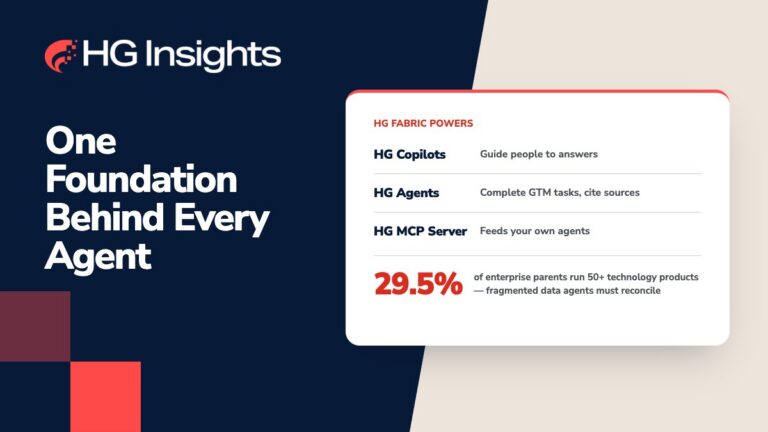
HG Insights runs its MCP server on top of RGI Fabric, which is verified technographic, spend, and buyer intent data that HG collects directly rather than aggregates from resold sources. As of June 2026, that MCP server is live inside OpenAI Codex, giving sales teams access to a library of more than 15 prebuilt GTM workflows, including account research briefs, pre-call briefs, and competitive battle cards, built directly into the tools reps already use.
Teams evaluating what a proprietary, MCP-native data layer looks like in practice can see the full GTM infrastructure for AI agents solution, or book a demo to see how HG Insights’ data foundation powers your AI agents directly.
Frequently Asked Questions
What does an MCP server do?
An MCP server gives an AI agent a standardized way to request data or trigger actions in an external system, such as a CRM, database, or file store. It handles the translation between the agent’s plain-language request and whatever format the underlying system requires, then returns a structured response the agent can use.
How is an MCP server different from a regular API?
An API is a set of fixed endpoints each application integrates with separately. An MCP server wraps one or more APIs in a shared, standardized protocol so any MCP-compatible agent can call it the same way, without custom integration work for every new AI platform or tool.
Who created the Model Context Protocol?
Anthropic introduced Model Context Protocol in November 2024. OpenAI and Google DeepMind adopted the standard within about a year, and in December 2025 governance passed to the Agentic AI Foundation under the Linux Foundation, making MCP an industry-wide standard rather than a single vendor’s specification.
Do I need to build my own MCP server?
Only if you’re exposing your own proprietary data or systems to AI agents. Most GTM and RevOps leaders will instead evaluate vendors that already run an MCP server, checking whether the underlying data is proprietary, how often it refreshes, and what governance controls are in place before connecting an agent to it.
Is MCP secure enough for enterprise data?
Security is now partly defined by the protocol itself, not left entirely to each server’s implementation. Since a March 2025 spec update, MCP has included an OAuth 2.1-based authorization framework for remote servers, covering how a client obtains and presents access tokens. That authorization layer is optional under the spec, though, so buyers should still confirm a given server actually implements it, along with role-based access and audit logging, before granting an agent access.
What AI platforms support MCP?
Claude, ChatGPT, Microsoft Copilot, Cursor, and Windsurf all support MCP, along with cloud platforms including AWS and Google Cloud. Actual installs are still catching up to that platform support: HG Insights data shows fewer than 3 in 1,000 companies running GitHub Enterprise have installed the GitHub MCP Server itself, a sign of how early MCP adoption still is at the tooling layer even as the protocol standardizes fast.