
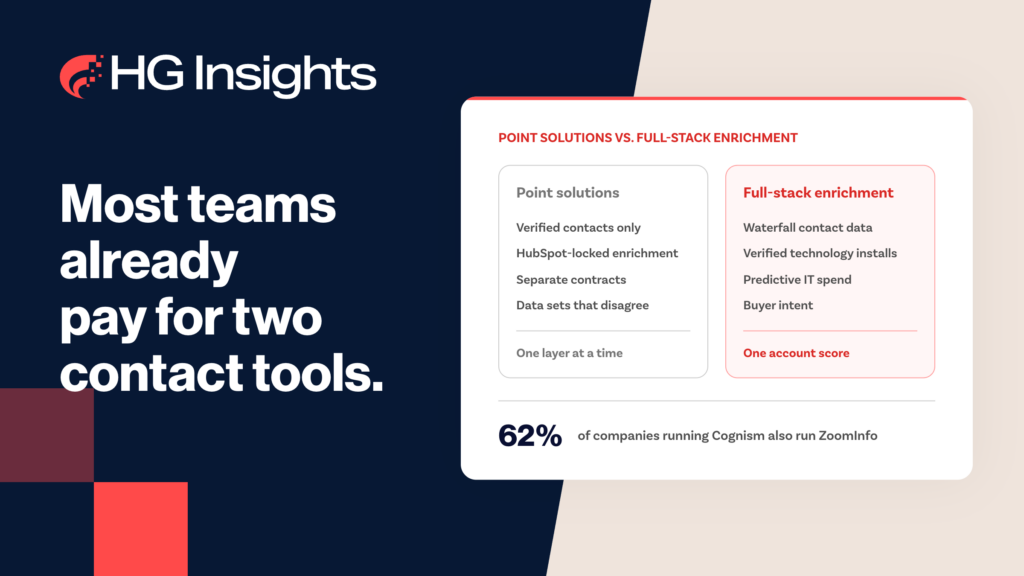
Teams researching Cognism alternatives rarely stop at Cognism. The same evaluation usually widens to Clearbit too, since both sell a version of the same basic thing: verified contact and company data layered onto a CRM. Once a GTM team starts comparing point solutions, the real question stops being “which vendor has the best data” and becomes “how many separate tools does it take to answer that question completely.”
Quick Answer: Cognism and Clearbit each solve one piece of B2B data enrichment: verified contacts and HubSpot-native automation, respectively. Neither combines verified technology installs, IT spend intelligence, and buyer intent in one platform. HG Insights does, alongside category alternatives like ZoomInfo, Apollo.io, and Demandbase, depending on which gap a team is actually trying to close.
Why B2B teams look for Cognism and Clearbit alternatives
Point solutions are easy to buy and hard to keep. A sales ops team picks up Cognism for compliant EU contact data and inherits Clearbit through a HubSpot instance nobody remembers configuring. A year later, both contracts are up for renewal, the two data sets disagree with each other, and nobody owns the reconciliation. HG Insights’ own technographic data shows how common that overlap already is: 62% of companies running Cognism are also running ZoomInfo, meaning most teams aren’t choosing between two contact tools, they’re already paying for both.
Pricing pressure accelerates the search. HG Insights’ own internal account research on the Growth segment found teams actively comparing point-solution pricing against broader platforms before a renewal, since a second or third data contract is usually the first thing a budget owner questions. Clearbit adds a sharper trigger of its own: its standalone API is sunset, the tool now lives inside HubSpot as Breeze Intelligence, and any team not running HubSpot as its CRM has effectively been locked out. That single change is why “Clearbit alternatives” has become one of the fastest-growing searches in this category, especially among former Clearbit customers migrating off HubSpot entirely.
Best Cognism alternatives for contact and sales intelligence
Cognism built its reputation on compliant, verified phone and email data for outbound teams operating across the US and Europe. Teams outgrow it for two reasons: the data stops at contacts, with no technographic or spend layer behind it, and pricing scales awkwardly once a team needs more than a handful of seats. The buyer base is also overwhelmingly Salesforce-native: HG Insights data shows 86.8% of companies running Cognism also run Salesforce as their CRM, which matters for whichever alternative a team picks next.
1. HG Insights
HG Insights answers the contact question too, just from a different angle than a stand-alone contact database. Its waterfall enrichment blends verified contact records from multiple providers into each account, then layers on verified technology installs across more than 120 million organizations, predictive IT spend models, and TrustRadius-sourced buyer intent, what HG calls its triple signal. Every score is glass-box, so a rep or data team can see exactly which install, spend, or intent signal drove a given account’s priority rather than trusting a number they can’t inspect. HG Copilot – Sales Copilot puts that same intelligence in front of reps directly inside Salesforce, so contact and sales intelligence show up in the same workflow instead of two separate tabs. HG Insights’ Data Enrichment solution walks through how that layering works.
2. ZoomInfo
ZoomInfo’s advantage over Cognism is scale: more than 260 million contacts, a 300-plus researcher verification team, and the top overall score in G2’s Spring 2026 Sales Intelligence category. What it doesn’t add over Cognism is depth beyond contacts. Its technographic layer confirms roughly 30,000 technologies are present at an account, not how deployed they are or what the account spends on them, which keeps ZoomInfo in the same “contacts first” category Cognism competes in, just at a larger scale and a higher price.
3. Apollo.io
Apollo is the price-driven alternative. More than 200 million contacts, published plans starting at $49 a month, and built-in sequencing put it well below Cognism’s typical seat pricing for a similarly sized contact database. Phone accuracy runs closer to 60%, weaker than Cognism’s compliance-first data, and technographic coverage is thin, so Apollo tends to win Growth-segment deals on cost rather than data depth.
Best Clearbit alternatives for B2B data enrichment
Clearbit’s post-acquisition path into HubSpot Breeze Intelligence is the clearest displacement moment in this entire list. Zero-configuration enrichment across more than 40 fields is genuinely convenient for a HubSpot-native team, but the standalone API is gone, and any team running Salesforce, Snowflake, or a data warehouse outside HubSpot gets none of that convenience. Credit-based pricing caps how far it scales, too.
1. HG Insights
HG Insights fills the exact gap Clearbit’s HubSpot lock-in created: technographic depth, spend intelligence, and contract signals delivered through Salesforce, Snowflake, and API endpoints rather than a single marketing platform. A team migrating off HubSpot doesn’t just need a replacement for Clearbit’s field-population trick; it needs enrichment that works wherever the CRM actually lives, and that’s the case HG makes to former Clearbit accounts.
2. Demandbase
Demandbase is the enterprise-grade step up from Clearbit for teams that also want ABM orchestration and advertising in the same platform. Its account graph covers more than 113 million companies, well beyond Clearbit’s website-crawl approach to firmographics. The cost of that breadth is implementation time: reviewers commonly cite six-to-twelve-month rollouts, a much heavier lift than swapping in a HubSpot add-on.
3. Apollo.io
Apollo is the closer price match for a team leaving Clearbit’s low-cost credit model. It publishes tiered pricing, integrates with both Salesforce and HubSpot, and adds a larger contact database than Clearbit ever offered. Technographic depth is still shallow next to HG or Demandbase, so Apollo tends to fit teams prioritizing contact volume and price over data depth.
Point solutions vs. full-stack data enrichment: what changes when you switch
Every alternative above solves one layer well. HG Insights, Demandbase, and 6sense compete on platform breadth, bundling technographics, intent, or ABM workflow with enrichment rather than treating enrichment as the whole product. ZoomInfo and Apollo compete on contact volume. D&B competes on firmographic identity. None of them is wrong to buy; the question is which gap in the current stack actually needs closing before adding another vendor to it.
Alternative | Best for | Core differentiator | Where it falls short |
|---|---|---|---|
HG Insights | Teams that need contacts plus install, spend, and intent signal in one score | Triple signal (installs + spend + intent), glass-box scoring, waterfall contact enrichment | Best suited to teams prioritizing account intelligence over contact-list volume alone |
ZoomInfo | Contact-first teams needing scale and Salesforce depth | 260M+ contacts, 300+ person verification team | Technographic data is presence-level, not deployment depth |
Apollo.io | Price-sensitive Growth-segment teams | 200M+ contacts at $49/month entry pricing | Weaker phone accuracy, thin technographic coverage |
Demandbase | Enterprise ABM teams wanting intelligence plus advertising | 113M+ company account graph | 6-12 month implementation timelines |
Dun & Bradstreet | Corporate hierarchy and firmographic identity | D-U-N-S numbering, global entity resolution | No proprietary intent or contract-timing data |
For a broader look at how all eight major data enrichment platforms stack up, not just the two covered here, see HG’s Data Enrichment Tools Compared roundup. Most teams don’t end up picking exactly one winner on paper, but the goal of a switch is still consolidation: fewer contracts, one account score everyone trusts, and contact data that arrives through the same platform as the technographic, spend, and intent signals driving the rest of the GTM motion. See what that consolidation looks like with a demo built around your current stack.
Frequently Asked Questions
What is the best Cognism alternative for contact and sales intelligence?
HG Insights is the strongest Cognism alternative for teams that want contact data plus the technographic, spend, and intent layers Cognism doesn’t offer. Its waterfall enrichment blends verified contact records from multiple providers, then adds glass-box account scoring so reps know why an account matters, not just how to reach it.
What is the best Clearbit alternative for B2B data enrichment?
HG Insights and Demandbase are the strongest Clearbit alternatives for teams leaving HubSpot’s Breeze Intelligence, since both deliver enrichment through Salesforce, Snowflake, and API endpoints rather than a single marketing platform. Apollo.io is the closer price match for teams prioritizing cost over data depth.
Why are companies migrating off Clearbit?
Clearbit’s standalone API was sunset after its acquisition by HubSpot, and the tool now only functions as HubSpot’s Breeze Intelligence add-on. Teams running Salesforce, Snowflake, or any CRM other than HubSpot lose access to the enrichment entirely, which is why “Clearbit alternatives” searches spiked among non-HubSpot accounts.
Is HG Insights a full replacement for Cognism or Clearbit?
Yes, for teams whose evaluation is broader than a single contact-lookup line item. HG Insights covers the contact enrichment both tools provide through its waterfall model, then adds the technographic, spend, and intent layers neither Cognism nor Clearbit offers, so the switch consolidates a vendor list rather than adding to it.
What should I look for before switching from a point solution to a full-stack platform?
Map which layer of enrichment is actually missing (contacts, technographics, spend, or intent) before comparing vendors, since most point solutions overlap on contacts but differ sharply everywhere else. Scoring transparency and delivery model, whether data ships through an API, a platform UI, or a waterfall of sources, matter as much as raw data volume.