
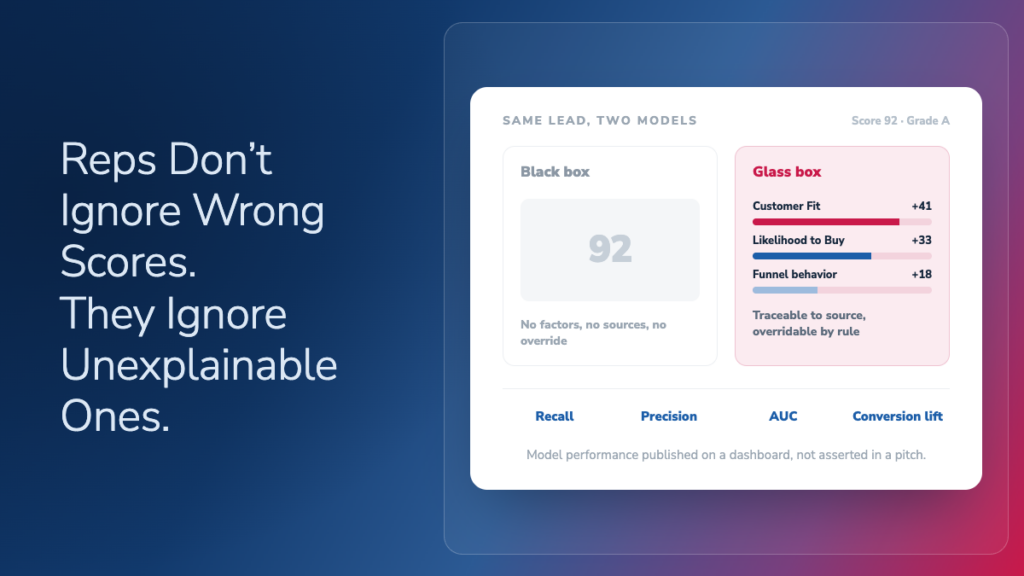
Static, assumption-based lead scoring is quietly leaking pipeline, and the instinct to fix it with black-box AI lead scoring only trades one kind of distrust for another. Growing company’s marketing teams are right to want a smarter model. Where the upgrade goes wrong is treating “smarter” and “trustworthy” as the same requirement. A model nobody on the sales floor can question isn’t a better model. It’s the same guesswork wearing a more confident label. This piece lays out why glass-box scoring, not just AI scoring, is the real endpoint worth building toward.
Quick answer: Glass-box AI lead scoring shows the specific factors behind every score and lets marketing ops set rules that correct the model when it gets a pattern wrong. Black-box scoring returns a number with no explanation. For a team evaluating an AI scoring upgrade, auditability decides whether sales ever trusts the score enough to act on it, which is the whole point of scoring leads in the first place.
The Trust Gap Behind the AI Scoring Upgrade
Most Growth-segment marketing teams built their current lead scoring model on assumptions: ten points for a demo request, five for a pricing page visit, a guess at what “good fit” looks like. Nobody validated those weights against actual conversion data, and it shows. Industry benchmarks put average MQL-to-SQL conversion at 13 to 15 percent, which means roughly 85 out of every 100 marketing-qualified leads never become sales-qualified.
That’s the pain driving the current wave of AI scoring evaluations. It’s also where teams hit a second, less obvious problem. Forrester’s 2026 Buyer Insights research, drawn from more than 17,500 global buyer responses, found that 19 percent of buyers using AI report feeling less confident in their purchasing decisions because of unreliable AI output. Marketing ops is watching that same dynamic play out internally: reps stop trusting a score the moment they can’t explain it to their own manager, and an AI model that can’t explain itself just moves that failure point from “the rules were guesses” to “the model is a mystery.”
Replacing static scoring with an opaque AI model doesn’t close the trust gap. It relocates it. The fix isn’t a smarter black box. It’s a model that shows its work.
Why Glass-Box Scoring Is the Real Upgrade, Not Just a Bigger Model
Glass-box scoring means every score decomposes into the specific factors that produced it, and a person can override the result when their judgment disagrees. That’s a different bar than “AI-powered.” Most AI-powered scoring tools in the category talk about accuracy and prediction quality. Far fewer talk about whether a marketing ops leader can open a single lead, see exactly why it scored the way it did, and check the model’s track record against real outcomes. Competitive research into the lead scoring category found that glass-box positioning, full auditability plus override rights, is largely unclaimed territory. Vendors compete on model sophistication. Almost none compete on showing their work.
Every score decomposes into its contributing factors
A score without a reason attached is a verdict, not a tool. HG Insights’ Score Lookup exposes the full calculation breakdown behind any individual lead score: the result, the explanation, and the specific contributing factors and enrichment sources that produced it. Those contributing factors are also where the two halves of the data come together. Score Lookup shows first-party funnel behavior from your CRM alongside third-party company context such as technology stack, hiring signals, and firmographics so the explanation covers not just what the lead did, but what the company behind them actually looks like. A model that only sees the form fill has less to explain in the first place. A marketing ops leader can pull up one lead, see that it scored high because of firmographic fit plus a recent spike in relevant engagement, and know exactly what to tell a rep who asks why. That single capability turns “trust the model” into “check the model,” which is a much easier thing to ask a skeptical team to do.
Scores that can be overridden, not just explained
Explaining a score is only half the requirement. A model that shows its reasoning but still can’t be adjusted still asks the team to defer to it completely. Glass-box scoring treats the model’s output as a starting point a person can correct, not a final answer they have to accept. When a marketing ops leader knows a signal is stale, or knows a specific account doesn’t fit the pattern the model assumed, overriding the score should be as visible and as auditable as the score itself. That’s the difference between a model built to be trusted and a model built to be obeyed.
Model quality you can verify independently
Trust in an individual score is one thing. Trust in the model overall is another, and it shouldn’t rest on a vendor’s word. HG’s model performance dashboards expose recall, precision, AUC, and conversion lift, so a team can check whether the model is actually finding the leads worth pursuing and correctly leaving the rest alone, rather than taking “our AI is accurate” as a marketing claim. Recall shows how much of the real opportunity the model is catching. Precision shows how much of what it flags is actually worth a rep’s time. AUC gives a single number for how well the model separates good leads from bad ones across every threshold. Conversion lift ties all three back to the metric that matters: whether scored leads actually convert better than unscored ones. None of that requires taking the model’s word for anything.
How Auditable Scoring Changes the Job for Every Revenue Team
Marketing ops gets the most direct benefit. Instead of defending a scoring model with “that’s just how it’s configured,” they can point to the specific factors behind any lead and to a dashboard that shows the model’s real conversion lift over time. That’s a fundamentally different conversation with sales leadership, and a much shorter one.
Sales reps get something they’ve usually never had with an AI scoring tool: a reason. A rep who can see that a lead scored high because of a technographic match and a recent spike in relevant research activity will act on that score differently than a rep handed a bare number. Reps don’t ignore scores because they’re wrong. They ignore scores they can’t explain to themselves in the middle of a call.
RevOps and marketing leadership get an audit trail instead of a black box to defend in a QBR. When a scoring model’s logic and performance metrics are visible on demand, “why did we deprioritize that segment” has an answer that doesn’t start with “the vendor says.” That matters more than it used to. Internal governance expectations around AI decisioning are tightening, and a model that already shows its work is one you won’t have to retrofit.
What Is Glass-Box AI Scoring?
Glass-box AI scoring is a lead or account scoring model where every score can be traced back to the specific data points and weightings that produced it, and where a person can review or override that score rather than accept it as final. It’s the opposite of black-box scoring, which returns a number or grade without exposing the reasoning behind it.
The distinction matters because accuracy and trust aren’t the same problem. A model can be statistically accurate and still get ignored if the people using it can’t see why it made a given call. Glass-box scoring solves the adoption problem that accuracy alone doesn’t touch: it gives reps and marketing ops a reason to act on a score instead of working around it.
Build Auditable Lead Scoring with HG Insights Data Studio
HG Insights Data Studio scores leads and accounts through three connected models: Customer Fit, which answers who looks like a real prospect, Likelihood to Buy, which answers who’s showing buying signals right now, and Lead Grade, which combines the two into a single A-through-E grade. Every one of those scores traces back through Score Lookup to the specific factors and enrichment sources behind it, and the model performance dashboards report recall, precision, AUC (Area under cover), and conversion lift so the whole system can be checked against real outcomes, not just trusted on faith.
For a lean marketing team evaluating an AI scoring upgrade, that’s the difference between adopting a model and adopting a mystery. See how HG Insights Data Studio gives marketing ops an auditable, overridable score for every lead.
Frequently Asked Questions
What is glass-box AI scoring?
Glass-box AI scoring is a lead or account scoring model that shows the exact factors behind every score and lets a team correct the model when it gets something wrong. It contrasts with black-box scoring, which returns a number without explaining the reasoning that produced it.
Why is black-box AI lead scoring a problem for marketing ops?
Black-box scoring gives marketing ops a result with no way to defend it to sales or leadership. When a rep asks why a lead scored high and the only answer is “the model decided,” the score gets ignored, and the team is left managing the same trust gap static scoring had, just with a more sophisticated model behind it.
How is glass-box scoring different from explainable AI?
Explainable AI shows the reasoning behind a decision. Glass-box scoring goes a step further by also letting a person correct that decision. A model can explain itself and still demand blind acceptance; glass-box scoring treats the model’s logic as something a team can adjust, not just inspect.
What metrics should marketing ops check to trust a lead scoring model?
Recall, precision, AUC, and conversion lift together show whether a model is finding the leads worth pursuing, correctly filtering out the rest, and actually improving conversion outcomes. Checking these on an ongoing dashboard, rather than accepting a vendor’s accuracy claim, is what makes trust in the model verifiable rather than assumed.
Can an AI lead score be overridden if it looks wrong?
In a glass-box model, yes. Because a marketing ops leader who sees the model getting a pattern wrong can write an override, a rule that corrects the score for every record matching that condition. The override becomes part of the model and stays visible to anyone reviewing it, rather than a one-off edit nobody can trace later.
Is glass-box scoring only relevant for enterprise teams?
No. Growth-segment teams typically have fewer resources to spend defending a scoring model that sales doesn’t trust, which makes an auditable, correctable score more valuable, not less. A smaller team can’t afford to have its AI investment quietly ignored by reps who don’t understand it.
Why does a lead scoring model need third-party data?
A model can only explain what it can see. Scoring built on CRM data alone knows what the lead did such as the form fill, the page visits, the email opens but not what the company behind them looks like. Unifying first-party funnel behavior with third-party technographic and firmographic data means two people who submitted the identical form stop scoring the same when one works at a perfect-fit account and the other never will.