
Voice of customer solutions have become the deciding factor in how B2B buyers evaluate vendors they’ve never spoken to. Before a sales call happens, most buying committees have already read reviews, compared scores, and formed an opinion based on what other customers said. Pick the wrong platform to collect and activate that feedback, and a deal loses its proof points at the exact moment it needs them. This comparison breaks down how TrustRadius, G2, and Deeto handle review depth, intent data, and content activation, so advocacy, product marketing and demand generation teams can choose the platform that actually moves deals forward.
Quick answer: The best voice of customer platforms for B2B teams are TrustRadius, G2, and Deeto, and each solves a different part of the problem. TrustRadius leads on review depth and authenticated intent-driven leads. G2 leads on marketplace scale and integration breadth. Deeto leads on real-time reference calls between prospects and existing customers.
What is a voice of customer platform (and why it matters for B2B teams)
A voice of customer platform collects verified feedback from paying customers, usually as written reviews, video testimonials, or live reference calls, then makes that feedback usable in marketing and sales. That is a different job than customer experience survey software like Qualtrics or Gong, which measures satisfaction and sentiment across a company’s own customer base over time. The platforms in this post, TrustRadius, G2, and Deeto, sit in the B2B review and proof-point category instead. Their purpose is turning customer opinions into public evidence that shapes a prospect’s decision before a rep ever picks up the phone.
Voice of customer software vs. CX survey platforms
It’s worth separating these two categories up front, because a Google search for “voice of customer software” mostly surfaces CX survey tools built for internal sentiment tracking, not the review and proof-point platforms this post covers. Survey platforms answer “how satisfied are our customers.” Review and reference platforms answer “will a prospect trust what our customers said enough to buy.” Product marketing and demand gen teams evaluating TrustRadius, G2, or Deeto are usually trying to solve the second problem, not the first, and the two software categories rarely overlap on features or pricing.
Why B2B teams can’t skip this anymore
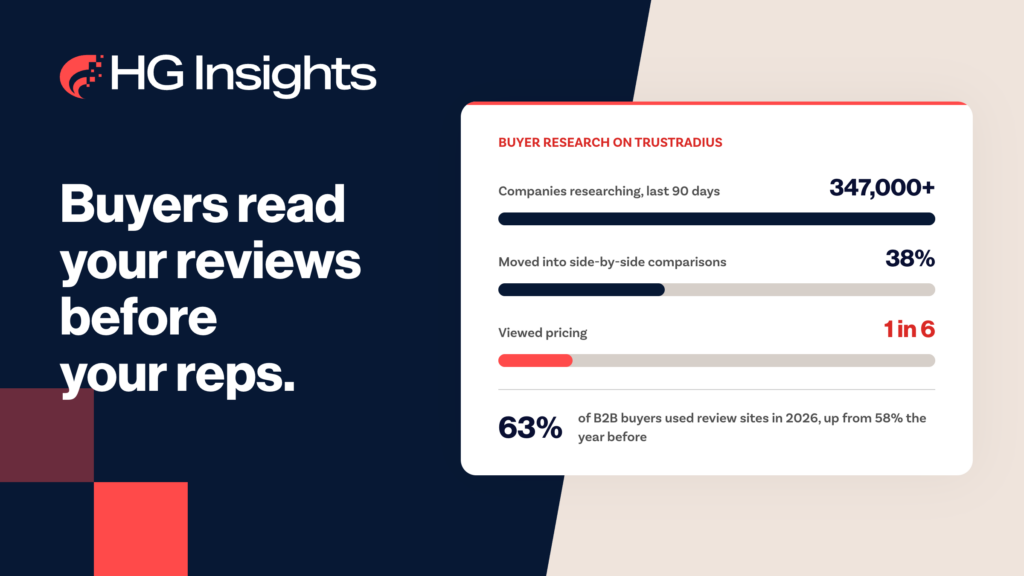
Public product review sites have become one of the most consulted information sources for B2B software buyers: review-site usage climbed to 63% in 2026, up from 58% the year before, and 74% of buyers consulted customer reviews at some point during their purchase journey, according to TrustRadius’s 2026 B2B Buying Disconnect Report. HG Insights sees the same pattern in its own buyer-intent data: reviews and ratings pages draw more than double the research activity of plain product pages, 57% of companies versus 25%. Buying committees now average 10 to 13 stakeholders, according to Corporate Visions’ 2026 research on B2B buying behavior, and most of them read reviews independently before a vendor conversation starts. A platform with thin, stale, or unverified reviews is effectively invisible to that research process, no matter how strong the actual product is.
How this comparison evaluated the best voice of customer platforms
Three factors separate these platforms more than any feature checklist: how deep and verified the reviews actually are, how easily that content gets turned into usable sales and marketing assets, and how much intent data comes back to the vendor. Those three factors are also where TrustRadius, G2, and Deeto diverge most sharply from each other.
Review depth and authenticity
Review length and verification standards vary widely across platforms, and that gap matters more than most buyers assume. A platform with a high rejection rate and long-form review requirements produces fewer but more credible reviews. A platform optimized for review volume produces more coverage but invites more noise, including reviews written mainly to claim an incentive.
Content activation
Collecting a review is only half the job. The best platforms let a vendor tag, organize, and republish specific quotes across campaigns, sales decks, and landing pages instead of leaving proof points stranded on a single profile page.
Intent data and lead delivery
TrustRadius and G2 track which accounts are researching a category or a specific vendor, then route that activity back as a sales signal. Deeto’s intent signal works differently: it’s first-party only, built from its own reference and advocate activity rather than broader category or vendor research. Either way, the quality of that signal, not just its volume, is what determines whether it becomes a real pipeline source.
TrustRadius: best for authenticated reviews, GEO, and intent-driven leads
TrustRadius built its category position around depth over volume, and that shows up in nearly every part of the product.
Review depth and a rejection rate that backs it up
TrustRadius reviews average more than 400 words, well above what most competing platforms disclose, and the platform reports rejecting roughly 60% of submissions that don’t meet its verification and quality bar. Vendors can also add custom reviewer questions, which lets a company shape the narrative a review captures instead of relying on a generic template.
TrustQuotes and award-driven sales enablement
TrustRadius centralizes approved quotes in a searchable library, so a marketer can pull a specific proof point for a campaign instead of manually re-reading old reviews. Additionally, these reviews can be syndicated across a vendor’s website for SEO/GEO. Its awards program works the same way: Buyers Choice requires roughly 75% customer consensus to win, which gives sales teams a credential earned by customer vote rather than pay-to-play vendor spend.
Downstream intent data and integrations
HG Customer Voice, powered by TrustRadius, the vendor solution for tech vendors looking to reach tech buyers on TrustRadius.com , delivers intent-driven leads based on buyer research activities on TrustRadius, meaning intent generated by someone actually evaluating a product rather than just visiting a page. That downstream intent isn’t a trickle: HG Insights tracked buyer-research activity from more than 347,000 distinct companies on TrustRadius in the last 90 days alone. Roughly 38% of those companies moved from browsing into side-by-side comparisons, and about 1 in 6 viewed pricing, the kind of activity that separates a real buying signal from a passing visit. It connects natively to Salesforce, HubSpot, Marketo, Snowflake, 6sense, and Demandbase, and it’s the only platform in this comparison with native Outreach integration, which matters because intent signals lose value fast if they don’t trigger an automated follow-up.
Built and optimized for LLMs
TrustRadius is uniquely positioned for GEO because it’s the software review platform AI engines actually trust: it receives roughly 60 million annualized crawls a year from major AI engines, with about half of those real-time requests to answer a live buyer question, not just training-data sweeps. That crawl volume matters because it means TrustRadius content is what ChatGPT, Google AI Overviews, Perplexity, and Claude are already reaching for when a buyer asks which product to trust, and it’s backed by verified reviews (averaging 400 words, 100% authenticated) plus HG Insights technographic data embedded right on the page, showing which companies actually run the product, in what industries, and at what company sizes. No other review platform pairs that scale of AI attention with that depth of real-world usage evidence, which is exactly what separates a citation an AI engine trusts from one it skips.
G2: best for broad category coverage and marketplace reach
G2 wins on sheer scale, and for demand gen teams prioritizing reach over depth, that scale is a legitimate advantage.
Scale and integration breadth
G2 holds more than 3 million reviews and draws more than 100 million visitors a year, giving vendors broader category coverage than any other platform in this space. Its integration list runs deeper than the other two overall, with native Salesforce, HubSpot, and Marketo connections, plus 6sense, Demandbase, and Performance Analytics dashboards that show revenue attribution directly inside the CRM, though TrustRadius covers the same core CRM and ABM connections.
Where G2’s authenticity gets questioned
That scale comes with a tradeoff. Industry analysis estimates 30% to 50% of G2 reviews may be incentivized, and G2 has faced documented criticism over moderation that favors vendors who pay for placement. Custom reviewer questions are capped at two per review, and G2 doesn’t disclose average review length, which independent comparisons suggest is materially shorter than TrustRadius. For a Customer or Product Marketing Manager fielding the objection “we already use G2, why do we need another platform,” the honest answer is that G2 covers volume and reach, while a platform like TrustRadius is built to answer a buyer’s authenticity question directly, which translates directly to visibility in LLMs.
Deeto: best for real-time customer reference calls
Deeto solves a different problem than either TrustRadius or G2. Instead of hosting its own review marketplace, Deeto connects prospects directly with a company’s existing customers for live reference conversations, tracking interest and matching advocates through tools it calls Deeto Core, Deeto 360, and Deeto Live. Its stated approach is to route authentic customer voice to where buyers already look for proof, including third-party sites like G2, rather than competing for review traffic itself. That makes Deeto less of a head-to-head substitute for TrustRadius or G2 and more of a complement focused specifically on the reference-call moment late in a deal cycle. Public information on Deeto’s pricing and roadmap is limited, so teams evaluating it should confirm current capabilities directly with the vendor before comparing it feature-for-feature against a review platform.
TrustRadius vs. G2 vs. Deeto: side-by-side comparison
TrustRadius | G2 | Deeto | |
|---|---|---|---|
Core model | Deep, verified reviews | High-volume review marketplace | Live customer reference calls |
Average review depth | 400+ words | Shorter, undisclosed | N/A (not review-based) |
Review verification | ~60% rejection rate, custom questions | Custom questions capped at 2 | Advocate opt-in, not review-based |
Content activation | TrustQuotes library | Widgets, no native quotes library | Reference microsites, live calls |
Intent data | Downstream research activity | Large-scale visitor intent | Not applicable |
GEO | Robust GEO Monitoring Dashboard, GEO Optimization Services | Some GEO reporting | |
Native integrations | Salesforce, Outreach, 6sense, Demandbase, Snowflake | Salesforce, HubSpot, Marketo, 6sense, Demandbase | CRM signal-based matching |
Best fit | Authenticity-driven proof and intent-based leads | Broad category coverage and integration reach | Late-stage reference conversations |
The pattern across all three: TrustRadius and G2 both compete on intent quality, but they land in different spots on authenticity. G2 wins on raw research reach. Deeto isn’t really competing on the same axis at all, since it’s built around live conversations rather than published reviews.
How to choose the right voice of customer platform for your team
A Customer Marketing or Product Marketing Manager building competitive battle cards needs a platform where review content can be tagged, filtered, and rebuilt into a specific proof point for a specific deal scenario. That’s where review depth and a searchable quotes library matter more than raw review count, since a battle card built on a 60-word review rarely survives a skeptical buyer’s follow-up question.
A VP of Demand Generation or CMO evaluating these platforms is usually optimizing for a different variable: how much of the intent data converts into real pipeline, and how cleanly that data flows into the martech stack already in place. That team should weigh integration depth and lead delivery model as heavily as review quality, since intent signals that arrive without a workflow attached tend to sit unused.
Sales enablement leaders sit closer to the point of use. For them, the deciding factor is often how fast a rep can find a relevant proof point mid-conversation, which is why a centralized quotes library or a live reference call option tends to outperform a platform where reviews are only browsable one profile page at a time.
Build a customer voice program with HG Insights
None of these platforms deliver full value sitting on their own. The gap most B2B teams hit isn’t collecting reviews, it’s connecting authenticated review activity to actual pipeline and revenue. HG Insights’ Customer Voice turns TrustRadius reviews into intent-driven leads, giving demand gen and sales teams a way to see which accounts are actively researching a category before those accounts ever fill out a form. Teams already weighing TrustRadius against G2 or Deeto can compare HG Customer Voice, powered by TrustRadius pricing directly against the vendors covered in this post to see where the intent-to-pipeline math actually lands.
Teams earlier in the process, still defining a broader voice of customer strategy rather than comparing specific platforms, may get more value starting with HG Insights’ guide to voice of customer generation and activation before narrowing down to a single vendor. For teams ready to move past comparison shopping, talking to HG Insights about a Customer Voice program (link to demo/contact page) is the fastest way to see what an intent-driven leads program would look like against a specific target account list.
Frequently Asked Questions
What is the best voice of customer platform?
There isn’t a single best platform, since TrustRadius, G2, and Deeto each optimize for something different. TrustRadius is the strongest choice for teams that need deep, authenticated reviews, LLM visibility and intent-driven leads. G2 is the strongest choice for teams prioritizing scale and integration breadth. Deeto fits best as a late-stage reference tool rather than a review platform replacement.
What voice of customer software should I use?
The right platform depends on what problem is most urgent. Choose TrustRadius if authenticity, review length and customization, and intent quality matter more than raw volume. Choose G2 if broad category visibility and CRM integration depth are the priority. Choose Deeto if the bottleneck is getting prospects onto live calls with real customers late in the deal cycle.
What is the best AI voice of customer software?
Most platforms in this category, including G2 and PeerSpot, now use AI to help generate or summarize review content, but AI features aren’t the deciding factor for most B2B teams. The more useful comparison is still review authenticity, intent data quality, and how easily content gets activated into sales and marketing assets.
How do I choose voice of customer software for a SaaS company?
Start by identifying whether the immediate need is proof-point depth, market reach, or reference-call velocity. A SaaS company selling into skeptical enterprise buyers usually benefits more from TrustRadius’s review depth, while one that needs broad category visibility for a self-serve or mid-market motion often leans toward G2’s scale.
What's the difference between TrustRadius and G2?
TrustRadius and G2 both deliver intent data, but they diverge sharply on authenticity. TrustRadius averages 400+ word reviews with a roughly 60% rejection rate, while G2’s shorter, undisclosed-length reviews carry an estimated 30% to 50% incentivized rate and documented moderation criticism. G2 wins on scale and integration breadth; TrustRadius wins on review depth and validated intent quality.
Is Deeto a good alternative to G2 or TrustRadius?
Deeto isn’t a direct substitute for either platform, since it’s built around live reference calls rather than published reviews. Teams already using TrustRadius or G2 for review collection often add Deeto for late-stage deals that need a real conversation with an existing customer, rather than replacing their review platform with it.