
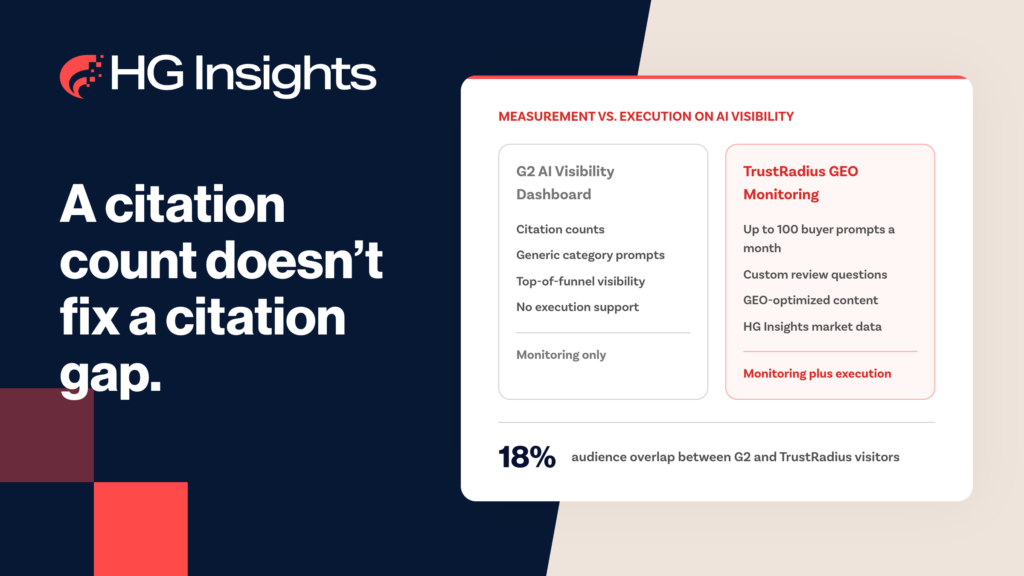
AI search visibility tools help B2B vendors see whether their product actually shows up when buyers ask ChatGPT, Claude, Perplexity, or Google’s AI Overviews about their category. Two names currently dominate that conversation: G2’s AI Visibility Dashboard and TrustRadius GEO Monitoring & Optimization. One disclosure before anything else: HG Insights owns TrustRadius, so this isn’t a neutral comparison. It’s an honest one, and it says plainly where G2 is ahead.
Quick Answer: G2’s AI Visibility Dashboard, powered by Profound, tracks how often a vendor’s G2 profile is cited by AI engines for generic category prompts. TrustRadius GEO Monitoring & Optimization, powered by Conductor, tracks the same citation activity, then pairs it with custom content, buyer-page optimization, and HG Insights market data. G2 cannot replicate without acquiring a technographic data provider.
What AI visibility monitoring tools actually track, and why G2 and TrustRadius both offer one now
Both products exist because of the same shift in buyer behavior. Seventy-three percent of B2B buyers now use AI tools during purchase research, up from 32% a year earlier (Averi Multi-Source Analysis, March 2026). A vendor that isn’t cited in that answer is invisible at the exact moment a shortlist forms, and 83% of buyers shortlist three products or fewer (TrustRadius 2026 B2B Buying Disconnect Report).
That’s the gap both tools were built to close. G2 built its AI Visibility Dashboard on Profound’s monitoring technology to show vendors how often their G2 profile gets cited across AI engines. TrustRadius launched a GEO Monitoring Dashboard, powered by Conductor, and Optimization Services to run that same tracking, then act on what it finds. Both answer the question “does an AI engine mention us when a buyer asks about our category?” They stop at very different points after that.
G2’s AI Visibility Dashboard: what it shows and where it stops
What the dashboard shows. G2’s dashboard tracks a set of generic category prompts and reports how often a vendor’s G2 profile is mentioned or cited across AI engines. It surfaces raw citation counts and basic competitive framing: who else showed up in the same answer. For a vendor with zero visibility into AI search today, that’s a genuine improvement over guessing.
Where it stops. The dashboard doesn’t do anything with the data it collects. There’s no strategic consultation on what to fix, no content creation to close citation gaps, and no way to shape the narrative an AI engine pulls from a vendor’s reviews. It measures the problem. It doesn’t touch the reviews, pages, or content driving the outcome, so a vendor with a weak citation rate sees roughly the same number every month until something changes in their G2 strategy.
TrustRadius GEO Monitoring & Optimization: measurement paired with execution
Three tabs, one picture. The GEO Monitoring Dashboard sits inside the HG Customer Voice, powered by TrustRadius Vendor Portal and tracks up to 100 real buyer prompts a month across major AI engines, including ChatGPT, Google AI Overviews, Google AI Mode, and others as a premium add-on (exact engine coverage depends on contract tier). Product Monitoring shows brand mentions, TrustRadius citations, and sentiment for a single product. Category Monitoring shows the same metrics at the category level, benchmarked against named competitors. Crawler Analytics shows how often AI crawlers actually visit a vendor’s TrustRadius pages, broken out by operator and page type.
The execution layer G2 doesn’t have. TrustRadius pairs that measurement with a dedicated team that builds custom review questions to get a vendor’s GTM narrative on the record in customers’ own words, writes GEO-optimized reports and competitive analyses for priority prompts. Prompt tracking is built around the mid-funnel and deep-funnel queries a vendor’s own pipeline actually depends on, not a fixed category list. It’s a program built around a vendor’s GTM strategy, not a dashboard handed over with a login and a “good luck.”
Head-to-head: AI search visibility tools compared
Line the two products up side by side and the differences are structural, not cosmetic.
What matters | G2 AI Visibility Dashboard | TrustRadius GEO Monitoring & Optimization |
|---|---|---|
What it measures | Citation and mention counts for generic category prompts | Product- and category-level citations, sentiment, and crawler activity across up to 100 buyer prompts |
AI engines tracked | Generic prompt set; engine coverage not disclosed publicly | ChatGPT, Google AI Overviews, Google AI Mode, Copilot, Perplexity, Claude, MS Copilot, ChatGPT Search, Gemini (varies by pricing tier) |
Execution support | None; monitoring only | Custom review questions, GEO-optimized content |
Market data enrichment | None | HG Insights install counts, market share, and industry segmentation on TrustRadius product pages |
Funnel coverage | Top-of-funnel, category-level visibility | Customized mid-funnel and bottom-funnel citations tied to buying decisions |
Audience reach | G2’s existing visitor base | 75% of TrustRadius visitors don’t see this content on G2 (18% audience overlap) |
G2 has a real advantage worth naming here: it currently owns stronger top-of-funnel, category-level AI visibility, largely because more vendors and more categories are represented on the platform today. TrustRadius owns the mid-funnel and bottom-funnel citations, the ones tied to actual buying decisions, where verified peer voice and structured data carry more weight than a raw mention count. For a vendor deciding where to put GEO effort first, that’s the real trade-off: broader top-of-funnel coverage on G2, or deeper buying-stage citation authority on TrustRadius.
Why the HG Insights data layer changes the comparison
The deeper difference sits underneath both products: data. TrustRadius product pages are enriched with HG Insights Contextual Intelligence, meaning real technology install counts, market share, and industry segmentation for the product being reviewed. That’s what lets the GEO Monitoring Dashboard show a vendor that mid-market financial services buyers are driving most of its citation activity, or that enterprise healthcare is under-indexed relative to where its actual customers sit. G2 can add schema markup to its own profile pages, but it can’t segment content by real buyer profiles the way TrustRadius does, because it doesn’t have that install-base data and can’t get it without acquiring a technographic intelligence provider outright.
HG Insights’ own technographic data adds a second, independent signal here. Among the B2B vendors HG tracks running both G2’s and TrustRadius’s review-monitoring tags on their own websites, the average AI-maturity score, HG’s composite measure of a company’s AI adoption across tooling, talent, and cloud usage, runs 31.6% higher than among vendors running G2’s tag alone (30.5 versus 23.2). Vendors serious enough about AI visibility to monitor it on more than one platform tend to be further along on AI adoption generally, which is exactly the kind of buyer-sophistication signal a raw citation count can’t show.
That data layer is also part of why TrustRadius reviews run roughly four times the length of competing platforms: HG-enriched pages give reviewers, and readers, more to work with, and AI engines need that depth and specificity to cite a source with confidence. See how the GEO Monitoring Dashboard & Optimization Services works for a specific product category.
Which tool fits which buyer
For the GEO or AI visibility specialist already running point on this inside a marketing org, often a one-person function evaluating vendors, the choice comes down to measurement versus execution. G2’s dashboard is a reasonable starting point for a vendor with no AI visibility program and no budget for one yet. TrustRadius GEO Monitoring & Optimization is built for the specialist who already has executive buy-in and needs a partner that does the work: custom content, buyer-segment targeting, and benchmarking against named competitors across the same AI engines buyers are actually using.
For the VP of marketing or CMO sponsoring the budget decision, the more useful question isn’t which dashboard looks better in a demo. It’s whether the team evaluating G2’s monitoring product has also priced out what it costs to build the execution layer afterward in-house: content creation,product -page optimization, and technographic data optimization , since G2’s tool stops exactly where that work begins. Talking through a GEO Share of Voice benchmark, built on HG Insights market intelligence, is a low-lift way to see where a specific product already stands against named competitors before committing budget to either path. Anyone still deciding whether GEO deserves a budget line at all can start with the TrustRadius 2026 B2B Buying Disconnect Report, which lays out how far AI has already moved into B2B purchase research, rather than jumping straight to a vendor call.
Frequently Asked Questions
What are AI visibility tools?
AI visibility tools track how often a product or brand gets mentioned or cited when buyers ask AI engines like ChatGPT, Claude, Gemini, or Perplexity about a category. They report citation counts, sentiment, and competitive mentions, and some pair that tracking with services to improve the citation rate over time.
What does G2's AI Visibility Dashboard track?
G2’s dashboard, powered by Profound, tracks how often a vendor’s G2 profile is mentioned or cited across AI engines for a set of generic category prompts. It reports raw citation data and basic competitive framing, but it doesn’t include content creation, buyer-page optimization, or strategic consultation.
How is GEO different from traditional SEO?
SEO optimizes for keyword rankings in traditional search results. GEO, generative engine optimization, structures content, schema, and buyer-page data so AI engines can parse and cite it directly in generated answers. The two disciplines rely on different signals, so a strong SEO strategy doesn’t automatically produce AI citations.
Which AI engines does TrustRadius GEO Monitoring track?
TrustRadius GEO Monitoring tracks citations across ChatGPT, Claude, Google AI Overviews, Microsoft Copilot, and Perplexity, with exact engine coverage depending on a vendor’s contract tier. The dashboard reports mentions, citations, and sentiment for each tracked prompt across these engines.
Does TrustRadius compete directly with G2?
Partially. Both platforms offer AI visibility monitoring, but audience overlap between them is only 18%, so a vendor tracked on both typically reaches different buyers rather than duplicating exposure. G2 currently leads in top-of-funnel, category-level visibility; TrustRadius focuses on the mid-funnel and bottom-funnel citations tied to buying decisions.
What's the best AI visibility tool for B2B companies comparing both?
There isn’t one universal answer; it depends on whether a company needs measurement alone or measurement paired with execution. A B2B vendor with no current AI visibility program can start with either dashboard, but one that needs custom content, buyer-segment targeting, and technographic data enrichment will find that layer only in TrustRadius GEO Monitoring & Optimization Services.